




1
John Mitchell: 'I think we are the standard bearers'
1

Three years ago the Springboks celebrated after a crushing 75-0 World Cup defeat. The context matters: the South Africans had just lost to England’s Red Roses, they were honouring the retiring Zenay Jordaan, and they were signing off from a World Cup they had only just returned to after missing the previous edition.
There was plenty to celebrate besides the scoreline.
Do not expect similar scenes this year if results go against them. This time South Africa aren’t here to simply take part. They’re here to leave a mark.
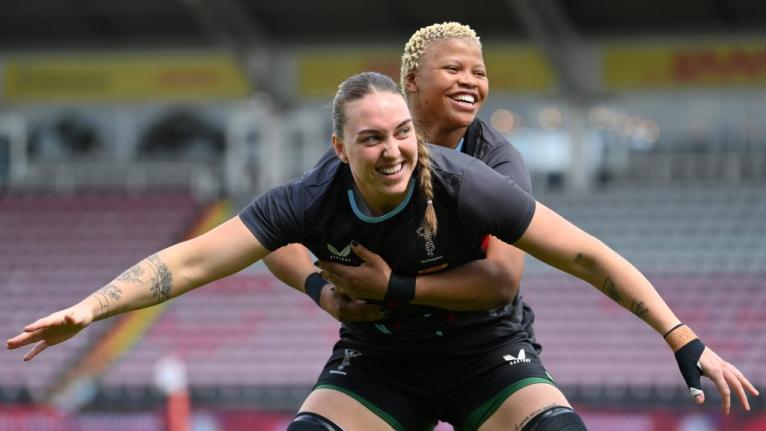
“We’ve spoken so much about how this is the time to step up,” says Danelle Lochner, the towering lock playing in her first World Cup. “We recognise that a lot of teams are further along in their development. We’re not saying we’re going to win the tournament. That would be unrealistic.

New Zealand Women’s superstar Portia Woodman-Wickliffe spoke to RugbyPass after receiving the prestigious, inaugural RugbyPass Women’s Top 50 award this week.
New Zealand Women’s superstar Portia Woodman-Wickliffe spoke to RugbyPass after receiving the prestigious, inaugural RugbyPass Women’s Top 50 award this week.
“But we’re not here to just make up the numbers. We want to prove that women’s rugby in South Africa deserves attention, that we deserve respect. That’s on us. We’ll only get that respect if we deliver on the field. We’re all fully focussed on what we need to do.”
They kick things off with a match against Brazil, the first team from South America to compete in the World Cup. The Yaras are ranked 25th in World Rugby’s rankings, 13 places behind the Springbok Women. A first tournament victory for South Africa since 2014 is essential. Lose, and the campaign risks being defined before it has begun. Win, and belief grows that the Boks can be more than plucky participants.
Then things ramp up. Their second game is against Italy, a side who edged them by four points in Cape Town last year and whose discipline and structure will test South Africa’s physicality. They close out the group with a clash against France, perennial contenders with depth across the field, where anything beyond a commendable defeat would exceed most expectations.
So, where can you watch the Women's Rugby World Cup 2025? Tonight (Friday, 22nd August) the 10th edition of the Women’s Rugby World Cup gets underway in Sunderland...
Read Now“We know we’re not going in as favourites,” Lochner continues. “But the growth of our team gives us a lot of confidence. We have structures in place. We have a game plan. We know what we need to do. We’re not shouting and making a lot of noise or promising we’ll do this or that. But keep an eye out for us. That’s all I’m saying.”
The professionalisation of the Bulls Daisies in 2023 has had a significant impact on the national team. 14 of the 32 players assembled play their club rugby in Pretoria. The Daisies have dominated the landscape for the past three years, winning a hat-trick of domestic titles while only losing one game. And while this has created a disparity in the league, it has helped solidify the spine of the group.
“Because so many of our players are professional, and because they don’t have to worry about things like a second job or worrying about when they can train, we can work on things on the scrum, the line-out, the maul,” says Lochner, who plays her club rugby in London with Harlequins.
“That’s become our strength and we now love to get physical with teams and we back ourselves to compete in that space. We want to go to dark places with teams. We want to bring them to the gutter. We want to get physical because that’s a South African way of playing. The men’s team has had so much success playing that way and we believe that it’s part of the South African rugby DNA.”
From this base South Africa will look to boss the point of contact. Aseza Hele from No. 8 will be given licence to range from the back of the pack and will provide the main thrust with ball in hand. Once those cracks emerge Nadine Roos – a full-back-scrum-half hybrid who cut her teeth in the sevens programme – will look to snipe around fringes and through half-gaps. Do not expect razzle-dazzle. The Boks are bringing bulldozers.
“We’ve got a powerful pack,” Lochner boasts, name-checking prop Bablwa Latsha, flanks Catha Jacobs and Sizophila Solontsi, as well as her second-row partner and skipper, Nolusindiso Booi, who has stepped up to lead the side after Lusanda Dumke effectively retired from the game this month citing health concerns.
“That’s a group of forwards that can cause problems,” Lochner adds, almost gushing at the prospect of steamrolling opponents. “Coach Swys has encouraged us to lean into this attitude. In the past we’ve maybe been a little less sure of what we are about. When you have a clear identity it makes things simple. Because then you’re not having to figure things out as you go along. There’s the plan, go and execute. It’s as simple as that.”
South Africa’s campaign is also being closely monitored beyond the immediate results. The women’s game globally is at a tipping point, with nations like Fiji, Japan and Wales previously showing that rapid growth is possible when investment and structures align. For the Boks, this tournament could serve as proof of concept. A competitive group-stage performance would not just raise their world ranking, it would provide tangible evidence to SA Rugby that a professional pathway is worth accelerating. The impact could ripple far wider than the World Cup itself.
Back home, interest in the women’s game is steadily building. The Daisies’ dominance has been a double-edged sword in domestic competition, but their rise has ensured that young girls now see rugby as a viable career in South Africa for the first time. Should this team take their chance on the global stage, they could inspire the next generation in much the same way the Springbok men did in 1995 and 2019.
The prize in England is not a trophy, but recognition: a chance to prove that South Africa’s women belong on the same stage as the best in the world, and that they are here not just to take part, but to be taken seriously.
Join free and tell us what you really think!
Sign up for freeThe idea the coach must be given the rest of the four-year cycle because he has been in place for most of it is fanciful.
Teams destined for finals will set their season up over the next phase of the competition. What do the four Aussie sides need?
Once named sevens world player of the year and a darling of the Stoop, the Argentine flyer has never forgotten his roots.
Excellent read
Not all leaders need to be captains but I don't think it suits Itoje
...
It sells itself with their infrastructure and stadiums


 Clear
Clear 


