
When New Zealand Rugby chairman David Kirk explained why the All Blacks were parting company with Scott Robertson, he surmised that effectively neither he nor the rest of the board felt the team was on the right trajectory.
NEW: Follow Your favourites in the App 📱
You can now follow their favourite teams, tournaments and players in the RugbyPass App!
He was presumably legally restricted on what he could say publicly given there would inevitably be non-disclosure agreements signed as part of Robertson’s termination, so Kirk had to keep the explanation suitably vague.
If he’d been able, he most likely would have been more specific and instead of riffing on a vibe about trajectory, he would have said that neither he nor the board had enough confidence in Robertson’s ability to coach the All Blacks to victory at the 2027 World Cup.
There are conspiracy theories sprouting everywhere about why Robertson was let go (most involve various supposed player mutinies) – but little-to-no-evidence to support them – and really, what effectively ended Razor’s tenure was the World Cup draw in early-December.
The draw was a killer for Robertson as it has put the All Blacks on course to meet South Africa in the quarterfinals if results go according to ranking – or, alternatively, if New Zealand lose their pool match against Australia, they will be on course to play England in the last eight.
Robertson, who was still in his position when the draw was made, said: “We play South Africa a lot and it’s [potentially] another time to have a crack at it.
“You’re going to have to face someone with their form to win it. The quarterfinal – if that’s the way it works out, then it’s just part of the draw. You have to embrace it.”
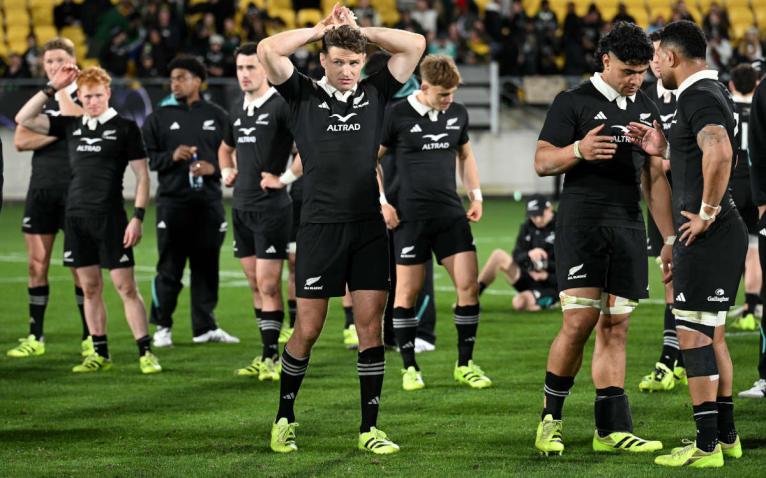
His optimism clearly wasn’t shared by the board, which, two weeks earlier had seen the All Blacks capitulate at Twickenham and lose 33-18.
It wasn’t necessarily the defeat, or the scoreline that alarmed the board – and most New Zealand supporters – it was the way the team fell apart after half-time and had no leadership, no connection with the coaching box and no ability to stop England scoring freely.
The 25 minutes after half-time were about as shambolic as any ever produced by the All Blacks. Beauden Barrett was kept on the field despite a leg injury which effectively meant the All Blacks didn’t have a goal-kicker as he couldn’t swing his leg.
It also meant, having seen Cam Roigard limp off before half-time, the All Blacks didn’t have anyone who could even kick for touch and when Codie Taylor was yellow carded in the 41st minute, the coaching panel decided they were willing to play without a recognised hooker on the field.
This all came to a head when the All Blacks won a penalty inside England’s half and captain Scott Barrett looked around and saw he had no one able to kick for goal, no one able to kick it to touch (although Will Jordan could have nudged it 30m), but no one able to throw it in to the lineout.
That chaotic scene damaged Robertson, as did the second half of the Test against South Africa in September in which the Boks scored 36 second half points and won the match by a record 43-10.
Are the All Blacks really a World Cup-winning team-in-waiting if they are guided by the right coaching group?
The long and the short of it is that the board weighed everything up and didn’t think that if they stuck with Robertson, the All Blacks would beat either South Africa or England and so they made a decision to find a new head coach.
Built into this decision is an unstated but undeniable conviction within NZR’s board that the All Blacks have the players to win the next World Cup, just not the right coaching set-up.
As much as Robertson’s win ratio of 74% was judged against the historic 76% the All Blacks have delivered since 1905, it was also based on the perceived quality of the players he had at his disposal.
Or, more bluntly, are the All Blacks really a World Cup-winning team-in-waiting if they are guided by the right coaching group?
And this is a point of genuine contention because not everyone would agree that New Zealand is developing players the way it used to.
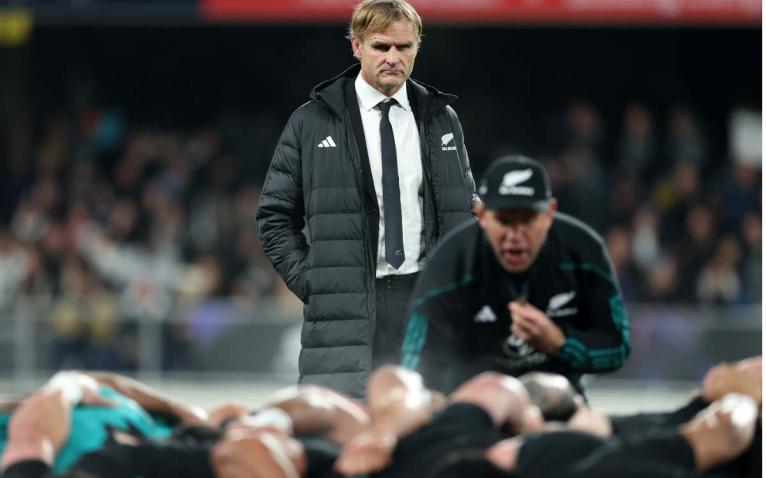
Some of this concern relates to the changed nature of Super Rugby having become a Pacific-only competition in 2022.
The loss of exposure to the South Africans is one problem. Their teams tended to have larger, confrontational athletes, a greater emphasis on set-piece and kicked more – effectively closely replicating the styles prevalent in Test rugby.
But so too are there concerns about the homogenisation of styles within New Zealand and the overall quality of the competition given the perpetual issues Australia has undergone.
In essence, Super Rugby has pushed so hard to be a fast, aerobic, ball-in-hand game that there are concerns that New Zealand doesn’t have players who kick and catch as well as the likes of South Africa and England.
There are also doubts about the country’s general developmental well-being given the demise of New Zealand teams – Under-20, Black Ferns, All Blacks and (men’s) All Blacks Sevens – on the world stage in the last decade.
The conclusion was reached, however, by those with deep knowledge of what came out of the major review into the All Blacks coaching set up that they could be a better, more consistent team under a different coaching set-up.
Anyone watching New Zealand teams over the last decade would inevitably wonder whether the players collectively possess the right skill-sets, if they have a strong sense of game management, and even if there is still that latent ability to produce an occasional injection of x-factor to break a defence or change the flow of a big game?
The conclusion was reached, however, by those with deep knowledge of what came out of the major review into the All Blacks coaching set up at the end of 2025, that the All Blacks could be a better, more consistent team under a different coaching set-up.
When senior player Jordie Barrett was asked for his thoughts ahead of the Hurricanes first pre-season game, he said: “It’s certainly been an interesting month, and it’s just the way things have progressed, and I am not going to delve into those findings and the process.
“A lot has happened in a short amount of time. I am just rapt to be wearing a Hurricanes polo today and looking forward to a big Super season.”
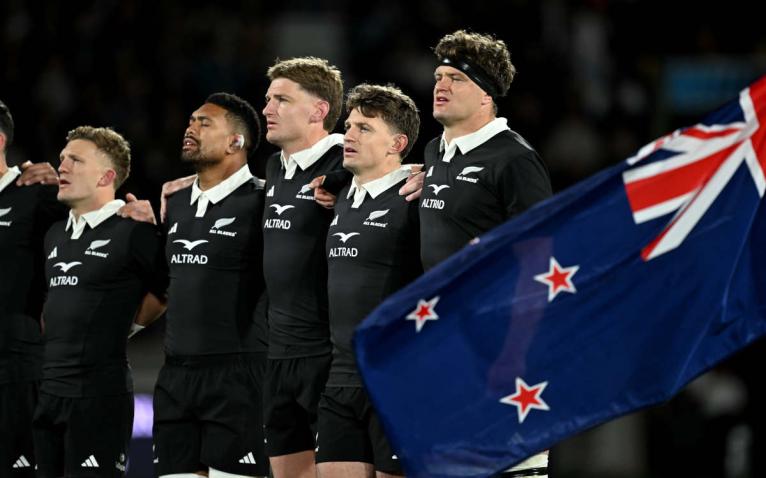
His comments suggest that he and his fellow senior players are going to be non-committal and careful about what they say about Robertson – and that they are hoping that the decision to part company with him will be vindicated in the way the All Blacks play this year under a new coach.
And it’s easy to understand why the playing group may be optimistic that improvement is entirely possible under a new coaching group as New Zealand still has incredible raw talent.
Cam Roigard is shaping as a genuine rival to Antoine Dupont as best No 9 in the world game.
Will Jordan remains the best finisher in the world game and Barrett was challenging Bundee Aki as the best No12 in the world in 2023.
Ardie Savea is a phenomenal all-rounder, Peter Lakai and Wallace Sititi have significant potential and there is a depth at lock and prop that suggests the All Blacks will have enough mobile, athletic, set-piece competent options for years to come.
On the major question of whether the All Blacks have the players to compete physically and technically at set-piece and collision, the answer is yes.
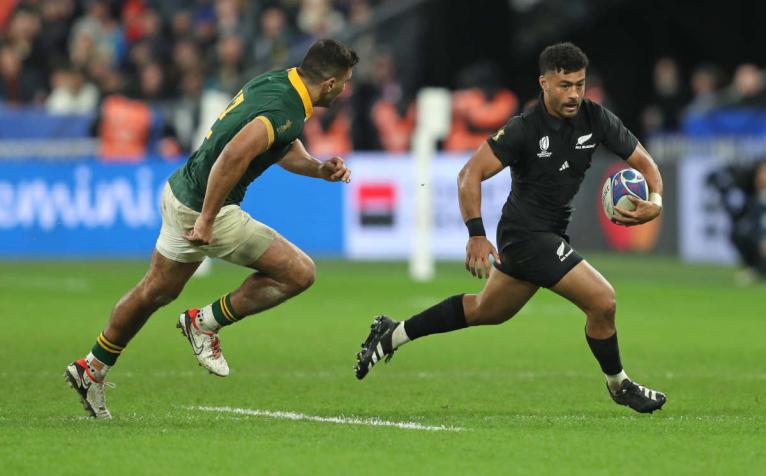
The three pressure points for the incoming coach are settling on a midfield combination, re-balancing the back three to ensure there is enough finishing power and kick-catch expertise, and deciding what to do at No 10 as Richie Mo’unga will be available later in the year.
On the question of whether they have a range of high-tempo athletes who can pass and catch under pressure, the answer is yes.
And really the three pressure points for the incoming coach are settling on a midfield combination, re-balancing the back three to ensure there is enough finishing power and kick-catch expertise, and deciding what to do at No 10 as Richie Mo’unga will be available later in the year.
On the midfield issue – the specific task is to find a centre who can firstly gel with Barrett, but more importantly facilitate the overall attack game.
This was something that never happened under Robertson, and the new coach will have to decide whether Rieko Ioane can be resurrected as an international 13, or whether Quinn Tupaea, who played so well there in a couple of Tests last year brings enough variation to the role.
Tied up in this is a need to determine whether Leicester Fainga’unuku is a midfielder or wing and what do with Billy Proctor – who looks so good at Super Rugby level but hasn’t yet settled into the higher level.
The balance of the back three never looked right under Robertson and given the trouble the All Blacks have had under the high ball, there is an argument to say Beauden Barrett should be restored to fullback to give the team a genuine kick-catcher and organiser with Jordan locked into the right wing and Fainga’anuku and Caleb Clarke the power options on the left.
And if Beauden Barrett is returned to fullback, the options at 10 become Damian McKenzie, Mounga and Ruben Love – three similarly shaped athletes, with the speed to shuffle across the field away from rush defences, and the ability to beat defenders in heavy traffic.
If the attack plan is based on utilising the speed, agility and soft hands of the No 10, then there can be continuity regardless of which of those three is picked.


What can you say?
He was showing motivational videos… and that was it.
It’s completely surreal.
Scott Robertson was completely adrift.
Who wanted us to continue with such a coach?
If you can even call him a coach, since everything related to on-field work was delegated to Hansen and Ryan.
It quickly became clear that Robertson was out of his depth in the role, but I didn’t think it was to this extent
https://www.planetrugby.com/news/scott-robertson-totally-different-in-all-blacks-role-as-shocking-details-emerge-leading-to-his-sacking
“Can the All Blacks navigate their way past old enemies to win the Rugby World Cup?”
Maybe. Depends on the referees…
Dear AB fans,
I know there is still some debate regarding if Razor’s AB’s were performaing or not, so I just looked at the average points over time (on both sides of the ball) to see if it highlighted anything and it certainly does;
2019 - Played 11, PF 440 (ave 40), PA 158 (ave 14) - PD + 282
2020 - Played 6, PF PF 145 (ave 25), PA 77 (ave 13) - PD +68
2021 - Played 11, PF 495 (ave 45), PA 205 (ave 19) - PD +290
2022 - Played 13, PF 420 (ave 32), PA 304 (ave 23) - PD + 116
2023 - Played 12, PF 480 (ave 40), PA 183 (ave 15) = PD +297
2024 - Played 14, PF 431 (ave 30), PA 270 (ave 19) = PD +161
2025 - Played 13, PF 384 (ave ave 29), PA 303 (ave 23) - PD +81
* the attack struggled from the 2nd ARG match in TRC
If you simply look at averages since the 2nd ARG TRC game, the stats say the following:
2025 - Played 9, PF 240 (ave 26), PA 216 (ave 24)
In fairness, whilst you look at Razor’s win rate percentage it didn’t look too bad but when you look at these as just averages, you can see why they ultimately said “trajectory’. The numbers don’t lie and they were getting worse on both sides of the ball since the ARG loss in TRC, which actually falls in with the narrative regarding trajectory but whilst the attack was getting worse, it may also have been the defence that cost him his job.
It certainly adds a slightly different narrative to the debate.
. . . and if you were wondering how Rassie’s SA record compared
2019 - Played 12, PF 424 (ave 35), PA 138 (ave 12) - PD + 286
2020 - No games
2021 - Played 13, PF 334 (ave 26), PA 244 (ave 19 points) - PD +90
2022 - Played 13, PF 370 (ave 28), PA 258 (ave 20 points) - PD + 112
2023 - Played 13, PF 404 (ave 31), PA 192 (ave 15 points) - PD +212
2024 - Played 13, PF 450 (ave 35), PA 220 (ave 17 points) - PD + 230
2025 - Played 15, PF 626 (ave 42), PA 243 (ave 16 points) - PD +383
It’s what we know, you have to work really hard against that SA defence to score points and then you have to work twice as hard to stop them.
Really interesting to see how the attack has been improving throughout Rassie’s tenure, with the meanest defence in world rugby.
That’s a very impressive record. 👏👏👏
It’s only natural that international fans wouldn’t be that critical of the team. They are somewhat disconnected from the day to day grind, and don’t see all the small mistakes, the alternative outcomes, or the way that things could have been done differently like a home board does.
That sad, the facts are that New Zealand are a tiny nation of about 2 million rugby followers, and they are (or were) on the top of the world, and face a battle to stay there. Anyone with an ounce of respect is going to do there utmost to stay there. Lose a grip on on those lips and the only way is down. So it’s also entirely logical that at some point, futile attempts are going to be made.
For me, there is still a lot of water to go under the bridge, and this Razor reign was the right trajectory. Everything was changing, it was just perhaps too quick to get the players buy in. The end of Hansens reign, and then Fosters, were just drops in a pond of change. They were nothing years were the players, after being unable to execute a flat fast width based style, getting constantly smashed well behind the gainline, simply tried to tread water and hope they would just be good enough. Teams like Ireland though had skill and execution that the All Blacks lacked and made fools of them. It was a lot better under Razor, his side had not yet thrown in the towel in their aspirations like Hansens (late) and Fosters had.
The next coach perfect a few of the causes that stopped that progress, and Kirk on the admin side though, there is still case to prove. A case for hope, and expectation.
The All Blacks have lost two years… unsuitable game plans, timid then incoherent selections, and a complete lack of initiative, topped off with muddled communication. Apparently, quite a few players didn’t even understand it…
He said he wanted to develop four players per position, but in reality nothing was ever done to achieve that. No 6–2 bench split; everything under Robertson was just a waste of time. Even thinking about him still makes me angry…
Everything will have to be rebuilt. And New Zealand rugby will need to break away from the flawed systems it has become bogged down in.
This is the last time I’ll mention that coach. I’m really looking forward to finding out who the future staff will be. It’s time for the All Blacks to truly move into the 2020s… or even 2026.
Yeah, Yeah! You will be one of the first to turn on the new coach! Kirk has sold NZR down the river. By the end of 2027 NZ will likely be languishing in 4th or 5th and you will be wondering how the heck that happened. Well Kirk happened and the sheeple blindly followed.
Its fair to say that Razor had his issues but look he was trying to address them and knew of them before he got axed. He was even trying to bring back Tony Brown. Now they have gone and sacked him and every available NZ coach is ruling themselves out except Joseph and its so bad they are asking Hansen and Fozzie to apply for the Job. like thats just desperation. A new coaching group could turn it around but so could Razor with new assistants and a fresh approach so this begs the question, why on earth did they have to fire him half way through the cycle? Good luck to the new coach and trying to get this group of players to their max potential.
Didn’t fire him he resigned. Subtle difference.
Valid questions! Surely they could have had a more dynamic approach. Change assistants, brain storm tactics.
But I think this was a personal hatchet 🪓 job by Kirk, who knows why.
The gagging if Razor, Wayne Smith’s shock and other factors point to that.
All I know, it is likely to reverberate through NZR for years to come.
Many lauded Kirk for his decisive action. Time will tell!