
The more England kicked at the Wallabies in the second half of last Saturday’s 25-7 loss at Twickenham, regaining more than their share of the ball in the process, the more obvious it became what is heading Australia’s way over their remaining three November Tests.
Official World Rankings in the App 📱
You can now check the official International World Rankings in the RugbyPass App!
And as if it was needed, watching Ireland and New Zealand do exactly the same thing to each other in Chicago only underlined this further.
The Wallabies are going to cop an aerial barrage through their upcoming European dates, and if they don’t address and fix a problem that is much more than a one-game issue, they may not win another game this year. That’s the reality.
It’s not a new thing. South Africa strangely stopped doing it in August, and both Argentina and New Zealand profited from it through The Rugby Championship.
It’s just the first of many issues for the Wallabies as they move from London to Udine this week.
Bombs incoming. Every week. Be ready
What did Italy coach Gonzalo Quesada, Ireland boss Andy Farrell and French counterpart Fabien Galthié have in common on the weekend?
All three watched the way England dominated Australia in the air and told their kicking coach to load up the repetitions at training over the next few weeks. None of the three head coaches could have watched the Wallabies’ failure to detonate England’s primary source of attack and thought, ‘nah, that’s not for us.’
Ireland played very much the same game in Chicago, though in fairness, New Zealand played it right back at them.
The All Blacks played exactly the same game against Australia in both Bledisloe Tests, too, and completely dominated field position. In the second match in Perth, New Zealand/ played nearly three-quarters of their possession share in the Australian half, while the Wallabies played barely half theirs in the All Blacks’ half.
England’s tactics mirrored this. Just a touch over of a third of their possession was played on their side of halfway, while the other two thirds was in the Australian half. The Wallabies, again, spent the bulk of their possession in their own half. Heck, Japan even tried to replicate the tactic last week in Tokyo but were too guilty of wet-weather turnovers themselves to make Australia pay.
The England back three fielded plenty of uncontested ball, with the Wallabies chase either infuriatingly non-existent or simply too slow.
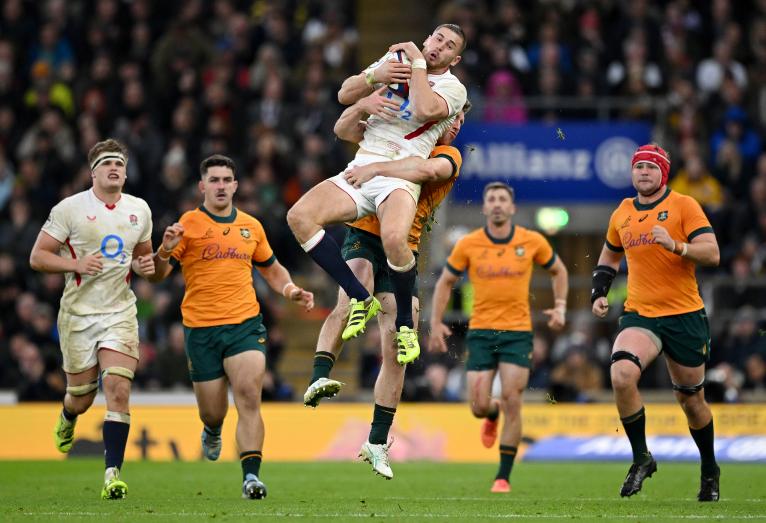
The main difference between the England and Australian kicking games was the chase. Both teams kicked a similar amount, but when whenever Alex Mitchell forced the Australia backfield to look skyward, more often than not they had Freddie Steward or Tommy Freeman or Tom Roebuck arriving on the scene at the same time. Often more than one of them.
Conversely, the England back three fielded plenty of uncontested ball, with the Wallabies chase either infuriatingly non-existent or simply too slow.
Whether that’s awareness of the kick, or the attitude to the chase, the Wallabies just have to improve this week, because that’s how the game is being played at the moment. Ireland won’t suddenly stop launching box-kick after box-kick, because as we saw in Chicago – and Twickenham – so much of their attack is based on the opportunities won from regained kicks in the opposition half.
The Wallabies have to be better in the air, they have to be significantly better forcing contests in return, and they have to make it as hard as they legally can for the opposition chasers to regain possession from kicks. Because that’s what they’ll face for the next three weeks.
Last quarter frailties continue for fourth straight Test
In both Bledisloe Cup Tests, in the wet in Tokyo, and yet again at Twickenham on Saturday, Australia’s game seriously deteriorated over the final 20 minutes.
I’ve outlined previously how the Wallabies had just eight per cent of possession in the last 10 minutes in Perth, but it’s a pattern bigger than just one game.
Over the last four games, the Wallabies have been deprived of ball in the closing stages, albeit they ‘enjoyed’ 49% of possession in the last 10 against Japan. In Auckland, it was just 26%, in Perth the aforementioned 8%, and in London on the weekend, only 44%.
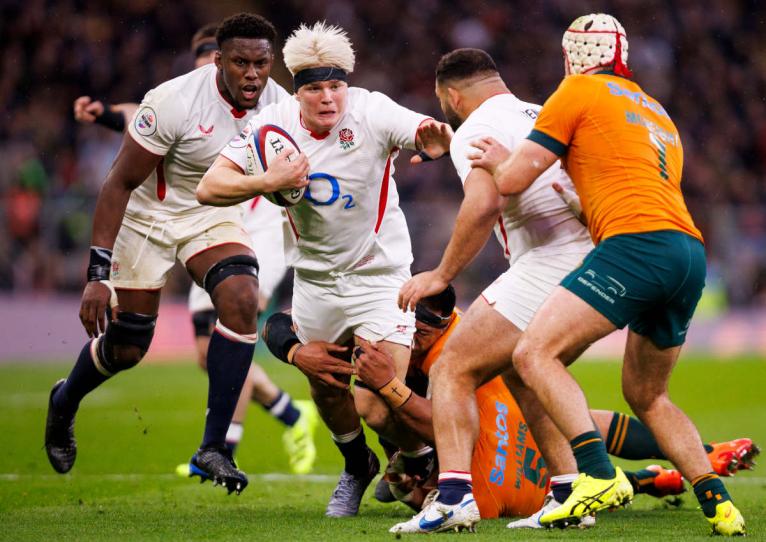
In both Bledisloe Tests, Australia closed the gap to within a converted try in the last quarter, but then never saw the ball again, essentially. In Tokyo, the Brave Blossoms actually closed to within one score themselves after finally getting an even share of ball, while at Twickenham, the wheels properly fell off after Henry Pollock’s runaway try in the 59th minute.
It might be scoreboard pressure, it’s certainly a lack of bench impact, but whatever it is, it needs to be addressed as well.
Steve Borthwick provoked all the headline variations of ‘bomb squad’ by sending five fresh forwards on in the 52nd minute, and this impact was certainly being felt by the time the ball bounced very nicely into Pollock’s left hand on the hour.
By contrast, Joe Schmidt again deployed the Australian replacements as pairs or single units, rather than a battalion, and his side found themselves quickly losing touch with the surge of fresh energy in one bulk addition.
What is the best XV currently?
Schmidt has long been a coach unafraid of change, and the 45 players already used by the Wallabies in 2025 is not too far removed from the 48 last season.
Even on last year’s UK tour, he made two starting XV changes from the final Bledisloe Test to the first November Test, and then eight, nine, and another six changes to the XV over the remaining games.
So, 13 changes from Bledisloe 2 this year to the Japan Test, another nine changes for Twickenham, and quite probably a similar number this weekend in Italy is entirely within keeping. By this time of year, rest and recovery is just as important as rotation and opportunity.
They’re a team currently playing like they’ve not spent a lot of time together when for the most part, that’s certainly not the case.
The Wallabies looked really tired and flat against England, but my real concern is whether any of the alternate options are any fresher? They’re hardly the first team to do it, but are the long-haul flights starting to catch up? It surely couldn’t be as simple as jet lag.
But further than this, with the current state of injuries and recent unavailability, do the Wallabies know what their best XV looks like right now? And will we get to see it any time over the next three weekends?
They’re a team currently playing like they’ve not spent a lot of time together when for the most part, that’s certainly not the case. So where is the combination, where are the familiar pods, where is the backline connection?
Building depth v getting results – eternal selection conundrum is biting
Among the 34 players announced in the Wallabies’ end of season tour squad last month were no less than 17 players with 15 or fewer Tests to their name. Another four had no more than 20.
While Len Ikitau is closing in on a 50th cap, the other recent inclusions, Darcy Swain and Tom Hooper, both have less than 20 caps as well. At the current rate of matches played annually, that’s 23 of 37 players with less than two full years of international experience.
It partly explains the patchy cohesion mentioned above. Schmidt is having to balance the urgent need of getting experience into new players so that he can build depth with the equally urgent need of competitiveness in the immediate Test week.
In his tenure so far, Schmidt has handed debuts to 23 different players, which is great. But then eight of last year’s record 19 debutants are not in this current Australian squad.
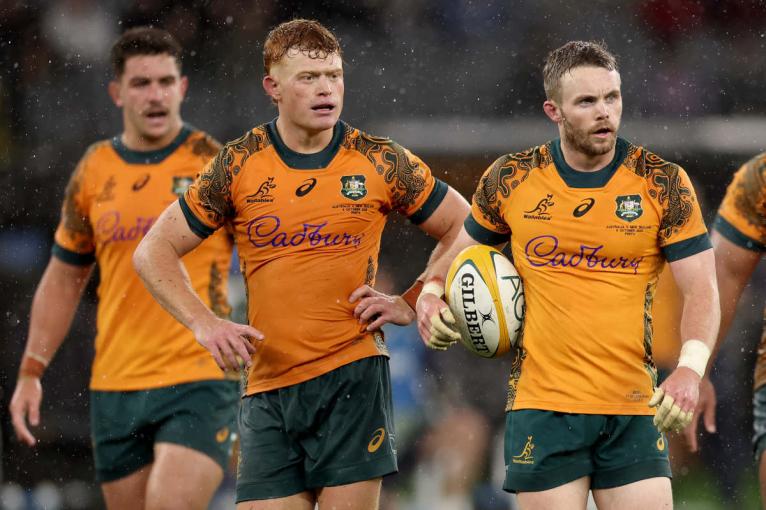
And then there’s this. Five of this season’s 12 Tests have ended with a replacement player left unused on the bench. Ben Donaldson, Filipo Daugunu, Tane Edmed (twice), and Ryan Lonergan all now presumably have a Test jersey in their collection that never saw action.
It’s perhaps one of the hardest challenges in coaching. How many changes are too many? And how much change can be made before competitiveness is affected? But equally, how do you build depth and experience with unused players, or even with 78th-minute replacements?
They’re all questions without answers for the Wallabies currently – but it does start collectively looking like an issue that is hurting the team.
This is not the time to be caught between 6th and 7th
The 25-7 loss to England didn’t hurt Australia too much in terms of the all-important World Rugby rankings, ‘only’ losing 0.40 to sixth-placed Argentina, and eighth-placed Scotland gaining no ranking benefit from thumping the 15th-ranked USA 85-0 at Murrayfield.
Right now, I’m not sure what’s worse; finishing 2025 in a flaccid form slump or being grouped with the number one in the world for a RWC on home soil.
The Wallabies can still regain sixth with wins in the next three weeks, and especially if wins were to come against Ireland and/or France. There are scenarios in play where Australia could be pushing for a top-four berth, in fact.
But the wins do have to come, and not just for the confidence of the team, but because the seedings for the 2027 Rugby World Cup will be based on these rankings in December this year.
With the RWC moving from four to six pools in 2027, a top-six ranking ensures you will not be placed in a pool with a likely tournament favourite.
And right now, I’m not sure what’s worse; finishing 2025 in a flaccid form slump or being grouped with the number one in the world for a RWC on home soil.


Thanks BeeMc! Great article!!!
Poms played well. Wallabies played ok for almost all of it imo.
But it doesnt take much for a in-form team like England to find and exploit Aussie weakness and pile on points
I felt WBs lost concentration, including the coaching team. They weren’t prepared for the peppering. and they weren’t alert to the bench replacement. Avoidable mistakes, I think
Oh, and great to see PMcD has found your pieces, Brett, and begun to comment.
Bad weekend for me, Brett, as an Irish born Australian. Both my teams underperforming in so many areas.
“The Wallabies can still regain sixth with wins in the next three weeks, and especially if wins were to come against Ireland and/or France.” This is a fascinating Nov. series, and the draw for RWC 2027 adds, even creates, that extra edge this year. I fear Australia may have blown a big chance to secure that sixth spot by losing to England. Ireland the same, though higher up the ladder. That loss to an AB side that is far from formidable, as many AB sides in the past have been, is a bad slip.
Looking at Australia, there is no doubt in my mind that to win just one of the remaining games, they will need the overseas based players. Italy next up could be tough. Well coached and inventive, the Italians have not recently always had the results to mirror this. I would settle for a one point win, hoping for more.
Ireland may be the big win of this EYOT. Recent history has shown that Ireland have struggled against the WB’s. At full strength, the WB’s can upset an Irish team not playing with conviction. Leinster were bottom of the URC table three weeks ago. If Farrell does not heed the warning signs, bring in inform players from the other three provinces, the WB’s could well cause “Irish eyes NOT smiling”
France….pity we have to play them on this tour !! But, heavy rain and wind, ALL the 50/50’s the WB’s way, French red card….no I’m dreaming…and tbh, don’t wish that on any opponent…the Irish superstition kicking in.😀
“There are scenarios in play where Australia could be pushing for a top-four berth, in fact.” And that is what is so fascinating. England might go undefeated, the AB’s might not win another game. The Boks would hope to be undefeated. Argentina won’t be easily knocked over by anyone. Yes, very interesting !
As much as I deplore England's kick first attack, it’s very effective. However as you stated they'll be playing teams that’ll defend better against it. I was more concerned by the Wallabies lack of attack. I’m not sure how they planned to win the game, it’s as if despite not having Skelton & Hooper in the forwards and Ikitau to hold the backline together they didn’t alter their game plan. The Wallabies used to play smarter then everyone , last Saturday they just played dumb.
To be fair, I am an ENG fan and I didn’t expect them to play that well.
The 3x7’s defence is the star of the show. We kick long and try to contest with the jumpers, or the 3x7’s bring the catcher to ground and win the counter ruck (before you can resource the breakdown).
When you look at the start of this years game vs last year, ENG created 90 rucks this year vs 40 odd last year, which is where they stop you quickly, make an absolute mess of the breakdown and make it harder to play from, which suffocated the attack.
ENG had 45% possession with 58% territory and shows you how well that defensive line maintained its position.
However, I must also admit I found the kick chase attack a little boring at times, so I hope to see the Fin Smith attack we played in the Six Nations return once we have a running fullback fit. Then it should get much more exciting and we’ll move the ball a bit more like you guys.
Theres always been a lot of talk about Australias super power being able to deal with the high ball due to their back ground in aussie rules etc… This wasnt on show on Saturday for sure but with the likes of Tom Wright out injured and the ability of Jorganson and Sualli in the air i feel this was more a blip caused by a well executed England vs a tired Australia.
I would expect a bounce back from this performance
The English Premiership aerial contests changed over the last 2 years and they have taken the AFL style of the high hanging, one arm tap back since the removal of screening players came in, so we are basically playing you at your own game and they are no longer selecting the shorter wingers as a result.
I think once you get TW & MN back in that side you will get much more parity from those plays.
Don’t give up faith, I actually think AUS have just played too much rugby and are tired. The tipping point came in the ARG games and they have looked tired ever since. You are better than you think you are, which is why you beat The Lions, SA & ARG this season. Don’t let a few results define what has been a fantastic season for AUS.
Everyone gotta be good under the high ball every week still green shoots there for Oz d will only be better next year
Australias kicking and catching game has suffered immeasurably without their gun 15 Tom Wright. They are constantly losing kicking duels with the current combos on the field. Edmeds boot is neither long or educated and their kick chase and accuracy of the kick off 9 is really poor. They look tired and bland and look unable to go back to the well after efforts against the Lions and Springboks as well as the rest of The Rugby Championship. Its been a tough year for them and its been terribly attritional with a number of players going down. The recent losses have also been really painful. They almost seem like a side playing a 4th innings in a dead rubber in a 5 match test series away from home where they have bowled several hundred overs and have 1 foot on the plane. This however is not the time to lose your focus and allow things to drift. It does look like its going to be really hard to regain intensity and momentum on the road. Schmidt too looks a coach on his way out. He has had some success but now needs to ensure he finishes strongly so that his gains are not diminished. Something tells me this could be a long 3 weeks.
“Schmidt too looks a coach on his way out. He has had some success but now needs to ensure he finishes strongly so that his gains are not diminished.”
That does worry me too, SK. I recall his last period with Ireland. It was said he lost the players. Don’t think that will happen with the WB’s. I do hope for a good finish for a man who is a superb coach, and to whom we as Australian rugby people owe so much. As do the Irish too.
That’s a great analogy, SK..
Brett I thought the support for Tane at the back was very poor. Everyone seemed to simply watch and hope rather than get there in support. Conversely the English had plenty in and around the catcher.
The loss of Slips, Tommy Hooper, the enforcer Will Skelton, Nic White, Tate, Lenny and Tom Wright had an impact.
Anyway its hope that kills us
You could probably same the same for Andrew Kellaway, BM..
Brett - Fear not, that ENG system has been built over nearly three years and was executed to perfection over the weekend, so will not be so easy to replicate by others this weekend.
ENG have 3 very different 10’s but Ford’s super strength is his tactical kicking and the “spiral bomb kicks”, so if you are playing him at 10, it’s with a plan to kick (otherwise you would select another with different skills) and with that you play Freddie Steward as the primary kick chaser at 15, so those two come as a unit as there is not much point in having one without the other.
ENG then have very tall wingers, who all have very strong aerial skills, with Roebuck & Freeman leading the way, whilst IF-W has incredible standing jump ability.
Then, if they don’t reclaim the catch themselves, you then have the 3x7’s and their swarm defence, where the 1st to arrive tackles the catcher, brings them to the ground and the other 7’s then win the ruck, or counter ruck you before the rest of your bigger forwards can arrive.
When you then realise the 5x7 strategy delivered a 93% tackle completion with 193 tackles, which reduced the AUS running metres and carry metres significantly vs last year’s stats (for a similar team line up), it was actually the “swarm defence” that did the most damage, whilst the kick chase also plays to their strengths.
Not every team will have such a specialist kicker at 10 and not every team has the back 3 aerial strength of ENG and none of them have yet followed the 5x7’s strategy but if they can subdue a very strong attacking team like Australia in that fashion, I wonder how long it will be before other sides start to follow and it will be really interesting to see how NZ cope with the same tactics in a few weeks time.
Much of what you say is spot on PMcD, but it’s certianly not unique to England.
As I wrote, Australia saw this all through the TRC, the Lions did it as well, and even Japan tried to implement it two weeks ago now.
The Wallabies have seen - and dealt with - this before. But you wouldn’t have known it, watching them at Twickenham..