
A famous Noel Coward ditty once declared primly only “mad dogs and Englishmen go out in the midday sun”. In professional rugby they play in the furnace of the regular season in France, a white-hot war of attrition lasting anywhere between 26 [Top 14] and 30 matches [Pro D2]; all the while knowing their efforts will never earn them another England cap.
The likes of Courtney Lawes, the brothers Willis and Vunipola, Manu Tuilagi, Jack Nowell, Joe Marchant and Dan Robson have all rolled up their trousers, knotted their hankies firmly on their heads and marched across the English Channel with sangfroid in their veins – and bodies ready to burn.
England supremo Steve Borthwick has steadfastly refused the temptation to invoke exceptions to the rule which denies him access to players plying their trade overseas, in leagues outside the Prem. When Wasps entered administration and Jack Willis signed on the dotted line with Toulouse, he remained available for England, at least temporarily. There was a window of opportunity to build a bridge from England to France, but it swiftly closed when the elder brother decided to extend his stay in the Haute-Garonne for another three years in April 2023.

England centurion Ben Youngs recently ruminated on the relevance of the rule on his For the Love of Rugby podcast.
“I do wonder now whether the rule of playing abroad is outdated,” said the former scrum-half. “I do think we have got to the period when it’s served its purpose, and if you go abroad you can still be eligible.”
There are counter-arguments to the ‘pick the best team and be damned’ theory of course, and the ex-Tiger and his co-host, Leicester and England prop Dan Cole, ran the gamut: the complicating factor of the need for release clauses, the lack of control of match minutes and associated player welfare issues, the different peaks and tapers on individual performance programmes.
Ultimately the twin Tigers worked out a top English professional in France can earn roughly £150k more across the Channel than he can in in the Prem; simply by being a dedicated ‘clubbie’, and even including the extra payments received by an England Test-match regular. It was a real eye-opener.
The single biggest destination for English players in the Top 14 has become the Var department of the Côte D’Azur. Ex-Quins and Bristol tight-head prop Kyle Sinckler, former Northampton second row Dave Ribbans, recent Gloucester number eight Zach Mercer and ex-Saint Lewis Ludlam between them formed 50% of the Toulonnais pack which ran on at Kingsholm to play the Cherry and Whites on Saturday.
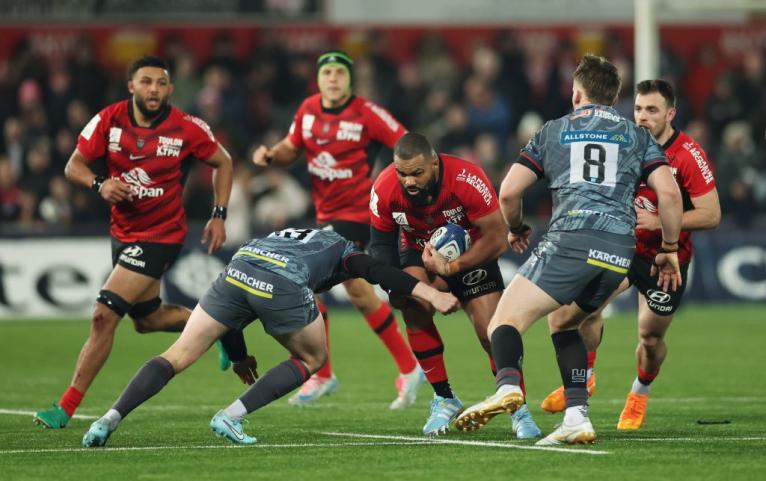
The exclamation mark in the backs to frame all that power up front was provided by Oliver Cowie at number 12. The 6ft 4ins, 95kg Cowie was born in France to English parents and his gran pitched up at the Recreation Ground on 7 February 2025 to watch him play on the wing for the French Under-20s against England. Cowie is JIFF-qualified and a product of the Toulon academy. He is a sign of the times, of the new potential for rapprochement between France and England, and he was good enough to outshine England hopeful Seb Atkinson at the weekend.
Sinckler, Ribbans and Ludlam have all become key cogs in a rapidly-improving rouge et noir machine which may yet become a worthy successor to the ‘galacticos’ who won three consecutive Champions cups between 2012 and 2015, and at least two of them would add concrete value to England’s forthcoming Six Nations campaign.
With Will Stuart and Asher Opoku-Fordjour ruled out of the tournament by injury, all things being equal in selection the natural replacement as bench tight-head would be Sinckler. The 32-year-old has been a partner prop to Ellis Genge at Bristol and the two know each other’s scrum preferences inside out. He started life at Toulon with a bang, making Midi Olympique’s ‘Top 14 team of the week’ three times in his first four starts, and he is probably more passionate about the scrum now than he was during his time in England.
“In France, there is more pressure in the ‘seams’, and I have had to adapt,” Sinckler said. “The spirit of the scrum is very different here. From the commands flexion, liez, jouer, the scrum is a story of life and death, it’s exhilarating. In England, we are more analytical. Here, the scrum, we put our emotions into it. It’s a whole city, a whole region that vibrates. In Toulon, you feel like a gladiator.”
Sinckler is playing probably playing five to six kilos heavier at the Stade Mayol than he was at the Stoop and Ashton Gate. And behind him, Ribbans tips the scales at around 130kg.
“I’ve probably put on another four or five kgs more than I was carrying at Saints,” said the lock. “It’s a fine balance. In this league, you need to have some weight behind you to make an impact in the tight carries and tough collisions. I’m involved in all the line-outs, calling those, so I still want to be explosive and have that as a strong point in my game.”
Sinckler and Ribbans represent exactly what Borthwick needs from his bench tight five in the Six Nations: leadership, physicality, and set-piece know-how. When club captain Charles Ollivon suffered a serious cruciate injury in early 2025, they turned to Ribbans as skipper, and a huge banner with the words “God Save Ribbans” silhouetted on the flag of Saint George was unfurled in the main stand. A sea of stamping fans in red and black, rising and falling in one heaving mass, celebrating an Anglicized South African. Like Sinckler, Ribbans paused for thought as he tapped into the emotion at the club: “Maybe the temperature heightens everything.”
Ludlam might find it slightly harder to break into the current England crop of five sevens, but he still has all the qualities the national side needs – able to play across all three positions, agile enough to win lineout ball, but with the six and seven skills to win the critical battles in contact. Ludlam still fits the profile of the superannuated seven hybrids Borthwick so prizes.
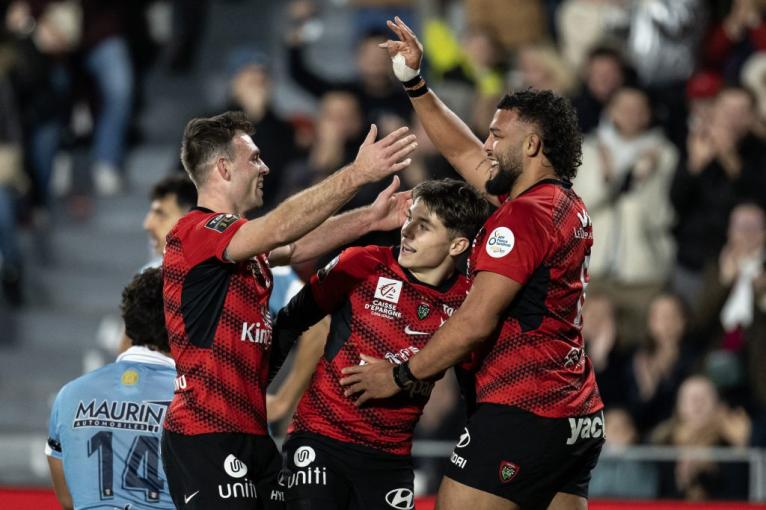
Like Sinckler and Ribbans, he has added ballast to cope with the physical demands of the Top 14.
“I dropped a lot [of weight] coming here, thinking French rugby is going to be more ball-in-play, a little bit more open, but the game is a little slower and more physical so I have actually put a little more on,” he said. “I’m about 114kg at the minute [he was 110 at Franklin’s Gardens], just because the games are more physical. You get a lot of big boys who just want you run straight at you more of the time.
“Here, the emotional side of the game is talked about a bit more. What they did well at Northampton was very clear and structured and it was problem-solving. It was, ‘We need to do, this because of this’.
“You leave the emotional side out of it a little bit more at Northampton. You talk about it on game day but here they are extremely passionate in training and [even] in meeting rooms before a game.”
The bright showers of flares, the pulsing noise, the supporters beating on the side of the team bus on the road to the Stade Mayol; the Pilou Pilou call to arms before the game. Rugby is a different experience in the Southwest of France, and England stands to benefit from the difference in attitude.
The Gloucester-Toulon game gave Test prospect Atkinson a taste of the difficulties he will face at a higher level. Atkinson is a good low tackler in the Prem, but he was twice brushed off by young Cowie in the first eight minutes.
— William Bishop (@RPvids1994) January 18, 2026
— William Bishop (@RPvids1994) January 18, 2026
Atkinson also had his issues on the other side of the tackle. At 6ft 2ins he often carries high into contact at the front of Gloucester’s set-piece attacks, relying on his natural strength to get to ground – but against defenders as strong as Ludlam it opened him up to the choke tackle turnover.
— William Bishop (@RPvids1994) January 18, 2026
— William Bishop (@RPvids1994) January 18, 2026
Ludlam had a full hand of tackle turnovers during the game: two choke tackle turnovers, with by another counter-ruck and then jackal in the space of just over 30 seconds.
— William Bishop (@RPvids1994) January 18, 2026
Sinckler was at the epicentre of a Toulonnais scrum effort which swept its opponents aside, ex-All Black Nepo Laulala and all.
— William Bishop (@RPvids1994) January 18, 2026
— William Bishop (@RPvids1994) January 18, 2026
The high-profile Prem players who entered voluntary exile on the far side of the English Channel – some, like Lawes, for life in the second division of French professional rugby – were pilloried as the ‘mad dogs’ of the English game for abandoning all hope of wearing the red rose on their chests ever again.
Now the choice does not look so clear-cut. Jack Willis was named Top 14 player of the year last season and that is a significant achievement in a league bursting at the seams with stars. Pierre Mignoni is building a team of realistic aspirants for the Bouclier de Brennus and the Champions Cup, on a firm foundation of England ‘has-beens’ including Sinckler, Ribbans, Ludlam and Mercer, not to mention Cowie.
Sinckler and Ribbans would add value to England’s bid to reclaim the Six Nations title. Ludlam would help, even in an area where Borthwick enjoys an embarrassment of riches. The flag of Saint George which exclaimed ‘God Save Ribbans!’ could be due for an upgrade and an expansion, and it may only be matter of time before it flutters at the old cabbage patch. Maybe those midday mad dogs were not so mad after all.


Pot kettle black! How one sided have you been?
Btw that last paragraph is a misrepresentation of my position. I've written an article saying that picking from overseas was a necessary part of his strategy because so many of the golden generation blooded by his predecessors had left or would be leaving. They must have been an exceptional group, because they formed 80% of his team for the next two world cups.
That's very different from England's situation, where it's just a few players.
Rassie is an exceptional coach. Sometimes there's a big uptick after a new coach e.g. England doing so well in 2016/17.
Is a huge leap to say that the Boks wouldn't have done just as well if pretty much all their players had stayed in Africa.
And you only ever talk about SA (who have improved) while you ignore Australia who have plummeted and Ireland who improved after they brought their players home.
https://www.theroar.com.au/2024/08/08/unity-strategic-genius-and-ruthless-priorities-how-rassie-reclaimed-the-summit-for-the-springboks/
Three was the rule in Rennie’s time and sometimes lobbied successfully for four. So what?
The whole point of the article is that Eng can add two or three Top 14 players without ‘opening the floodgates’ and allowing the big scary French leagues to hoover up all their top talent.
You disagree on principle and it has led you to make some breathtakingly one-sided statements. I’m still getting over your insistence that Rassie’s Bokke squad was already purpose-built for the 2019 RWC and SA’s move north and away from SR had little or no impact on Springbok success since 2018.🤯
Come on Nick, I’ve written in support of short spells overseas many times. Best of both worlds - the player gets to earn money and broaden their life and rugby experience but crucially the impact on workload management, cohesion and domestic rugby is limited. That isn’t what you are advocating in your article and neither Leinster or Exeter are French clubs.
You keep on shifting the goalposts. First it was “Australia have had just three overseas players for the last few years” and now you’re saying “apart from when Eddie was in charge.” (Actually Rennie sometimes had more than three too.)
You can’t force players to stay, but you can make it more likely. England, NZ and Ireland have done a good job in that space. Australia were doing well until 2015 - Semi finalists in every RWC except 07 and 95 from memory. Since then not so much. I’m not blaming current coaches for that, it’s historic decisions by administrators.
Yeah, I get the sense that environment and relationships come first for FR. By all accounts he’s had pretty strong relationships in every team he’s played for and seems to be very well respected by his peers, apart from sextoy (as HH delightfully christened him recently) ofc!
If most countries start picking from overseas then the contracts the French give out / the negotiations will change to reflect that. I’m all for it. Will not be good for NZ in particular as super rugby franchises have very low salary caps and Australia have opened the door to pick from outside SR. NZ will have to do something as Australian SR teams will be under 23 sides with a few scattered wallabies on RA top ups. Look at Tom Hooper as an example of what the future looks like. Young player on modest contract breaks into the national set up to be one of the consistent first choice picks but is still on tiny $ at the brumbies / modest RA top up negotiated 2 year ago ie not reflective of his standing in the game. So off to Exeter in the Prem he goes but also now able to be picked by Australian coaches and expect he will be.
Yes TH earns roughly twice the amount he could make in Canberra and he does it at an Aussie-friendly club in the UK. It makes sense from the player’s pov…
No player should be stopped from playing for England no matter where he earns his living. We should play the best team we can at all times.
There is a ‘free market’ argument here Andrew, tho in reality England prob don’t need to select more than two or three Top 14 playrs currently…
For the back row would start with curry underhill and earl at 8 . Pollock and Willis to come on and create ballast and pace . Don’t think anyone would like to face that .
Exactly. ‘Pick the team the opponent would least like to see’.