




1
England the only team not represented in official Six Nations team of the Championship
59

The history books show that Scotland will be seeking their first win over the All Blacks in 120 years when they face off at Murrayfield on Saturday afternoon.
Since the first meeting at Inverleith Field in Edinburgh in November 1905, they have played 32 times, with New Zealand winning 30 of the encounters, with two drawn, but there should be an asterisk.
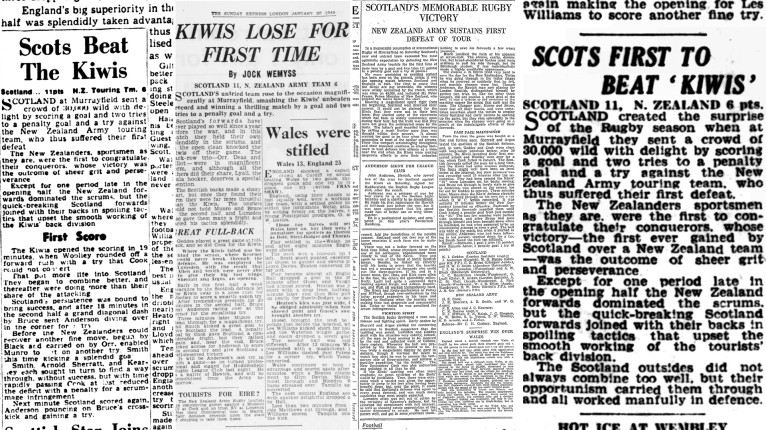
Scotland do have a victory over New Zealand, and it came in January 1946, in what were known as the Victory Internationals to celebrate the end of the Second World War.
In football, England, Scotland, Ireland, and Wales all played each other; in rugby, England, Wales, Scotland, France, and the Kiwis; and in cricket, England played the Australian Services in a series of unofficial matches.
The idea was also to help fill the gap between the end of the war and the resumption of the regular schedule in 1947, and was made easier by the number of top-class sportsmen from around the globe already being in Europe.
A group of New Zealand soldiers, half of whom would later become All Blacks, were formed into the 2nd New Zealand Expeditionary Force Rugby Team, known as the Kiwis, and on January 5th, 1946, they beat a Wales XV 11-3 in Cardiff.
Wearing the famous black shirts with the silver fern, the Kiwis had enjoyed plenty of time together, winning 13 of their 15 games, including beating England, and drawing the other two, scoring 234 points and conceding just 72.
Scotland, led by Keith Geddes, were able to field only player capped before the outbreak of hostilities, Edinburgh Academical prop, Ian Henderson. Given the fact that they had not played together before, along with the Kiwis’ forward strength, it was thought that it would be too much for the home side.
It was the case that the Kiwi scrum was dominant through almost all of the game, but according to a match report in The People newspaper, Scotland’s 11-6 win “was the outcome of sheer grit and perseverance”, adding: “The quick-breaking Scotland forwards joined with their backs in spoiling tactics that upset the smooth working of the tourists’ back division.
“The Scotland outsides did not always combine too well, but their opportunism carried them through, and all worked manfully in defence.”
Forty thousand packed inside Murrayfield, probably helped by the fact that all other games in the Scottish capital had been called off with pitches being unfit.
The Kiwis looked to be on course for another win when they took the lead early in the first half, when a poor Scottish clearance allowed a chance for Bill Woolley to score a smartly taken try.
Then, after an hour, Scotland applied tremendous pressure and were rewarded when Russell Bruce sent John Anderson, who had spent three years as a POW in Czechoslovakia, over in the corner to level the game.
Three minutes later, Scotland were ahead when William Munro raced through the Kiwis’ back line to score a magnificent solo try, and Doug Smith, who later became a Lion, added the extras.
Herb Cook landed a penalty to remind the Scots they were still there, that was until Anderson, who, 24 hours after the game, switched codes and turned professional with Huddersfield Rugby League Club, scored his second try.
Bruce sent over an inch-perfect kick that Anderson collected before touching down to give Scotland a historic and, to date, their only victory over New Zealand.
Scotland: K Geddes (London Scottish, capt); J Anderson (Hawick), W Munro (Glasgow HSFP), C Bruce (Glasgow Acads), D Smith (Aberdeen University); I Lumsden (Watsonians), A Black (Edinburgh University); I Henderson (Edinburgh Academical), G Lyall (Gala), R Aitken (London Scottish), A Watt (London Scottish), J Kirk (Edinburgh Academical), W Elliot (Edinburgh Academical), D Deas (Heriot’s FP), J Orr (Heriot’s FP).
New Zealand Army Team: H Cook; J Sherratt, J Smith, W Argus; F Allen, J Kearney; C Saxton (capt); N McPhail, F Haigh, J Simpson, A Blake, S Young, S Woolley, K Arnold, J Finlay.
Darcy Graham is psyched for the challenge of trying to help Scotland defeat New Zealand for the first time ever on Saturday.
Read Now
That was not the All Blacks but an army team. Bob Scott, who was banned from union for playing league, was the fullback.
Join free and tell us what you really think!
Sign up for freeThe idea the coach must be given the rest of the four-year cycle because he has been in place for most of it is fanciful.
Teams destined for finals will set their season up over the next phase of the competition. What do the four Aussie sides need?
Once named sevens world player of the year and a darling of the Stoop, the Argentine flyer has never forgotten his roots.
Actually agree with you on all these points!
But who would want Jake White or Gats as England coach now?
He uses it smartly, still largely ineffectual at close quarters with the bigger boys.
That’s not clinical, it’s surgical. 🤡😁
Great to see Ruben Love playing so well. The guy is class.
Borthwicks immediate future will be decided by an accountant!!


 Clear
Clear 


