
Squandered line breaks and chaotic attack feature heavily as RugbyPass kicks off its weekly review of the stats which mattered most across the Autumn Nations Series.
NEW: Follow Your favourites in the App 📱
You can now follow their favourite teams, tournaments and players in the RugbyPass App!
Stat of the week: Caleb Clarke (NZL) had as many line breaks as Ireland and the US combined.
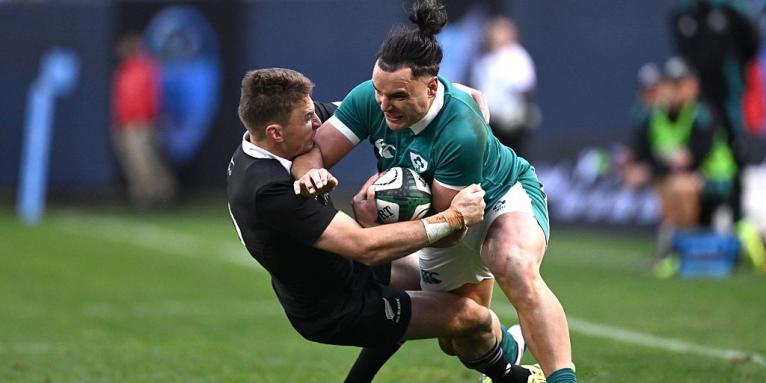
If you were new to rugby you might have seen the matches between Ireland and New Zealand, and Scotland and the USA, and assumed you were watching two completely different sports. One featured two of the best teams in the world going head-to-head. The other was a drubbing.
What are the similarities? Well, Ireland managed five 22 entries and two line breaks compared to six 22 entries and one linebreak for the US. Neither side was able to accrue the two key parts of efficient attack: volume of 22 entries and points per entry. For ease, we would expect a team to have a little under 10 22 entries per match and get a little under three points per entry. Ireland managed five and had just 1.4pts per entry whereas the USA had six and, of course, didn’t get any points from them in the 78-0 rout.
There are different ways to score points. Exeter Chiefs of yesteryear, or Leinster in more recent times, have scored tries by kicking penalties to touch deep in the opposition 22 then battering at the defence through relentless carries which might individually gain mere inches but through collective attrition, lead to five points. Ireland’s sole try, through Tadhg Furlong, came from that gradual short-range punching.
Or, you can score penalties or drop goals from deep without troubling the 22, as George Ford has been doing for Sale of late and Montauban did during their extraordinary ascent to the Top 14 last season. This was where Ireland differed from the USA. Twice they scored penalties without entering the 22, missing another off the tee.
Ireland were able to play this way because their defence had kept them not just in the game but ahead for almost an hour. That allowed them to keep ahead through long-range penalties and indeed go for those penalties rather than feel the need to kick into the 22 (their lineout success was a paltry 69%). But, between minutes 61 and 66 New Zealand scored 14 points without return and took the lead. On 66 minutes, with New Zealand eight points up and rampant, Ireland could no longer play the same way. With a weaker bench and the momentum against them, their challenge faded.
There are reasons to be optimistic if you are Irish. Their approach not only kept them in the game but gave them the lead. They were close to those rare line breaks throughout the match. Perhaps most crucially, a soft pass from Sam Prendergast to Jamie Osborne was dropped, hoofed downfield by Will Jordan where New Zealand won the penalty that led to the try which put them in front.
Ireland could have won this game, but in the long-term they won’t beat the best if they can’t improve their 22 entry stats and generate explosive plays.
Inefficient England and Potter perfection
One of the most misleading things in rugby is the scoreboard. At half-time England led just 10-7 thanks to a Ford penalty and conversion and a Ben Earl try. The heroics of Harry Potter ensured the Wallabies were just three points down despite being under the cosh for much of the opening 40 minutes.
The Australian back held up Earl as he was about to go over for his second try and then intercepted a loose Fraser Dingwall pass for a length of the field try. That made the game feel a lot closer at half-time than it was in reality and the 15 unanswered points scored in the second half were more in keeping with the feel of the contest.
None of that is to say England were perfect. They took just 1.6pts on average from each of their 13 entries to the away 22. This is in some ways England’s playing style in microcosm.
Their first try came from an Alex Mitchell box kick chased by Tom Roebuck with Earl, Sam Underhill and Jamie George creating a ring to collect any loose ball. On that occasion, Roebuck caught it on the full and Underhill and Earl stepped on the gas to support him and turn it into a try.
⌚️ The gather followed by the speed from Ben Earl to open the scores for England at HQ against Australia in the opening round of the #QuilterNS 😎💪#Breitling #DefiningMoment @Breitling pic.twitter.com/1wWPuRhkFe
— Quilter Nations Series (@QuilterNations) November 3, 2025
For the subsequent Henry Pollock try, Roebuck again went up for a contested kick with Pollock, Ollie Chessum, and Guy Pepper creating the ring. This time Roebuck slapped the ball back and Pollock made an unreal pick-up to score the try.
This type of kicking game is designed to create chaos. The entire plan is to cause more transitions in the game and hope your side comes out on top, and obviously that is trained to tilt the odds further in your favour.
We can see this in the kicking stats where Mitchell and Australia scrum-half Jake Gordon kicked 11 times. But two of Mitchell’s kicks directly led to tries whereas Gordon was more often kicking to clear his lines. England had just 34% of their possession in their own half compared to 55% for the under-pressure Aussies.
All in all, England were clearly good value for their victory though they will need to up their efficiency when they face New Zealand and Argentina. Australia must do more than rely on Potter magic (sorry Harry for the obvious pun).
Hybrid heroes
Debutant Liam McConnell looked to the manor born as he carried for 139m (most in the match), made four line breaks (second), and beat four defenders (sixth). In a game featuring Darcy Graham and Duhan van der Merwe, it was unusual a flanker led the charge. Or was it? In England’s match Ben Earl carried for 73m (third), New Zealand’s Ardie Savea led with four defenders beaten and Cam Roigard was the only back to score a try in that match. McConnell is the next in a long line of hybrid forwards who can function as backs.
Team work makes the dreamwork for @Scotlandteam 😎
Liam McConnell 🔗 Duhan Van Der Merwe
Watch every #QuilterNS match live on @tntsports & @discoveryplusUK 📺#QuilterNS #QCNS pic.twitter.com/OPSwuAv0VQ
— Quilter Nations Series (@QuilterNations) November 1, 2025
‘Can’ is the key word. There is a modern obsession with actually playing back-row talent such as Earl or Savea in the backline. This is missing the point. The brilliance of these players is that when you are attacking, they operate as extra backs but when you are defending or need more power they behave as forwards. England’s third try came from a maul where Guy Pepper won the lineout and Henry Pollock was the first to drive him forth – Pollock as a forward. Earlier, the Northampton tyro outpaced Australian cover from 30m out – Pollock as a back.


Sam - is it possible to look at the NZ centre partnership of QT & LF and compare their contributions vs TRC performance (JB & QT). It’s clear LF made a lot of post contact metres and carries, so just wanted to get a feel of what the stats said they did differently?
SCO were good . . . . but let’s be honest USA are absolute 🩲. 🤣🤣🤣
Yes—as a U.S. fan, it’s ugly to watch. We’ve regressed, getting passed by multiple second-tier European and South American nations. USA Rugby collects money and has no clue how to develop a competitive side (to be fair, the USA 7’s have greatly improved).
I thought IRE were better than I expected and started strongly. Yes they eventually faded, yes they need to create more chances and convert more points but whilst they are not quite the team of a few years ago, equally I don’t think they have suddenly become a bad team.
I see a lot of similarities for them this week to where ENG found themselves this time last year. They are competitive for 60 mins but need a stronger bench and game plan to maintain that for the full 80.
If they can magic 6 or 7 younger players into the system there’s no reason why this team can’t recover fairly quickly for RWC 2027.
. . . . and if you have Stat of the week being Caleb Clarke, Tragedy of the week had to be Beine’s red card, which has thankfully been overturned.
Not the result they wanted but I don’t think that game was as bad as it will feel.
It’s taken me a few days to get my head around the ENG result but this game is really about the strength of their defence in stopping the AUS attack, whilst also seeing how effective their box kick was.
If we are honest, ENG butchered a few tries out there (2 or 3 at least) but created 2 wonder tries by Earl & Pollock through the new 5x7’s approach (and the speed to convert) to help off set and keep the score board ticking over.
Ford & Steward are the best combination for what we have available but ultimately ENG will need to tighten up their centre defence to face NZ, especially with the new power combination of QT & LF, so I expect Slade & Lawrence “to join the fray” and I suspect the Fin Smith attack will be brought back in the Six Nations when they have a running full back to pair him with (Furbank or Daly).
However, if they can maintain this level of intensity in defence, with the Fin Smith style of attack from the last 6 Nations, ENG are going to be a very interesting team to watch.
Furbank is injured still and I don't think that Daley's in the squad.
Sam - Great article and loving this new feature of weekly stats.
How good was Caleb Clarke with the small number of involvements he was given? Whilst Razor has taken some convincing to put QT & LF together, they provide a totally different platform to play off with those powerful carries and I think the key is now getting the back 3 to attack the outside edges as a secondary play of the LF carries.
This could finally be the missing piece in their attack and will be interesting to see if Razor continues that selection this week. 🤞
As a long suffering ENG supporter, the only place I can start is WOW! It’s not been an easy journey for us to navigate since 2023 but when we started playing the 3x7’s last year we were usually leading the games until the 60th minute and then our bench came on and we were beaten in the 4th Quarter. Whilst most fans (including myself) thought our bench was weak, SB doubled down in the summer and the 5x7’s has turned into a masterstroke since ARG where we maintain that defensive intensity for the full 80, whilst also improving the scrum and playing kick chase to beat the opposition to the breakdown and cause havoc with the “swarm defence”.
As for IRE, they are almost where ENG were last year, so shouldn’t lose heart and suggests they are 5-7 players short of where they need to be and Joe McCarthy returning from injury will be a big help when it comes. They did well for 60 mins (whilst overcoming that daft red card decision) but they fell off in the final Quarter and are where ENG were this time last year (I know their pain).
If you are doing this each week, it may also be fun to have a stat based team of the week for us all to disagree with but will be a great feature to spark some debates on the chat.