
Remember the old joke about Super Rugby doing the rounds in the early noughties? “Too much like basketball,” they said, “not a serious testing ground for international rugby.” That didn’t stop one of either Australia or New Zealand dominating most of the first 15 years of a new millennium, with the odd brief interruption from England or South Africa.
NEW: Follow Your favourites in the App 📱
You can now follow their favourite teams, tournaments and players in the RugbyPass App!
Super Rugby was supercharged. There was fast movement up and down the court and teams took it in turns to score freely. The climax arrived on 19th February 2010 when the Chiefs beat the Lions 72-65 at Ellis Park. The scoreline included 18 tries and was almost worthy of a basketball game in itself.
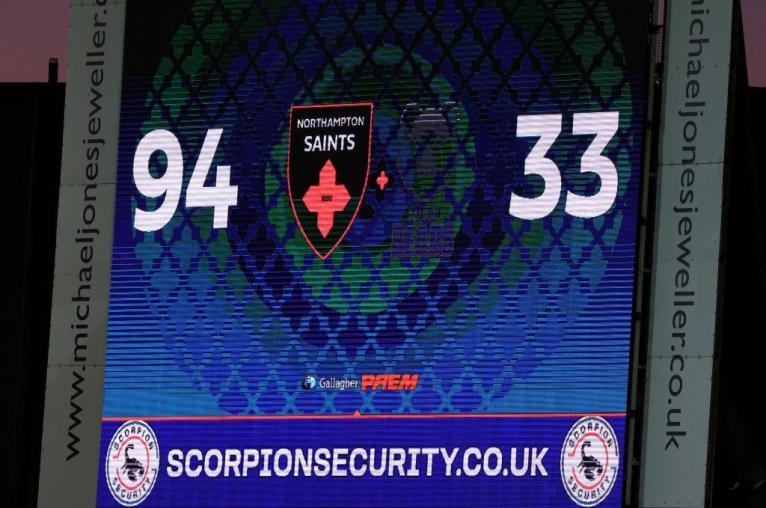
Now the Prem in England has gone one better. Over the last four rounds of play, there have been 83 points recorded in a game between Bath and Newcastle, 85 between Harlequins and Sale, 93 between Newcastle and Harlequins, and 108 between Sale and Saracens. Last Friday evening the ante was upped further, with a 127-point haul in the game between Northampton and Bristol. The Saints and the Bears pipped the Lions and Chiefs at the post, scoring 19 tries between them.
In Why We Want You To Be Rich, written jointly by Robert Kiyosaki and Donald Trump (yes, that Donald Trump) 20 years ago, Kiyosaki likened “rugby to basketball, with tackling”. The current Prem marketing machine is making a fair effort at doing without the tackling completely.
Two weeks ago, Bristol CEO Tom Tainton explained to a SportPro audience in London the Bears “don’t call ourselves a rugby club – we are a marketing agency that plays rugby”. Tainton envisaged a sport where off-field appeal was just as important, if not more so than on-field presence.
“There is no point going to market and spending marquee money on a player and just expect them to do something between the white lines on a Saturday. In the grand scheme of things, nobody remembers how Bristol got on against Harlequins two years ago. They will remember how a player made them feel.
“At Bristol Bears, we don’t call ourselves a rugby club. We are a marketing agency that plays rugby. Yes, our players have to be competent and able to deliver on the field, but if they are not bringing any value off the field, that genuinely factors into our recruitment conversations.
“I’d argue we have done the hard bit – the product is superb. There are young, articulate men and women playing the game. We’ve got a great base to grow from. We now have to take some bold risks to get out of our comfort zone and do things that the sport hasn’t previously done.”
His comments ignited derision and criticism among supporters, and Tainton moved to clarify them in a subsequent club statement, telling fans they had been taken out of context.
“To reassure our supporters, while we are proud to be different at Bears, our number one priority is performance,” he said. “To win trophies, and to inspire our community through rugby success. That hasn’t – and won’t ever – change.”
The dilemma of maintaining balance in a system which is trying to attract new supporters and achieve financial sustainability while at the same time, providing the foundation for a competitive national team, is no closer to resolution. For the year ending in June 2025, the turnover at Bristol Rugby Club Limited stood at £11.1m, £600k up on the previous season, but the club still posted a pre-tax loss of £5.6m. It is more dependent than any other club in the Prem on the largesse of its chief benefactor, the Lansdown family. Bristol Bears still need the life-support system of debt write-offs, cheap loans and generous repayment schedules in order to survive.
The club is attempting to change the demographic of the audience they attract to rugby games. Tainton and his cohorts want to tap into the family market, full metal jacket. A statement accompanying the club accounts highlighted it thus: “Match ticket sales and youth engagement strengthened over the 2024/25 season. Average Premiership league attendance increased by 13% to 21,439, driven in part by record youth ticket sales [Under-12 and Under-19].
“Youth engagement emerged as a standout success story with young supporters now representing 17.6% of the total crowd – the highest proportion in the club’s history.
“Attracting and retaining younger audiences remains a strategic priority, and the vibrant, family-friendly atmosphere that it brings bodes well for its long-term future.
“The demographic profile of new supporters was particularly positive: 32% were female and 20% were aged 24 or under. This reflects meaningful progress in diversifying the audience base and strengthening long-term supporter growth.”
As Tainton suggests, that target demographic changes the shape of player recruitment. Welsh international Louis Rees-Zammit returned to rugby from the NFL last summer and recently signed a long-term extension to his contract, while US superstar Ilona Maher’s short stint in Premiership Women’s Rugby boosted the club’s ticket sales and social media presence, with an estimated 3000% increase on TikTok.
Ultimately Maher was only at the club for 10 weeks and it is hard to know whether the investment in Rees-Zammit, reportedly over £600K p/a on the new multi-year deal, will be repaid in full. The Bears are never less than enormously entertaining to watch but their style of all-out attack can be a double-edged sword. They live and die by their need to market the game. There are no half measures and the scoring profile is everything, for better or worse.
A 59-26 loss to Toulouse dumped the Bears out of the Champions Cup in the round of 16 and the 94-point rout in Northampton has seriously undermined their points difference in a tight race to the fourth qualifying spot in the Prem.
At one end of the argument, Bristol Bears are typical of a league which is running riot, currently averaging over 8.6 tries per game. At the other end of the debate, the marketing drive is not helping the national cause. In his previous incarnation as coach of the Leicester Tigers, Steve Borthwick guided the most conservative, kick-heavy team in the league to a title. At the 2026 Six Nations, Borthwick’s England were schizophrenic, swapping between the impulse to kick against Wales, Scotland and Italy, and run the ball versus Ireland and France.
The only game in which the England players could fully express who and what they are for their clubs was the final match against Les Bleus. The men in white duly scored seven tries and 46 points, but conceded 48 at the Stade de France. Even the dying moments of the match left the unmistakeable musk of the Prem in its wake, with Henry Pollock running out of defence, losing the ball in an offloading attempt, and giving France one last bite at the cherry.
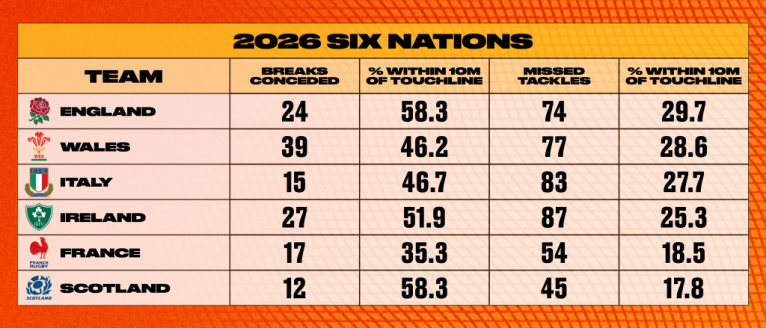
The problem of translation for Borthwick is a growing lack of desire to defend, given the prevailing climate in the Prem. At the Six Nations, England ranked dead last in one vital metric on defence: 44% of the breaks they gave up were converted into tries by the opposition. In the England-Ireland game at Twickenham, Opta analysis revealed: “England missed 28 tackles to Ireland’s 29. However, it was the work [or perhaps lack of it] after those defensive lapses which really set the sides apart. Ireland managed to scramble and stop the attack from 83% of their missed tackles, while England did so on just 57% of theirs, conceding either a try or a line break from the remaining 43%. That is an incredibly damaging figure.”
Half of those line-breaks occurred after play had passed the 15m line, and within 10 metres of touch. “Overall, England have conceded 24 line-breaks, with a joint-high 58% coming in those channels.”
In the course of the game at Franklin’s Garden, the Bears conceded one clean break every 3.8 minutes, and a try every 5.7 minutes. Calling their defence in the wide areas of the field, or after the break, sub-par would be kind.
— William Bishop (@RPvids1994) May 18, 2026
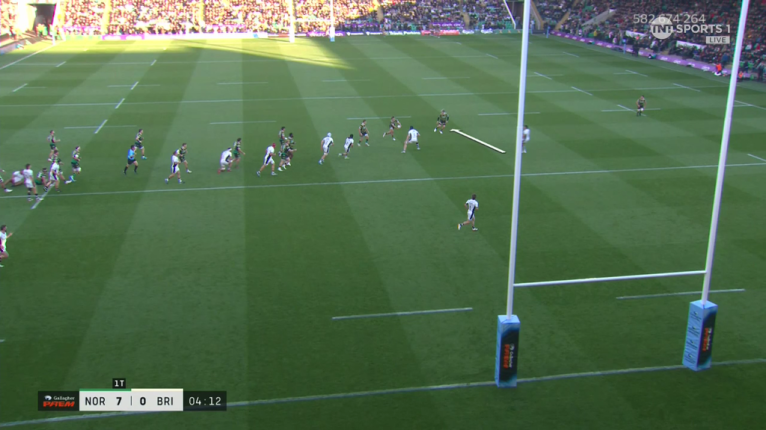
“I don’t know what [Bristol 10] Tom Jordan is doing. He is well covered on the inside, all he has to do is mark Henry Pollock,” exclaimed one of the very best defenders of the 13 channel in the professional era, Brian O’Driscoll on TNT Sports. Sadly, that outcome was typical of the Bristol defence beyond the 15m line throughout the match.
— William Bishop (@RPvids1994) May 18, 2026
— William Bishop (@RPvids1994) May 18, 2026
In the first example, England hopeful Benhard Janse van Rensburg gives up on the scramble early, and there is no sense of coordination or communication between Rees-Zammit and Rich Lane behind him. The same three players are under the microscope, and failing a similar test in the second.
The Saints never had to make any miracle passes to unlock Bristol in the wide areas, all they had to do was move the ball simply through the hands, then rely on the lack of work rate in recovery defence.
— William Bishop (@RPvids1994) May 18, 2026
— William Bishop (@RPvids1994) May 18, 2026
You do not expect a man worth £600k a season to surrender on the play as quickly as Rees-Zammit does in that first clip. No South African side worth its salt would give up any of those scores. They defend to the end.
The Prem has rapidly become a marketer’s dream with its devotion to scoring tries and its appeal to a new demographic: more youngsters, more females and more families now attend league matches than ever before. At the same time, the emphasis on attack, attack and more attack as the best means of defence means Borthwick is living out his worst nightmare. His England team has lost the will to defend in the wide areas and on the scramble after a break is made. English rugby really has become like basketball – without the tackling.

NEW IN THE APP: Official World Rugby Rankings hub! Compare team rankings side-by-side, with data going back 20 years.
Download the RugbyPass app on the App Store (iOS) and Google Play (Android) now!


Who cares?
I played Rugby Union from the age of 5½ and would never miss a game.
Now if I see “Rugby” on the screen I will flip the channel or switch off. This sport “Rugby” is disgusting to watch.
Forward passing allowed under the guise of momentum (the Law clearly states forward is the ball moving towards the opposition dead bell line).
Offsides at breakdowns.
Feeding Scrum.
Not straight at lineouts.
Lifting in linouts.
Hands in rucks.
Substitutions instead of Replacements.
The sport has been bastardised to to point it has more simularities to rugby league than Rugby Football Union so you can take your “Rugby” and shove it up ur arse!
Ofc we never had any of the problems you mention in ‘the good old days’… And it was quite okay for ppl were to nut-grab, rake, punch and kick each other in the head 😉
Honestly, I despair at the idea that marketing is as important, never mind more important, than the game. Of course, finding eloquent players or “characters” off the pitch is great but good players with a rugby ethic and work rate, coached by the best available are the qualities that make rugby awesome. Saracens in their heyday, Bath and Northampton now and Leinster and Glasgow and then the talent fest that exists in the South of France, all are about playing the game. Of course, we love the Bordeaux flair but that’s about talent, not marketing.
Things like renaming the Premiership as the Prem make me despair. I’d like to see some statistics that justify what was probably an expensive marketing exercise and (I know its just my opinion) only infantlised a league that has to recognise tradition as well as off field business.
I am not against marketing but whatever the Bristol CEO meant, claiming it was out of context, is nonsense. It shows that decisions are being driven, at some clubs and in some leagues and national structures by conflicting dynamics. It needs sorting out and that Northampton vs Bristol game was am awful advert for the game.
Welcome to the modern world JB!
The only caveat I would say is the Bristol Bears accounts are not complete, as the stadium costs and sponsorship etc are all accounted for in the Bristol City accounts, so the accounts you see are the trading loss once the stadium costs are removed and are consolidated at the Sport Bristol/Pula Sports accounts level.
It’s just down to the way they are structured.
NB - what’s your take on ENG’s outside channel being so soft, is that weak defence of the back 3, or have teams learnt how to exploit them on the edges.
We were very poor and felt pretty soft across the park but it was clear that teams just shredded us during the Six Nations.
Was there anything that you noticed to explain why they were so soft this year?
England selected three different pairings at centre and on the wings, and two different FBs in the course of the 6N. It’s hard to develop any cohesion like that.
I think the Roebuck-Arundell pairing was weak on the edge, and for three games Tommy Freeman was finding his feet at 13. At 12 Seb Atkinson is nothing like as good as Fraser Dingwall as a defensive reader of the game.
Those would be my first thoughts!
That sort of shameful effort is usually linked to issues in the dressing room. I don’t believe Janse Van Rensburg gives up like that unless there is an issue or he’s not fit.
I travelled to Bristol to watch the Reds play a trial there, and it’s a great ground, and they do a terrific job of making it a fun occasion, but I wouldn’t be happy following a team that folded like that frequently.
The owner is a very lucky chap, who built a very good business, so he has sunk £250m to build the stadium and fund the losses of the various Sports teams he has put in the City.
However, despite all that money, neither of them are winning teams, so it does suggest something isn’t quite right with their approach but not sure why.
Great article and quite a bit to unravel in this one NB.
Covid caused the financial losses that created the lower salary cap.
Salary cap has generally shrunk the playing squads (from 46-48 down to 38-42 is what I see).
Greater demographics of younger academy graduates being roughly 50% of playing squads.
This has led to strong home team line ups and weaker away “rotations”.
The last part has certainly led to some of the blowouts we are seeing as a result.
Teams prioritise home games & Investec with strongest teams.
Are looking for a 4 try bonus point on away trips (and are happy with that point)
The defence intensifies during the playoffs (so they can do it) but injuries are having a greater impact on teams since Covid.
There is no doubt we are seeing more blowout miss-matches but is this the impact of injury and rotation, or is it just bad defence?
NRB have struggled all season (and got worse of late).
Gloucester have been poor but improved since the 6 Nations with key forwards returning.
Quins - I’m not too sure where to start? Defence was always optional 🤣
Sale have fallen apart since the Curry’s were injured.
Bristol start the season well but once they get injuries around Feb, fall off considerably.
You could argue that Bath & Saints held UBB better than most and are two of the better PREM sides in defence. Leicester & Sarries are a bit hot & cold in defence.
I don’t think I can argue that defence has become less effective, I’m just not too sure which of the above are the main drivers and feels like lots of things coming together, so lots of different strands to discuss.
I don’t thnik ther is one D in the Prem which can be described as outstanding - at least not on the same level as Sarries a few years ago in their pomp.
I also cannot think of too many great D coaches in the league right now, maybe only Lee Radford and Mike Forshaw?
And also ofc the culture of the game has moved hugely towards providing an attacking spectacle.
You have to wonder how many pro entities England can really sustain too. It’s prob heresy to say it, but 10 may be too many.