
Rugby has never sounded more cerebral. Listen to coaches now and the game is one great moving diagram. There are shapes and systems, launch plays and exit strategies, pods and pictures, folding defenders and edge threats, decoys and manipulations, two-sided attacks and shoulder angles in the scrum. Boffins with laptops and YouTubers are among the most influential figures in the game. Everyone and their nan has an opinion on the precise number of kicks required to win a Test.
Buy Rugby World Cup 2027 Tickets
1 Year to Go until the biggest Men's Rugby World Cup ever kicks off in Australia. Go All Out and secure your tickets now.
And while it’s true that rugby has never been more tactically sophisticated, two matches over the opening weekend of the Nations Championship underlined an important truth that has existed since some schoolboy at Rugby School first decided that football would be improved by picking it up and running into people.
The first was South Africa’s physical intimidation of England, a match in which both teams carried the ball 117 times but only one side seemed to make those carries count. With the same amount of ball, England made half the number of line-breaks as South Africa and 46 fewer metres post-contact. Couple that with the Springboks’ dominance at the scrum and maul and it’s no wonder Steve Borthwick’s men were outmuscled in a 45-21 defeat.
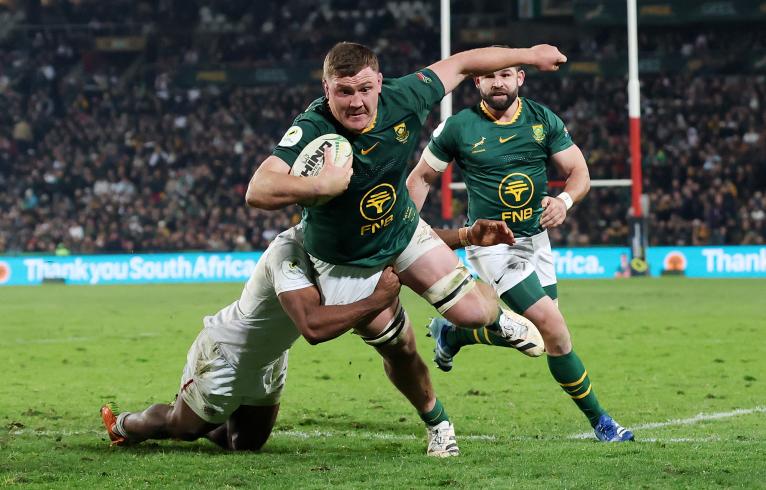
The second example came earlier in the day. Australia played by far the better rugby for long stretches against Ireland. They were more adventurous with ball in hand, more incisive from midfield, got the ball to their wingers with greater zip and were inventive from first-phase strike plays. And yet they lacked the grunt to turn the tide. Tadhg Beirne’s introduction around the 52nd minute completely changed the complexion of the contest. Ireland’s pack now had another hefty unit who could do the rugby equivalent of putting a foot on the ball and slowing things to an attritional grind.
A big man running over another big man remains one of the sport’s most devastating tactical weapons.
That is not to say rugby is simple. It is to say that rugby is still honest. All the cleverness in the world depends on someone first winning the right to use it by bossing the point of contact and stampeding over the gainline. Mike Tyson famously said that everyone has a plan until they get punched in the mouth. Rugby’s version is not far off. Everyone has a defensive system until a two-metre man mountain runs straight through the middle of it.
Former Wallabies coach Ewen McKenzie framed the challenge of facing South Africa this week. The Springboks do not always hide their punch. In fact, that is part of the problem. “South Africa give you the shape; you know what’s coming,” McKenzie said. “You know who’s going to get the ball, but it’s a question of whether you can stop Pieter-Steph du Toit. He is going to get a couple of metres.”
Shortly after the restart, Wiese peeled off a lineout and came rumbling back through a mess of white shirts, as if personally offended by the earlier indignity and determined to correct the record. It was not subtle. It did not need to be.
South Africa’s win over England offered this in its purest form. England did not lack effort. But, as David Flatman put it on ITV’s commentary, they lost the alpha battle. There was a neat morality play tucked within the broader struggle either side of half-time.
In the dying moments of the first half, George Martin thundered into Jasper Wiese and sent him backwards. It was a statement of intent from England, one of those moments that seemed to say: fine, if this is the game you want, we can play it too. But the Springbok number eight kept the receipt.
Shortly after the restart, Wiese peeled off a lineout and came rumbling back through a mess of white shirts, as if personally offended by the earlier indignity and determined to correct the record. It was not subtle. It did not need to be. Seconds later, after the initial blitz, Jesse Kriel was dotting down.
This is the bit that often gets lost when people talk about power as if it is merely crude. A dominant carry is not anti-tactical. It is tactical. It is a pass before the pass, a kick before the kick, a lineout move before the lineout move. It asks a question that cannot be answered on a whiteboard. Can you stop this person, here and now, without compromising everything around him?
If the answer is no, the fly-half suddenly looks like a genius. The scrum-half has cleaner ball. The centres have softer shoulders. The back three have space to hunt. The entire attacking system starts to hum, not because the system has become more ingenious, but because the system has been given forward motion.
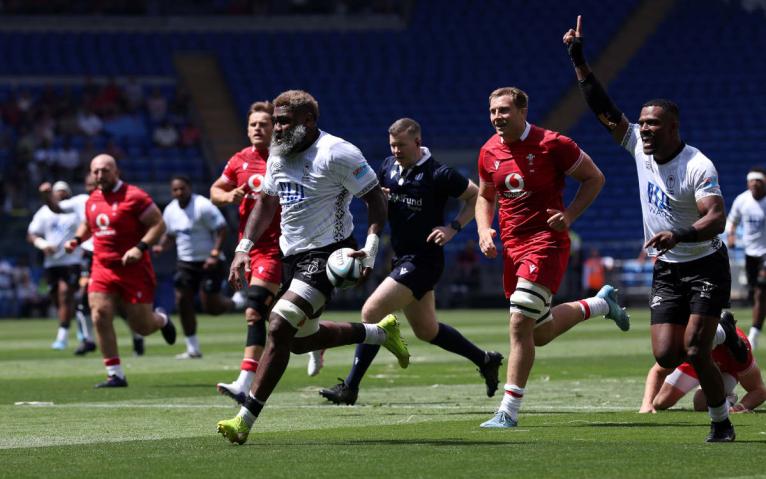
But there is a necessary caveat. Go-forward on its own is not enough. Fiji offered the other side of the argument in their defeat to Wales. They ran for what felt like the best part of a kilometre, carried from deep, offloaded through traffic and turned the pitch into a playground. For long stretches they looked like the more dangerous side. They made Wales look heavy-footed and narrow. They created that familiar Fijian sensation that something ridiculous might happen at any moment. And still they lost.
That does not make the metres meaningless. Nor does it mean the offloads were indulgent. Fiji’s ability to move the ball is not decoration. It is their identity and often their weapon. But there is a difference between movement and control. There is a difference between beating defenders and breaking a match. There is a difference between travelling a long way and arriving somewhere useful. Go-forward without an end product is just guff.
South Africa, by contrast, carried with consequence. They turned collisions into pressure, pressure into field position, field position into penalties, and penalties into points. That is the distinction. And it’s why the primary aim for Australia before a home World Cup next year is the fitness and motivation of Will Skelton.
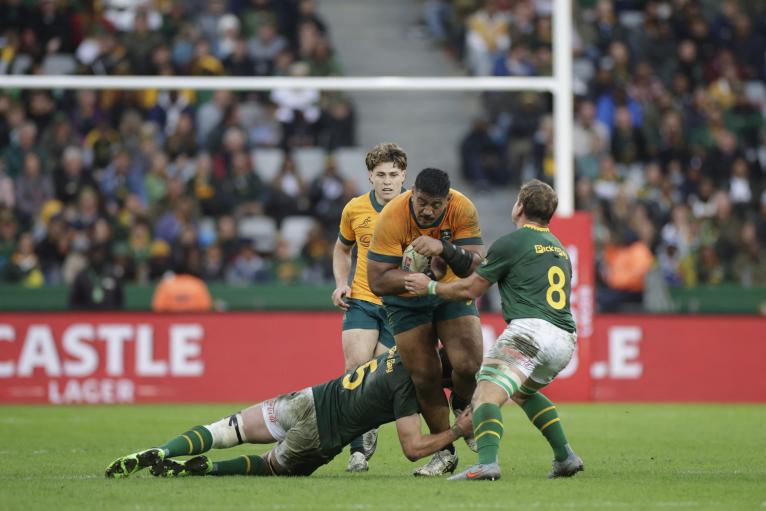
The 2.03m, 140kg behemoth is a tactical device disguised as a heavy vehicle. He gives the Wallabies easy metres. Even when he’s felled, he manages to land several steps closer to the opposition’s try line. He draws tacklers who would rather be elsewhere. He makes defenders set their feet. He buys time for everyone behind him.
Rugby might sound more cerebral. The conversations we are having are not the same as the ones our grandparents used to have. But patterns, pods and kicking strategies still have to pass through contact eventually.
Without him, Australia can still be quick, clever and inventive. They can still create from midfield, shift the ball wide and produce moments that make the highlights reel. But there are moments in Test rugby when a side does not need another idea. It needs a massive man to carry three defenders for four metres.
This should be comforting to traditionalists. For all the talk of patterns, pods and laptop geniuses, rugby has not escaped itself. It is still a collision game. It still rewards the player who can take a pass on the gainline, absorb punishment and somehow keep moving.
But there is a worry there too. If the sport’s deepest truth is still physical dominance, the arms race is obvious. Bigger benches. Heavier locks. Back-rowers with the handling of centres and the dimensions of brick outhouses. Some nations, therefore, will always be bringing a pistol to a bazooka fight.
Wherever one stands on this debate, and the likes of Cheslin Kolbe and Louis Bielle-Biarrey offer a much-needed counterbalance, it is hard to deny the old truth has survived the new language. Rugby might sound more cerebral. The conversations we are having are not the same as the ones our grandparents used to have. But patterns, pods and kicking strategies still have to pass through contact eventually.
Before the trick move, before the layered attack, before the winger finishes in the corner and the analyst clips it up for Monday morning, there is usually one essential act hidden in plain sight.
A big man runs over another big man. And the game opens from there.

NEW IN THE APP: Official World Rugby Rankings hub! Compare team rankings side-by-side, with data going back 20 years.
Download the RugbyPass app on the App Store (iOS) and Google Play (Android) now!


Similar to American Football, I love that “old school” brute strength still matters. American Football has been taken over by deep passes and trying to get out on the edge to use speed, but when a running back lays out someone in the secondary or a nose guard parks a running back on the grass, everyone is reminded that pure dominance still matters. Certainly last second offloads and grubber kicks for tries are fantastic, but a big hit let’s all players and supporters know what the tone is going to be and there is nothing like that gladiatorial satisfaction! Great write-up 👍
Terrific article Daniel!
was this article written by an ex hooker? I haven’t seen any credible opinion that suggests rugby fans live to watch a bunch of fatties rumble from one end of the field to the other. Hence the game’s rules have to favour speed and athleticism over the grim arm wrestle.
The real difference now is having both brute force AND speed at your disposal. It’s not just one or the other — you can deploy whichever the situation demands.
What makes teams like the Boks so dangerous is that they no longer rely on just Plan A or Plan B. If one approach isn’t working, they seamlessly switch to the other — or blend both — while throwing in a few clever tricks in between. That adaptability comes from rock-solid structure and total buy-in from the players.
When everyone is on the same page and willing to execute whatever the game requires, you become incredibly difficult to prepare for and even harder to beat.
Well put Rawky
Undoubtedly mass still matters in rugby. The Boks lost last year when they fielded packs that were smaller or similar in collective mass (weight and height) than the opposition (Aussie and ABs). The formula worked again for the them last weekend. It is also important to note that the Boks are great at what NB calls periodising their mass - they often bring on the big in the last 30-40 minutes with great effect. That’s exactly what happened with England whose impact bench were really ineffective - there was only 10 points difference with 10 to go. Two yellows (that’s a lot of lost mass) and it was game over. With that said, France has shown that big and fast is lethal - the 6N is the best evidence of that - and that pure speed can be very effective, as the game against the ABs showed. 80% <3 second ruck speed in that game should be sending huge alarm bells into SA where the <3 ruck speed was only 49%. Now the Boks are great at slowing the game down. But this hurricane rugby is on its way - and we may see a taste of it with Scotland - the only team to beat France in the 6N. In a way it’s too bad the Boks have so many injuries because it may be lack of cohesion rather than this form of rugby that wins the day (if it does…). Still we may be seeing the dawn of a new age - one based more on speed than power - or more likely a combination of both.
Who needs Will Skelton when the Wallabies have the best ‘big man’ runner in world rugby - one, Rob Valetini.
‘Bobby V’ was absolutely destructive against the Irish; not even the impressive Jasper Wiese compares when blasting through opposition defences at test level.
Ps. I'm a New Zealander.
They need more than just Valetini..agree. he's a grt player.
Cant do it alone.
I’m a South African and I adore Valetini, for me he is the preeminent no.8 in the game. Consistent and box office every time he plays. An incredible player.
well - you know what they say about opinions….
Not a word on NZ-FRA game as it doesn’t fit this well known one dimensional theory. Unfortunately that theory won’t bring big crowds of fans except in a very limited number of countries. As indicated on this site and other sites this is the the high speed/intensity and creative type of NZ-FRA rugby that a lot of fans are looking for.
😂😂ah please all blacks definitely do not play high speed intensity rugby they are very one dimensional, can only play one way, super rugby isn’t test rugby
I want a combination of both…
Actually a lot of fans just want to see their country win. They don't care how they do it. I heard NZ commetator say he would rather see NZ look good and lose. It is a NZ thing possibly a French thing as well.
I think casual fans can enjoy crash bash and big guys running at each other if the game keeps moving but what I think they struggle with is box kicking then knock on then scrum then reset scrum then penalty then maul then penalty then same again then card not only the large amounts of time with nothing going on but also they have no idea why ref is blowing whistle
Perhaps that’s that game is the exception that proves the rule?