
Last year, when South Africa visited Dublin, Ireland’s pack was subjected to a brutal, occasionally humiliating examination of their credentials. Across a 24-13 defeat that barely reflected the one-sided nature of the forward contest, Ireland conceded six scrum penalties and a penalty try, had four men sin-binned and James Ryan shown a 20-minute red card. At times it felt as if the Irish forwards were carrying sandbags over their shoulders while being dragged backwards by an invisible rope.
HSBC SVNS returns to Cape Town this December!
Don't miss your chance to see the world’s best rugby teams take centre stage 5-6 December in Cape Town.
South Africa’s first win in Dublin since 2012 was a sobering reminder that no pack on earth can match the ferocity and power of the Springboks at full tilt. Saturday provides another opportunity to demonstrate that superiority. But for the purposes of this team’s development, and its quest to become the first nation to win three consecutive World Cups next year, perhaps it is time to put down the sledgehammer and reach for the katana.
The evidence from Paris suggests why a recalibration is necessary. South Africa lost 21-19 to France despite enjoying 55 per cent possession and 58 per cent territory. They won all 15 lineouts on their own throw, maintained a perfect scrum success rate and extracted nine penalties from the French scrum. By almost every conventional measure of forward dominance, they had done enough to win twice.
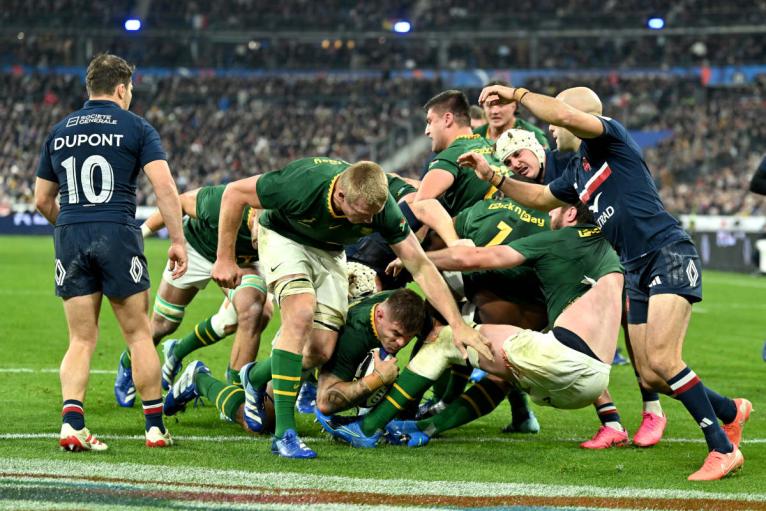
All three South African tries came through close-range forward pressure. Jan-Hendrik Wessels and Malcolm Marx scored from lineout drives, while Cobus Reinach burrowed over after sustained pressure following a sequence from a lineout that saw the ball inch towards the poles from the left touchline. Each five-pointer was deserved. But where was the try fashioned by a sweeping backline movement? The pass that released a winger? The clever change of angle that left defenders clutching at thin air?
Of course, there will be South Africans wondering what all the fuss is about. And they have a point. Winning is all that matters in Test rugby. Nobody awards additional points for artistic merit. A pushover try counts exactly the same as a spectacular counter-attack, and the Springboks have collected enough silverware to suggest they understand this better than most. If Ireland’s scrum disintegrates again and South Africa win by 20 points without completing a single ambitious backline movement, the celebrations will be entirely justified.
This is not an argument for abandoning physicality. Quite the opposite. Dominating collisions should create opportunities elsewhere.
But winning and evolving are not mutually exclusive. The greatest teams continue to search for improvements even when their methods are successful. The Springboks should be asking not merely whether their existing weapons can overwhelm opponents, but what happens when those weapons are neutralised.
Tony Brown has articulated the ambition. Speaking on the Plumtree Uncut podcast in October, the attack coach identified three essentials: “Momentum, speed and space.”
He also acknowledged a distinctly South African habit. Players are encouraged from a young age to run over opponents, he explained, when international rugby often requires greater use of footwork, skill and available space.
This is not an argument for abandoning physicality. Quite the opposite. Dominating collisions should create opportunities elsewhere. If three defenders are required to stop a charging forward, there must be space beyond them. The trick is recognising it before the defence reorganises.
Which brings us to Damian Willemse. Few players possess his combination of footwork, acceleration and spatial awareness. Yet at full-back he can become an occasional participant rather than a central figure in the attacking conversation. And against France, with very few opportunities, he produced potentially his worst performance in his nation’s colours.
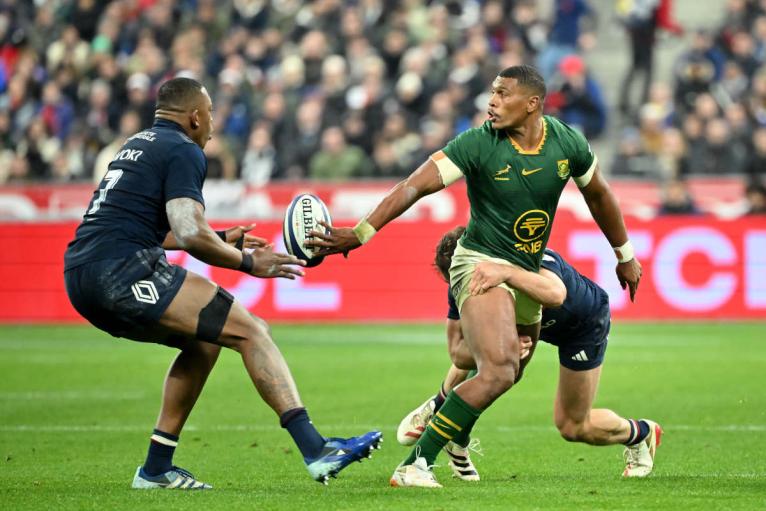
Against Ireland, I want Willemse arriving at first receiver, taking the ball at second receiver and appearing on either side of the breakdown. Not simply joining the line as another runner, but helping to direct it. His creativity is almost boundless. Using him on the periphery is a waste of his supreme gifts.
Imagine Sacha Feinberg-Mngomezulu taking the ball flat, with Willemse sweeping behind a forward pod. Suddenly Ireland must account for two distributors, each capable of attacking the line. Willemse can straighten, release a runner or accelerate through a gap himself. That uncertainty is worth more than another predictable collision.
The same principle should apply to the wings. Kurt-Lee Arendse and Ethan Hooker are too dangerous to spend long passages stationed near the touchline, waiting for possession to complete an improbable journey through half a dozen pairs of hands.
Few inside centres consistently attract so much defensive attention as De Allende, or eke out as many extra metres post contact. But that attention is precisely why he should be encouraged to pass more often.
Bring them in-field. Send them against tired forwards. Use them on short lines off the scrum-half or looping around the centres. A winger coming off his touchline can create the space that another winger eventually exploits. Both are potent weapons when chasing high kicks but, to steal a line from the Swedish footballer Zlatan Ibrahimovi?, this feels like owning a Ferrari just to drive it like a Fiat.
Then there is Damian de Allende. His ability to carry through contact remains one of South Africa’s most reliable attacking assets. Few inside centres consistently attract so much defensive attention, or eke out as many extra metres post contact. But that attention is precisely why he should be encouraged to pass more often.
The objective is not to turn him into a delicate playmaker. It is to make defenders hesitate. If they know he will carry, they can load up and brace for impact. If they suspect he might release Jesse Kriel through a gap, or find Willemse on his outside shoulder, they must make a decision. And hesitation, even for half a second, is an attacking opportunity.
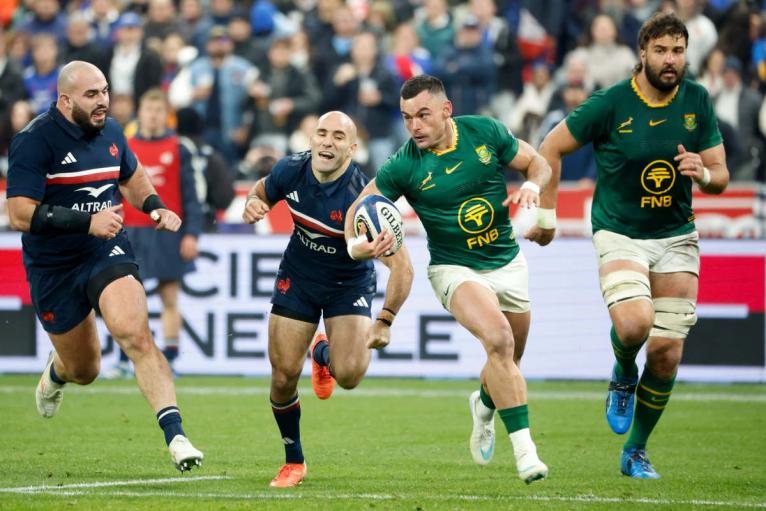
Kriel is central to this. His defensive intelligence and industry are rightly celebrated, but he is also a dangerous runner when given the ball in space. Against France, his extraordinary break from near his own goal line carried South Africa deep into French territory. Give him the ball earlier. Let him attack a defender’s outside shoulder. Allow him to run onto passes rather than receive them with the defence already upon him.
There is precedent for this ambition. In Dublin last year, South Africa’s opening try came after De Allende broke through midfield and Willemse finished spectacularly in the corner. Power and invention worked together.
Yet that same afternoon provided a warning. Despite Ireland’s extraordinary disciplinary collapse, South Africa scored only one try after half-time. Even against depleted opposition, their superiority was not always translated into points. Just like against France last Friday, there was a tendency to double down on one approach rather than seek alternative paths to the try-line.
Another demolition of Ireland’s pack would confirm what the rugby world already knows. A performance combining that physical supremacy with deception, width and clinical finishing would reveal something more exciting.
None of this requires a revolution. It demands better timing, more varied positioning and greater trust in the skills already available.
There is no shame in winning through the scrum, the maul or relentless physical pressure. Those qualities have underpinned one of international rugby’s great eras. But this side possesses too much attacking talent to be satisfied with them alone. Their fans should also expect more and demand that promises of incision are delivered.
Another demolition of Ireland’s pack would confirm what the rugby world already knows. A performance combining that physical supremacy with deception, width and clinical finishing would reveal something more exciting.
The Springboks have mastered the art of making opponents go backwards. It’s about time they regularly let us see what happens when they make defenders look the wrong way.
 Register your interest to receive priority updates on RWC27 ticket releases. Don't miss out, stay in the loop!


Comments
Join free and tell us what you really think!
Sign up for free