




1
{{item.n}}

Super Rugby Pacific 2026 will be played at an even faster and more furious pace than ever before. The governing body has brought in five law changes that will see the game sped up and limit stoppages.
Laws 10.5, 15.7, and 20.2 all work to limit stoppages, speed up decision-making, or remove scrums from the game, and in turn remove the time it takes to set those scrums. Laws 8.3 and 18.8a deal with penalty try sanctions and the 50:22m kicking rule.
While many across the Pacific are likely to support a sped-up game, there are always unintended consequences when tweaking the laws.
The Super Rugby Pacific press release says:
“Over the last four years, more than four minutes of ‘dead time’ has been eradicated from Super Rugby Pacific games – a result of law innovation combined with strong intent from match officials.”
This dead time relates to time at rucks, time setting up and resetting set pieces like scrums and lineouts, as well as generally limiting stoppages for non-urgent injuries and the like.
Super Rugby Pacific CEO Jack Mesley says these changes are in line with the competition’s ambition to be fan-focused.
“These innovations for 2026 reflect the ongoing commitment of Super Rugby Pacific to deliver the most entertaining and engaging rugby competition in the world,” he said.
“We want to be a competition that encourages quick taps and faster restarts, that cuts down on unnecessary stoppages, and that embraces positive, attacking rugby.”
While the time limits on the setting of scrums and lineouts, as well as rucks, are all universally supported, this next step, particularly law changes 10.5 and 15.7, will inevitably change the strategies around defence.
These changes state: “[a]ccidental offsides and teams delaying playing the ball away from a ruck will result in free kicks rather than scrums.”
This will fundamentally change the defending team’s requirements around kick receipts.
For the attacking side, little will change, as a sole chaser can cause chaos in an opponent’s backfield, and the consequences of not retrieving the ball are marginal.
However, for the defending side, a dropped catch being knocked forward into a retreating teammate will suddenly go from a scrum down, to having an exposed backfield and few defenders to repel a free kick and the oncoming opposition.
A similar situation will arise at lineouts, as it’s not uncommon for dropped balls to clatter into players in front of the receiver, once again causing a mad scramble to repel a free kick.
While this will create more running and require more agile defensive systems, it will also cause rugby to lose some of the structure which makes it unique and special.
Separately, the “teams delaying playing the ball away from a ruck” and the penalty of a free kick looks to bring new jeopardy to halfbacks who want to test out the referee’s patience and five-second timer. This change will indeed have the desired effect of speeding up play, with very little unintended consequence to speak of.
Subsequently, law 15.17 also stipulates: “[a]fter the referee has called ‘use it’ at the ruck, no additional players from the team in possession may join the ruck.”
This rule is broadly welcomed, and it will see a higher number of charge-downs throughout SRP 2026. These two aspects of law 15.7 are great innovations, as the caterpillar ruck has somewhat made a comeback and is slowing the game down for all the wrong reasons.
Law 18.8a states: “[t]eams will be permitted to pass the ball back into their half before kicking a 50:22.”
A Fiji homecoming is sparking Manasa Mataele's Rugby World Cup dream as the electric winger vows to roll up his sleeves for the Drua.
Read NowThis will have attack and kicking coaches, and any playmaker worth their salt, licking their lips. Attacking sides can either attack a 12-man defensive line or have free rein to manipulate the defending side’s backfield.
Defences won’t be able to afford to have just the fullback and a winger in the backfield; it would inevitably leave either a touchline or the centre of the field exposed to a probing kick. While this change will alter the makeup of the defensive backfield, it will likewise alter defensive strategy.
Ideally, defensive lines that are short on numbers employ a drift system to make up for the overlaps, but because this threat will now be extended to the defender’s own half, defences won’t be able to afford to drift. This is because attacks will be able to attack well into the opposition’s half and can sit a fullback or flyhalf just inside their own half, and should the attack break down, the halfback can spin a 20m pass back to their kicker, who will try to launch a piercing kick to make material gain.
This will put a strain on defensive systems that usually have a connected linespeed ethos, and will favour sides who run a rush defence because defences will now be on a sort of clock to limit phases with a depleted defensive line.
A small tweak, which will help to minimise pedantic law implementation, is law 20.2, stating: “[p]layers will be allowed to take quick taps within one metre either side of the of the mark, or anywhere behind the mark, if they are within that two-metre channel running parallel to the touchlines.”
Finally, law 8.3 states: “It will no longer be mandatory for the referee to issue a yellow or red card to a player on the defending team when awarding a penalty try. Any sanction will be at the discretion of the referee.”
This will be music to many fans’ ears. The oppressive need to double-punish a team that is usually conceding a penalty try when under immense and constant pressure usually took the sting out of games that had the potential for a good underdog story. A side that was already getting marmalised in the scrum or in a maul, time and time again, needs anything but a yellow card.
It is pertinent to note the wording of the rule: “[a]ny sanction will be at the discretion of the referee,” this will discourage any coach from instructing their team to infringe when the heat comes on when defending their line.
To be clear, this law change has only removed the requirement of a yellow card upon a penalty try. It has not done away with the punishment or the possibility of the ‘cheese’ card altogether.
While many aspects of these law changes appear positive, any change that removes a key contest from the game, being scrums, should be scrutinised. Broadcasters, pundits, and those who have prominent voices in the game seldom do enough to explain, highlight, champion, herald and analyse scrums.
Stadia don’t innovate to have a “scrum anthem” to create buzz around the grounds when 16 of the biggest men on the pitch go to war against each other. This removal of the scrum will only serve those who think “union is too stop-start”, and it will do nothing for Test sides when it comes to the July Tests, as scrums are the foundation of championship-winning teams.
The fact that these laws are endemic to Super Rugby Pacific creates a juncture of IP for players who learn to use these new innovations to their benefit, for come July Tests, it will be back to the old laws.
Nonetheless, if these laws are to help the audience, attendance, and fan numbers, then they should be given a chance. This is because, despite rugby union having many staunch supporters, it’s known for having a rabble of fair-weather fans who often crow that not enough is being done to make it relevant, and at times, that it’s “too slow and boring.”
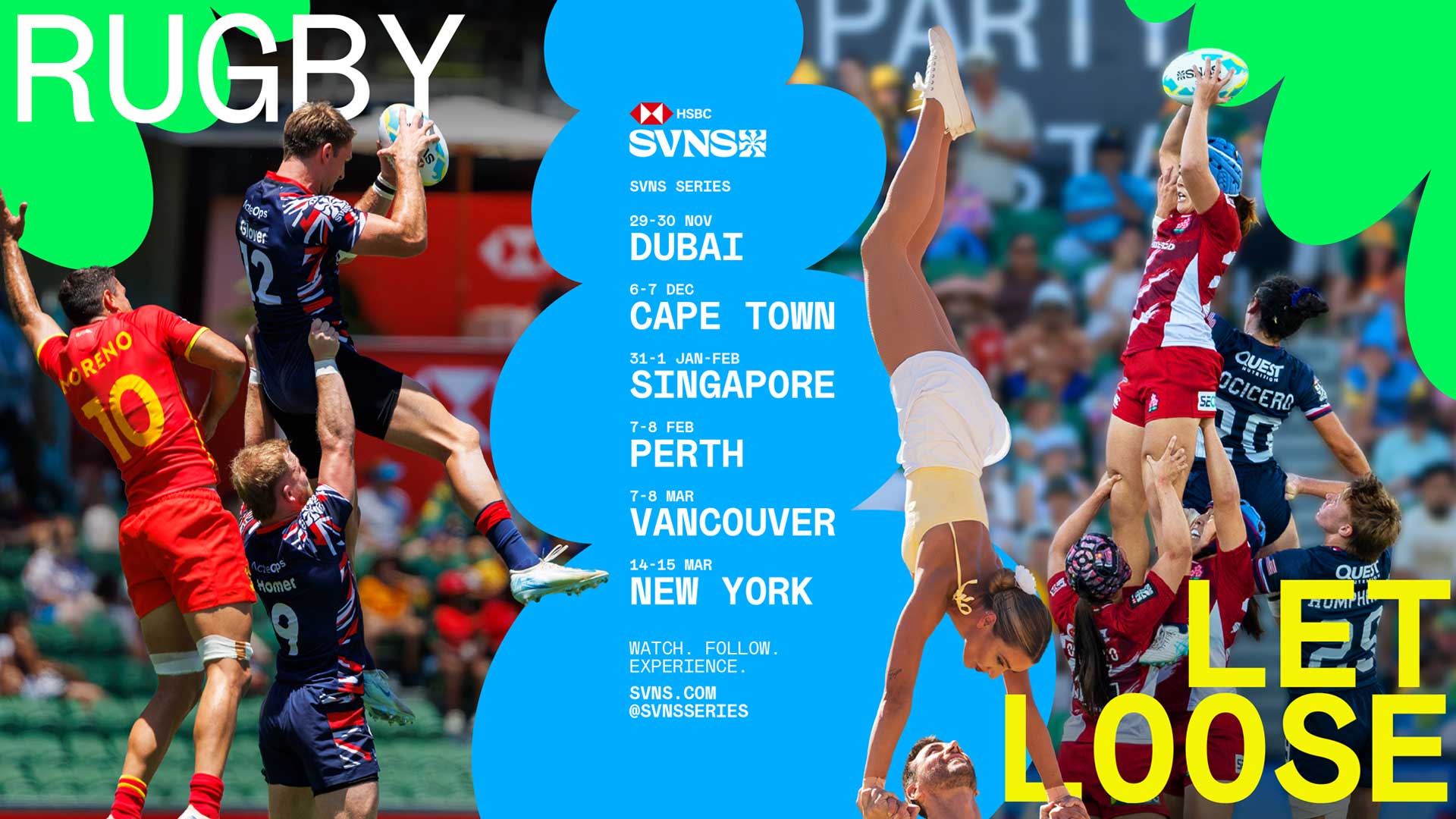
Watch all the upcoming SVNS action for FREE on RPTV!
*Available live in select territories
Just to be clear to those ignorant of the history of global rugby rule changes, NZ and Australia have, for the last thirty years, and at considerable risk to their own immediate interests at test level, allowed Super rugby to be a test bed for a sequence of rule changes WR are interested in. These changes are just another instance of it.
Shot clocks and the 20 minute red card were tried in SR first, eventually accepted by the Northern dictatorship after much argument, despite their obvious value.
The thing is, there would be no progress in rationalising the game without NZ and Australia taking this risk. Top 14, URC and English Premiership and their respective national administrations are, as always, ultra conservative, not leaders, their competition and national administrators sitting in sanctimonious judgment on NZ and Australia for trying to improve the game.
They have never and will never allow their precious competitions to be a test bed for necessary change. They’re too cunning for that. They sit back, let NZ and Australia take all the risk, sneer at them for trying, laugh at them for taking the risk, are outraged at innovation, then slowly, sullenly, accept change they cannot avoid. Check the comments on this article. Chock full of condescension, fake outrage and conservatism, directed at NZ and Australia for having the audacity to attempt to make the game better. The more things change…
Now SA used to part of the attempt to drag the game forward, but since their move north they have become the most arch of conservatives. Erasmus’s constant cynicism, his repeated attempts to exploit loop holes in the laws through deliberate offending, as well as loading the reserves bench with forwards to prevent the game from ever opening up, and the success that cynicism has brought South Africa, has convinced SA to pursue an agenda of time wasting, maximal set pieces, and minimum in play time. Even the dead heads in the 6 Nations are starting to question such an obsessively conservative, cynical approach.
The sequence of events with these rule changes is that they are trialled in SR, debated by WR, subject to the agreement of the northern dictatorship, have a minority of the changes accepted, which are suspended till after the July tests, then applied during TRC.
So given that the rules seek to further depower the scrum by creating less of them, and also create less box kicks, I’m fully expecting SA to oppose both tooth and nail and then, if forced to accept such beneficial change, insist that they are not applied till after the All Blacks tour of SA, in defiance of the usual practice. And I’m fully expecting the Northern dictatorship to give them exactly what they want.
All the rule changes are excellent, but I doubt it will have any impact on the North Hemisphere dictatorship, which SA is part of, and their imposition of NFL rugby. They want a rigidly structured, set piece based, kick and defense dominated game that is, at its core, absolutely opposed to speed and innovation, and have legislated that for decades.
The Northern Hemisphere administrators and officials, the people who control the game in their own interests, certainly not the interests of rugby around the world, are all just different forms of Matthieu Raynal. Only the accents and the insults are different. As you can see from the comments from their supporters here.
Be interesting how the North Hemisphere dictatorship react to the tap kick channel being widened to 2 metres, which should remove all law based obstruction of them being taken. The North dictatorship hate tap kicks, they represent exactly the speed and innovation they want to eradicate.
That's why when Carlos Spencer came up with the idea of simply bouncing the ball off his knee to maximise the speed and efficiency of the tap kick the dictatorship immediately went to the extreme measure of changing the law itself from the free kick having to be taken by any part of the leg to any part of the lower leg. Far too much speed, far too much innovation for the dictatorship.
It's easy to imagine their propaganda when they refuse to adopt the change. Not enough time for the defenders to get onside, unfair, etc etc. Same as it was then, same as it's always been.
Excellent from your skewed perception. There is always the unintended consequences of law changes. You should listen to real students of the game, and then argue with their logic.
The Antipodeans are trying to change the core of rugby, because they cannot compete. At the same time they are trying to compete with rival codes in their countries.
So they see any opposition to rule changes as a dictatorship. But never fear you have Brett Robinson as chair of the IRFU and that wonderfully talented ex NZR chair in your corner.
Problem is, the Boks will just find new ways of beating you. They have always done that despite the Antipodeans trying to negate their strengths.
Besides that, you will soon see that all the supposed innovations will ultimately lead to more scrums. The contestable kicks will cause knock on’s = scrum.
As usual the innovators have not considered this possibility.
Thanks for taking the time to look into the effects of these changes John. I’m not really fused, I just hope they have iteration right, making a change is only the first step in an improvement cycle.
If I’m now to play off your thoughts some things that come to mind would be that attacking sides will in encouraged to play more phases around half way as now they can essentially go forward another 10 meters while still having the 50/22 as an option. Now of course it will become even more of an option as it will be easier, so teams will be even more inclined to carry the ball further, to better position their kicker?
Also how do you correlate an increasing incentive for box kicks around them being both harder to execute with less time, and being more likely to be charged down, given the proximity of players?
I think even if theres more positive results for a contestable kick (for the kicking team) I don’t think you will see as many used given the changes. We have had a few discussions around the kick a minute France v Ireland game that Nick Bishop wrote about, Otagoman suggest having no restrictions on ‘marking’ the ball. Do you still think the game might need another law of top off these new SR ones, like ‘marking’ or ‘deliberate knock on’ rulings, to really bring some balance back to kicking tactics (not just 80% contestables)?
for come July Tests, it will be back to the old laws.
That’s not decided yet is it?
Cheers for the comment JW and your considered thoughts.
Re the box kicks numbers etc., there will be an adjustment period where rucks are set long enough quickly enough that will see a increased chance of charge downs.
After they adjust, rucks will set at once to circumvent the rule and so we will have “normal” caterpillar rucks again, but less regularly. The new rule if teams want to circumvent it will require sides to be narrower in their shape, which is not conducive to good attack shape.
So that is my correlation between there being risk for more charge downs but also using the box kick as weapon will have it’s perks as well as I outlined in the piece.
What I enjoy with these law variations is that they tip the power a little more towards the centre between attack and defence, because for a while rugby has been a defensive dominanted game, and it has been since before the 2019 RWC.
But as mentioned, come July Tests, these won’t be around. I believe there is a meeting of rugby minds happening very soon that will see law changes considered and implemented but I believe any decision there will not come into effect until after the Nations Championship July Tests.
Players can adjust quickly to changes in the laws. This will not hinder them in tests. NZ and Aus have to get the fans back because the money raising model is not working relaying on internationals. While it is not just the plodding on the field that is solely responsible it plays a big part. The npc has started bringing back fans because everything is done quicker including scrum.
Can they! It took them a while to adjust to test rugby. The rest of the world is not responsible for keeping rugby in NZ and Australia relevant. Winning would be a good start though.
It’s the age old problem of the balance of tight fives scrummaging ability. World Rugby should change scrums back to what they where and are meant to be (the use of penalties to enforce behavour has failed and should be discontinued) and then selection will be back to all shapes and sizes, but currently a Super Rugby coach could well find himself being punished by selecting Test quality props in his side, and be extention, if that continues it to going to discourage Test quality props etc from being developed as well.
Right now I think it might be worth adding scrums back into certain facets, especially if they can discover circumstances where say 1 minute add breaks/timeouts can occur without a disruption into positive sequences of play. Say for example the sequence in the England v All Black game where England had made there way to the ABs 22 but could not gain further momentum and Steward had a collision that saw the ref stop play. England were awarded the scrum and play resumed after a minute or more it took to remove Steward from the field and then proceeded to shunt the All Blacks sideways, causing the blindside and number 8 to get stuck in the scrum and the resulting blindside overlap have no cover coming across to stop them.
You had there both a sequence where a) play was going nowhere, b) a lengthy stoppage, and c) a chance for England to use a strength of theres from a ‘strike’ play than as a viewer we would only be waiting 10 seconds for. You can find other instances to use a scrum weapon too I reckon, like allowed the sideline to call a timeout at any point. They ref blows his whistle, the team are required to make a substitution (what timeouts a written in for), and they get a scrum put in. Play resumes as both scums are packed and waiting for the ref to call hit after the 1 min add finishes.
Just a few thoughts than deliver on some recent topics. I should add as a viewer I thought the 6N cover was fairly poor as it appeared they stopped playing replays for the international viewers (while the local broadcasters cut to adds).
For a corner of the world with the fewest fans and players - they sure interfere more than their fair share.
I think the Currie Cup should trial a few of their own laws.
Scrums for everything.
The interest in the game is changing in South Africa HH, the reason you’re not seeing the change you want is because most of the fans there don’t want it.
😂😂😂😂
Please go and create your own game, your own World Cup etc and leave the rest of us alone.
Too late for you, we’ve infiltrated the top of WR now.
We WILL HAVE OUR GAME BACK!
Do you really think Super Rugby come up with these in isolation?
They are proposed in collaboration with WR and if the don’t work they don’t get trialed further.
I’m not a fan of tweaking the laws all the time. But fans from certain countries moan about any and all changes regardless of how sensible they are. The furor about the 20min red was embarrassing
packed stadiums in Europe! Must be the intellect of antipodean fans that is really the issue then resulting in a need to keep dumbing down the game!
Rugby is poorly support in Europe unknown, what are you talking about? Way behind multiple other sports.
Well you look after your own and we will do the same for us. How many world cups does the north have again?
Stop screwing with our beautiful game. We are not league - we are rugby union and proudly so! Stop fvck!ng with our game!!!!
I’m afraid the way it’s going it has been turning into league unknown. These are good changes that will return rugby to the old days.
And again ill prepare, the SR players to the demands of test rugby! I understand that the powers that be need to put bums on seats to promote rugby in the face of competition with rival sporting codes, but it will again mentally condition players for a type of rugby that doesn’t thrive in the test arena, where the physicality and setpiece battles are more intense.
Join free and tell us what you really think!
Sign up for freeClubs wanting to join England's top tier will now need 'tens of millions' just to buy a share after promotion and relegation was ditched.
The 109-cap All Blacks lock is plying his trade in Japan and Dave Rennie has been pushing hard for his return to Test rugby
They may have finished in the bottom half of the U20 Six Nations but some Wales players showed unmistakable glimpses of talent.
Seeing ain't feeling, my friend!
Red bull doesn't give you wings
Apparently Mike Blair is an innovative coach but I dont know much about him
Now, whereabout are the adults that support the All Blacks?


 Clear
Clear 


