
In his more secret moments, Fraser McReight might be dreaming of playing with a red rose on his chest, instead of a wallaby. It is one of the ultimate ironies, and perhaps a sign of the times England now have far more vacancies for good number sevens on their advertising board than Australia.
NEW: Follow Your favourites in the App 📱
You can now follow their favourite teams, tournaments and players in the RugbyPass App!
The Wallabies used to own the factory line for breakaways, they produced some of the great open-sides of the professional era in George Smith, David Pocock and Michael Hooper. They could even afford to ignore others who might have been first choice for other nations, such as Liam Gill and Matty Hodgson. Now, not so much.
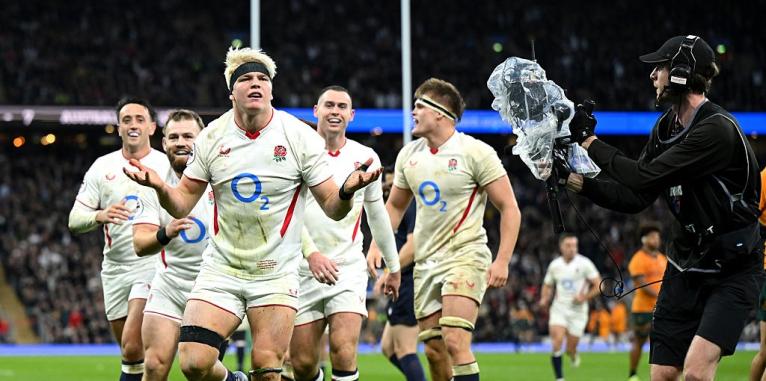
While there are still a couple of good ‘uns competing for selection in McReight and Carlo Tizzano, you seldom see more than one on the pitch together. Steve Borthwick’s squad which took the field at Allianz Stadium contained no fewer than five natural open-sides, Australia’s a mere one.
For those who believed Borthwick should have copied Andy Farrell’s Lions and shuffled their autumn forward deck to include a big number eight such as Tom Willis and a hybrid lineout specialist like Olly Chessum or Chandler Cunningham-South at six, November opener came as a sobering pause for reflection. Willis is returning to his professional first love in Bordeaux and Borthwick is sticking to the formula which has trumped every England opponent since the loss to Ireland nine months ago.
The full house of number sevens has accounted for Six Nations champions France and Wales by a record score at the Principality Stadium, it has won a series in Argentina 2-0 with a squad shorn of its Lions and now it has engineered a 25-7 victory over a resurgent Wallabies. An eight-match winning streak at the top level of the international game is no trifling matter.
England’s squadron of fleet-flooted sevens did the unthinkable. They made the visitors look ponderous in thought and deed, and a lot slower than the men in white. The red rose has sometimes been able to bludgeon the green and gold, but very rarely has it beaten the Wallabies for speed, in the mind or in the body. That was the real significance of what happened at the old cabbage patch.
Australia built 112 rucks and carried on 130 occasions to generate 339 metres. England built only 67 rucks and carried 98 times to gain 521m. Australia’s bigger and more powerful back-row played second fiddle to England’s ‘light brigade’.
Back-Row | C/MG | CB/TB |
|---|---|---|
 England England | 22 for 195m | 2/6 |
 Australia Australia | 33 for 141m | 2/5 |
C/MG = Carries / Metres Gained
CB/TB = Clean Breaks / Tackle Busts

The impact was too obvious to ignore by commentators on either side of equator. Former England captain Matt Dawson derided Joe Schmidt’s side as “the worst I have seen them, ever” on BBC Sport: “Australia were so disjointed. It was a woeful performance.”
One of the staunchest buttresses of Wallaby support in the media, ex-centre Morgan Turiniui, was equally scathing on Stan Sport:
“There’s some harsh truths [to emerge] out of this game.
“I think one of them is the Wallabies failed to mount one coherent, sufficient attacking foray in 80 minutes.
“I thought their breakdown was poor with and without the ball. Their desperation when the ball was in the air was poor.
“It was a really disappointing performance from the Wallabies. The effort is there. They’re doing their best, but I think we expect more development, especially in how they’re trying to build attack.”
England were ahead of the game off the field too, operating at full-strength outside the international window due to a player-release agreement between the RFU and the Prem. By contrast, Rugby Australia could not secure the services of four men who would have helped the cause in Will Skelton, Tom Hooper, Len Ikitau and James O’Connor. The sooner RA forges meaningful relationships with significant English clubs such as Exeter and Northampton, who regularly employ and improve their players, the better. Player release needs to be written into contracts, or sabbaticals involving the union, in indelible black ink.
England started the game with three sevens in harness – Sam Underhill, new cap Guy Pepper and Ben Earl – and they kept that arrangement until the very end, with Tom Curry and Henry Pollock launched down the runway to replace Underhill and Earl respectively.
A man who has been playing at six in the green, black and gold of his club Northampton, Alex Coles, was chosen to add even more speed in the second row. West London in November was like Cardiff in March, all over again. England did not exactly run amok as they had done against Wales, but they still won the final half-hour decisively enough, 15-0.
In the build-up to the Ireland-New Zealand encounter at Soldier Field, Ireland assistant coach Andrew Goodman had recently referenced the current dilemma for an attack coach on the Aotearoa Rugby Pod: “…trying to find that balance around how much time you’re putting into your set piece ‘specials’ versus how much time you’re working on that transitional part of the game.
“The team that can dominate the air, or the scraps battle on the ground, and then can transition well into the attack or defence. The best are the teams that are often coming out on top.”
England’s three number sevens allowed them to get more back-row presence around the high ball on the kick-chase, and Bath duo Pepper and Underhill won two early turnovers. The first is a counter-ruck on Tane Edmed led by Underhill, the second a double jackal by the men from the Rec.
— William Bishop (@RPvids1994) November 2, 2025
— William Bishop (@RPvids1994) November 2, 2025
The speed of the sevens was equally effective in defence of the high ball, with England constructing a pocket around the ball after first touch.
— William Bishop (@RPvids1994) November 2, 2025
Pepper picks up the scraps that fall from the table of the contest between ex-Tigers team-mates Freddy Steward and Harry Potter, and Underhill is on hand to secure the ball over the top of the tackle.
Joseph-Aukuso Suaalii was a dominating force in the air this time last year at Twickenham, but he had to wait until the hour mark to win back a restart on Saturday, and he was beaten to the catch by Tom Roebuck for England’s first score.
— William Bishop (@RPvids1994) November 2, 2025
There is a lot of nuance and accuracy in the way England go about their business. Jamie George slides out to the right touchline to give Sale’s right wing the inside line on chase, and Roebuck is good enough to win the one-on-one battle with RA’s marquee signing. Inevitably, Underhill and Earl are in close support once the ball is won, and Earl’s speed across the ground is far too much for the two pursuing Wallaby backs, Edmed and Potter. Willis would definitely not have scored that try.
It was hard not to wonder what McReight might be making of it all. The Queenslander did trojan work in defence, winning four turnovers on the ground and another in the tackle, but he was a man on a solitary mission with precious little support.
The coup de grace arrived when two Lions, Curry and Pollock, came off the bench to replace Underhill and Earl. As Schmidt commented ruefully after the event, “it was a real see-saw affair, but I felt they got the better of us in the second half. They’re a really good team. Particularly in that last quarter, where I thought some of the guys coming off the bench, with the experience and power they had, I felt we struggled.”
The newly bleached blond genius of the Prem topped off a miserable afternoon for Schmidt by scoring another try from exactly the same scenario as the man he replaced.
— William Bishop (@RPvids1994) November 2, 2025
England win the high ball in defence and they are better positioned to pick up the morsels from their own contestable kick than Australia. They had the back-row speed to finish any chances that fell their way, and the three sevens did not diminish their power in the maul – not in the least.
— William Bishop (@RPvids1994) November 2, 2025
First, Pepper is on point after the receipt by Maro Itoje, then Curry leads the drive through to the goalline. This is Borthwick’s brave new England, where the rapier sets up the use of the bludgeon, and not the other way around.
The underlying irony of the encounter between two of rugby’s rising powers at Twickenham was that the home team won by showing a level of ‘smarts’ more typically associated with the visitors. England did not try to club the Wallabies to death with the power of their set-piece as they have done in the past.
Borthwick picked a mobile, supple back five. As Australia toiled with the traditional, England parried and countered with a progressive rugby solution based around the unstructured attacking potential of the contestable kick.
The red rose made the green and gold look statuesque and ponderous, and only McReight among the tourists could live with the sheer speed and dynamism of the England forwards. England have won eight on the trot, Aussie have lost four of their past five matches. Skelton, Hooper and Ikitau have been sorely missed, and the cavalry cannot ride over the hill fast enough.


Another great discussion NB and I think we have gained quite a few insights to understanding the benefits of this new 5x7 strategy.
Tokyo raised a good question in the thread, how should NZ react?
Given it’s still a fresh partnership, I think they will start with Parker, Savea & Lakai but should they also consider bringing Sititi & Karifi off the bench around 60 mins to counter that ENG bench and match them for intensity at the breakdown?
Interesting dilemma, especially with the new power combo’s in the centres that should create more space out wide. It will be interesting to see if Razor deviates, or maintains the style and system we have seen so far this season?
Razor has tended in the opposite direction to SB, picking biggers for choice in the B/R. Bit Savea/Lakai/Parker is a solid expectation.
It’s really annoying they played IRE vs NZ as the Gallagher Cup, so they have not included the stats as part of the Quilter Series on the Six Nations website. Mildly annoying.
See how you processed that P? ‘Really’ to ‘mildly’ in the space of two short lines!😉