
If there’s been a common theme with the Wallabies all these years, it’s definitely lessons. Lessons taken forward from welcome wins, lessons borne out of frustrating losses, even lessons learned at the selection table.
This playing group has been taking lessons through three consecutive coaches now and the current one, Joe Schmidt, regularly speaks of the growth of the squad coming out of lessons heeded along the way.
The ‘progression’ along their ‘rugby journey’, to use the warm-and-fuzzy terminology, has been there for all to see under Schmidt.
In the context of the recent Lions Series, that progression and those lessons learned from the First Test loss through to the Third Test win were very welcome.
It was certainly noticeable that the Wallabies side selected for Brisbane had an appearance of mobility over go-forward and gain-line power.
And now, proving that the modern professional game has no room for either sentiment or enjoying the moment, the Wallabies have been in South Africa for nearly a week, preparing for the opening weekend of The Rugby Championship against the Springboks this Saturday.
The equation: win at Ellis Park, Johannesburg for the first time since 1963. Simples.
So, what were the lessons of the Lions Series, and how do the Wallabies need to carry them forward from here to continue their improvement against the top two teams in the world in South Africa and New Zealand, and the eternal challenge of facing Argentina?
Size does matter
With Australian rugby awash with players of Polynesian background and body-type at just about every level nowadays, and definitely replicated through the professional teams, it was surprising – and costly – to see the Wallabies go into the First Test against the Lions so undersized.
With Brumbies captain Allan Ala’alatoa the only player in the pack of island descent, it was certainly noted how Anglo and ‘white’ the Australian side looked against a Lions side well-stacked with physical, hard-edged players. Which is not to say that only Polynesian players provide size; of course they don’t. But it was certainly noticeable that the Wallabies side selected for Brisbane had an appearance of mobility over go-forward and gain-line power.

The game wasn’t even finished when the history books started highlighting the Wallabies’ passive presence in the contact areas, as well as the Lions’ dominance in the ground-making stakes. The Lions used their size advantage well, and Australia rued some selection table conservatism almost immediately.
“Will Skelton and Rob Valetini both trained really well this morning but we didn’t know if that was going to be close enough to game time or not,” Schmidt said after the First Test loss. After seeing the Wallabies ball-carriers monstered in the face of the physical Lions defence, the news that Skelton and Valetini perhaps could have played didn’t go down that well with the average Australian rugby fan that night.
Both players more than proved their worth in Melbourne a week later, and both were on the plane to South Africa. Schmidt said as the team departed from Sydney that Skelton and Valetini – and rejuvenated tighthead Taniela Tupou – would all be available for the Ellis Park clash.
It was much more welcome selection news, and incredibly timely knowing what is coming this weekend in Johannesburg.
Physicality with a capital FIZZ
Skelton and Valetini’s inclusion for the Second Test in Melbourne brought a much harder edge to the Wallabies both with the ball and without it, as the Lions were very quickly reminded that the Australians could play as hard and as physical as anyone.
Whether it was a deliberate dress rehearsal for the Boks at Ellis Park is immaterial, but it certainly won’t hurt at all that the Wallabies now have two Tests under their belt playing angry and right in the face of the opposition.
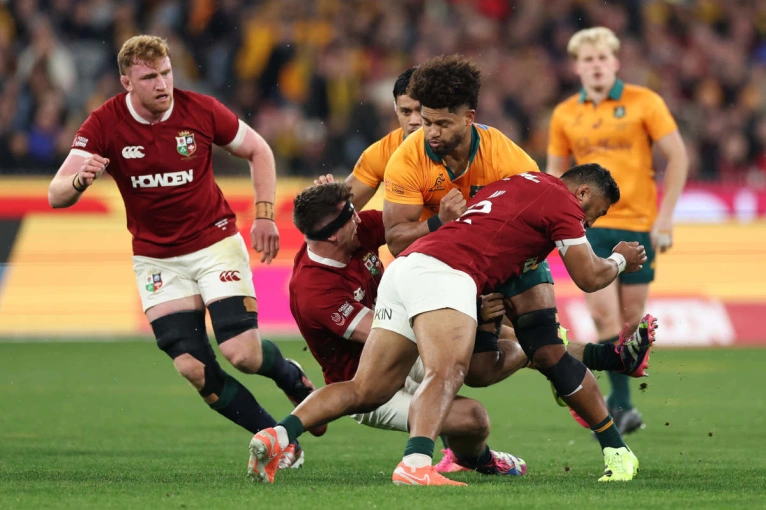
With Rassie Erasmus seemingly naming teams earlier and earlier now (on Monday this week!), the Australians will have no excuse not to school-up on the Springboks they’ll face on Saturday. There’s no subtlety about the side South Africa have named at all – plenty of size and physicality up front, and plenty of speed out wide. Oh, and a hybrid back-rower in the centres.
Scrum-half Nic White – who Boks fans can’t wait to welcome if and when he takes the field on this tour – spoke of the Melbourne and Sydney Tests being a ‘line in the sand’ benchmark for the Wallabies, and they certainly didn’t back away from anything the Lions wanted to throw at them across the two, at times surprisingly angry and spiteful, matches.
That’s good, because there will be no let-up for the next 160 minutes and change.
The Wallabies have seen for themselves that matching up in the hard-carrying, hard-hitting stakes is the only way to push the best teams, and there cannot be any excuse for taking a backward step this week.
Defensive shift required
One of the key criticisms of the Wallabies through the Lions Series was that their defence is still too often too porous, leaking points in clumps, and often relieving pressure they’d worked so hard to build.
In Brisbane, the Lions had two tries disallowed straight after Max Jorgensen’s try, before ultimately shelling Tom Curry’s try in the corner just before half-time.
It feels like the Wallabies’ hold-and-drift defence in an age of rush-and-blitz and line speed is starting to show signs of age too.
In Melbourne, it was Curry again and Huw Jones’ score within three minutes of each other, coming only minutes after the Wallabies scored three tries to get out to a 23-5 lead. Instead, they came into the sheds leading by only six.
This isn’t a new thing sadly. Indeed, it’s been an issue for some time. After averaging just under 28 points per game conceded in Dave Rennie’s last season, and out to nearly 30 under Eddie Jones in 2023, the Wallabies last season pushed that beyond 30 in Schmidt’s first season.
On that front, the 26.5 points per game Australia conceded on last year’s UK tour was a welcome improvement, and the 21.5 average through the Fiji and Lions Tests can be seen as an extension of that.
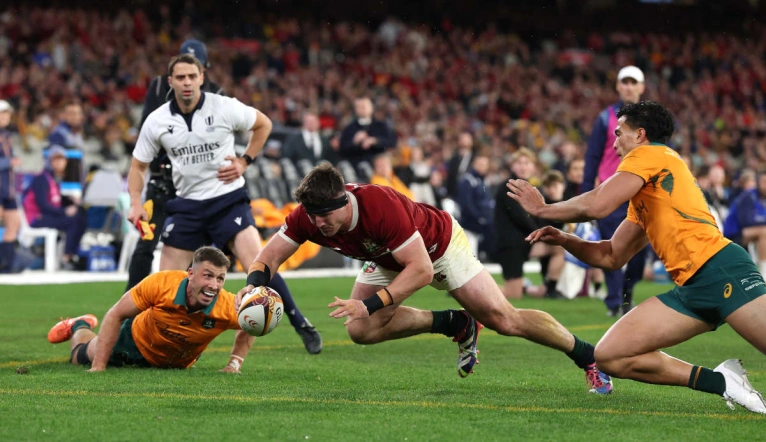
But the issue of leaking points in clumps still needs addressing, and it feels like the Wallabies’ hold-and-drift defence in an age of rush-and-blitz and line speed is starting to show signs of age too.
The worry here is that this week the Springboks, while hardly shirking on the size factor, have named one of the fastest backlines their always-confident supporters can remember. Manie Libbok feeding the speed men out wide, with a ridiculously strong-on-ball back-row unit, means that the Wallabies – perhaps more than ever – really can’t hold off and play with a passive defensive line. The Springboks might already be licking their lips.
Schmidt made mention of perhaps playing too passively in Brisbane, and that was certainly rectified in Melbourne and Sydney. It will have to be the norm at Ellis Park.
There can never be enough fly-half cover
In the week of the first Lions Test, with confirmation that Schmidt’s first choice at no.10, Noah Lolesio, was going to miss upwards of six months after a nasty neck injury against Fiji, Australia’s fly-half stocks were already looking more than a bit thin.
And that situation hasn’t improved at all with Tom Lynagh remaining home in Queensland, recovering after failing an HIA just before half-time in Sydney, in the unpenalized incident that saw Irish hooker Dan Sheehan subsequently suspended for three matches.
“We’ll also be really conservative with Tom,” Schmidt said last week. “He’s a young player – you’ve seen the size of him versus the size of some of the guys firing into him – and we’ve just got to make sure we look after them as best we can.”
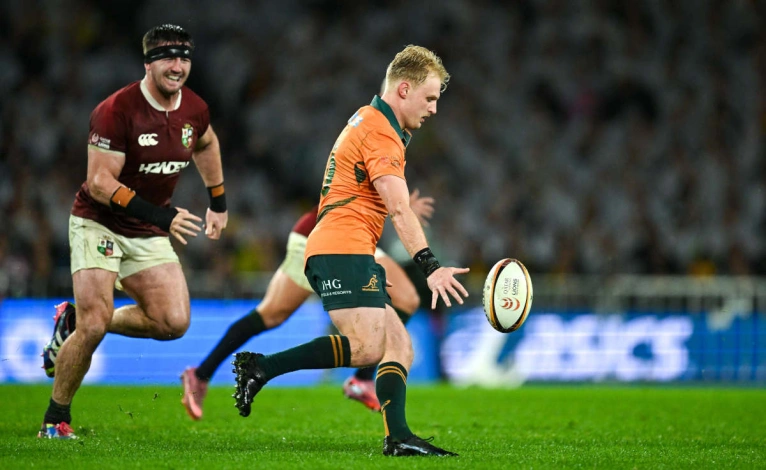
It wasn’t Lynagh’s first heavy concussion in 2025, and the growing list of high-contact injuries he’s sustained already in a short career is a bit of a worry.
But his absence leaves Ben Donaldson, the recalled new Brumbies fly-half Tane Edmed, and the evergreen James O’Connor as the last 10s standing. Even just one more injury might have the Wallabies edging closer to the panic button, and two more would represent an absolute disaster of depth management in the one position that has concerned Australian rugby for two decades.
The really worrying part is that there is no ready improvement on the horizon, with only four professional teams in Australia. It’s not like professional teams around the world are swimming in Australian fly-halves, either.
So please, get well soon, Tom. For Australia’s sake.


Comments
Join free and tell us what you really think!
Sign up for free