
One week is a very long time in sporting journalism. Only a few days ago, I penned an article which concluded with a quote from defence guru Shaun Edwards. He was lamenting the growing difficulties of his job, as the game rolls relentlessly down ‘entertainment road’ – more points, more tries and ever more content:
“World Rugby want more points, and a lot of the rules have changed in favour of the attack. The quality of the pitches [is] unrecognisable. Most people when they go to watch rugby don’t go to watch defence, they go to watch attack. I used to say ‘keep them to under 20 points’ – so 16, 17 points. But now, a good day at the office for defence is 21, 22 points.”
Now the most decorated defence coach of the professional era appears to be persona non grata in the French coaching set-up, and soon to be joining the massed ranks of the unemployed. According to a recent report in L’Equipe, Edwards is set to be replaced by Gérald Bastide, the defence coach for the French women, before the fixture against England ‘A’ in Vannes on 19 June, with ex-Montpellier centre Geoffrey Doumayrou touted for the position in the long term.
It is a remarkable development in the career of the man who has been, hands-down, the premier D coach in the world over the last 20 years, whether he was coaching as part of Warren Gatland’s teams with Wasps and Wales or crossing the channel after the 2019 World Cup. Everywhere Edwards has gone, the uptick in performance has been both categorical and immediate. He is a proven winner, yet now he is surplus to requirements with Fabien Galthié’s Tricolores.
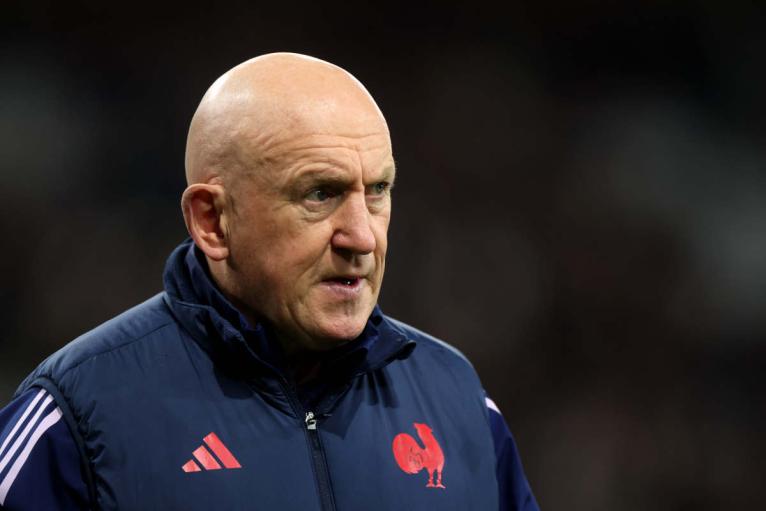
The reason behind his departure reflects the underlying trends in the game which the man himself described, and it should give pause to any knee-jerk reaction calling for the dismissal of current England supremo Steve Borthwick. Rugby Pass’ own Andy Goode could hardly contain his excitement: ‘If the news of Shaun Edwards parting ways with France rugby is true, you’d hope [RFU chief executive] Bill Sweeney has the cojones to pick up the phone and offer him a five-year deal to run through the next two World Cups. We can’t miss out on him again!’
Would Edwards have been a great English appointment back in 2006 [when incumbent coach Andy Robinson first asked him to do the job], or after the 2019 World Cup when he was let go by Wales? Absolutely. The situation is not as clear now as it was back then. Edwards would likely restructure England around the core principles of a long in-field kicking game and strong D on chase, as he did so successfully with Wales and France. But the game has moved on and you now need to be able to score four tries or 30 points to win a game of international rugby.
When the men in white finally made the improvement every red rose supporter wanted in the very last match of the Six Nations against Les Bleus, they did it by scoring tries – seven of them in all – and scoring 46 points. That performance was a reflection of the attacking character of the Prem and its top teams like Northampton Saints, who would be providing most of the backs for the national side. Would Edwards pick attack-minded aficionados Fin Smith and George Furbank, when he preferred those devotees of defence and the kicking game, Dan Biggar and Leigh Halfpenny, with Wales? The jury is out.
Defence coaches like to coach defence. While Edwards would improve England’s porous Six Nations showing, the lion’s share of tracksuit coaching time would be allotted to defence, just as it has been by Springboks World Cup winner Jacques Nienaber as the senior coach of Irish giants Leinster.
The scoring is not going to stop, the tries will continue to cascade, and the meaning of defence has subtly shifted. It is very rarely possible to stop elite attacks in their tracks
The balance in Leinster’s game has been more ‘off’ than ‘on’ as a result. Ex-Leinster and Scotland coach Matt Williams bemoaned the lack of balance between attack and defence which resulted in Leinster’s resounding 41-19 loss to UBB in his column for The Irish Times. The Girondins completed a massive 93% of their 215 tackles on the day.
“In the sweltering heat of Bilbao, it was obvious that both Leinster’s attacking and defensive systems required a major overhaul,” Williams wrote.
“There is no doubt Jacques Nienaber is a fine coach. His defensive system has won World Cups. However, he is not the first coach who has tried to take a system that worked with a high degree of success at one organisation to another club, and found it was not transferable.
“Leinster’s defensive system is no longer fit for purpose and must be either discarded or deeply modified. To continue with Nienaber’s current system is a folly and will lead to another catastrophic failure somewhere down the line.”
When Springbok Svengali Rassie Erasmus had a choice between persisting with ‘Tony-ball’, or swinging back to the tried-and-trusted double World Cup-winning methods of 2019 and 2023, of which Nienaber was an integral part, he eventually decided to twist rather than stick.
After treading water with Handré Pollard at number 10 in rounds two and three of the 2025 Rugby Championship, Rassie screwed his courage to the sticking point and pushed his chips all-in on Sacha Feinberg-Mngomezulu and Damian Willemse in round four at Wellington’s Cake Tin. South Africa overwhelmed the All Blacks 43-10 and the Springboks have not stopped or taken a backward glance since.
It distils the choice every coach faces at the top end of the game. The scoring is not going to stop, the tries will continue to cascade, and the meaning of defence has subtly shifted. It is very rarely possible to stop elite attacks in their tracks; now it is more a case of managing them to the point where you can turn over the ball, whether it is holding the ball up over your own goal-line or pilfering it after a line-break further downfield.
In their November tour game against France, the Springboks gave a master-class in the third quarter, even though they were permanently down to 14 men after the straight red card issued to second-row Lood De Jager at the end of the first period. They only conceded three points in 20 minutes, while delivering an object lesson in scramble defence after breaks had been made against them.
At the 2026 Six Nations, England ranked dead last in one critical metric on defence: 44% of the breaks they gave up were converted into tries by the opposition. In the third quarter at the Stade de France, the Bokke conceded six line-breaks but turned over possession at all of France’s four attacking possessions. It was the natural outcome of the dynamic balance between the French attack and the South African cover defence:
— William Bishop (@RPvids1994) June 1, 2026
This is close to the ideal counter-attack scenario for Les Bleus: turnover ball at a ruck in midfield moved towards Louis Bielle-Biarrey on the left-hand side of the field. Although the Boks try to shut down the play via the blitz, the ball is successfully transferred outside and two short breaks are made, both by the Bordeaux flyer – one down the left at 43:15, the second after a kick reclaim down the right at 43:37. Despite the twin breaks, France are outmuscled at the final ruck and South Africa win a turnover lineout.
The relative failure of the French attack and the success of the Boks’ defence can be illustrated perfectly by comparing two screenshots taken from within the sequence:
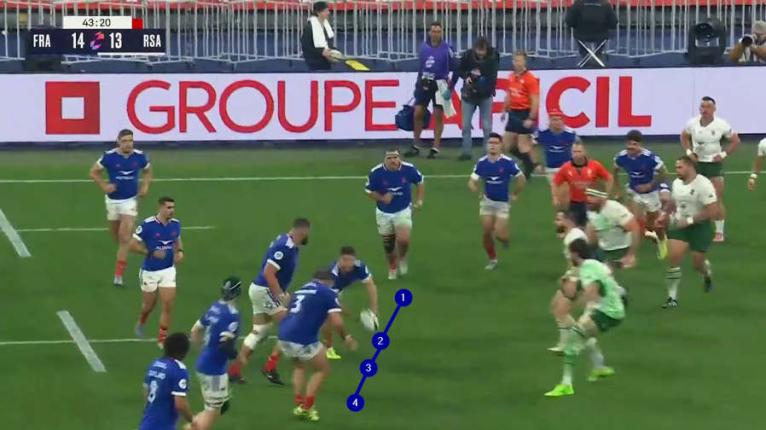
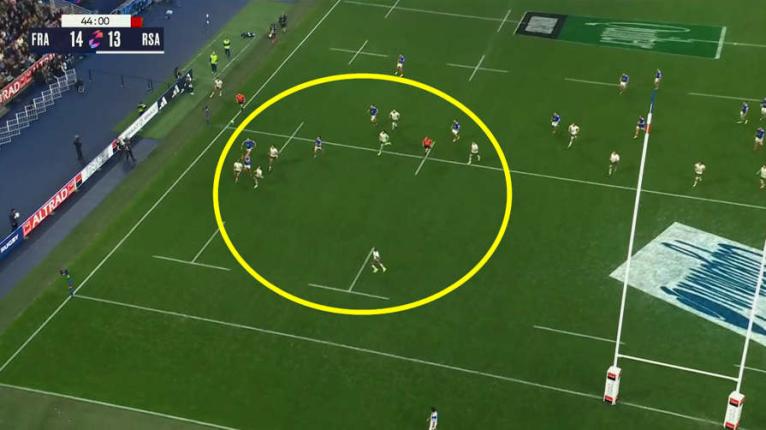
The first shows the ‘Dupont attack formation’ France were employing at the time, with four forwards assembled in a block outside their scrum-half, Nolann Le Garrec. The idea is for the forwards to overwhelm the interior defence and create a definite breach for Romain Ntamack and the rest of the backs to exploit.
The overhead shot illustrates both the commitment of the South African scramble and the deficiencies of the French attack. As Bielle-Biarrey climbs high to reclaim the kick by his club colleague Damian Penaud, there are seven Springboks around the ball to France’s five, and four against two in the vicinity of the ruck. South Africa is winning the battle of numbers even with one man less on the field of play.
The same situation arose only three minutes later:
— William Bishop (@RPvids1994) June 1, 2026
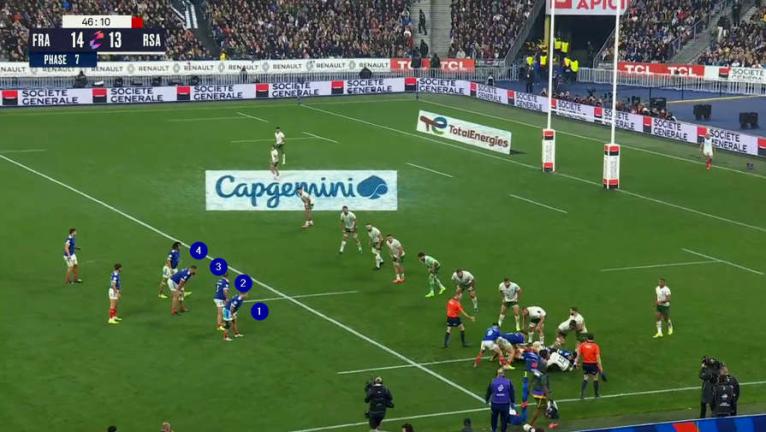
Once again, Les Bleus start with their block of four forwards off nine and successfully circumnavigate the Springbok blitz to create a break on Bielle-Biarrey’s side of the field, but the little magician is swallowed up at the point of contact, with the Boks enjoying a 7-4 advantage in numbers around the ball at the critical moment.
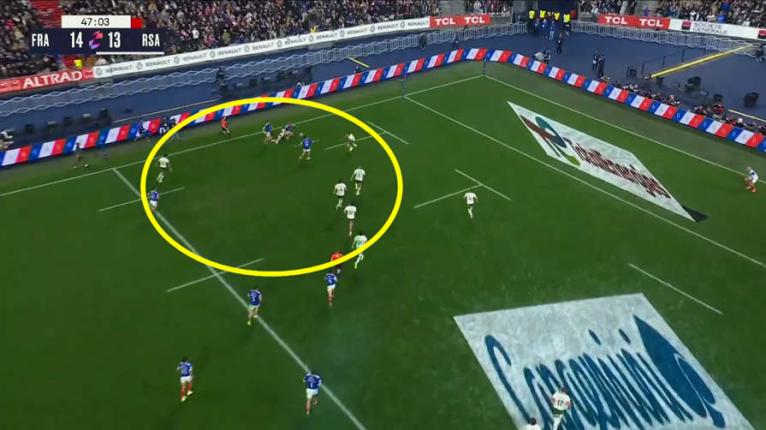
The final example occurred just before South Africa took the game by the scruff of the neck in the final quarter:
— William Bishop (@RPvids1994) June 1, 2026
The block of forwards outside Le Garrec creates more space for little Louis down the left, but on the way back from the sideline, the Springboks are the undisputed masters. First Cobus Reinach dives in at the foot of an under-resourced ruck and the handling of the French forwards is under severe pressure thereafter.
Even if the ball clears the blitz on the left of the D, there are Boks aplenty folding across in cover, ready to mop up the remnants of the French attack. That is why Galthié changed course so radically at the 2026 Six Nations, and it is why Matthieu Jalibert became the poster boy for a new attacking campaign.
Would the appointment of Shaun Edwards to the England head coaching role improve the men in white? Back in 2006 and 2019 when it really was on the cards, almost certainly. Now? Not so much. The game is moving beyond defence coaches at an alarming rate of knots, and it has become much harder to stop the flow of tries and points.
Scoring is the name of the game, and the entire concept of defence is being re-evaluated, and forced to adjust to the flow. Rassie Erasmus knows it, and where he goes others will follow. You won’t plug all the leaks, but your repair kit has to be in tip-top condition. There will be blood, and sometimes a lot of it. The trick now is how quickly you stop the bleeding, reset, and remember who you are.

Relive the drama, intensity, and history — all the iconic British & Irish Lions documentaries from 2001-2021, available now on RugbyPass TV.


Just watching the Cheifs put the Saders to the sword in the first half and think it’s a good example of the argument here.
The ability to stop the bleeding by scrambling and attacking the breakdown is becoming more important than stopping ball movement at source with rush D and long kicking to pin a team back.
I wonder if being able to put up a more contestable box kick if you loose attacking momentum means stopping an attack at source just has less currency now.
Nah mate you’re just hooked, good and proper. It happens, accept it😁
I didn’t expect or ask for ‘a fair hearing’ - I was simply making just criticisms of arguments so very poor that I didn’t think they should go unchallenged, but which, due to past experience, I didn’t expect you to change.
You laid out your views in a whole article, and you expect a reply in a few words. You ought to realise sound bites aren’t enough to explain, or rebut, a position - or do you like them because you’re afraid of criticism? I have already pointed out, you very certainly don’t stay on topic!!! I did. I’m happy to let others judge who’s right.
As before in this thread you put words into my mouth, which don’t reflect what I wrote and which go entirely off topic!!!
Since the topic is NOT whether UBB is a good team, which is clearly an obsession of yours, but whether, I quote you,
'“The game is moving beyond defence coaches at an alarming rate of knots, and it has become much harder to stop the flow of tries and points.
Scoring is the name of the game, and the entire concept of defence is being re-evaluated, and forced to adjust to the flow.”
my comments were entirely relevant, being counter-examples, showing that the attack you rate most highly can be contained by the best defences, so your position isn’t tenable.
I’m not interested in your views, because, so far, they’ve all been totally unconvincing. However, I don’t think such nonsense should go unchallenged.
I’m glad you’ve lost interest in this conversation and I hope you stop replying, as rebutting nonsense is a waste of my time, but I wouldn’t want you to assume the absence of a reply is an admission you are correct.
Feel free not to reply to any comments I make on any future articles of yours, unless you stay on point, and don’t descend to insults. If you behave as you have done in this case, expect replies!!!!
Perhaps we can agree that we disagree, and we each have contempt for the other’s arguments.
I am quite satisfied I gave you a fair hearing.
But I also asked you to be concise and stay on topic.
To which you responded by writing ever more lengthy essays on one single theme which I can easily summarize in the following sentence:
“Matthieu Jalibert is rubbish and the UBB attack is over-rated”.
Your one piece of so-called ‘evidence’ included one game which UBB won decisively, by 30 points to 15, and another they lost by two points to the winners of the EPCR Challenge Cup.
Not surprising I lost interest in the convo eh?
You are a perfect example of a common phenomenon: criticisms very often say more about the one making the criticism than the one being criticised. Look in the mirror and don’t judge others by your own standards.
You really do give new meaning to the phrase ‘an empty vessel makes the most noise’. It also tells a lot of porkies and cannot help but return to its one big obsession.
Since you keep wandering off the point, I’ll remind you of the conclusion of your article yet again, which was the focus of my comment:
'“The game is moving beyond defence coaches at an alarming rate of knots, and it has become much harder to stop the flow of tries and points.
Scoring is the name of the game, and the entire concept of defence is being re-evaluated, and forced to adjust to the flow.”
Your favourite attack is UBB. I brought forward two examples which illustrated the UBB attack following UBB philosophy can be contained (for details see my previous comments, I’m not going to repeat them yet again). And further added that if two club teams can contain this attack, then it is absurd to suggest that the Boks won’t be able to.
As the defence was effective against your favourite attack in both my examples, they prove you are wrong when you say the game is moving beyond defence, unless you can give examples of attacks better than UBB which can do what UBB can’t, score prolifically whatever defence they face, thus truly moving beyond defence.
There is no reason why I should help you defend your own conclusion, as you have requested, by naming the attacks better than UBB. I would then have to waste more time proving that these attacks, though superior to UBB, aren’t beyond defence either, to back up my contention that your conclusion is rubbish.
The impression that attacks have moved beyond defence has not been created by France scoring more in the 6N than last year, they didn’t, they scored slightly fewer points! It has been created by the collapse of the French defence, letting in far more points than last year. An impression back up by some monster scores in the leagues, in many cases due to the tendency not to send first teams to every league match, and a growing gap between the best and the rest. However, doesn’t mean that good defences can’t contain some of the best attacks. There have been huge victories before now, such as the 59/3 in the Top14 final 2 years ago, or the 80 points scored against Leicester last year, and while scoring has increased since the latest rule changes, nevertheless some defences are keeping up.
As for your latest nonsense. Where did you explain why beating club teams from France (presumably ProD2, considering the end of your sentence), England, Ireland, Scotland and South Africa means more to France’s international future than beating sides from the Top14?
Since the Top 14 is a stronger league than either the Prem or the URC this is a highly dubious proposition, and you simply gave your personal unsupported opinion that UBB “transcend” the league. Of course, a lot of Top 14 games feature weakened teams and aren’t a true test, but I deliberately chose two important matches for my examples with full strength teams on both sides, as I stated clearly.
IMO, with all the physical changes to the players and the law changes for faster more ball minutes etc…The Def role has changed. All the usual stuff of the def system, line speed structure, communication, pressure etc etc are all critical. For me, game management has become def and the role of the modern def coach. Yes, it has always been important, but I feel it has switched from more attack focus to a def focus. It is very hard to stop teams from coming away with points when they get in range now and we are seeing more and more of just pick-and-goes over actual attack in this red zone. You can tackle your heart out, but the system will fail, and from what I have been seeing in SRP (with the new laws), teams seem to be holding on in def….then suddenly the opposition gets in the right area (mostly a run of penalties), and we have a run of points. Lots of points in bunches at critical points of games which make a tight contest look like a comfortable win.
Not sure if I am getting my point over clearly (at the end of a tiring day so rambling); I guess I just see the game is all about managing where the game is played, which has always been important…But I think it is def more important now then he has been in the past and a critical part of def coaching now. A def team stopping a team from getting points when in the reds zone is celebrated as a miracle now and a complete failure from the attacking team….
I agree, I don’t think we will be a s strong next season.
They have retained Jacko Coetzee (which I didn’t think they would), added Du Preez and promoted Arthur Green from the Academy (who is a good carrier) but needs a few seasons to add some strength, whilst also having Miles Reid as an option at 8.
I think Saints & Leicester will be the two top sides next season, although who knows with Sarries if they get a hot start to the season.
It looks like JvG has had to bite down hard on some tough recuitment decisions this season P - as you say they don’t realy have another explosive ball-carrier like Barbeary up front, DdP is more of a grinder, and I think that swap may bring them back to the pack a little bit…
Trev Davison is out from I understand?
I’ve just watched GB&R with Alfie Barbeary.
Bath dropped him and said JvG decided not to renew, which is why he had to look for another club. Was looking towards France but didn’t want to go and then the Sarries news opened the door and gave him a lifeline.
Suggests that JvG decided to swap him for Du Preez, rather than reacting but Alfie also admitted he wasn’t playing well enough at the start of the season and has only come into form towards the end.
I’m surprised Bath let him go, given he’s been 1st choice starter when he is available but he’s also had quite a few injuries and will become expensive in this next contract (25-27), so it’s a tricky balance at that stage of your career.
Bath were lucky to get through yesterday, we held on by a thread at the end.
Martin made a big difference in the maul when he came on, as did Charlie Clare in the scrum. That Tigers scrum put us under a lot of pressure in the second half, Saints might struggle if Big Trev is still missing, he’s the one they have been creaking without in the last few weeks.
Agree that one of them can pull out a shock result, my money’s on tigers though…
As a neutral you couldn’t help but pull for Exeter in that one.
After the season the Chiefs had last season, to do what they have done this year and in how well Rob Baxter has turned it all around was fairly impressive.
I do think one of Exeter or Leicester will pull off a shock result, I’m just not sure which one it will be.
The atmosphere was pretty incredible at Sandy Park yesterday. I’m glad that Tony Rowe got what looks like his final exit memory from Sandy Park and they will empty the tank next week to see if they can go again vs Bath.
Yep I was at Sandy Park, it was quite a day. No love lost on Sarries I’m afraid!
I think TdT gave Bath an early reminder of what we will miss next season.
Bath just about held out against Leicester but we need to get our walking wounded back into the 23 for next week - Dunn is back, so fingers crossed that Roux, Pepper & Russell return and we should be in better shape for Exeter next week.
I’m glad Exeter got a grandstand send off from Sandy Park - that day will live long in the memory for Tony Rowe and he deserved to go out on a high.
End of an era for Sarries - will be interesting to see how things develop next season but was a brilliant run whilst it lasted, so very few regrets for Mark McCall.
Great article Nic. Exactly the sort of detail us amateurs would miss. This is why i love your articles so much!
Cheers JA.
Actually, I agree. If you had a free hand you could probably pick a more rounded combination, that brings more to the table.
Two big fishermen in one small pond P!
Or else he’ll get more support in the emeral isle.
Yep Dylan was a masterstroke.
It’s why I still value that grey haired experience in coaching teams. I still think that’s what Borthers is missing at the moment and why I think John Mitchell would have been a better pick.
That is what Eddie Jones did, although his appointment of Dylan Hartley as captain went far better than anyone imagined. That was the clever thing Eddie got right.
We are in that cycle where the youngsters will get better, so Tuipulotu, Sela, Griffin, Arthur Green (Will Green’s lad), Van der Linde (scrum half), Max Ojomoh, Hennessey and possibly Tyler Offiah will improve but we’ve lost a lot more than we gained as a collective squad.
I’m surprised they retained Jacko Coetzee given his injury history & Cokanasiga, I thought they would convert that into a gnarly TH lock, which we could do with. Dave Ribbans would have been such a good signing for both Bath & England but I think he is quite happy with how things are.
It was a good group we built, and there was not a lot of talent around when we started in 2012. But none of the coaches had any top-level experience og big tournaments and that counted when we played big games. Eddie ofc had plenty which is why he was successful with more or less the same side!
Yes you def look as if you have more significant ‘outs’ than ‘ins’. Even the two highest profile ‘ins’ are really just stopgaps compared to the players they replace…