
The defence coach for Sir Clive Woodward’s 2003 World Cup winning England team, ex-Great Britain Rugby League supremo Phil Larder, once memorably described the difference between the two codes. We were chewing the fat in the lobby of a hotel in Perth on the British and Irish Lions tour of Australia in 2001, watching the world go by in a blur of red.
Phil toyed with an amusing, unspoken thought as the twin lineout towers, Scott Murray and Malcolm O’Kelly loped past like two giraffes in the Serengeti. “Look at those two, they would never play league! If a rugby league team walked through the lobby now, you wouldn’t able to tell the difference between the backs and the forwards,” he chuckled.
If anyone is in doubt rugby is in a state of constant transformation, they should keep an ear glued to events at World Rugby’s Shape of the Game conference which began on Thursday in London. Representatives from both hemispheres meet annually to knock heads and make decisions on the best path of development for the game in the future.
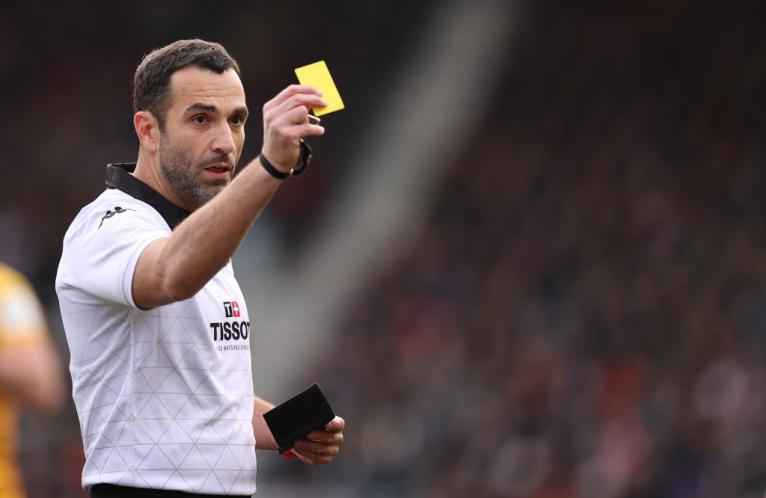
The battle lines already appear to be drawn, if a recent report by French media outlet L’Equipe is to be believed. On one side, South Africa has allied with France in the northern hemisphere to protect the traditional values around set-piece, and the greater variety of body types it encourages; on the other, Australia and New Zealand want to speed up the game even further, and promote the rugby league-type ‘one size fits all’ athlete with a raft of new law trials for Super Rugby Pacific 2026.
More protection for the number nine in contact situations, fewer scrums and more free-kicks for events such as accidental offside and delays in playing the ball, quick taps allowed anywhere behind the mark rather than directly on it. According to the proponents of further change, over four minutes of dead time has been saved by recent Super Rugby innovations, which CEO Jack Mesley says “reflect the ongoing commitment of Super Rugby Pacific to deliver the most entertaining and engaging rugby competition in the world… We want to be a competition that encourages quick taps and faster restarts, that cuts down on unnecessary stoppages, and that embraces positive, attacking rugby.”
On the other side of the argument, recently retired French referee Mathieu Raynal, who now works on the refereeing high-performance panel at the FRR, led the counter-charge on Sud Radio.
“They [Australia and New Zealand] want more passing, more tries, less time spent in mauls and scrums, whereas we [the northern hemisphere] defend these specific elements and are against directions being set by the southern hemisphere.
“Our championship [the Top 14] works. Our stadiums are full, rugby is watched more than football in the country. We don’t want to follow directions coming from countries where stadiums are empty, where they are trying to recreate spectacle and bring people back to stadiums at any cost, even if it means sacrificing fairness and the principle of player safety.”
Raynal’s words were significantly translated on X by SA Rugby’s high performance manager Dave Wessels, who previously worked as head coach of the Melbourne Rebels in Super Rugby, then retweeted by none other than Rassie Erasmus. The French official upped the ante further as the invisible power struggle came into focus with the Shape of the Game conference.
“[Set-pieces] are powerful symbols of our sport. By this route, everyone can participate in our sport: the big guys, the tall guys, the short guys, the fast guys… In the long run, the rugby that New Zealand and Australia advocate will homogenise player profiles. We’ll end up with only back-rowers or centres. This will have an impact on the democratisation of our sport.”
Perhaps the biggest irony is South Africa and France, not Australia and New Zealand have pioneered the use of league-style ‘hybrids’ in the modern game – men such as Oscar Jégou and André Esterhuizen, who can play a role in the backs and the forwards.
Arguably they are also the two sides who have innovated the most at national level over the past year. After watching his charges being slowly clubbed to death by 14 South Africans in November, France head honcho Fabien Galthié courageously decided to move away from the static power which can decide local Six Nations titles, and towards the all-court game which can win you World Cups. If you want to be the best, you have to find a game which can beat the best.
The raw mid-term stats after three rounds of the Six Nations attest to the effectiveness of the key decisions Galthié has made. The basic table illustrates the higher ball-in-play, and greater active time of possession Les Bleus have been able to manage.

Critical to Galthié’s new vision of the game has been the selection of UBB wizard Matthieu Jalibert at 10, and two mobile second rowers who have played international rugby in the back-row in Mickael Guillard and Charles Ollivon. The following table shows how France’s attack pattern changed between the first two rounds versus Ireland and Wales, when Jalibert started, and the third-round game against Italy, which he missed because of injury.
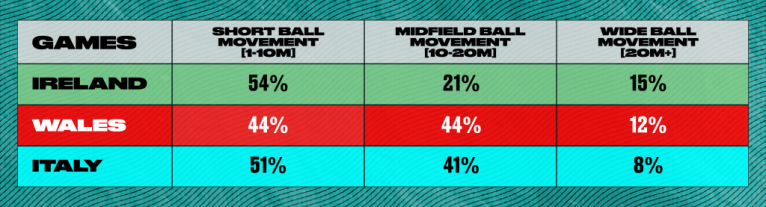
With Jalibert starting, French willingness to move the ball wide was a massive 75% higher than it was with Ramos running on in round three. Over the first two rounds, the average distribution of ball-carries into contact was 10 by Antoine Dupont, compared to 14 by Jalibert; against Italy the situation was reversed, with Dupont maintaining his average [10] but Ramos dropping below Jalibert’s [8].
It is the exquisite equilibrium between Dupont and Jalibert which is driving the French game forward. After three rounds of play, le petit générale at nine leads all kickers with an average of 18 for 516 metres per game. Jalibert ranks first for successful offloads [4.5 per game], line-break assists [2.5] and try assists [2.1]. The perfection in the playmaking scales is almost enough to make you cry. Almost.
That balance has had some interesting ripple-effects in the selection of other, apparently unrelated areas of the team. When Galthié decided on a back-row including yeoman defender Anthony Jelonch at number eight, he needed a primary wave, workhorse ball-carrier and that man was Guillard. Thus far, Guillard averages a Ben Earl-like 19 carries for 86m per game, compared to Jelonch’s modest figures of nine carries for 35m.
Then he picked wide-ranging, yard-eating Ollivon in the second row alongside Guillard to make the most out of the greater proportion of wide ball movement originating from Jalibert.
What does it look like in practice? Let’s draw a few samples from the opening round against Ireland.
— William Bishop (@RPvids1994) February 26, 2026
— William Bishop (@RPvids1994) February 26, 2026
— William Bishop (@RPvids1994) February 26, 2026
In the third round versus Italy, Anthony Jelonch was entrusted the traditional number eight role of running the ball back from opening kick-off, and he’s firmly ‘rejected’ by the first Italian follow-up tackle. The exit kick by Dupont is rendered that little bit more difficult from deep inside the French 22, and the Azzurri get the ball back near halfway.
In the second and third clips from the Ireland match, Guillard was the chosen man, able to break the first tackle and run the ball back outside the 22 from exit situations and set up a freer box-kicking scenario for his scrum-half. The picture is completed when his locking partner Ollivon becomes the first man up in support of Louis Bielle-Biarrey on the opposite side of the field.
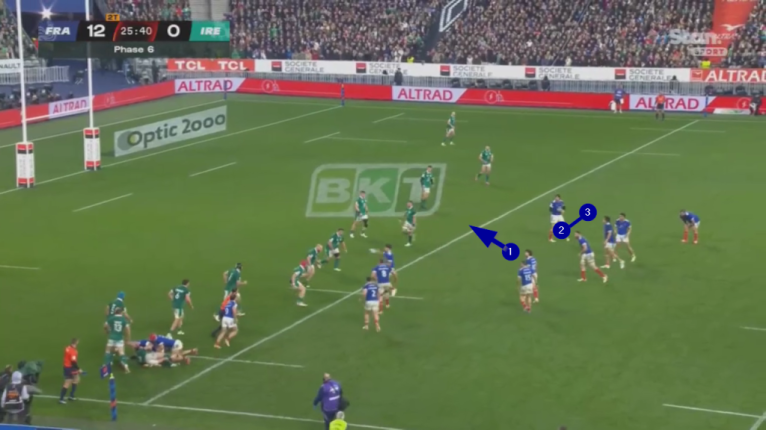
With Jalibert starting at outside-half, both second rows were frequently sighted outside the 10 in attack.
— William Bishop (@RPvids1994) February 26, 2026
Jalibert’s late withdrawal from the XV to play Italy shifted Ramos into the 10 hot-seat, and it meant the two Toulousain second rows Emmanuel Meafou and Thibault Flament were operating inside the 10, and directly off the service by Dupont.
— William Bishop (@RPvids1994) February 26, 2026
— William Bishop (@RPvids1994) February 26, 2026
The ultimate irony of the southern hemisphere’s push for greater speed and less dead time is France and South Africa are already ahead of the game. Both are picking hybrid forward/backs, where Australia and New Zealand are not. Les Bleus are packing their back five forwards with four men who have all operated at international level in the back-row, and a fifth who filled in at centre in the 2024 Six Nations. That is not the signature selection of a coach who wants to kill the game at the set-piece.
With Jalibert at 10, France are moving the point of attack wider than it has at any time since Dupont was anointed the starting scrum-half, and the best player of the professional era. Rugby needs its giraffes picking fruit out of the lineout trees, and its rhinos locking horns at the scrum. Les Bleus, like the Springboks, are already showing they can roam the prairie, running like the wind and cornering on a dime. So, who is kidding who?


I’m not sure what conclusion you’re trying to draw but SA weren’t worried about scoring that game, they didn’t care. All they were trying to do was prove who is the biggest, strongest, and best out of Ireland and South Africa. If it didn’t do it for you, and you in fact thought the opposite, that just makes it even more hilarious!
But the key in what you are talking about is that SA aren’t a team focused on benefiting from a power scrum in any other manner that winning penalties. If a team like NZ had that sort of scrum then rather than winning cards, those would be exchanged for winning tries. You’d have push over tries, number 8 peal tries, halfback peel tries.
Of course that would get old for any nation pretty quick though, and even NZ might just be happy to revert to brutally annihilating the opposition.
Full credit to Irelands never say die attitude though!
It's not remotely silly. The boks disgraced us in the scrum in Nov and we’d 6 cards across the game.
That should be the mitigation when discussing a 30-40 PT win. They won by 11 PTS and had to resort to off the ball antics at 77 mins to run the clock and make the game safe
I've no idea why scrums seem to scare you? They are set pieces. No more. A couple of decent 50:22 kickers in your backline could all but keep scrums out of it
Scrums are speed bumps. A team can always find a way to work around them
I'm saying there was no mismatch and yet a player was still millimetres from a clean neck break
Imagine it was a physical mismatch? It's common sense that there are minimum physical requirements in certain positions
Wing would be a tricky one, but with the introduction/example of Hooker, no, you could argue that is also a position where brawn is taking over. Often SA has produced big wingers, the white ones, that leave due to quotas, and its a very typical position that has the same dynamic with the demographics in the Pacific.
I’d still think at URC it is largely a position that is not contested by the brawny.
What sort of physical mismatch are you talking about? Meeuws was from the same stock as those SAns of course, otherwise not sure what you’re trying to say. Why are we talking about mismatches?
None of their wingers are big and this an era when wingers are expected to tackle
A driver in the sports eventual professionalism was the huge problem in the 80’s with severe neck injuries and the need for a centralised sporting body to govern the sport. That was as a result of physical mismatches.
They all have an equal shot at lasting, long term brain damage but specialists positions are so for a reason
Ben Darwin? The 2003 ABs v Wallabies RWC semi? A very bad blooded game and yet the actions of Kees Meeuws prevented a collapsed scrum and very possibly saved the life of Darwin. That was evenly matched and still could have gone horribly wrong
It's dangerous enough without mismatches
Sigh.
It’s the same.
The attack was previously happy to crash over the line because it was easy to do and you got an attacking scrum. Teams would do it repeatedly looking for penalties and cards. It was rightly eradicated by making it a drop out.
Now teams don’t want to crash over the line and be forced to work back to the same point again, so now they dive at the ground ensuring the opposition can’t hold them up and they can slip the ball along the ground.
Both situations, including the failure of Irelands attack to penetrate, can be fixed by improving the contest for the ball. Or we can keep making one off rule changes that have side effects. Enforcing the requirement to stay on you feet would have huge implications (if it wasn’t just enforced inside the 5m) but I think that direction would be good for the game, where a limit on sets would be bad.
And while were going full circle, the concept and attitude having a phase limit creates has value, the point was to do it organically, by get the laws and interpretations on point (and factoring those in for all situations, on the goal line or working your way to a 22).
Go back to the start point of the discussion JW.
It is about the change whereby a ball held up over the goal-line turned into a dropout to the defence rather than a 5m scrum to the attack.
The last sequence in Ire-NZ had nothing in common with that scenario because it never reached the goal-line, and only reached the oppo 22.
So we are talking about the balance between attack and defence inside the 22, not outside it.
I always remember when Phil Vickery first burst on to the scene. Phil was 6’3 and weighed in at about 120 kilos and he was one of the props who forced a rethink on the propping position. Sheer size, esp at Tight-head became a prerequisite.
Bang on, both entities should be able to co exist.
Set piece enables free flowing play that is lovely to watch (look at basically any SA or France try)
Rugby is too diverse of a sport to not have 110kg+ props playing, if you want to watch centres run at each other go play 7s
NB this from Nic Gill -“We have gone from the average size of a prop being 115kg to the average now being 135kg.
“That’s because the rules have changed – two props on the bench – and the athletes’ professionalism has changed”
That’s mass NB!
Yeah true. And really just a bit of fun trying to work out the why of the outcomes. Keep the analysis coming NB!
😇
Yes agree!
England Italy could equally be a cracker. The Italians at home will be fired up.
Yes agree teams are evolving still and I hope kicking will as you say be just a weapon used among many. And I concede that the England Ireland game showed it can be done. Looking forward to Scotland v France too - could be the highlight of the 6N.
What is totally perplexing about all the moaning about kicking is that the New Zealanders call it footy.
It’s slightly in and slightly off topic@NB , and I guess we’re not in a bar where you can order an article, but I think it could be interesting to have a piece on players switching to props during their career like Atonio or Posi, which are interesting stories!
We had a small discussion on the topic down there and I think it could be interesting in the wake of the game, how it has evolved and how it will be played.
We’re at an era of mind blowing South African props, deservedly the best, and how the rest tries to cope with that, far behind.
Italy’s doing an amazing job, England, bar their 3 main injuries at TH, are also looking great, and Argentina is still a force to be reckoned with (just as Georgia, obviously).
It’s also what prevents France from being more dominant, losing 2 world class props in the last 2 years - one out of repeated injuries and lack of form, Baille, the other being Atonio.
With the increase of aerial battles, the probability of having scrums might be higher (is it though? Don’t have the data).
But with the rules staying the same, the scrum is still a strong pillar of the game, and every team needs to address it.
The debate in France about moving Tuilagi from second row to TH prop is not huge, but it’s an idea that keeps coming back quite often, not only because Posolo was such an exciting prospect that might end up like Jordan Joseph, but also because TH prop is the only position where there are no world class prop anymore (to me, Gros is not top world class like Baille used to be, but he’s got the international level).
Thanks!
I apologise if it has already been tackled!
It is an interesting topic and one I recall France having 50 years ago Soli.
I recall they were trying to replace Gerard Cholley and they picked a succession of big men who could play either lock or prop to do it. Patrick Salas and Jean-Paul Wolff spring to mind.
England tried to move Gloucester lock John Orwin to THP. Argy had Martin Scelzo. Aussie had Pone Faamausili recently.
So you do get those very big men, around 6’4 or 6’5 who you wd normally think of as a second row but have the wide body of a prop - just taller.
Atonio was one of those, Posolo Tuilagi is prob in the same boat now. I don’t see Tuilagi ever playing international rugby as a second row so he’d be advised to convert sooner rather than later.
So who benefits from these proposed changes?
It sounds to me that these proposed adjustments to the laws coming from Aus/NZ are still really about television and associated revenue and capturing the casual or new to the sport viewer. Which is why the game turned pro in the first place. Rugby league is a great game and it is not rugby union and vice versa. Do Rugby Australia really think that they will capture market share from League? Why not introduce the mark anywhere on the field to see if they can snag some Aussie Rules fans as well?
There is not much wrong with the laws as is if they are applied consistently.
The old idea was always that you trumpeted Super Rugby changes as the way forward for the game as a whole because SR was always the best comp in the world. But it isn’t anymore.