
Step into your rugby time capsule for a moment, and close the silver door behind you. Enter ‘1984’ as your intended destination on the control panel. When you emerge, you will find yourself in a whole new Wallaby world, at a time when the Wallabies were sitting on top of the rugby world.
Buy Rugby World Cup 2027 Tickets
1 Year to Go until the biggest Men's Rugby World Cup ever kicks off in Australia. Go All Out and secure your tickets now.
As a student at Exeter University, I was privileged to watch the second tour game in 1984 against the South and South West Division at the old County Ground, which doubled as a Speedway track in its spare time. It was a glorious autumn day, and we were packed on the frosty, sun-stroked bank on the far side of the oval.
What I remember from that day is not the rather uneventful 12-12 draw, but the Wallaby backline practice before the game. The Wallaby backs started tight, with no more than two or three metres between them, and the ball fizzed and hopped like popcorn on a hot stove between them. There were short cuts, circle balls, double rounds and a fiesta of second touches as the inside backs wrapped around into the big open prairie towards the far sideline.
The lads from Saint Luke’s College looked at each other over the top of their pints, as sharp young rugby minds scrambled desperately to catch up with the future we had just witnessed. We all shared the same thought at the same time. This was a glimpse of the game to come and we had never seen anything like it.
The ball-playing magician that was Mark Ella did not even feature in that game in Devon, but when Alan Jones added him to the mix in the Test matches which followed, the fireworks ignited and the chances of the home nations dropped with them, to somewhere between ‘slim’ and ‘none’. Australia duly won the grand slam of all four matches in the UK and Ireland by an aggregate score of 100-33, 12 tries to one. Slim was out of town for the entire two months the tour lasted.
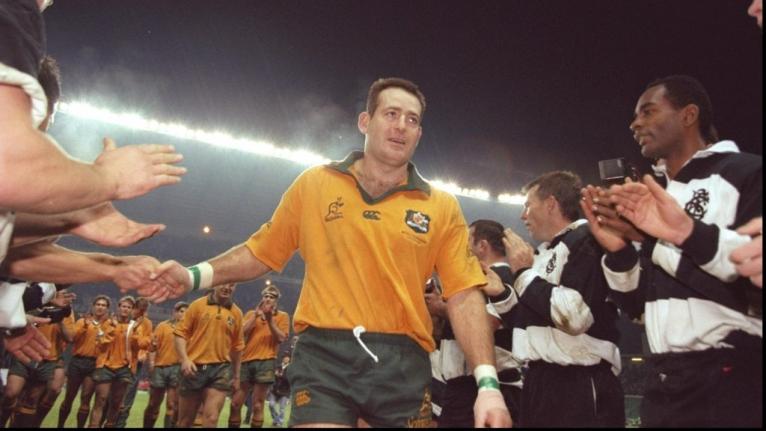
If the likes of Ella and David Campese are watching the Australian contribution to Super Rugby Pacific right now, they will be shaking their heads and wondering what on earth has happened to the Australian knack for rugby innovation. Much of Campese’s commentary is over the top, but his observations at the end of Joe Schmidt’s first year in charge of the Wallabies are still worth a second look.
“Joe Schmidt. He has no idea about Australian rugby,” Campese said. “He’s a New Zealander. He’s not interested in finding out who we are. We used to counter-attack or, at least, attack from the opposition 22. Now, we maul from the 22. That’s not Australian rugby.
“We used to attack! In Australia, we need to entertain to get people to watch. I’m not saying he’s a bad coach, but why do we have to have a New Zealand coach? We’re not New Zealanders.”
When Campese repeated his criticisms before the 2025 Rugby Championship, he initially had to row back on them after the Wallabies’ outstanding 38-22 away win over the Springboks at Ellis Park in round one. Then Australia lost four of their next five matches and maybe, just maybe Campo’s darts weren’t far off.
Statistically, Schmidt is currently the third national coach in a row to sit with a win-loss record of under 50%, dating back seven years to 2019. Newly-appointed All Blacks supremo Dave Rennie finished at around 40% in 2022, the nine-game second coming of Eddie Jones rolled in at 22% one year later, while Schmidt’s record currently slots in between the two at 39%. It is not a good look for a proud, two-time World Cup winning rugby nation.
New Zealanders stepped into the Aussie rugby ecosystem because Australia was struggling to forge a successful path forwards. The problems did not originate with a Kiwi, but Schmidt has inherited them. The situation will be the same for Queenslander Les Kiss as it has been for two decades now, when he finally he takes hold of the green-and-gold reins midway through 2026.
From the Randwick short passing attack of the mid-80s and 90s, to the John Muggleton-coached, league-style defence of 1999, to the multi-phase offence developed by Rod Macqueen and Jones in the early noughties, Australia had always been one step ahead of the game elsewhere, and the stream of innovations meant it punched above its weight in a three-sport domestic market. Where Australia led, others followed.
That is no longer the case. Ask yourself if Australia has any ready successors to Alan Jones and Macqueen as general managers, or Bob Dwyer, Eddie Jones and Alec Evans as coaches, and the answer is a resounding ‘no’. There are some good ones for sure, but there are arguably no class-leaders. Australia has skilled copy-and-pasters, but creative coaching pioneers are few and far between. That applies especially on the offensive side of the ball.
The issue was neatly encapsulated by the round robin of local derbies in the past two rounds of Super Rugby Pacific. In round 14 the Western Force overcame the Queensland Reds 19-14 in Perth, last weekend the Brumbies held off a late rally by the Waratahs to win 21-14 in Sydney. The four Australian sides averaged only 2.5 tries and 17 points between them per game, and to reprise Campese’s observation, that is not nearly enough to fulfil the need to entertain, and draw people to watch the game in Aussie. It is way off the standard currently being set in European club competition, not to mention the class-leading Kiwi franchises within SRP itself.
Super Rugby Pacific rounds 1-14
| Attacking area [per game] | AUS teams | NZL teams |
| Ave rucks built | 104 | 90 |
| Ave offloads | 6.2 | 8.5 |
| Ave clean breaks | 6.3 | 7.6 |
| Ave tries | 4.1 | 4.9 |
| Ave kicks | 27 | 27 |
Australian teams need to build an average of 17 rucks to achieve one clean break, the Kiwis need only 11. They need 26 rucks to score a try, eight more than their Trans-Tasman neighbours. In the game between the Force and the Reds, the Westerners controlled the ball for large swathes of the match, but they still required 130 rucks to achieve five breaks and two tries. You can work out the averages for yourself.
In Sydney, the ball was propelled skywards off the boot no fewer than 81 times, for a colossal combined total of over 2400m. Although the ball was in play for almost 39 minutes, the atmosphere at the Allianz Stadium was eerily quiet for long periods. You could tune into private conversations in the front row of the Arthur Beetson & Ron Coote Stand if you strained hard enough.
The game in Sydney was remarkably ‘un-Australian’ in process and outcome. These were after all, clubs who boasted a couple of the brightest half-back combinations in the country – Teddy Wilson and Jack Bowen for the Tahs, Ryan Lonergan and Declan Meredith for the Ponies – and two international-quality players who could be competing for the World Cup job at the back, in the shape of Max Jorgensen and Tom Wright.
The game offered Jorgensen and Wright an opportunity to showcase their relative merits in the 15 jersey ahead of the tournament in 2027, with ‘Jorgo’ probably edging a split decision on the day.
The Brumbies’ ex-leaguer showed good touch on the attacking kick, the New South Welshman flashed the ability to spark counter-attack off the receipt.
— William Bishop (@RPvids1994) May 24, 2026
— William Bishop (@RPvids1994) May 24, 2026
Both sequences start with a Lonergan box-kick from an advanced upfield position, which is one of the reasons the game averaged one kick for every minute the game lasted. Jorgensen comes up short in the first instance, but makes a quicksilver catch-and-present in the second.
Both players are superior creators on the outside when the chance presents itself.
— William Bishop (@RPvids1994) May 24, 2026
— William Bishop (@RPvids1994) May 24, 2026
Of the pair, Wright is probably the weaker link as a last line of defence.
— William Bishop (@RPvids1994) May 24, 2026
— William Bishop (@RPvids1994) May 24, 2026
When Jorgensen went head-to-head with Wright on these two attacking plays, he emerged a winner, kicking through to ‘coffin corner’ in the first clip and forcing a 5m attacking lineout, and beating his opposite number on the outside to score a try in the second.
When I analysed the Wallaby attack for Wales around 2005, we discovered Australia had around 70 strike variations off scrum and lineout, which as Graham Henry jovially suggested at the time, was “about 65 more than anyone else”. They would run 12 phases designed to create a specific individual mismatch on the 13th.
It was symbolic of how far ahead the Wallabies were in several aspects of offensive thinking, but 20 years have passed since then and the waters of coaching creativity have receded to the point where Canute no longer has to hold back the tide. He can sit comfortably on the beach, with no prospect of being overlapped by the ebbs and flows of Australian innovation.
The likes of Campese articulate a sense of intuitive outrage, often without knowing the whys and wherefores of modern professional praxis. They know something is wrong, but they cannot accept that the standard of Australian coaching has fallen so far behind the standard-bearing eras of the eighties, nineties and noughties. No more Macqeens, or Dwyers, or an even an early Eddie on the face of God’s green one. If it is left to New Zealanders to rediscover the Australian Way, whose fault is it?

NEW IN THE APP: Official World Rugby Rankings hub! Compare team rankings side-by-side, with data going back 20 years.
Download the RugbyPass app on the App Store (iOS) and Google Play (Android) now!


The closest thing we have had to an innovative coach in the past decade is probably Scott Wisemantel, and shedding him was part of the great Eddie/Hammer strategy in 2023. No idea where he is now.
Please don’t give that Rock Spider Alan Jones any more air time
Great article Nick. I saw in the commentz that you rated Cheika above McKenzie which is interesting. I always think the McKenzie saga was such a big ‘what could have been’ for Aus rugby. Would love to know more about why you don’t rate him as highly?
The stats only support what anyone who loves the game already knows: forward ‘play’ is ruining our game! It's repetitive and it's boring. 10-15 drives for the line, until one of them finally knocks it on. And what the lell is going on with the sudden return of ‘tap-n-go-nowhere’? Scrums that take forever to set and then have to be RE-set, as often as not. Don't know which side’s at fault? Don't care! Just pick one, award a free kick and get on with it. Lineouts that involve a tea break, before they finally wander in … it's almost as if the last thing that the forwards want to do is PLAY! An 80 minute game with the ball IN PLAY less that half of that is a. a 40 minute game and b. a ripoff of spectators hard earned money - it's not what we pay to see or want to see. They finally did something about show pony goal kickers but at least there was only one of them, there are EIGHT forwards who need a rocket strategically placed! Coaches? Schmidt has done a great job of rebuilding a team that was demoralised and unbuilt by Jones - there's an air of confidence that's long been absent, now let's take advantage of that and PLAY!
Let’s hope so, as you say Schmidt has done a good job but still landed at 39% win rate. It’s come to something.😉
We are ranked 8th in the world. We were ranked 9th under Jones.
Yeah 12 phases of boring nothing rugby, being rewarded with the rules to be able to build endless phases, bugger ingenuity but lots of repeat efforts.
Now, or back then?😁
Watching a great game of RL last night until they emulated RU by sending Ponga off .
Joe Schmidt didn’t come to win matches . He came to restore, confidence , skill , opportunity and enjoyment of the game to all players . He has succeeded ! The game is in great shape.
We still don’t have many world class players . That is not Joe Schmidt’s fault . We lack locks , halves and centres . We keep poaching wingers ?
Valentini , McReight , Bell , Alaatoa , Slipper , Ikatua and Tom Wright are world class . Jorgensen isn’t .
I was impressed with Scott Young last week . He looks a better player than Wilson .
…and turning them into soemthing else…🤣
No further noise about Ponga switching codes then?
That was a good bit of defending.
Of the pair I would have said jorgo was the worst.
From the clips it looks like Jorgo has made some good strides in his fullback play from the start of the year, good stuff.
THat’s a bit of a stretch for Campese, what where the two nationalities of these teams coachs?
I doubt his hands are his best attribute right now, but who knows how he might develop in the next few years?
No doubt but soft skills take you next level especially when u are a physical beast and a workhorse catching that difficult pass putting someone thru a hole when they expecting you to smash it up je already does all the tough stuff and them some get older get craftier up skill