




1
Springboks player ratings vs All Blacks | 1st Test Rugby's Greatest Rivalry 2026
6


 Share
Share 
Wellington, 2025. New Zealand beaten by a record score. 43-10. Thirty-six unanswered points in the second half. A brace for Cheslin Kolbe. A masterclass from Damian Willemse. Six tries to one.
We heard about that game so often in the build-up to this Test that it began to feel like a reference point for the new Springboks. Proof that South Africa had evolved. That Tony Brown had added wit to the muscle. That the Boks could still bludgeon teams, but could now also manipulate space, shift the point of attack and unleash their backs before a defence had time to settle.
Which made Ellis Park all the more baffling. It was as if the Boks had learned nothing. South Africa did not lose because they were too ambitious. They lost because, for long stretches, they barely tried to fire a shot.
Box kick. Big carry. Big hit. Scrum. Repeat.
There is nothing inherently wrong with any of those things. The Springboks have won two World Cups by understanding pressure better than anyone. Their scrum remains terrifying. Their defence still folds bodies. Their kicking game can suffocate opponents.
But these Springboks are supposed to have evolved beyond that. And the numbers make the conservatism harder to excuse.
South Africa had enough ball and enough field position. They finished with 51% possession, 61% territory and almost 100 more post-contact metres than New Zealand.
The forwards did their part. The scrum folded New Zealand repeatedly, the maul made ground and the collisions were largely won. You imagine a few of those forwards had some choice words for the backs afterwards. They had built the platform. Nobody seemed especially interested in using it. Too often the next phase was either another carry into traffic or another kick into the air.
Jasper Wiese carried 17 times, comfortably more than any other Springbok. But Willemse was rarely brought in at first receiver, Kriel barely featured and De Allende, on his 100th cap, was mostly asked to run straight. Even Esterhuizen’s try rather proved the point. It came not from slick interplay but from one enormous man getting the ball and deciding he would not be tackled.
So much of South Africa’s threat depended on individuals creating something through force rather than the system creating something for individuals.
And yet this is supposed to be one of the staples of Brown’s attack: moving the heavy artillery into the trams, forcing defenders to make uncomfortable decisions and using forwards as links as well as battering rams.
New Zealand did it regularly. Tupou Vaa’i kept popping up in wider channels, giving the All Blacks another carrying and passing option away from the traffic. South Africa’s heavies mostly stayed central.
There was one second-half surge from Eben Etzebeth down the left that immediately made ground. It looked like the sort of moment this attack was supposed to produce routinely. Which begged another obvious question. Where had that been?
South Africa did not necessarily kick too much. Williams’ box kicks often put New Zealand under genuine pressure, and the raw numbers were almost identical: 17 kicks to the All Blacks’ 18.
The problem was what came around them. Too often pressure was built without any real attempt to cash it in through the hands. New Zealand passed 124 times to South Africa’s 106 and were far more willing to shift the point of attack once space appeared.
Fabian Holland’s charge-down try was the obvious punishment, but it would be too easy to make the kicking game the villain. The deeper issue was faith in an old formula: win the collisions, squeeze at the set piece, kick well and trust that the game will eventually bend your way.
Perhaps sustained success had made the formula feel infallible. It is hard to imagine a side this experienced being genuinely arrogant, but a few seasoned Springboks may simply have forgotten what losing regularly to the All Blacks feels like. Against lesser sides, bash and crash so often works. Against New Zealand, it can become a dangerous kind of complacency.
And when the Boks did finally try to move the ball with ambition, they looked rusty doing it. Passes went behind runners. Timing broke down. Sacha Feinberg-Mngomezulu had a poor game, overrunning Williams and struggling to impose himself when South Africa did finally try to play. Willemse tried to inject width but too often the move died before it had properly begun. Perhaps that was why they kept kicking.
But that raises another problem. Why pick this backline, and why appoint an assistant coach with such a clear attacking ideology, if you are not prepared to trust either? In Wellington, they did
There, Willemse was everywhere. Kolbe was brought into the game repeatedly. The point of attack shifted. Forwards handled. New Zealand were pulled apart by a team with chutzpah and energy, not merely asked to dig deep against a wave of battering rams. Next week requires more than better execution. It may require a philosophical correction.
Manie Libbok has to come into serious consideration. Whatever his imperfections, Libbok demands that other South Africans play. He stands flatter, moves the ball early and searches for space rather than another collision on his own. Feinberg-Mngomezulu might be the better rugby player, but there’s a case to be made that Libbok is the better flyhalf.
There is also an argument for getting Willemse much closer to the action. Perhaps that means starting him at 12. Perhaps it simply means stationing him at first receiver no matter who starts at 12 or 10. He is the form player in the South African backline. He has to be more involved.
Whatever it is, something has to change. Because this was not a defeat caused by overplaying. Quite the opposite.
South Africa had spent a year pointing to Wellington as evidence of what they had become. Then, when New Zealand arrived at Ellis Park, they played as if none of it had happened.
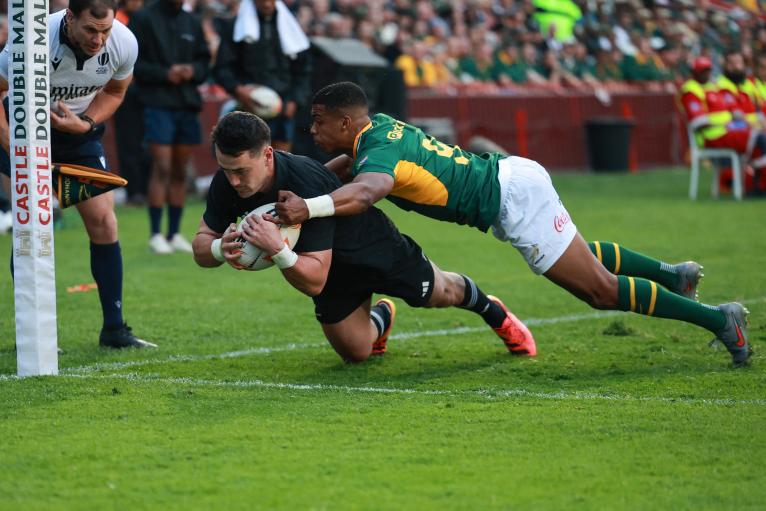
Springboks player ratings: South Africa started Rugby's Greatest Rivalry in disastrous fashion, losing 33-16 to the All Blacks on Saturday at Ellis Park.
Read Now
Watch Rugby's Greatest Rivalry LIVE
Two rugby giants collide. Stream live, replays and highlights free on RugbyPass TV.

Win a VIP match experience at the Baltimore Test, plus travel & accommodation up to $2,500.
The Back-Lines are far apart. The good news is that the ‘Boks will finally play exciting rugby. I can hardly wait! John
very silly article. SA and NZ play each other all the bloody time, so a one off result really doesn’t matter at all. Wait for the series to end, or identify a long-term trend, before claiming that anything has been demonstrated one way or the other.
All blacks took their chances, we didnt
Feels like a statement win. ABs with a totally settled 15/23 and the right players in their positions. Pragmatic and measured. The fact they didn’t get off to a flyer and had to wrestle control and then turn the screw is massive for them.
The worry for the Boks is that they still had total scrum dominance for 60 mins. They just didn’t have the ability to play phases, keep their discipline or make any impact in the ABs 22.
SFM is still box office every game in 10 but looks some way off having the composure yet for test level.
It’s been quite some time since Rassie has had to pick his team up and get them believing. Next week will be a huge measure of his ability.
I was at the game. The boks fired plenty shots. So I don’t agree with that statement.
Handling errors galore after doing all the work to get into the AB 22.
There may have been 10x 22m entries without any points for it. At least. So shots were fired.
ABs on the other hand made every 22m entry count on the scoreboard.
Well done to them.
I did mentioned I was worried. Since when does Malcolm allow himself to be stripped when he is virtually over the line. SFM was careless - it was almost as -oh well if it doesn’t work this time it’ll work next time. And I won a bet that we were going to lose that scrum on the AB’s like - ho hum here we go again. We were careless. When I was coaching an u12 team they had a poor game and made something like 15 knock on in the game although we still won - just. The Tuesday practice I pitched up with a cheap teapot - I told them it was my grandmother’s and very precious. I made them play with it and not drop it - the next Saturday we scored six tries and we never had one knock on - my point is that we have become careless - we really were careless. Arrogant - we can blast you off the park we don’t have to worry about anything else.
I do believe it's the start of the changing of the guard. Today was a statement win. We've peaked before RWC 2027.
We might sneak a win in the series, but I simply cannot see us beating NZ by a 17 point margin. Our ageing team looks cooked.
Getting into range to fire a shot is not the same as firing a shot.
Boks got a lesson as to what happens when a physically dominant team with no shape that can’t execute basic passing skills meets an efficient team with a plan. Hopefully Rassie gets on with fixing it this week.
Join free and tell us what you really think!
Sign up for freeAre the world champion Springboks or new-look All Blacks in pole position to win their hugely anticipated first Test on Saturday?
The Springbok dynasty doesn't look like it is going to disappear any time soon and it could, in fact, get even stronger in future
Thinus Delport, Richard Bands and Ricky Januarie all achieved rugby immortality with career-defining tries against New Zealand.
This match felt like the 2018 Erasmus win. We won, whilst NZ still had a good team.
Nonsense - we were all over them - we were just bloody careless.
do you think this fixture is ‘astonishing’?
You make a very good point about now being pretty much unable to switch out Lord.
Proper baller for such a big guy. Arguably even better in open play, away from the set pieces.
Agree. Tackling Boks should be worth double. He was excellent.
All blacks took their chances, we didnt
Semantics.
You wrote “Box kick, big carry, scrum, repeat”.
...


 Clear
Clear 


 Copy link
  Facebook
  X/Twitter
  WhatsApp
  Messenger