
“Every battle is won or lost before it is fought”. That pithy saying by the Chinese warrior-philosopher Sun-Tzu has become an axiom of modern sport at the elite level. The winning tends to consist of the preparation: the logistics on the approach-road to battle, the detail of the planning, the precision of the fore-knowledge of the strengths and weaknesses on both sides, observed without bias.
Buy Rugby World Cup 2027 Tickets
1 Year to Go until the biggest Men's Rugby World Cup ever kicks off in Australia. Go All Out and secure your tickets now.
That is the process Rassie Erasmus and Dave Rennie, the rival head coaches of South Africa and New Zealand, will be fine-tuning now. The battle will only be fought at 17:10 on Saturday at Ellis Park, but there are myriad is to be dotted and ts to be crossed before then – in selection, in game planning, and in physical and mental training.
*
What did The All Blacks learn from wins over under-strength URC sides?
The New Zealand coaching panel probably guessed they would be playing three weakened URC teams in the first two weeks of the tour. It has become de rigeur for coaches to withdraw players of national interest from the provincial games, and the situation is further complicated by a pre-season lay-off for other top domestic performers.
The Bulls front-row resources for the game at Loftus Versveld last Saturday were a case in point. There are four players of national interest in that group – Springbok bench props Gerhard Steenekamp and Wilco Louw, hooker/prop hybrid Jan-Hendrik Wessels and hooker Johan Grobbelaar – and three other high-quality league performers in the shape of twin tight-heads Francois Klopper and Mornay Smith, and hooker Akker ‘the Angry Warthog’ van der Merwe. Of those seven players, only Klopper and Grobbelaar made it on to the pitch in Pretoria.
Those withdrawals will have made it considerably harder for the Kiwi coaching panel to quantify the extent of their obvious improvement at scrum-time, but that is par for the course on longer tours nowadays. Solidity at the scrum and in defence of the lineout drive were two areas mentioned in dispatches by assistant coach Neil Barnes recently.
“We’ve had a good test up front,” he said. “When you think about our first game against the Stormers, we got shown up a little bit in our maul defence and set-piece. But we’ve made some shifts in that – still got more to do.
“The awesome thing is we’re creating a lot of opportunities. I think we probably left four or five tries out there [in the 50-19 win at Loftus]. We’re creating a lot, and that’s what we’re after. We’ve just got to get better at finishing. But look, we’re getting plenty out of it, and good on these teams that were playing against us, because it’s out-of-season for them.”
The 2026 All Blacks have already hit the wall of physicality embodied by South African rugby, even if they have not encountered many of the country’s best players. The following comparative tables illustrate how that physicality has tempered the Rennie wave of attacking optimism in the first three rounds of the Nations Championship.
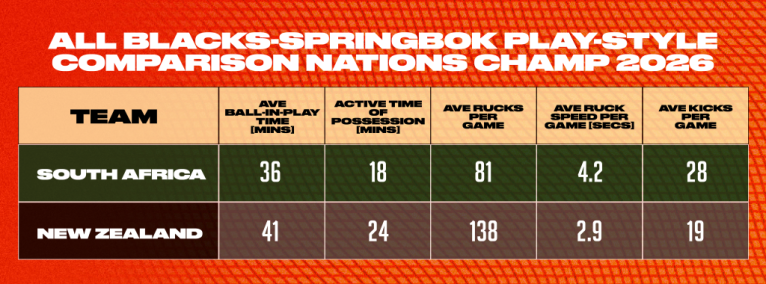
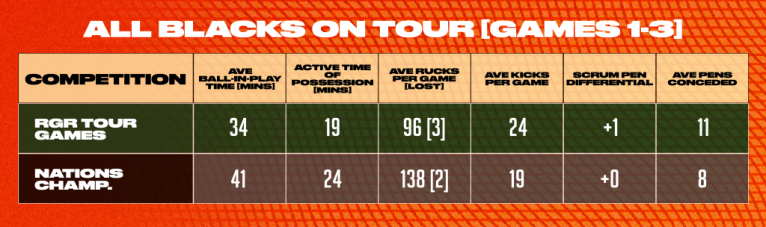
Even against three under-strength teams, the partly-enforced changes in the All Blacks’ approach on tour are significant.
- The average ball-in-play time on tour [34 mins] has dropped far below what Rennie would want, and to the point it suits South Africa better than the tourists.
- New Zealand’s portion of active time of possession within that ball-in-play time, and the number of rucks they have been able to build to apply pressure on their opponents, are probably at least two minutes and 25 rucks short of Rennie’s targets for a winning formula against the Boks.
- The number of kicks launched and penalties conceded have risen proportionally, as the All Blacks have experienced more problems retaining ball at their own rucks. They are conceding turnovers at the breakdown at one in every 32 rucks, compared to one in every 69 during the Nations Championship.
- The scrum has shown improvement from the Stormers to the Bulls, but is it ready for the Bomb Squad? The Capetonians fielded better depth in the front row than the men from the north, with Neethling Fouché, Vernon Matongo, Ntuthuko Mchunu and André-Hugo Venter all regular starters in URC play, and three of them on the fringes of the Springbok squad. They won pen count at scrum time 4-2, while the Bulls lost it 0-2.
- The lineout still depends heavily on the presence of Fabian Holland. Without the big Dutchman, it hobbles along at an unimpressive 83% retention rate on tour – the same figure as in the Nations Championship. With him, it jumps to 25 wins out of 26 [96%] on tour, with five steals on the opposition throw for good measure.
As the last two bullet points imply, there is an upside for New Zealand. The refereeing across the three matches has shifted gradually in favour of the kind of game which may suit the All Blacks.
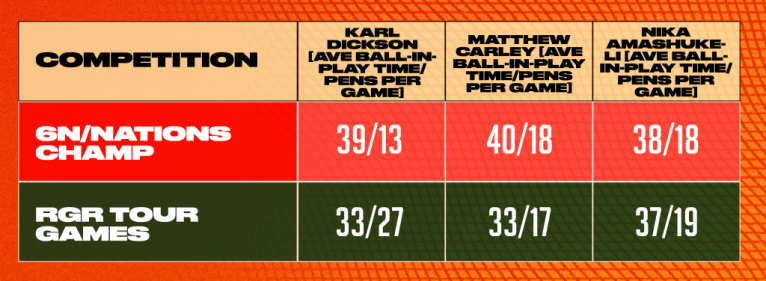
Ball-in-play time rose gradually to a peak of 37 minutes in the Bulls game managed by Nika Amashukeli, and that is far closer to the figure Rennie will want – even if it is not quite enough to run the Boks off their feet. Penalty awards have fallen by an average of nine per game over the past two matches overseen by Matthew Carley and the Georgian, and that will help the fluidity of play too. Amashukeli’s tour stats match up most closely with those he has produced in other international competitions this year, and they occurred on the Highveld at altitude, in conditions similar to those at Ellis Park, the venue for the first Test.
New Zealand have still to reveal their selection hand fully: Ardie Savea, Will Jordan and Cam Roigard are yet to appear on tour, while Tyrel Lomax only played his first game at the weekend. That core group of Lomax at tight-head for the scrum, Holland in the second row for lineout, Savea at eight and Roigard at nine for carrying threat in and around the ruck, and Jordan in the back three for finishing power will be key to the chances of Kiwi success. If Rennie can keep that group together without mishap, the All Blacks have a shot at 2-2; if not, they will struggle to win a Test match.
How will Rassie tackle the Test series?
After arriving home in batches from Argentina last Monday and Tuesday, the players from the 26-man Springbok squad which played the Pumas only returned to the training field on Friday and Saturday. “It was important to manage the players who travelled to Argentina well and afford them sufficient time to recover from the match and switch back into the domestic time zone, which is why we only started training as a full group late in the week,” said Erasmus, stressing the need to balance workload and recovery.
The game against the Pumas raised some interesting questions about the tactical approach the Springbok Svengali will employ in the coming weeks.
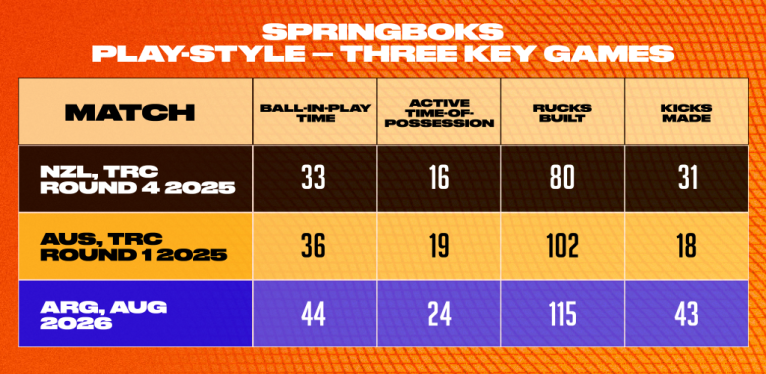
The statement Springbok performance came at the Cake Tin in Wellington, a 43-10 rout where lean attacking efficiency reached its peak: only seven rucks required per clean break and 16 needed per try; five tries out of six scored on changes of possession, and all within five phases of play; low-ball-in-play allied to a high contestable kicking output. Whenever the Boks have tried to expand Tony Brown’s attack to a higher time of possession, as in the round one loss to Australia in last year’s Rugby Championship and the recent win over the Pumas, the results have not been nearly as impressive.
In both matches, South Africa experimented by keeping the ball for longer periods of play, and this is indeed a proven formula for beating possession-based opponents: we will starve your strength by keeping the ball ourselves. But attacking efficiency evaporated in the process, with the rucks-per-try ratio dropping like a stone to 1:34 and 1:57 versus Australia and Argentina respectively, and the rucks required to achieve a clean break somersaulting from one in seven against the All Blacks to one in 29 versus the Pumas.
The Cake Tin triumph was picture-perfect, with the All Blacks gifting the Springboks a stream of turnover and kick return opportunities, more than enough for the Boks to fill their boots. Scott Robertson’s side kicked to the Springboks on 30 occasions, but Rennie’s charges will not be as compliant. These All Blacks will be aiming to kick at least 10 times per game less than that.
That means the hosts are likely be restricted to the ball they can win in the tackle, or pilfer from the All Blacks’ breakdown. It is the battle everyone really wants to see – a stingy, ravenous Springbok defence against the new, gleaming All Blacks multi-phase attack. The irresistible force of the cleanout in black versus the immoveable object of the jackaling unit in green and gold. Erasmus himself delivered the perfect prognosis when he said: “We think there’s a certain way you win World Cups, and we think that’s a grind.
“We think when you’re under pressure on your attack, it’s very tough to keep cohesion if the pressure is very big and you start fumbling a few balls, and then you must stick to your guns.
“We try to find a balance between that, and when games are really, really clutch-and-crunch, that you have a system you can fall back onto, which protects the players sometimes from not always having the confidence to do things.”
To answer Sun Tzu’s question about preparation, whoever hones his edges in the breakdown battle will likely win the Greatest Rivalry war.
Postscript
*With Kennedy Tsimba’s next contribution on ‘shift theory’ in the pipeline next week, Kennedy is inviting readers to consider the following three questions during the first Test, and after the game has finished:
- How do both teams respond to contestable kicks?
2. Who adapts fastest when the original structure breaks down?
3. How does each team manage the space behind the defensive line in the shift?

Your home for rugby. Download the RugbyPass app on the App Store (iOS) and Google Play (Android) now!
Follow your favourite teams, tournaments and players, and get personalised news and Match Centre notifications direct to your device.
From live rugby streams and upcoming fixtures to breaking news, in-depth analysis and live scores, RugbyPass has everything you need to stay connected to the game.


“I have made peace with the fact that I might not be very happy come seven pm SA time today. I will console myself on the fact that the Springboks, over the past seven years have given me endless days of happiness.” Wrote that early yesterday - And a huge shout out to the AB’s Rennie and his coaching staff. Congrats to all the AB supporters - enjoy the rest of the weekend and the week to come.
Over the last two days I could sense something big coming.
This is the pivotal point for or both teams. The old status quo has been restored.
We can go back to consoling ourselves with the fact that we are the second best rugby team and we will occasionally knock over the mighty All Blacks. The balance of power has truly shifted and I genuinely don’t see another Wellington on the horizon.
The second coming of Wellington cannot come fast enough after that Springbok handling shambles G.
‘Big ugly bear’😉
Ha ha 😂
What I love most about this series is that it’s not about SA or the AB’s, it’s literally about the future direction of the game and if power forwards trump over speed, skill and movement and if it’s best to go all out attack, or maintain a stronger focus on defence and a heavy forward bench.
. . . . And i think it’s fair to say the double RWC Champion status probably tells you power forwards are the best way to win games but everyone is still hopeful the AB’s can make a contest of it and hoping movement and pace still have their chances in the modern world.
The other thing about this test is that’s is so early in the Dave Rennie rebuild, we are just not too sure what to expect and that’s what I really like about this series but we’ll get to answer most of those questions over the next 4 tests.
As previous articles on the tour have shown, that is exactly what this tour is P! A battle for the game’s future.
In particular, the number of pens awarded will be crucial to that future. If we start getting Tests with over 20 pens per game it will be a setback to the game’s progress.
Right now this tour is prob the biggest showcase for the game outside a WC or a Lions tour, so it needs to keep a firm grip on how it wants to present itself to new spectators, not least in Baltimore!