
I’m positively hyperventilating about The Greatest Rivalry Test Series and it has my mind doing overtime as to how many ways it could go. It may be a heatwave here in the UK but over in South Africa, it’s piping hot for another reason. As ever, when it comes to rugby, there is no off-switch and this is what has been on my mind over the last month.
Buy Rugby World Cup 2027 Tickets
1 Year to Go until the biggest Men's Rugby World Cup ever kicks off in Australia. Go All Out and secure your tickets now.
Rassie’s next Bok generation could be the greatest ever
Sometimes the “next generation” can be a bit of letdown. Whether it’s people or products, the next in line doesn’t always mean an improvement. If you’ve ever spent a £1,000 on a new phone in recent years, or you’re acquainted with royal history over the past 1,000 years, you’ll know succession doesn’t always equal success — King John of England was arguably the iPhone 6 Plus of monarchs. However, the next generation of Rassie’s Springboks could arguably be the best to ever do it. They simply have to be, and for one reason: if you aren’t an almost generational-level player, you simply don’t get to play in the Test team proper.
Yes, Rassie has revolutionised squad rotation, and his use of “A” fixtures and development games has created a squad with more depth than a subwoofer. But to get into his Test team proper, you have to be better than good. Better than very good, even. There are currently stacks of very good players who can’t get a look-in with the Springboks. Take Evan Roos, for example — a player who would stroll into almost any other team in the world. His ball-carrying is elite level. The number of carries and the depth of his carries make the Stormers the Stormers. Yet because he doesn’t automatically look for the ground with a safe carry, and often carries beyond the safety of his ruck cleaners, he is seen as a bit of a risk in certain quarters of South Africa. He never considers a one-metre carry enough — he’s a five-metre-minimum type of guy. But because he’s up against the adamantine Jasper Wiese and explosive Cameron Hanekom, he is mind-bendingly third choice at No 8. The same can be said at outside-half, where South Africa and the Stormers now have the generational talent of Sacha Feinberg-Mngomezulu being chased by the hugely impressive Stormers’ debutant Yaqeen Ahmed — who already looks like a 10-cap Bok, despite only having played professional rugby for about 45 seconds. Bok rugby is the envy of the world now. It will be for a long while to come — and it is a joy to watch, unless you’re a New Zealander.
New maul-law could be hugely positive
New laws, law tweaks and a return to old law interpretations are what make rugby so progressive. It’s why the game constantly evolves. The latest is a return to an interpretation in the maul — particularly with reference to lineout mauls. Defensive players are no longer allowed to move past the ball (the ball’s position within the maul) — and if they do, they must return to the back of said maul. Here’s a bit more detail:
– The maul is a key contest for possession in rugby union in which both the attack and defence must comply with the law.
– Players must join (or rejoin) the maul by binding onto the hindmost player in the maul, not by creating a chain of two or more players and swinging up, or round, the side.
– Any player bound on the outside of the maul, may contest possession with their other arm, or may continue pushing/driving on the maul, but must not be in a position to pull/drag the maul.
– Once a player loses dominance and moves to be in a position to drag or pull, they should remove themselves from the contest or will be liable to sanction.
– Players must leave the maul if they become unbound or are not in a position to push/drive.
– “Bound” means with the whole arm in contact from hand to shoulder.
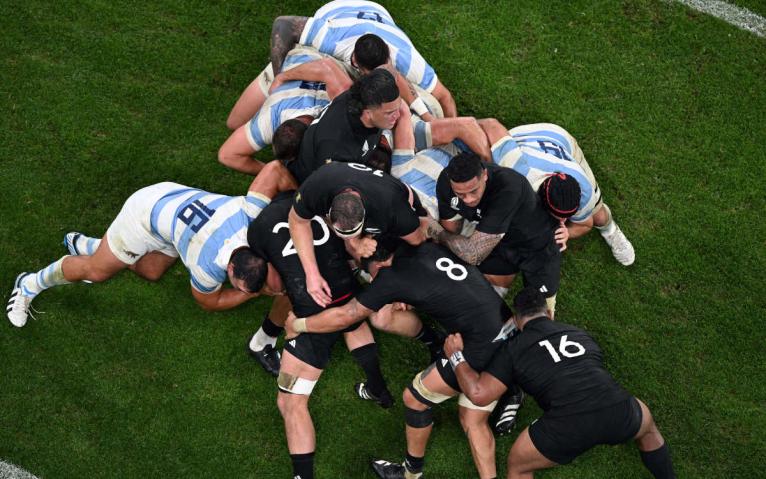
It means that mauls are cleaner, easier to referee and arguably now being refereed in the manner in which they were intended. Early indications suggest that lineout mauls will become a more powerful weapon for the team with the throw-in and therefore increase the likelihood of a team scoring from five metres. But it could have the complete opposite effect, and one which would be hugely positive. Currently, a five-metre lineout drive feels almost like a 50/50 outcome. So teams often choose not to jump and instead stay on the ground so that they can set their maul defence and maul bullets, etc. However, if the maul drive gets nearer an 80/20 outcome, then teams may as well jump and contest — they will have nothing to lose. It could mean a return to genuinely contestable lineouts on the five-metre line. More contested lineouts require taller and lighter players to compete. Taller, lighter players are exactly what rugby requires to free up space on the gainline and reduce the effectiveness of tackle completions. It could be a massive positive for the sport.
The hardest job in rugby – being a graphic designer
Being a tighthead is tough. Goalkickers have it rough on occasion. And tackling Cheslin Kolbe is akin to eating yoghurt with a fork. But no one in rugby has as difficult a task as graphic designers. As is always the case, August sees the launch of new rugby kits, which, no matter how good their aesthetic or innovation, will almost certainly be panned by 50% of the rugby population regardless. The same goes for rebrands — like the Sharks have done in recent weeks. Within two seconds of the Sharks launching their new logo, you’d have sworn that the designer had swapped the shark for a newt.
Within rugby, nothing seems to stir up opinions like graphic design. Which is really weird. If a local pub redesigns its sign, people don’t queue up outside and immediately start hurling abuse at the landlord. When a new clothing label releases its autumn/winter collection, consumers don’t hurl conkers at the shop window. Yet if you add a collar on a rugby shirt, you could have unwittingly started 48 hours of civil unrest. So, if you ever meet a graphic designer who works in rugby, put your arm around them and give them a hug. They deserve it.
Test rugby isn’t bloated. It’s what punters want
For some reason, Test rugby is often regarded as being “bloated” — especially on social media. It’s a stance which implies that the calendar is overly concerned with Test matches, leaving little room for club/regional/franchise rugby. But Test rugby is what pays the bills in virtually every Test nation. Test rugby’s sales far outweigh the sales for club rugby. Club rugby attracts the purists.
Test rugby attracts the purists and the event-goers — and event-goers spend lots of money. To say that Test rugby is bloated is the opposite of the situation. If rugby needs money, which it does, there’s an argument that the game needs more Test rugby, not less.
 Register your interest to receive priority updates on RWC27 ticket releases. Don't miss out, stay in the loop!


Let’s face it, the AB’ have been found out….They can no longer get away with the type of infringements that helped them win games in the past. For the past several years the refereeing of games has improved greatly. The ABs have measured and weighed and found wanting……And how do they respond…..blame the coaching, blame the refs. but never blame the actual men on the field. Sad but true……learn to play within the rules and stop looking for excuses if you can’t win.
Hey Stuart Lee.
thanks for advice. Rennie’s team were clearly listening to you.
Ha ha DC - SB can’t wait for 90 minutes after the test. Downwards spiral, incompetent and need refs to assist the win. Every time you lose to any team, it’s not your players fault but the ref.
And you say we are the worst supporters, I think a shipment of mirrors is on the way to NZ.
As always, will rely on the incompetence of referees - particularly English ones - to give the third world victories they clearly didn’t deserve. A tale as old as time at this point
naaigie! I see you’ve recovered from Saturday’s backseat mauling! Your mommy should probably have it reupholstered.
Enjoy this Saturday’s backseat shenanigans. Between you and daddy you’ll probably make a few bucks.
The civilised world will be enjoying an awesome rugby spectacle between the two greatest rugby teams on the planet!
They clearly won’t be. Springboks overrated, on the downward slope.
I don’t know sb. I think they are still the best in the world and you’d need w/l data over a season to make a definitive comment on trend. But glad to see other countries can successfully compete with this very formidable team.
Sure they are but at present have incredible depth
Rassie is coach until 2031 and since 2024 he has been contracting the best u20 players to PONI contracts having them join his annual camps to train with and play against actual World Cup winners in trial matches. So come 2028 his players are ready made with Bok DNA.
So lets see coaches ticked, players ticked, continuity ticked. Things that the self proclaimed “saviours of rugby” do not even know themselves.
Oh and the players coming through are now 2x and soon to be 3x u20 World Champions. When last did the “saviours of rugby” demonstrate that their juniors are the best in the world?
if E.Hooker is a poster boy for “greatest generation” then this article is self defeating. Tidy player, no X factor.
Looked the part in Wellington last year …