
There are worse things than being remembered for the best ten seconds of your life.
NEW: Follow Your favourites in the App 📱
You can now follow their favourite teams, tournaments and players in the RugbyPass App!
Richard Bands has won Currie Cups, played Test rugby for South Africa and built a second career teaching young props the mysteries of the scrum. More than two decades after his last Springbok appearance, none of that is usually the first thing people want to discuss.
They want to talk about Carlos Spencer.
“I’m more than chuffed,” Bands says. “In my career, I’ve created something that 23 years later, when I speak to people, they still can tell me exactly where they were watching that game, watching me score that try.”
Thinus Delport knows the feeling. His professional career lasted 14 years, took him from Johannesburg to Gloucester and Japan, and has since led into broadcasting, coaching and charity work. Yet give him a microphone at a rugby function and there is one clip likely to precede his introduction.
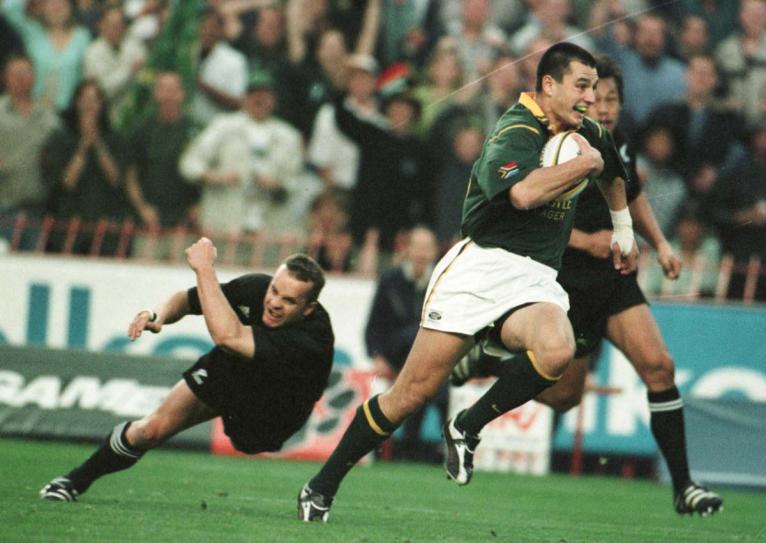
“All you have to do in life is score one try against the All Blacks,” he jokes. “Score one try against the All Blacks and your life is made.”
Because in rugby, there are tries, and then there are tries against New Zealand.
South Africans have accumulated enough of them to fill several highlight reels. Bryan Habana scored eight against the Springboks’ greatest rivals. Malcolm Marx is tied with Joost van der Westhuizen on six. Cheslin Kolbe is chasing them with five. But certain tries escape the match in which they were scored. They become little pieces of folklore, replayed until the grain of the footage and the cadence of the commentary are as familiar as the action itself. For one generation of Springbok supporters, three stand apart.
Delport at Ellis Park in 2000. Bands in Dunedin in 2003. Ricky Januarie at the same ground five years later.
Three unlikely bursts through black shirts. Three players who discovered that a few seconds can follow you for the rest of your life.
‘I bashed him’ – Bands on the run
For Bands, the journey to Dunedin was improbable before he even got on the plane.
He had stopped playing rugby for four years while farming cattle. When he attempted to resurrect his career, he says the Cheetahs declined to offer him a contract because he was regarded as a “substandard club player”.
“Playing for the Boks is just a thought that’s not really in your mind,” he says of those years. “To be honest, I’d pretty much given up on that dream.”
Over 20 metres, I was the quickest in the Bulls and the Boks squad. Over 40 metres, I was second quickest. And over 100 metres, I was last. So luckily that try was only 50 metres.
Eventually he moved to Pretoria. By 2002 he was a Currie Cup winner with the Bulls, although another disappointment followed when he was overlooked for the Springboks’ end-of-year tour. He resolved to attack the following Super 12 season without expectation. Unburdened, he produced performances that could no longer be ignored. At 29, Bands became a Test prop.
“In those days, you were never really sure where you stood with a jersey,” he says of an unsettled period for the Springboks. Nick Mallett had overseen a world record-equalling run of 17 consecutive Test wins between 1997 and 1998 but was gone by September 2000. Harry Viljoen lasted little more than a year and by the time Bands made his debut in 2003, Rudolf Straeuli was South Africa’s third head coach in less than three years. “It was always like, are you going to play or are you not going to play?”
The contrast with the modern Springboks, he believes, is continuity. Rassie Erasmus inherited and then expanded a culture in which newcomers understand their place. Bands’ generation lived through repeated coaching changes and uncertainty. They also lived beneath the shadow of an imposing All Blacks side.
“We really thought we had a bite of the cherry somewhere or another, but we always lacked that little bit of confidence,” Bands says. “Confidence is contagious; so is the lack thereof.”
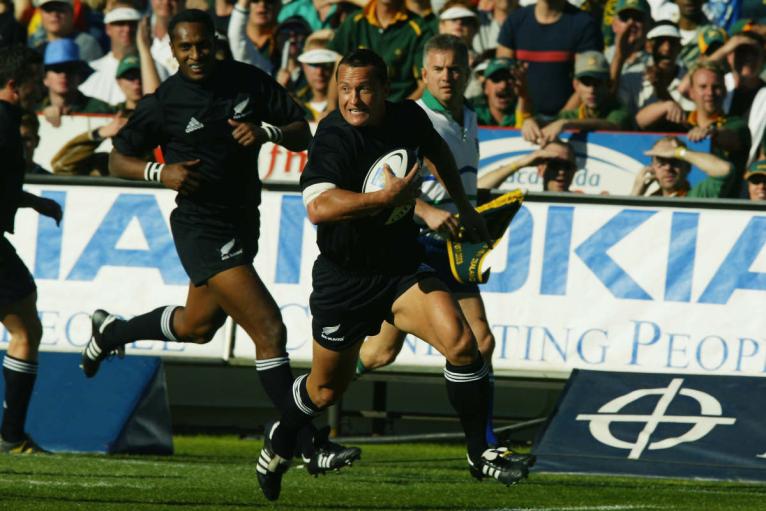
A few weeks before Dunedin, New Zealand had demonstrated the distance between the sides by winning 52-16 at Loftus Versfeld. Bands remembers trying to stem something unstoppable.
“It didn’t matter how many fingers we put in the cracks of the wall, it just kept coming. We didn’t know how to stop it. It was just a black wave demolishing us.”
At the centre of it was Spencer. Bands still talks about the All Blacks fly-half with something approaching awe: “poetry in motion”, “10 years ahead of his time” and perhaps, in his estimation, one of New Zealand’s greatest ever players. Which makes what happened next even better.
At Carisbrook, South Africa were attempting to salvage something from a grim Tri-Nations campaign. They had lost their opening three matches while the unbeaten All Blacks needed only a bonus point to secure the title. Joe Rokocoko’s early try put New Zealand 7-0 ahead before Bands took a short pass from Van der Westhuizen and hit a hole around Australian referee Peter Marshall. That part was not accidental. During the week the Springboks had discussed refereeing positioning. An official, Bands was told, was unlikely to stop play merely because he had inadvertently occupied a defender’s space. Bands drew the obvious conclusion.
“If that’s the case, then the hole must be where the referee’s standing,” Bands explains. He ran at Marshall’s shoulder. Marshall moved. The hole opened.
Then came Spencer. “I just bashed him,” Bands says matter-of-factly, simplifying one of the iconic moments in Springboks history and a triumph for front-rowers around the world.
Bands looked for support, found none and kept running. The sight of a tighthead prop galloping through open country is funny enough. The identity of those chasing him elevates the sequence towards the absurd.
Bands was out-running Jerry Collins. This, he insists, was less miraculous than it looked.
“Over 20 metres, I was the quickest in the Bulls and the Boks squad. Over 40 metres, I was second quickest. And over 100 metres, I was last. So luckily that try was only 50 metres.”
The moment did not secure the result. Spencer kicked four penalties as New Zealand won 19-11 to wrap up the Tri-Nations title, with Bands responsible for South Africa’s only try. But defeat did little to diminish what he had done. The following morning, a New Zealand newspaper compared him to “The Fridge”, the nickname of William Perry, the 150kg Chicago Bears defensive lineman who became an unlikely ball-carrier and cult hero in the NFL during the 1980s. When he landed back in Johannesburg and encountered a wall of media, the scale of what he had done began to register.
“Jeez,” he remembers thinking. “Maybe I did something special.”
Delport’s dash to glory in dizzying Test
Three years earlier, Delport had experienced his own version of immortality at Ellis Park.
His circumstances were different. A full-back rather than a prop, pace was supposed to be part of his armoury. He describes his younger self as “attack-minded”, “quick” and “confident”, although with hindsight he considers himself tactically naive.
The opposition full-back that day represented the standard everyone else was chasing.
Christian Cullen was “a fantastic counter-attack player”, Delport says. “Such a lovely balanced runner. Quick. He wasn’t a big guy, but he was very powerful and strong.”
Alongside Jonah Lomu and Tana Umaga, Cullen formed a back three designed to punish mistakes. Yet Ellis Park produced one of those wonderfully unhinged Springboks-All Blacks Tests in which control became impossible.
I thought, ‘I’ve got to accelerate here, otherwise I’m going to get smashed by Tana.’ And then it was that moment: ‘oh, he’s not tackling me. I’m free.’
South Africa eventually won 46-40 after the lead changed hands six times. Robbie Fleck and scrum-half Werner Swanepoel scored two tries each for the Boks; Cullen and Umaga did likewise for New Zealand. South Africa had arrived on a four-Test losing streak but attacked with freedom, scoring five tries inside the opening 35 minutes to surge 33-13 clear. The All Blacks being the All Blacks, they then scored twice before half-time to reduce the gap to six.
Delport’s contribution was the fifth of those South African tries. It began not with a sweeping counter-attack but a scrum that failed to settle inside the Boks’ half. From the resulting free-kick, the ball travelled through the midfield and Delport appeared on Grant Esterhuizen’s shoulder. He ran an out-to-in line, noticed Umaga tracking across and accelerated before the tackle could arrive.
“I thought, ‘I’ve got to accelerate here, otherwise I’m going to get smashed by Tana.’ And then it was that moment: ‘oh, he’s not tackling me. I’m free.’”
Ahead was Cullen. Delport did not step him so much as bend his run around him, using a skill he believes has faded slightly from modern rugby: the swerve. “I saw him and thought, I’m going to put on the after-burners.”
Once past Cullen, his concern was not the significance of the moment but whether Lomu was arriving on the cover. He looked across. It was Andrew Mehrtens instead. The try was his.
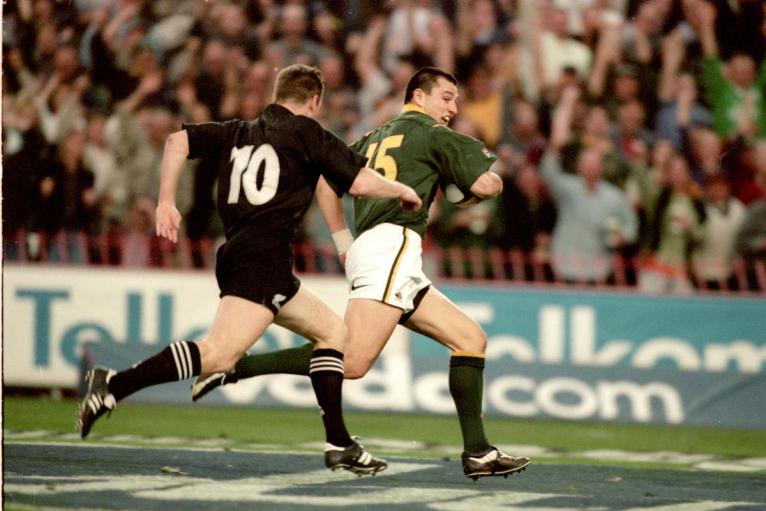
Twenty-six years later, it remains his. “This is that moment that always comes to the front,” he says. “It sort of defines my career, or keeps me current in a certain way.”
Then he laughs. The present Springboks, with their World Cups and unprecedented depth, have complicated his old advice about needing only one try against New Zealand. Still, he points out, not all of them have scored one.
Ricky’s chip-and-gather makes history in Dunedin
Eight years after Delport’s run and five after Bands’, Ricky Januarie produced perhaps the most consequential of the three in 2008.
The setting was again Carisbrook, the old House of Pain. South Africa had not won a Test in New Zealand for 10 years. They had never won at Carisbrook. New Zealand were protecting a world-record sequence of 30 consecutive home Test victories. A week earlier they had beaten the Boks 19-8 in Wellington.
With the second Test nearing its end, the situation deteriorated further. South Africa trailed 28-23 when captain Victor Matfield was sent to the sin-bin. The Boks were down to 14 men, five points behind and running out of time. Januarie saw something.
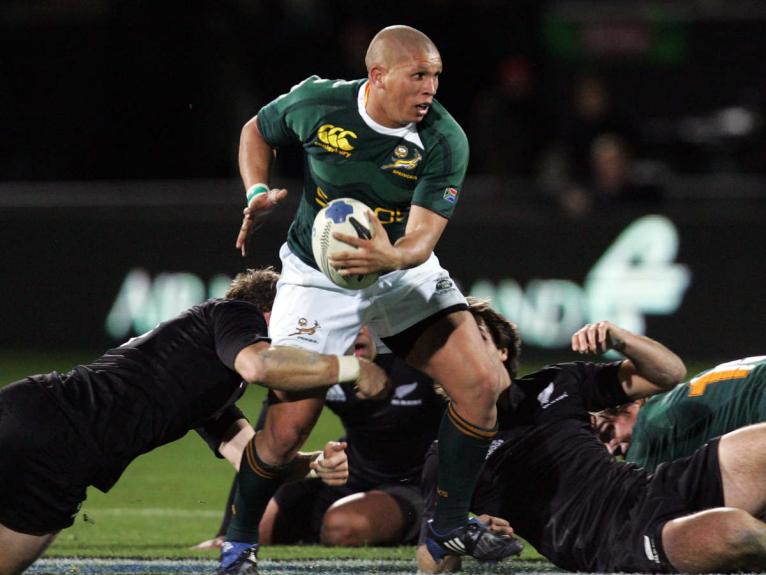
Keven Mealamu drifted away from the ruck. The scrum-half darted through the space, found Leon MacDonald ahead of him and chipped over the full-back. The bounce sat up. Januarie gathered and flew towards the line.
Frans Steyn converted. 30-28. Graham Henry could only admire it. “You couldn’t have got a better Test match,” the All Blacks coach said. “They pulled it out of the fire, I guess, through a great play by Ricky Januarie late in the game.”
Jean de Villiers understood the history immediately. “It took us 100 years to win here,” he said afterwards, “and hopefully we won’t have to wait another 100 years to win again.”
The try was subsequently named South Africa’s try of the year. Januarie would finish with 47 Springbok caps and play professionally until 2019, but that little chip at Carisbrook remains the clip attached most tightly to his name.
That is the strange economy of sporting memory. A career takes decades to construct. It consists of thousands of training sessions, tackles nobody remembers, flights, injuries, selections, omissions and games whose scores eventually fade into the morass.
Then one afternoon changes everything. An entire life distilled to a single moment. Decades of toil and sacrifice reduced to a few seconds.
Neither Delport nor Bands resents the reduction. “I’m just grateful that I have this one moment,” Delport says. Bands is equally content. “Even though I’ve done a lot, if this one is standing out, then so be it. To be remembered for that is fine. I don’t mind.”
None of them are in the conversation for all-time Boks teams. And yet, all three of them are immortal.
Perhaps that is part of the appeal of an old sporting highlight. It preserves something that even the person in it can no longer possess. Bands, Delport and Januarie have long since hung up their boots. None of them are in the conversation for all-time Boks teams. And yet, all three of them are immortal. Their powers may have faded but the footage of their glory has not.
On your screen Cullen is always waiting in the backfield. Spencer is always about to be flattened. MacDonald is always watching the ball sail over his head.
And three Springboks are always young enough, quick enough and audacious enough to keep running. Ten seconds. That’s all it takes to enter eternity.


It’s an interesting way to frame the discussion and perhaps reveals the simple truth that New Zealand remains as it always has been the true litmus test for any side and when you're the current World Champions you can't feel comfortable unless you can beat them consistently.
Very few teams ever achieve the ascendency for long against New Zealand and the fact that still in terms of overall performance the two best sides in rugby history are the AB sides under Henry and Hanson is proof that they always will be the team to beat, no matter who currently sits atop the standings or who the reigning World Champions are.
A try scored against them should be celebrated. It's a huge achievement since they don't give them up easily with one of the most formidable red zone defences in the world. It's impressive that so many greats of the game can be remembered entirely on the basis of a single score against the ABs and proves just how invaluable such moments are.
Scoring amazing tries against NZ means absolutely nothing if we lose. It's that simple.
Then you missed the point of the article. Mr Gallan used the examples he did precisely to show how important scoring a try against New Zealand under any circumstances is, regardless of the final outcome.
An underrated Bok try against the All Blacks was scored by Gerrie Germishuys in Durban in 1976. A terrific, sweeping piece of backline play from one side of the field to the other. It’s on YouTube.
The Bands try is one of the best even the most diehard AB fan gotta give it up when a prop scores one like that running free from his cage it’s like seeing a extremely rare animal in the wild.
As much as we love King Carlos seeing him getting rolled given his “cocky” persona was have to admit pretty amusing ..how you like them Toffee pops brutha
Reading some of his back story above makes it even better tho it doesn’t suprise me he has that look
We had a prop like that at Hillcrest Villagers RFC in Durban. He was quicker than any winger over 20m - we used to set up newcomer wingers and ask them if they thought they could outsprint a prop from a standing start - many red facers and down downs at fines evenings. If we got a penalty within 10m of the tryline the back line would make their way to the half way line before the penalty was taken - he was simply unstoppable ten meters from the line when he took the ball at full tilt from the tap.
Great article!
Thanks Daniel, it’s good to have some real feelings come through for this upcoming clash. Very cool article.