




1
‘Complete package’: O’Mahony has no hesitation in Erasmus vs Farrell call
10


 Share
Share 
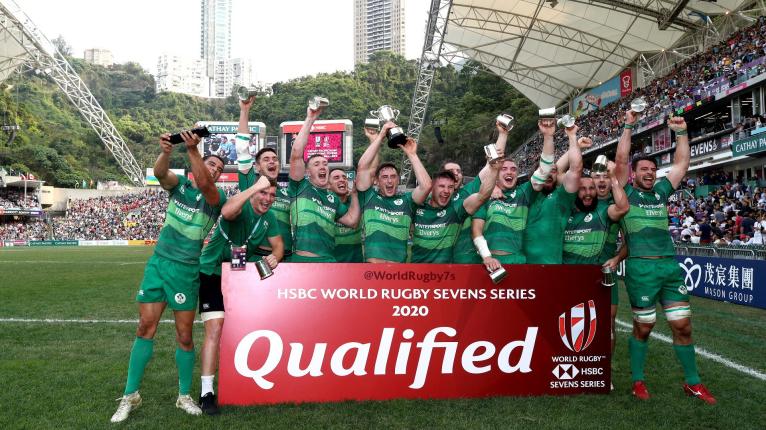
Ireland have secured a place as a core team on the HSBC World Rugby Sevens Series 2020 after beating hosts Hong Kong in the final of the men’s annual world series qualifier.
After three days of pulsating action, Anthony Eddy’s side proved to be worthy winners following six straight victories and finished up with a comfortable 28-7 win in the competition-decider, which made up for their heartache of 12 months ago when they lost in the semi-final.
The victory in front of a packed, 40,000 strong crowd at the Hong Kong Stadium means Ireland will become one of the 15 core teams contesting the 10-round world series.
In the final Ireland struck first through Harry McNulty and captain Billy Dardis added the conversion. It gave them a spring in their step and an excellent angled run from O’Shea delivered their second just before half-time. A second successful conversion put them 14 points up before they extended that out to 21.
Hong Kong responded when Ireland went down to six men following a yellow card but Terry Kennedy’s converted try created a 28-7 advantage. As the time went into the red, the home side continued to battle but Ireland’s gutsy defence held firm and the players cried tears of joy as the full-time whistle sounded.
“We’re just delighted with this,” said captain Dardis after the full-time whistle. “It’s been a long and hard road. I think that we all just stood on the pitch there and couldn’t move. We’re just speechless. It’s class! It won’t sink in for a couple of weeks.”
This time last year, Ireland were knocked out at the semi-final stage by eventual winners Japan but went on to have a head-turning season.
The side played as the invitational team at the London and Paris rounds in the 2018 world series and took home a bronze medal from London. They won 23 of their 24 matches across the Rugby Europe Sevens Grand Prix Series and at this all-important qualifying competition showed their strength and quality.
Ireland were housed in Pool F alongside Jamaica, Uruguay and Russia. The first day saw them comprehensively beat the Reggae Crocs 26-0 before starting strongly against Los Teros Sevens.
A 26-7 lead over Uruguay was clawed back though and had Tomas Ubilla not missed the final conversion attempt, a loss would have been recorded. Ireland used the overnight break to refocus and returned to record back-to-back wins over Russia on day two.
The first 33-7 victory completed their pool campaign before a statement quarter-final result followed. A 47-0 victory in the last-eight included braces from Jordon Conroy, O’Shea and Kennedy and created a last-four meeting with Germany.
The semi-final was a clash of the titans as both sides gave it absolutely everything. Although Anthony Eddy’s outfit led 5-0 at the break they went 10-5 down in the second half.
Despite the high stakes, Ireland kept their composure and worked a team try with just over a minute to go. Captain Dardis was the try-scorer and his monster conversion pushed them 12-10 in front. The cherry on top arrived after they secured the final kick-off and Conroy carried two German defenders over the line with him. Dardis again converted for a 19-10 victory.
Having earned their place on the HSBC World Rugby Sevens Series 2020, Ireland can now look forward to playing at the top level of rugby sevens ahead of the Tokyo 2020 Olympic Games. Ireland will aim for Olympic qualification when the European regional qualification tournament takes place in Colomiers, France on 13-14 July, 2019.
World Rugby recently announced a new-look men’s and women’s HSBC World Rugby Sevens Series which includes at least six combined events, as the women’s series increases to eight rounds for the first time in its history over the next four-year cycle. Dubai, Cape Town, New Zealand, Sydney, Hong Kong and Paris will host combined men’s and women’s sevens events from next season onwards as part of the next four-year world series hosting cycle.
Ireland Sevens squad
Billy Dardis (Terenure RFC) Captain
Jordan Conroy (Buccaneers RFC)
Ian Fitzpatrick (Lansdowne FC)
Foster Horan (Lansdowne FC)
Hugo Keenan (UCD RFC/Leinster)
Terry Kennedy (St. Mary’s College RFC)
Adam Leavy (Lansdowne FC)
Mick McGrath (Clontarf FC)
Harry McNulty (UCD RFC)
Bryan Mollen (Blackrock College RFC)
John O’Donnell (Lansdowne FC)
Greg O’Shea (Shannon RFC)
Mark Roche (Blackrock College RFC)
Join free and tell us what you really think!
Sign up for freeThere was a record amount of tries on the opening weekend of the Gallagher Prem, but has it got out of hand?
Australia picked up where New Zealand left off in unearthing more of the tools which could stop South Africa's charge for a third straight Rugby World Cup.
Five tries each, four yellow cards in the final 10 minutes and frayed nerves aplenty - relive the drama of Australia's win over South Africa.
Stephen Varney plays for Exeter .. not Gloucester.
Recalled to the top 14. International window is closed.
It was also bogus sports science that pushed this.
It's a little sad NB because something has been lost in nz rugby culture.
Ed has quit the internet
Tell us, Ed? Whereabouts. England is a lovely place. Mainly
...


 Clear
Clear 


 Copy link
  Facebook
  X/Twitter
  WhatsApp
  Messenger