
It is 22 years since England won the World Cup under the auspices of Sir Clive Woodward in 2003. They are the only northern nation to have interrupted the victory procession of the southern hemisphere ‘big three’ of the Wallabies, Springboks and All Blacks. Speak it in a whisper, but the stars may just be aligning for another English World Cup triumph at the 2027 World Cup.
The tournament will be played in Australia, the same venue where Woodward’s men achieved their success. The comparisons are appropriate, because head coach Steve Borthwick is rapidly assembling the deepest and most powerful squad of England players since the turn of the millennium, and he will be reminding them of their historical provenance in the land down under. Rugby in Australia holds no fears for the men in white.
Borthwick’s selection is as far-sighted now as Woodward’s was back then, and it is being developed with Australia’s hard grounds and clement rugby climate in mind. The end-of-year campaign showed that he is developing two separate front-row combinations to provide 80-minute impact and challenge the Springboks at their point of super-strength.
Woodward could pick horses for different courses from among a deep pool of props including Phil Vickery, Julian White, Jason Leonard, Trevor Woodman and Graham Rowntree. Borthwick already has Will Stuart, Joe Heyes, Fin Baxter, Ellis Genge and Asher Opoku-Fordjour at his disposal.
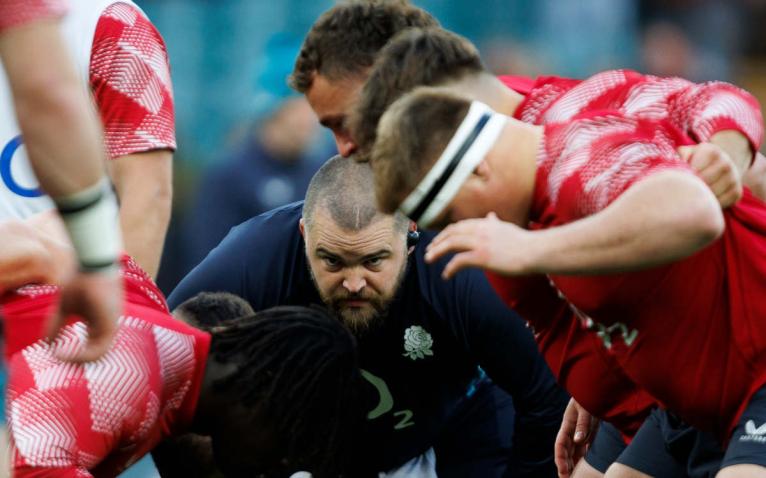
The Cumbrian supremo has also reverse-engineered his back-row selection philosophy to accommodate the host of high-quality number sevens currently being produced in the Prem. Once again, he is following a well-worn, World Cup-winning coaching footprint. Sir Clive had been the first England coach of that era to abandon ‘the big back row’ theory which had been espoused by Geoff Cooke and Jack Rowell before him. Let Tigers’ Neil Back, all 5ft 10ins of him, and 90 kilos dripping wet, pick up the story:
“I felt Geoff Cooke and Jack Rowell ultimately came to grief as England coaches at the very highest level because they wanted big blokes playing at No.7 – Ben Clarke, Steve Ojomoh and even a young Lawrence Dallaglio. In my opinion it set the development of English rugby back years.
“I had spent all of my rugby life training with the backs, learning how to play the linking role between forwards and backs until it became second nature. Lawrence, Steve and Ben were all great players, but how many of them could say the same?
“In global terms, it restricted England to being a bully in its own backyard. A very good bully it has to be said, but in my opinion Cooke and Rowell were content with dominating the Six Nations rather than [attempting to] beat the likes of Australia, South Africa and the All Blacks.
“[England defence coach] Phil Larder and Clive Woodward had a very different mindset in terms of what they thought an England team could be, and it certainly affected their view of what a Neil Back could contribute.”
Where Cooke and Rowell had looked straight past the small man as if he was invisible, Woodward and Larder came to the same situation with an open mind. Phil Larder immediately recognised that ‘Backy’ was the best tackler on the team, with the highest level of conditioning, and ‘the only one who could play Rugby League right away’. All of a sudden, size really didn’t matter.
The preferred England back row by 2003 had Back and Richard Hill bookending Dallaglio at No 8; none of the three an acknowledged lineout expert or a penny over 6ft 4ins but every man jack having started games of rugby for England on the openside of the scrum.
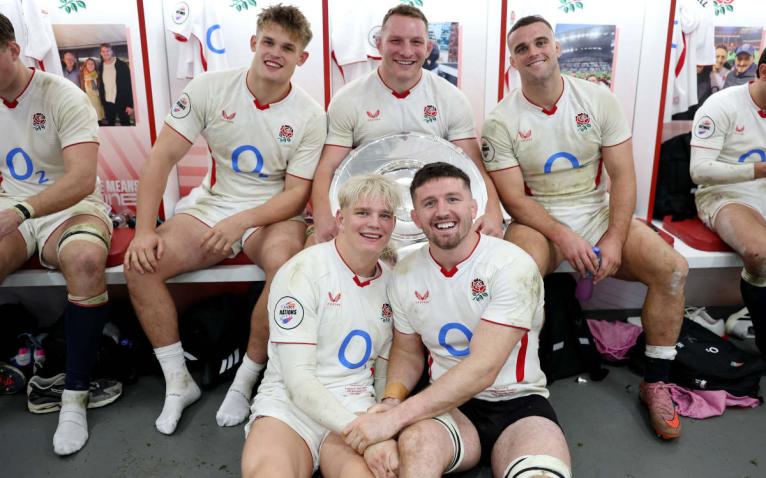
Woodward banished the blinkered obsession with size in the back five forwards, all the way back to where it belonged in the Dark Ages, and 20 years later Steve Borthwick is doing the same. ‘Borthers’ is tipping his hat to England’s current glut of high-quality breakaways by picking no less than five number sevens in his 23-man squad. Furthermore, Maro Itoje’s partner in the second row throughout 2025 has been permed from a group of men who have all played blind-side flanker for their clubs – to wit Ollie Chessum, Chandler Cunningham-South, Alex Coles or Charlie Ewels.
The desire for size and athleticism has if anything, moved backwards in the team, back as far as the back three, and this is where England in 2027 may prove to be a significant improvement on its predecessor 24 years ago. Take a look at the differential in size:


The average for England 2003 is 5ft 10.5 inches tall and 91 kilos but by 2027 those figures may have grown to 6ft 3ins and almost 100kgs. The 2003 group featured three players under 6ft tall in the back three, with only Ben Cohen a true aerial menace. Wind the clock on 24 years and it is likely every player in the back three will be over 6ft tall and at least four of the group will be outstanding ‘masters of the air-waves’.
From Borthwick’s point of view, the changes which allow the chaser of a high ball unimpeded access to the contest could not have come at a better moment. He now has a range of tall, top-drawer athletes to win the ball in the air and a host of sevens buzzing at ground zero to pick up any crumbs which fall from the table.
Whether it is a high contestable or cross-kick, the direct link from George Ford or Fin Smith or Owen Farrell to the wings represents a genuine threat. The first hint came in the second Test of England’s 2024 tour of New Zealand:
— William Bishop (@RPvids1994) December 1, 2025
This is Marcus Smith to Tommy Freeman on the cross-kick near the New Zealand goal-line. Come the autumn of 2025, the British & Irish Lions’ Test wingman had been moved inside to number 13, with big Tom Roebuck taking his place versus Australia:
— William Bishop (@RPvids1994) November 2, 2025
On this occasion it is a high contestable kick from an exit scenario, but the connection between Ford [kicking] and Roebuck [receiving] is just as smooth as it was between Marcus and Tommy over 12 months before. Roebuck wins his individual aerial battle with Australian League kingpin Joseph-Aukuso Sua’ali’i, and then the speed of England’s new sevens-based back-row takes over. As soon as Roebuck wins the first touch, the two men closest to him are Ben Earl and Sam Underhill, who run straight past the only big back-rower in the vicinity, Australia’s Bobby Valetini. In the final act, Saracens ace Earl comfortably outpaces a brace of chasing Wallaby backs en route to the posts.
The form of the latest teen sensation suggests that England could get even better in the air than either Roebuck or Freeman. Saracens winger Noah Caluori, only 19, was originally brought in to England’s training camp at Bagshot to impersonate Sua’ali’i in a hi-vis jacket ahead of the game against the Wallabies, only a few weeks after scoring two tries for Champ club Ampthill against the Cornish Pirates on loan. The transition from the humble surroundings of Dillingham Park to palatial Pennyhill within one solitary month was breathtaking:
“It was a bit like ‘I can’t believe this is happening’, because my first call-up was a bit unexpected, the day after the Sale game [where Caluori scored five tries for Saracens on debut].
“There was a moment where I thought ‘I’m going to flick the switch, I’m going to go for it all’. On the high-intensity Tuesday, Maro [Itoje], my captain at Saracens and with England, told me to not let this opportunity go to waste.
“He said a lot of people come into camp for the first time and think ‘I’m just going to cruise by this, not do anything, not make any mistakes’. And he told me that while he knows I’m not that type of player, just to go for it. That really motivated me.”
As his coach with England Under-18s Will Parkin explained, “If you can jump higher than the other kids and then catch above your head, it’s going to be undefendable.” Amen to that.
Noah Caluori can do things in the air that even basketball legend Michel Jordan would appreciate:
— William Bishop (@RPvids1994) December 1, 2025
— William Bishop (@RPvids1994) December 1, 2025
In the first clip the young man runs 40 metres at full tilt to take the ball in stride without any hesitation at all. Most wingers would not have made it to the 22 without losing orientation or running out of gas, or both. The second example illustrates the sheer heights that Caluori can scale. He is so far off the ground that his opposite number ends up running through his hips. You can either allow yourself to be outjumped in the contest or you foul the Mill Hill prodigy and give up a penalty try, and Sale’s Tom O’Flaherty chose the latter.
Caluori is equally dangerous returning kicks out of defence, and his ability to run through the catch and transition seamlessly into a sprint is uncanny:
— William Bishop (@RPvids1994) December 1, 2025
Arguably England emerged from the end-of-year tours with as many positives to count from their investments as South Africa. Borthwick’s men learned that the multiple number sevens theory could work against a New Zealand team which included four men with experience of starting professional games at either number six or number eight.
They found one right wing with as much, if not more, aerial ability than Freeman in Roebuck, and they practised against another teenager with more potential than both at Pennyhill Park in Caluori. English rugby is moving in the right direction, and it may be moving as quickly as it did back in 2002-2003. Right now, only Rassie’s Springboks stand in the road.


Well it’s not addressed to you! Anyone who knows my posting history on here knows exactly who it’s addressed to, and he seems to have gone unusually quiet in reply. I wonder why…
Great comment!
Who are you saying doesn't acknowledge error tho? Not sure who that bit is addressed to.
Oxford English Dictionary example of ‘hypocrisy’:
“It is pretty obvious you have to be right all the time, and you cannot bear it when things do not go your way.
You start attacking the man not the ball.”
NB is a pretty knowledgeable guy and much of what he writes is on the money but nobody gets everything right all of the time, and this is where the fun starts. The interesting thing on here though, is that the back catalogue for every post is accessible and anyone who is motivated enough can do exactly what you’ve done and forensically dissect historical contradictory opinions that have been expressed.
Despite that, I’ve yet to see any acknowledgment of error, even when they are presented incontrovertibly in black and white! It doesn’t reflect well on anyone if they are unable to accept their clear and obvious errors…
Oh and fwiw, I’d reckon SB will give SA a shot at 12 (not at all sure he’s convinced FD is the answer) and look further at OL to continue playing 13 (as well as TF). Ojomoh’s recent impact may well cement that call further.
“attacking the man not the ball”
Sincerest form of flattery nb…again!!! 🤣🤣 or should the emoji be 😱?
are you able to give an example? if i’ve ever not acknowledged being wrong I’m genuinely sorry!
I’ve already put on 2 kilos for Christmas!
Well ahead of schedule.
Indeed HH, hope the Christmas prep is going well!
Painful
It is pretty obvious you have to be right all the time, and you cannot bear it when things do not go your way.
You start attacking the man not the ball.
Too bad.
You didn’t defend Earl’s selection against all comers. You didn’t defend it in conversation with me. I don’t need to ask PMcD because I have read your comments.
I wasn’t campaigning for Fin Smith at the start of the 6N. You’re lying! But Fin Smith did deserve the shirt by the end of the 6N. Marcus Smith never did.
“It’s a choice and it could go either way, so you should take some of your own medicine and try exercising a little humility when anyone dares to disagree with you. Okay?”
Nick, I tend to be pretty humble when I’m proven wrong! You’ve irked me because despite being by far the best analyst on this site, you’re extremely arrogant in the comments sections. In nearly every interaction we’ve ever had, you’ve been really quick to shut me down, have then been proven wrong, and have then denied memory of that interaction.
It was interesting to watch the Investec games this weekend having discussed all the various players in this article.
Obviously the WILL STUART injury looks a bad one and I expect he will be out for the rest of the season but was good to see Fasogbon put in a strong showing for Gloucester vs Castre, who will likely be the beneficiary, as did SEB ATKINSON in the same game.
Interesting to see Sarries starting CALUORI in the big games and he did well, as did TUIPULOTU off the bench for Bath.
A queasy feeling of deja vu passed through me with Stuart’s injury as a 2025 Lion… it always happens after a Lions tour.🤕
Fasogbon and Atkinson previously discussed. I still think Opoku will get first dibs at THP, and I doubt SB will be ready dump Dingwall as quickly as some others believe… If Caluori is ready we may yet see Tommy F move inside again. We’ll see.
How is Ollie Lawrence now, he is the key to everything in the Eng midfield?
Wow, as my Dad’s dentist once said, ‘I had no idea I was being monitored so closely!’
But it’s good that you are at least listening. That’s a good start.
At the time of the article - halfway thru the 6N - England were kicking 40 times per game - yes 40. And this was with the two attacking Smiths at 10 and 15, not George Ford or Owen Farrell. Against Aussie and NZ this November, they averaged closer to 30.
Most importantly of all, this was all happening before the rules preventing kick chase obstruction had taken root, and they have changed the face of the game completely.
As for the Tom Willis piece, I state in the piece that “England are looking to kick with the idea of defending further upfield, preferably in the opponent’s half. The twin openside selection in the back-row is perfectly attuned to that style”. That meant Earl at number 8 and I argued for his continued presence in the England team.
I’ve been defending Earl’s selection against all-comers ever since - ask PMcD who contributes to these forums regularly. I also felt he deserved to start for the Lions v Aussie.
And IIRC, you were campaigning for Fin Smith, not George Ford at the start of the 6N.
Anyway let’s move on from the wilful misrepresentations.
You may be right about Seb Atkinson or Max Ojomoh. But there is little evidence right now that SB feels it is more important to start them at 12 than it is to say, get more of his outstanding group of young wings into the game.
Against Aussie he picked Tommy Freeman at 13 so he could choose Tom Roebuck at 14. Versus NZ he kept faith with Fraser Dingwall at 12.
It’s a choice and it could go either way, so you should take some of your own medicine and try exercising a little humility when anyone dares to disagree with you. Okay?
You did, actually. “Have England Suddenly Become a ‘Lucky’ Team” was a decent article, but the comments were a different story.
You said, in reply to Tom: “It’s the Leicester influence that Borthers has never truly shrugged off. Kick 35+ times per game, no more than two phases in your own half etc. I just don’t feel it’s well adapted to the ppl England has available.”
In a different thread, I said that “Box-kicking isn’t just a strategy that works well for the current starting XV, but one that works well for all the possible lineups they could field.”
You quoted that and replied to me saying “As the article indicates, it doesn’t work - neither v Scotland nor v France. Any kind of data you want to extrapolate will show you, not just the stats I’ve included here.
But hey, keep believing😄”
I kept believing - whereas you decided to lie about the past!
Your article “Should Tom Willis Start for England in the Six Nations?” was also a decent article. We had an extended discussion in the comments, in which I argued that England should continue with Ben Earl at 8. You were the one saying that a more conventional back row would be the way to go.
“I also understand that Test coaches will not dump experience as readily as you seem to think. England already have five excellent choices at centre [inc Freeman] and it will be hard for any newbie to break into that top echelon. Maybe Atkinson is good enough to do it in 2026, who knows? But it is not the childs play it appears to those who only pick teams on paper.”
Nick - a year ago you were arguing that Borthwick should continue selecting Marcus Smith at 10, when I was suggesting going back to Ford. One day you’ll need to learn some humility when it comes to your selection predictions.
I’m pretty sure I never said any such thing about the box-kicking strategy but I can find articles predicting England would split France and Ireland in the 6N table. And suggesting exactly the two front rows they are fielding now. And lauding the three sevens policy ahead of the orthodox B/R all the papers [and you probably] were putting forward in the autumn. And praising Tommy Freeman’s aerial ability and saying he and IFW were certainties to go on tour down under!
I also understand that Test coaches will not dump experience as readily as you seem to think. England already have five excellent choices at centre [inc Freeman] and it will be hard for any newbie to break into that top echelon. Maybe Atkinson is good enough to do it in 2026, who knows? But it is not the childs play it appears to those who only pick teams on paper.
“Who is to say they are better than Lawrence or Dingwall as Test 12’s??”
All my comments are written by me and reflect my opinion. I suspect Borthwick has the same opinion. He speaks extremely highly of Atkinson, who the Telegraph were reporting was due to start ahead of Dingwall in the autumn. Obviously Lawrence is an incredible test player, but Borthwick has clearly decided that he isn’t a 12. His last 9 test caps have all come at 13; while his last club start at 12 was almost 2 years ago.
“Or in real selection terms, better than Slade or Freeman at 13 because those two will prob be competing for the outside centre spot - which will force Lawrence back inside.”
I think you’ll be fairly quickly proven wrong about this - just as you were proven wrong when you said (in February) that box-kicking was a losing strategy that was not suited to the players England had available!
Who is to say they are better than Lawrence or Dingwall as Test 12’s??
Or in real selection terms, better than Slade or Freeman at 13 because those two will prob be competing for the outside centre spot - which will force Lawrence back inside.
Dingwall hasn’t played as well at 12 as Atkinson or Ojomoh. Don’t know why you’d drop 2 proven test level players.
In the 2024 six nations Borthwick selected 3 cap Tommy Freeman, 0 cap Feyi-Waboso, and 0 cap Tom Roebuck as the only right wingers in the squad. I think he’s very happy to let 2 (or 3) novices compete for the same job when they are the best players available.
Priscilla Q of D😁
🤣yeah
Hope so!
It’s easy to realise with hindsight but when you look at matchday lineups, SB’s were always going to play the way they did and we needed a more powerful forward lineup.
I think if ENG had played:
Marler, George, Sinkler,
Itoje, Kruis
Lawes, Curry, Vunipola
with a 6|2 bench to match SB’s, we might have stood a better chance but when you look at that SB team, you see they were on the journey to greatness, so I am not sure we would have beaten them that day.
Eddie was almost Rassie’s first high profile victim . . . . And 7 years later everyone is still trying to work out how to beat them. 🤣
FL was my favourite player, so clever in the way he would attack the breakdown and absorb the impacts but his ability to stay in the jackal in the big moments was incredible. I was desperate to see how FL, Underhill & Felatau would go together but I think I had to wait about 18 months to get all of them on the pitch together with injuries.
🤣🤣🤣 I literally wet myself laughing when I saw him.
I can still remember his first scrum session with Shawsy, he didn’t know where to bind on him due to the height difference. 🤣
England definitely have the potential to pull it off and their trajectory is looking solid! They should now concentrate on winning away from home regularly. Lets see how the 6Ns goes…should be a decent indicator and obviously that game against the Boks in mid 2026 too.
The belief that one can pull it all off can be just as important
Sensible comment thanx Lou…
Yeah I forgot Cozza started at Bris and I remember Pete Stiff. He’d prob be playing prop now like John Orwin!
I was 1994-1996, so the happy days of the amateur era.
Bristol had the older senior players like Pete Stiff, Ralph Knibbs & Mark Tainton playing back then, with some really good younger players like Alan Sharp, Mark Regan, Paul Hull, Derek Eves and some brilliant youngsters - Simon Shaw, Martin Corry, Kev Maggs etc