
Fighter versus boxer, bludgeon against rapier, the tale of the tape says it could be one of the all-time classic contests. England will look to bulldoze Canada into the ropes; Canada will aim to box the ears off England in only a few days’ time at the old cabbage patch in West London. It could be one of the great ones.
Before Saturday comes, sit down and enjoy a beer in front of the campfire, because both sides have fascinating stories to tell, stories which will take the listener deep into the night.
The Red Roses are seeking redemption after their 30-match winning streak came to an end in the last minute of the last game at Eden Park three years ago. Now the same moment is slouching towards Bethlehem again, with England currently running hot on another 32-match unbeaten run and a second World Cup final looming. This time it is at home, and many of the same players will not want to repeat the experience on their own turf, and in front of their own people.
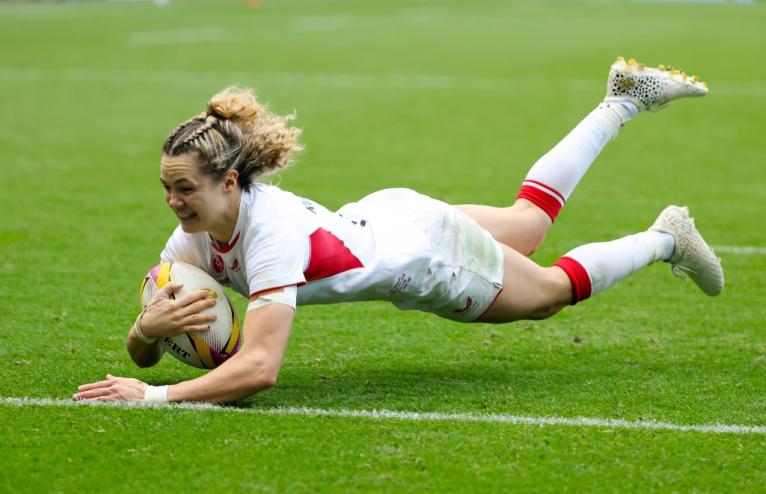
The prospect is frightening and exhilarating, and whenever Red Roses have given an interview in the knockout stages, the talk inevitably turns towards the crushing pressure to reverse the outcome from New Zealand 2022.
“We’re having fun out there. There’s some good celebrations going on and we are just trying to enjoy the game as much as we can and not take it [too seriously].
“The pressure is there already. It’s already big, we don’t need to make it bigger. We don’t mind if people want to tell us we’re under pressure – because we see that as a privilege.” [Meg Jones]
“Opportunity is just along the scale from fear of failure – only without the inhibitions – and, the way we want to play the game, we can’t be held back by anything.
“Honestly – we’re just excited. It’s already been the biggest and best World Cup yet, so – in that department – it’s job done. As for the pressure – it’s a privilege that everyone thinks there is so much [of it resting] on us! We’ve earned it, so come at us.” [Alex Matthews]
Notice a similarity in tone and phrasing? The first comment is star centre Meg Jones, the second new skipper Alex Matthews, in conversation with RugbyPass. When you have forgotten how to lose, it is impossible to know how and when the next threat will materialise. You may think you know, but you don’t. The unknown remains stubbornly opaque, until you find yourself in the eye of the storm.
The England players cannot be sure how they will react if the pressure ratchets up to Eden Park proportions and the game goes down to the wire. For Canada it is a very different narrative. The fear for the Red Roses is they will fall asleep into a rugby recurrence of the nightmare on Elm Street. The Canadians may be wondering whether they will wake up from their fairytale, only to find that it has all been just a pipedream.
On the eve of International Women’s Day in March, Rugby Canada had trumpeted a crowdfunding clarion call for CAD $1m [£530K] with one crystal-clear mission statement: ‘Win Rugby World Cup 2025’. Although a CAD $150,000 donation from the Canadian Rugby Foundation’s Monty Heald Fund had pushed it halfway to the target figure by April, 100% of the original fundraising goal had still not been realised before the tournament started.
Crowdfunding support may have elevated the operating budget from CAD $2.6m to CAD $3.55m, but as Rugby Canada CEO Nathan Bombrys told RugbyPass back in April: “Even after we raise this money, we’re still going to have one of the smallest budgets in the entire tournament. In Canada, philanthropy is a key part of the mix, and people are willing to support a good cause.
“They want to see the game grow, and they appreciate that the players are amateurs. They are professional in their approach, but they are not being paid, they have to do something else [for work], and our public appreciates that.”
When you emerge from that background to overcome a nation which has not lost a knockout game at the premier tournament in the world since 1991, you have to shake yourself to check it is really true. As ex-England captain Katy Daley-Mclean commented on the BBC after Canada had defeated the Black Ferns in a titanic semi-final, “you see how well-resourced some nations are, and then you have fairytales. Canada are a fairytale. You don’t beat New Zealand in World Cups. That was a statement of intent for whoever they play next week.”
Waking dream or recurring nightmare, the raw stats suggest the game will be a far closer call than many anticipate. It could go all the way down to the wire, just as England will be fearing and Canada will be hoping.
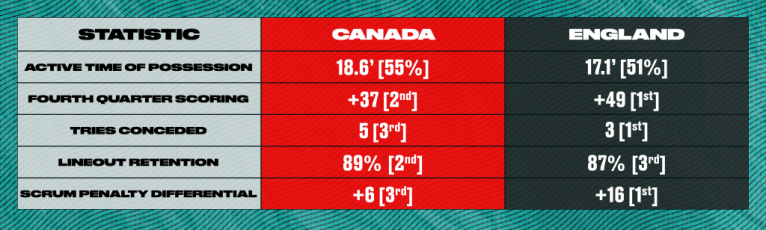
Set-piece performance is on a roughly level footing, with Canada enjoying marginally the better lineout return and England ruling the roost at scrum time. Both defences are top-notch and both sides have the conditioning values to establish dominance in the final quarter of games.
Where Canada like to play with ball in hand, England are quite happy to play without it, and it is here the clash of styles may hint at a classic final to come.
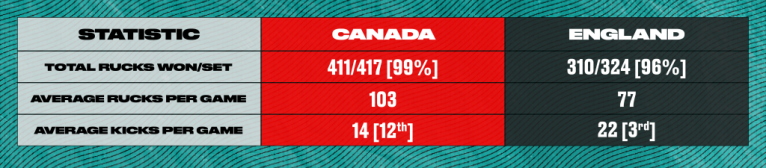
Make no mistake, the Canadian attacking breakdown will be the major battleground of the final. Canada have won all but six of their own rucks throughout the competition and they produce ball the quickest, at an average speed of 2.45 seconds per ruck.
England do not have either the same ability or desire to play multi-phase rugby but they are proud owners of the stingiest breakdown defence in the tournament, with their opponents requiring an average time of 3.3 seconds to generate a delivery from the ruck.
The battlelines have been drawn and the crux of the contest will pass in the blink of an eye; or rather, 0.85 seconds. If Canada can win consistent lightning-quick ball, there will be little even the yeoman red rose defence can do to stop Alex Tessier from pulling the strings, and the likes of Florence Symonds, Julia Schell and Asia Hogan-Rochester from reaping the bounty in the outside channels.
Nowhere is the essence of the contest distilled better than in the centres. In the red corner a tactical wizard at 12 in the shape of playmaker Tessier, yoked to a sevens thoroughbred in flying Symonds. In the blue corner, two ladies who could fit right into the back-row in the form of Gloucester Hartpury’s Tatyana Heard and Cardiff-born Jones. The latter even wears a headband, as if to emphasise the point.
The Trailfinder did an open-side’s work against France in the semi-final, winning three turnovers on the deck and one above ground as the lead tackler in a choke turnover.
The most rounded skillset of all four midfielders belongs to Tessier. She regularly appears at first receiver instead of the nominal fly-half Taylor Perry, and she established her threat on the pass in the first half of the semi-final.
The left-to-right, all-in-one transfer from Tessier is the key to unlocking the pace and power of Symonds outside her. When the New Zealand defence began to focus on the pass, Tessier ran and kicked instead.
In the first clip, Tessier sees the Black Ferns committing outside and over-reading the pass, and she cuts back on the angle to exploit the hole. The second example illustrates what it means to keep tactical control of the game with the boot. The flame-haired 12 kicked nine times in the second half, first forcing Braxton Sorensen-McGee to ‘lift’ with her reply, then drawing a charge-down and the penalty for a block on chase from the second contestable.
While England may hold the professional trumps in terms of ultimate conditioning values, Canada have their own jokers to play. The twin on-field ‘brains’ of the Maple Leaf operation are probably ahead of anyone on the Red Rose side in steering the tactical ship and changing the course of the game, and they are Tessier and second row Sophie de Goede.
De Goede is the daughter of ex-Cardiff second row Hans de Goede, who became the first Canadian men’s captain to lead his country into a World Cup in 1987. Her mother, Stephanie White de Goede, was the female national team’s first skipper. A 10 in her younger days, Sophie kicks goals, makes breakdown pilfers and leads all comers in ball-carries, offloads and lineout takes at the World Cup. But the way De Goede picks her running lines off the Canadian playmakers emphatically suggests a superior rugby IQ.
In both instances, De Goede is sensing space in the same way an inside back would, shifting across from the wide to the short side in that second clip to make the extra attacker and involved variously as first receiver, acting scrum-half at the next ruck and first cleanout in the space of only 12 seconds of play. She has a centre’s brain baked into a second row’s body, and it is a rich delicacy indeed.
Anyone who thinks the final is a foregone conclusion should think again, and take a moment to listen to De Goede’s words in Rugby World magazine a couple of years ago.
“When you think about the broader perspective, we do feel like we’re playing for the future of Canadian rugby, not just women but men as well. We need to drive the sport forward and try to get more profile and more backing, and that only comes with success.
“Seeing it that way brings a certain amount of pressure but it’s also a big opportunity. There’s a lot riding on this. It’s about the here and now but it’s also about the future. That’s the way I see it.”
Those are not the words of someone preparing to lose. For all those piling their bets on the Red Rose, Caveat Emptor.


Comments
Join free and tell us what you really think!
Sign up for free