
Maybe it’s an Aussie thing, but Eddie Jones is never happier than when reaching for a cricketing analogy to describe all things rugby. The wily Australian knows how to swap categories and translate thinking from one sport to another. When he imagined Northampton full-back George Furbank looking down the runway at an international career in 2020, he immediately saw an all-rounder, a Freddie Flintoff or a ‘Beefy’ Botham.
All-rounders are typically slightly better at either batting or bowling and Eddie envisaged the youthful Franklins Gardens backstop as a 15 who could also play 10.
“I believe he can be a very good 10, maybe that’s going to be a position that we consider him strongly for in the future. I’ve always had this feeling, and speaking to [then Northampton head coach] Chris Boyd has reinforced that he has got the ability to play 10.
“George has got a calm demeanour, good catch-and-pass skills, a solid kicking game and he’s a strong defender. He reads the game well, he’s decisive and he runs good lines. He’s a very impressive young fella.
“He’s just one of those footballers that you don’t need to coach a lot. He just naturally knows how to play. He’s got great positional sense. A lot of players coming through now play to a particular pattern, whereas he plays to the position of the ball. He senses where the ball is going to be.”
That is the quintessence of a rugby back-line all-rounder distilled, the sum and the substance of the matter. All-rounders who can manage the shift from auxiliary to prime playmaker and back again tend to possess a wide range of skills, but above all they have a refined positional sense. They know exactly where to be to oil the wheels in attack or defence, and for that reason they become central ‘glue’ players in a team’s development.
It is probably no coincidence either that Furbank enjoyed a multi-sport background at school, and he had originally imagined a future as a professional cricketer. When he looked up at the big wooden commemorative ‘scoreboard’ at Bedford School, the Saint was spellbound by batting records broken by former England skipper Alastair Cook. Furbank went to the Sixth Form College for a couple of years, knowing Cook had gone there.
“The pavilion at Bedford is named after him, so you can’t escape it! Cricket was a big part of my life growing up – the 2005 Ashes was my first big memory.
“I looked up to Freddie Flintoff and Kevin Pietersen. All my rugby came at Huntingdon Rugby Club from the age of five until I was 16 when I moved schools to Bedford.
“I had other sports at my first school, Kimbolton. I loved playing hockey, cricket and football there before my focus switched to rugby. It’s still pretty crazy to me I’ve played [rugby] for England.”
When Steve Borthwick ignited England’s first big cycle of improvement midway through the 2024 Six Nations, the backline players at the core of it were the two Georges [Ford and Furbank] in the playmaking axis, with Ollie Lawrence and Henry Slade in the centres and Tommy Freeman and Immanuel Feyi-Waboso manning the wings.
Furbank had been brought in to replace Borthwick’s long-time favourite at Welford Road, 6ft 5in master of the airwaves Freddie Steward. As I observed at the time,
“With the estimable Freddie Steward at full-back, England have tended to kick back rather than risk making a mistake in that no-man’s land between the two 40m lines.
“With George Furbank at No.15, Steve Borthwick swapped Leicester for Northampton and went against type as a coach.
“‘Borthers pushed his chips all-in on counter-attack with ball-in-hand, from positions on the field he would previously have considered either highly suspect, or speculative at best.”
England’s eureka moment occurred as early as the fourth minute of the match against champions Ireland.
— William Bishop (@RPvids1994) December 12, 2025
— William Bishop (@RPvids1994) December 12, 2025
First the Northampton full-back returns the kick by Ireland’s James Lowe ball in hand, rather than booting the ball up in the air and chasing after it. Then he shows that refined positional sense Eddie Jones noted by escaping from the first ruck and recycling himself outside Ford to make the key pass on the scoring play. That’s an all-rounder for you. Furbank is in the right place at the right time, and he becomes the vital glue in England’s two-phase try.
When he picked Furbank for a 2022 ‘Le Crunch’ Six Nations fixture against France back in 2022, moving Steward to the less-familiar right wing spot to accommodate him, Jones had explained the tactical switch as follows:
“France is the highest kicking team in the world so I don’t think they are going to deviate away from that too much. They come through the centre with their big forwards and once they tie you up a little bit, they spread the ball to the backs but they won’t do that without using their long kicking game to get them up the field.”
Nothing much has changed in the intervening three years. When Les Bleus kick, they are prepared to be patient and they tend to kick long, looking for the ideal ball to run back at the opponent via their lethal back three. Look at the following table for average length of kicks from the 2025 Six Nations, which France won:
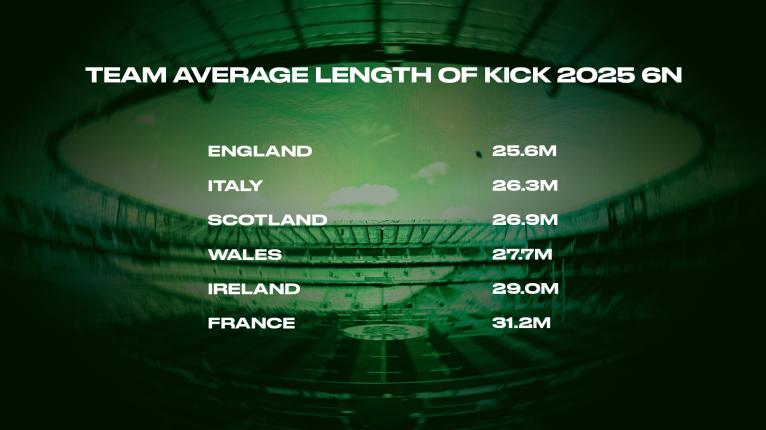
Maybe it is the Rugby League influence represented by Shaun Edwards in France and Andy Farrell in Ireland, but both of England’s principal rivals for the Six Nations title in 2026 kick longer than the likes of England, Scotland and Italy. The men in white may still want a kick returner at the back who can make the most of the opportunities that France and Ireland give them, the all-rounder who can either kick or bring the ball back by hand with equal facility.
In Furbank’s injury-enforced absence, Steve Borthwick selected Steward for the key November tour matches versus Australia, New Zealand and Argentina, and gave Harlequins’ Marcus Smith a run-out at 15 for the game against Fiji. Elliot Daly, 33, is also back in the frame after an arm fracture ended his tour of Australia with the British & Irish Lions.
With his booming left-foot kicking game and broad range of experience at both wing and centre, the Saracens man also falls into the all-rounder bracket, and the England head honcho described him in terms strikingly similar to Jones’ tribute to Furbank: “I always think those smart players can keep playing even later in their careers, because they have such intelligence about the game. I think Elliot’s in that category.”
While Steward has dropped some weight and become more elusive on the counter, he will probably never become the seamless all-rounders that Furbank and Daly already are. Therein lies a critical choice for Borthwick for the forthcoming Six Nations, on 21 February against Ireland at Twickenham; and on 14 March in the final match of the final round in Paris.
Furbank started for his club against Top 14 fast-risers Pau in the first round of the European Champions Cup, and after a sluggish start, his relationship with Saints’ principal playmaker Fin Smith began to shine. Northampton made two trademark scores where the interaction of numbers 10 and 15 was pivotal.
— William Bishop (@RPvids1994) December 12, 2025
— William Bishop (@RPvids1994) December 12, 2025
The shrewd chip-through and regather by Smith all starts from a kick return where his backfield partner-in-crime Furbank has cleaned out over the receiver, No.14 James Ramm on the right. After the initial cut has been made up the middle, the firm of Smith & Furbank has already recycled itself to make further progress down the right sideline on the next phase. Then the full-back showcases his ability as a facilitator, acting as scrum-half before sliding beyond Smith to provide the money pass out to the left on the final play. It is the speed of realignment by Smith and Furbank in attack which enables the move to continue, and the try to be scored. Between them, the pair contribute four passes, two runs, one kick and another cleanout in only 45 seconds of attacking play.
The second scoring sequence after oranges also originated from a receipt by Ramm, on this occasion with Smith providing the initial cleanout support.
— William Bishop (@RPvids1994) December 12, 2025
— William Bishop (@RPvids1994) December 12, 2025
With Smith out of play temporarily, Furbank picks up the thread at first receiver on two consecutive phases, and after Smith makes another break, he is there again to supply the killer pass to Ramm out on the right. Four passes, two cleanouts and one run in the space of 30 seconds. The interaction between the two is seamless and it glues the entire Northampton attack together on a sequence swinging from one sideline to the other.
When Jones initially spotted Furbank on his England radar, he envisaged a full-back with the skills to play at outside-half. When Furbank imagined himself playing international sport at school, he probably saw a batter looking up at the school records on the wall and aspiring to be the second coming of Alastair Cook.
That kind of versatility always finds a place in international sport, but the big question for Borthwick is where it fits in right now. The Saints man was an important factor in the English renaissance at the 2024 Six Nations and he is rapidly returning to both Test-worthy form and fitness. He has proved he can mind-meld with either Ford or Fin Smith, and against the longer kicking games of both France and Ireland, he could be an essential rather than a luxury.
Open the shoulders and swing the bat, Furbank could just be due another big innings for England.


Typical Aussie!
But very interesting to hear
Furbank is such a smooth operator, I love watching him play. I think he’ll be straight back in for the Nations if fit. A lot of Hendy fans here, I’m one too but he’s dropped an awful lot of balls recently as well as scoring a lot of tries in a free flowing attack. I don't think England need to rush him, lets pick him once he’s banging down the door.
Another big bloke at around 100 k’s and 6’3 too. Good for high ball.
Yep it’s a huge project but to attract one of the top coaches they’ll need a profile where they can reasonably expect to win 50% of their games…
This year and next year was always going to be tough given how much work needed to be put in place to rebuild the foundations (which they have done commercially).
I think the next 3 years after that is where the hard work will begin on rebuilding and replacing that entire squad. It’s probably a 40 player rebuild, which is why it will take 3-5 years to rebuild into a competitive team.
Watched Saints give the Bulls last rites yesterday. Pollock playing off No 10. Reminds me of a young Bobby Skinstadt. Going to be interesting to see how (if) Rassie can nullify the Saints attack which I presume will be wearing white come the summer yours to the Douth. From what I have watched recently England are going to be a very heavyweight factor in 2027.
I saw the result and then watched the game but it was a closer contest than the scoreline suggested for 60 mins but Saints were relentless in their constant attacking shapes and how many options they provide for Fin Smith to pull the trigger on it attack.
It’s not fair when they put Van der Mesh in the 12/13 channel off those 6 man line outs. You know what’s coming but you have to put 3 defenders forward to play human skittles and he comfortably wins the contact yards against them and leaves a massive numbers difference for the next wave of the Saints attack.
It’s a really clever attacking system, where they keep going until you run out of defenders.
It’s a really nice brand of rugby they have created over the last 30 years and their Franklins Garden pitch was always one of the best surfaces in the premiership for quick, running rugby.
Fair summary GVF. A weakened Bulls side team but it leave only the Stormers looking likely to advance in Europe this season…
Saints have the best integrated attack in the Prem and you can see the likes of Mitchell, Fin, Dingwall, Freeman and Furbank being involved with Eng for years to come. George Hendy too. That boy is a player.
Saints were very impressive this weekend but one thing we don’t really discuss is the double threat that Henry Pollock creates in attack when playing with Fin Smith. He almost plays as an extra shadow 12 on the other side, to give Smith options on both sides and makes it a very high octane attack.
I do wonder if you would start Pollock at 8 when playing with Fin Smith, which is another dimension to consider in this Saints axis concept.
I thought Furbank was very good but Hendy has improved from last year, so can’t be far off breaking into that ENG squad.
Young Henry is creating a bit of a problem for himself isn’t he? Even as a Saint he’s cast mostly as a ‘finisher’ not a ‘starter’. Does he want to be a run-on player, or the world’s best relief pitcher?
Right now you have to start Ben Earl because he is far more robust on heavy carries than Henry. Can you imagine Henry carrying over 20 times versus the ABs as Earl did? No.
Absolutely agree with this, especially when you have Dingwall at 12 aswell.
Hendy has been very very good this season and now furbanks back he's moved to the wing where he's scoring tries for fun in the last 2 games. To think they've still got Freeman to add into their backline aswell is quite something.
Slightly off topic but I watched Glasgow vs Toulouse and I couldn’t help but think how good Jack Willis, Tom Curry & Ben Earl would be for England.
Jack Willis has really developed as a player at Toulouse and is a much better player than when he left. I also watched the Durban Sharks vs Saracens and they really struggled to deal with Jack Willis and his carrying, these really are two options that ENG are missing out on when it comes to RWC 2027 selection.
Yes Jack Willis is one player who could even improve the current Eng back row. He’s tall at 6’3 so can win lineout and he has enough 8 about him to do some heavy carry work. That is one aspect of his game which has improved hugely at Toulouse.
I’d still have Sam Underhill at 7 though.😉
This is a good reminder that Furbank was looking locked in at 15 for England 2 years ago. He was very good on their tour to NZ if I remember right.
The blocking law change has created a bit of a renaissance for Steward though. I think (read: hope) either AUS or NZ can come up with a system to counter the aerial assault. It’s a tricky thing though, I’m thinking something like a combination of:
- Tall backfield players that can jump
- Teach them to catch GAA/AFL style over the head
- Dominant scrummagers to punish any knock ons caused under the high ball
- A 6-2 bench with mobile back rowers to match the 5x7s in the last 20.
- A 6 or 8 that’s good in the lineout to expose the 5x7 there (very hard to balance with mobility, Tom Hooper the ideal player for this)
- Put pressure on the 9 at any opportunity like the ABs did at Eden park.
- Then a kicking/possession strategy that ties all this together. I have less ideas about this
In any case, the england coaches should be very happy with their backline options as they can always revert to something different. I can’t remember them ever having this much depth across all positions? Maybe only 9 is a little thin after Mitchell?
Not so much on D tho. Time was if you kicked to Freddie with a protective shield around him it was 100% a clean catch. But even he is suffering in a one on one contest v the chaser now. The chaser can always do enough to prevent a clean receipt now.
England 9’s it is very much a ccase of Alex Mitchell and then all the rest. Nobody else has emerged from the pack behind him as a clear #2.
Great post Toko and absolutely spot on.
The only thing I would say, when you see potential of players like Noah Calouri and Tyler Offiah, ENG already have the next wave of wingers coming through who do items 1 & 2 far better than the current incumbents, so it’s only going to get harder to contest in those areas.
Calouri’s best skill is literally running backwards at 6 foot 4 inches (194 cm), with arms upright and he catches the ball like a Premiership Soccer keeper on crosses and does a similar thing on cross field kicks. It’s an incredible skill set that I see occasionally from others but he does it most games and is so comfortable catching overhead. Tyler Offiah (Martin Offiah’s son) isn’t as good but is almost identical in how he plays, so those two will improve ENG as they come through and they are taller and more athletic than the current batch of wingers.
I really struggled to get my head around the 5x7’s, I thought it would be a disaster and they would be overpowered and struggle at the line out . . . . BUT my fears so far have been proven wrong. We’ve actually gone from 130 tackles per game to +180 tackles, which is why we are so much better on D and constraining the naturally attacking teams (with 91% tackle completion).
Defensively, this is the best I have seen an England side. I still think they are still a bit dull in attack and is the reason why I would prefer Fin Smith at 10, who moves the ball quicker and plays a more expansive game plan but it will all depend how much that impacts the 5x7’s gameplan and why I think they may stick to the tactical kicking and back the D to constrain the opposition, rather than go all out in attack.
It’s made them harder to beat but I am still worried if the large power teams can just play through us, so will be another big test in the 6 Nations playing FRA in Paris and ultimately, will they be able to constrain SA on those firmer pitches in AUS where they will probably use Tonyball more than they did this Autumn in Europe. That’s still the unknown in the back of my mind with this new system and if that workrate at +180 tackles can be sustained across a RWC timeline (we changed the team week to week).