
It wasn’t so much that the Wallabies lost to France that has rankled Australian rugby fans since Saturday night, but rather that there was no obvious plan of how to get themselves out of the hole they were suddenly in midway through the second half in Brisbane.
NEW: Follow Your favourites in the App 📱
You can now follow their favourite teams, tournaments and players in the RugbyPass App!
Eighth-ranked Australia were always going to be up against it, facing the fourth-ranked French, especially with the fresh Toulouse and Montpellier contingent waiting to meet them in Brisbane, after missing the first Nations Championship Test in New Zealand the week before.
And the uphill task only became harder when key players Carter Gordon and Tom Hooper were ruled out early last week, and then Ben Donaldson as well only 24 hours later.
It meant the Wallabies’ primary playmaking and game-controlling duties were left to ACT Brumbies fly-half Declan Meredith, on his debut, and Queensland Reds full-back Jock Campbell.
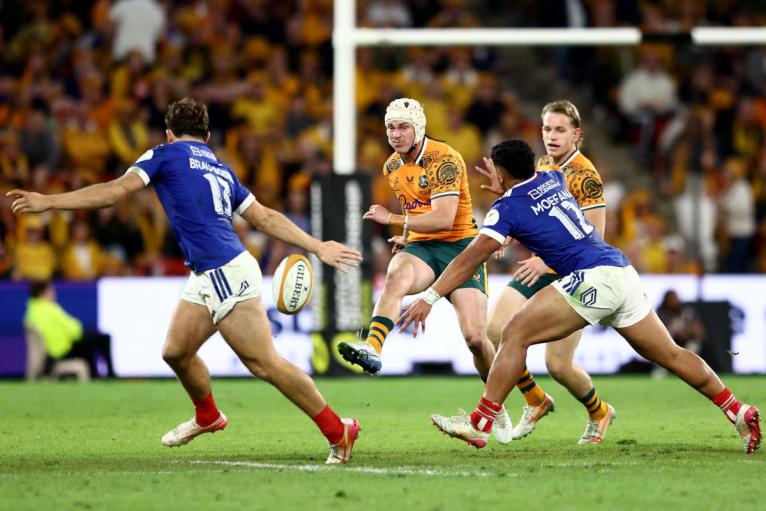
Meredith started the Super Rugby Pacific season in superb form before fading, not unlike the Brumbies, over the back half of the season. But his form was good enough to keep the incumbent Wallabies fly-half, Tane Edmed, on the bench all season bar one load management rotation match.
Campbell has filled in at fly-half for Queensland, including once around mid-season this year, but has never started a professional level game in a No.10 jersey.
To suggest it was a risk was to indulge in significant understatement.
Once Meredith and scrum-half Ryan Lonergan were replaced just shy of the hour mark, it felt like the last vestiges of Australia’s attacking shape went with them.
And so it quickly proved. As France sparked up properly in the second half, the Wallabies quickly found themselves on the back foot and even playing into Les Bleus’ hands.
As the attacking shape departed, the French defence was able to pressure the Wallabies into mistakes, pushing the Australians deeper into their own half and with no evident plan of how to get out of it.
Once Meredith and scrum-half Ryan Lonergan were replaced just shy of the hour mark, it felt like the last vestiges of Australia’s attacking shape went with them. Several times replacement nine Tate McDermott took off from the base of the ruck only to stop before contact and search for options nearby, having to change direction and retreat in the face of advancing defenders before getting the ball to whoever was closest.
Campbell, when trying to play to space, found himself playing much more east-west than north-south, with the French defenders happy to hand him off from one to the next. All they had to do was wait for the next inevitable Wallabies mistake and take advantage in any direction of their choosing.
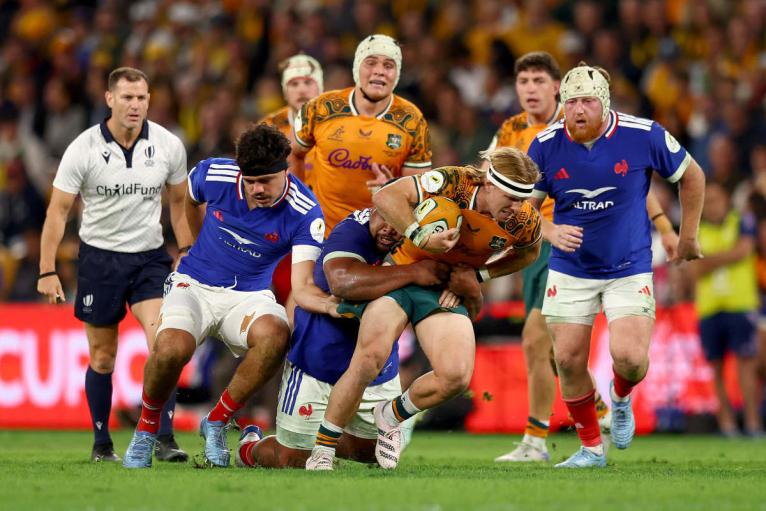
This lack of shape led to Australia ceding ground quickly, which in turn highlighted yet another current shortcoming.
The Wallabies’ kicking game is becoming more and more predictable, in which defending teams know that if they can withstand the carries and any extended phase play that comes with it, Australia will have to kick for lack of any other real option.
Though they will often maintain possession for many more than five phases, the plan amounts to an almost rugby league-style of phase play until nothing happens, then kick.
Of the six teams playing Nations Championship games in Australia and New Zealand last Saturday, the Wallabies – across both defeats – and also Japan, in their loss to Ireland, were forced into kicking for territory in nearly two-thirds of all the kicks they made, yet still had less than half of the territory share for the match.
The Wallabies are still playing the old Irish high-possession system they played under Joe Schmidt and for many years under Andy Farrell as well. They remain convinced possession remains the best way of exiting their own half, yet are consistently being pinned back in their own half because of it.
The Wallabies are yet to fully embrace the idea that modern rugby is often best played without the ball. Maybe that’s the gradual influence of all the other possession-heavy sport played in Australia impacting our rugby now.
Both Ireland in Sydney, and France in Brisbane, kicked back at Australia for half of all kicks they took, and won the territory battle, 57% and 54% respectively. The Wallabies held more than half of all possession in both games, but what good is that when you’re stuck on your side of halfway?
Australia are also making fewer attacking kicks than these teams – and New Zealand and Italy as well – and though they might be retaining a similar percentage of contestable kicks as the others, that’s only equated to three contestable kicks retained across the two games.
Ireland’s game now has swung completely in the other direction. At least half of all kicks in both Nations Championship games so far have been made in attack, roughly half of those attacking kicks have been contestable. They retained 60% of contestables against the Wallabies, and 75% against Japan in Newcastle. They enjoyed 57% of territory, and scored five tries in both games, averaging 3.6 points per 22 entry.
Clearly, Ireland have made the switch to playing with the ball only where you can actually do something with it, but the Wallabies are yet to fully embrace the idea that modern rugby is often best played without the ball. Maybe that’s the gradual influence of all the other possession-heavy sport played in Australia impacting our rugby now.

It will be interesting to see whether the upcoming coaching transition to Les Kiss looks to make this adjustment, though you wouldn’t classify the Queensland Reds team of 2026, or any recent vintage, as being one that avoided playing in their own half at all costs.
It will be interesting to see whether there are signs of his increased input in the Wallabies’ preparations in Perth, where Kiss and his incoming coaching team become more involved in the lead-up to Australia hosting Italy at HBF Park on Saturday.
As it stands right now, it’s hard to know who needs a win over the Italians more – Schmidt or the playing group.
Schmidt said himself in Brisbane that he’s a naturally competitive guy and would love to have had more success with the Australian team than he has. He knows that there will be more focus on him this week, being his last Test week in charge, and he would love nothing more than to finish his time in Australia with a win.
Schmidt will say this week that the players don’t owe him anything, but they certainly owe themselves an opportunity to enjoy the fruits of what they’re trying to deliver on the field.
But it’s also been a good while since the Wallabies lost seven games on the bounce, and that will obviously be a major motivator for the players this weekend.
They will want to send Schmidt off with a win as well, but more importantly, they need to remind themselves as much as anyone that these two really strong first halves against Ireland and France can be backed up after half-time, and that they can play games out much closer to the full 80 minutes.
And they deserve that kind of performance. They’ve played some truly outstanding rugby in passages over these first two games of the Nations Championship, and it’s clear that they are trying to play with more enterprise. They’re playing wider to try and get the ball to their strike players in more space, and they have had success in opening up some very good defences.
Schmidt will say this week that the players don’t owe him anything, but they certainly owe themselves an opportunity to enjoy the fruits of what they’re trying to deliver on the field. The first step to achieving that success starts with not making things harder out on the field than it already is.
 Register your interest to receive priority updates on RWC27 ticket releases. Don't miss out, stay in the loop!


Good luck to the Wallabies 💥
You have nailed the frustration. The complete lack of game plan to stay in that second half was embarrassing. The bench is full of toilers, not guys who can change the game (Tupou and McDermott excepted). Shaw’s primary skill is workrate - hitting rucks, making tackles and a solid lineout. Using him off the bench makes zero sense, particularly when a big guy who can have an impact isn’t even in the squad. Bring Amatosero off the bench if you won’t pick LSL. Why else is he in the squad? CdC was a forced change, but damn, we’re missing Gleeson’s bench impact. We were unlucky to lose Nasser (BPA was excellent).
The constant changing of our 10 contributes to our awful kicking game, but the SR teams aren’t very different from the Wallabies wrt playing style, so it’s probably asking too much for the flyhalves to become skilled kickers with the limited time they have practising it in game situations.
I watched an ITV review of the two weekends’ rugby with ROG and Biggar, and O’Gara was in despair for the amount of game time Frawley gets. He spoke of a test 10 needing 100 club games to learn the craft.
Our 3 starters this year have 56, 78, and 18, with the most likely backup when fit, Lynagh having 37. Explains a lot.
Hi Brett, more than anything the Wallabies need their best players on the pitch. With injuries to our definitive playmakers (2), our attacking nous went with it. To add insult to injury, the selectors then think that an untested duo of Meredith/Campbell can steer an international side with no experience is laughable.
Joe's kriptonite has always been his tunnel vision when it came to the substitutes and squad. How Noah / Foley haven't been called in beggars belief. We need a win now, not in 2 years.
Where is Edmed ?
Playing 10 for Tuggeranong in Canberra..
Australia mainly plays a possession-based game (and they do it fairly well) because they don’t have the confidence to play with attacking kicks in behind, probably because they simply don’t have the players with the skill set to execute that kind of game.
The quality of their half-backs has been a problem for more than a decade now, and without world-class halves, Australia will never be able to turn things around. Coaches come and go, but the defeats keep piling up.
The fly-half we saw against France on Saturday wouldn’t be a first-choice No. 10 for any Top 14 side. He had a few good games for the Brumbies at the start of the season, and suddenly he finds himself wearing the No. 10 jersey for the Wallabies—a two-time Rugby World Cup-winning team.
The talent pool is extremely thin in certain positions, and in my opinion there’s no short-term solution. With the Rugby World Cup on home soil fast approaching, things could get very difficult.
We have the players but our kiwi coaches won’t select them. There’s no pointy criticising Australia when we have a kiwi coaches undermining the team. It just doesn’t count.
I do not understand why everyone keeps on about the long kicking since that's what has gotten us into this situation in the first place.
When we kick long, we give the ball away. It's as simple as that. When we keep the ball in hand and if we kick we kick short, then we have go forwards.
What's so hard about that concept for people to wrap their heads around?
We don't need a Finn Russell or Romain Ntamack. We need someone in the 10 jersey who suits our natural style, which is free running backed up by massed support.
Whenever we go long, we have no one who can even make a contest of it and if they do somehow manage to get there they almost always knock it on.
And when the rarest of the rare happens and the Australian player comes down with possession there's no one for them to pass it to and they often don't have the pace or nous to evade the defenders closing in.
So the fact that this keeps happening tells me that this isn't the way to go for us.
The term that you're using and that everyone else has been using, “game drivers", is just another empty buzz word.
The person with the ball by definition is the game driver since they are the one who determines what happens with the ball.
It's not a specific role nor should it be classified as one. You're the game driver because you're seeing opportunity and tying to exploit it by doing something with the ball.
And you can also be a game driver without the ball which to your credit was something you raised.
This is because without the ball you can use your ball contest and gain line pressure to compel the opponent into playing a certain way.
Other sides do this to the Wallabies all the time but the Wallabies seldom do it to other teams.
Part of that is leadership, part of it is the rugby intellect of the players generally to read the game and understand what's going on at all times.
Both are things that can be worked on and certainly must be worked on if the Wallabies are ever to return to anything close to competitive at this level of competition.
A great start would be to replace Wilson as captain. He's a great player but he's a poor captain and although serving the Wallabies earnestly with his whole heart in that capacity he just has never been able to deliver as the team have needed him to in the role.
TC, attacking kicking, rather than long or territorial kicking is what I’ve highlighted. As I’ve mentioned here elsewhere, the only other team in the NCs with similarly low attacking kick numbers is NZ.
The Wallabies are retaining similar % of contestable kicks, but they’re not putting up nearly as many as other teams, which is also contributing to them losing territory battles, which is forcing them to kick for territory..
Great read Brett. I agree our lack of an attacking kicking game is a key weakness. You can play running rugby for 40min but not for 80min. Interestingly the Reds upped their attacking kicks this year from 2025, it was a clear strategic shift. Maybe Les will continue this at the WBs? But we need the players that can execute. Can’t think of many as slick as what they’ve got in the Boks, France, and NZ. I suspect Joe is letting the players decide what they want their identity to be, and will support them with skills and strategy in achieving this. Not sold on the rationale that league has anything to do with this, but more the myth of the running rugby identity in Australia. Attacking kicks are celebrated in league too, the Roosters are certainly using a lot this year, for obvious reasons with Marky Mark on the wing there, and admittedly they are to some extent an outlier in the stats there. But the Alfie Langer grubber, the Andrews John chip kick, or the "Burton Bomb"….also very much part of the attacking style in league.
When viewed along side the other teams in the Nations Championships TL, the only other team with the low attacking kick numbers is NZ. And unfortunately, the Wallabies currently don’t have the rest of the game to back that up like the All Blacks can..
How many games has Schmidt taken charge of? 30 now I think. In that time he has 10 victories. In the last 17 matches just 4 wins. After the Lions series people were quick to congratulate Schmidt for the great job he did in making Australia competitive enough to make the Lions series a fight. They were right to do that. Since then though this team has been on a major slide. Now after 2 and a half years the question is did Schmidt really do anything to improve this team and its fortunes for the better? With a 33% record over his time he did no better than his predecessors and once again the Wallabies are suffering of a crisis of identity, playing resources and results. Schmidt leaves the team in the same state he found it in. Low on confidence and losing. They may not be in the same disarray as after the Jones era but its rather dismay that just over one year out from the world cup they do not look capable of challenging for that tournament even on their own patch.
11 wins, NLAR
Good analysis but when you don’t have elite game drivers, it’s hard to win a test match. Especially against a quality French outfit who despite not training together are far better on paper.
Hell of a problem to have SB, trying to fit Ntamack and Jalibert into a backline together..
It’s a sobering reflection of Australian rugby that Carter Gordon should be considered a “key” player. Solid enough at club level, but below average against Tier 1 countries.
He’ll be a super star once he gets used to the rigour of test rugby
A victory in his final game would catapult his career Wallabies win percentage to 38.7% (12 wins from 31 Tests).
Even if the Wallabies were to emphatically smash Italy by 100 points, Joe’s tenure would lie second bottom on the rung, sandwiched between the great hatchet job of Eddie Jones and the damp fart era of Dingo Dave.
Let’s be honest, the Joe Schmidt Experience has been warmly underwhelming. Overwhelmingly disappointing.
Not sure why anyone should be concerned about anything more than a prompt and unceremonious send off, preferably followed by a bout of amnesia.
Who could have done any better? You can only do what you can with the players you’ve got.
Very difficult to argue with Bretts points on game style. Very clear that there are three key factors in addition to JS’s tactical system. 1) Our gameplan completely falls down when the 9/10’s are changed and/or injured. 2) As is the case for AU teams in SR; we have no effective tactical and long kicking game to match or opposition. 3) We have no effective leadership or composure when the game starts getting away from us. Usually about the time of the 60 min tactical replacement window. This is consistent with the same leadership group of the Reds with the same results.
Really good points, SF..
To many mistakes and a couple of pointless kicks to many at important part of game when in doubt put it up high and some missed tackles other than that Oz still showed can easily foot it with the big guns score was flattering to France in the end but still deserving of victory
Firstly why they didn’t select Tom wright as the stand in no 10 after DM went off. Tom has played no 10 in league and also has stepped in to the role in rugby games. And jock who could be a good no 10 given some time , was fab at fullback last week.
But to me the schemozzle is in defence. It’s a joke. Max j missed crucial tackles as did daugunu -as did others. it’s not acceptable at that level. But more so their defensive structure has been poor for a long time- Laurie fisher is a great coach but not in defence.
The defence shape and strategy was a disgrace.
While I’m not sure Les is the guy , and hope to be proven wrong ( Qld weren’t great even after three years of Les) scott Macleod is. I’m hoping he will completely revamp our defensive posture. That at least will give us a fighting chance of not being regularly spanked.
I’m going to copy and paste something I said on 8/9 Rugby today, JB:
I know it's a popular theory to uphold, Wright being an option at 10, but I don't think it's going to happen, nor do I really think it's ever been real. I know he has a history as a schoolboy 10/12, and I know he played 6 (12 in rugby, essentially) for Manly in league. But that was nearly a decade ago now.
There's also a big difference between standing at first receiver for a specific play, and properly managing a game as a no.10. If Wright really had these abilities, we'd have seen him play 10 well before now. Asking a 30yo fullback to play flyhalf is a tall order, as Campbell has found out several times this year..
Joe certainly hasn’t been helped with injuries and I think there are some questions to be asked of the S&C team because the Wallabies seem to be getting more injuries than a lot of other teams. 100% on the tactics and I’m a bit worried that Kiss, who has been with Joe for so long will have the same or similar game plan. The Reds in 2026 were hot and cold and while they played some great rugby at times, their poor games were very poor - a bit like the Wallabies TBH.
Valid points KwAuss - though some guys (Gordon, Paisami, etc) have a history of soft tissue injuries, too
The AB’s attack coach who with Foster prefered Finlay Christie over Cam Roigard in 2023…
His unflattering tenure with RA is the reason I'm glad NZR never gave him the AB’s job…
100% I still think that if we’d picked Roigard for the RWC final we would have won that game - never mind all water under the bridge now. Seeing Joe’s unfathomable selections, poor game plan and lack of growth I am so glad he is in Australia and not NZ
Hitting some nails on some heads here.
Joe will quietly have been enormously disappointed to have lost Gordon and Donaldson. With those two plus Lonergan, Campbell and Wright there was the makings of a good kicking team with multiple playmakers; counter-attack variability a point of strength.
All valid points, PM. Wright’s two 50/22s were massive in the first half..
Only a fool would have selected Campbell as the replacement 10.
The headline should be ‘Joe Schmidt should stop making life difficult for the Wallabies, deliberately’.
The sooner he is gone the better.
Bring back Eddie - nah not really only joking..
Well funny you should say that. Joe Schmidt’s record over his last nine games is actually worse than Eddie Jones’ record over the nine games he coached the Wallabies not so long ago. Eddie won 2. Joe won 1. So Eddie Jones is twice as good as Joe Schmidt, obviously.
So those that say that hopeless Australian Eddie Jones was the worst coach of all time so all Australian coaches must be hopeless, must have a very interesting opinion of Joe Schmidt.
Crickets ?