
It is 15 years since ex-England and Lions hooker Brian Moore demanded a change in the scrummaging laws – or rather a more forceful re-implementation of the existing laws – via an online petition in The Daily Telegraph. The idea was to bring back the art of hooking the ball for the man in the middle of the front row.
It read: “We, the undersigned, demand that the International Rugby Board mandate all referees to properly apply Law 20.6d, requiring a scrum-half to feed the ball in the scrum along the middle line, during all games.
“Furthermore, any referee unwilling or unable to referee the above law in letter and spirit may face disciplinary action.”
About one year later, in May 2010, Moore reappeared on the rugbyrefs.com site forum with a note of explanation: “if you force the scrum-half to feed the ball straight, the hooker has to put his weight on the non-striking foot, dive forward when he sweeps his leg and complete the hook in a roughly round movement.”
It was a laudable attempt. Moore’s experiment was briefly trialled, but the venture turned out to be a rather wistful and short-lived revisit of the amateur era. When the ball was fed into the scrum exactly down the middle of the tunnel in a modern professional scrum, the pressures were so great the hooker could not even raise his foot to strike for the ball without risking serious injury.
The advances in size and power, particularly in Mooro’s old spot, were simply too much to overcome. Nowadays the prime directive allows the halfback to align with his left shoulder down the middle line of the scrum, so the feed occurs underneath his hooker’s feet.
No position on the field has undergone a more profound transformation with the advent of professionalism. In the last World Cup of the amateur era in 1995, the eight starting hookers from the [then] Five Nations up north and the Tri Nations down south averaged just under 100kg [99.5]. Wind the clock on to the last tournament in 2023, and that average had risen by 13kg.
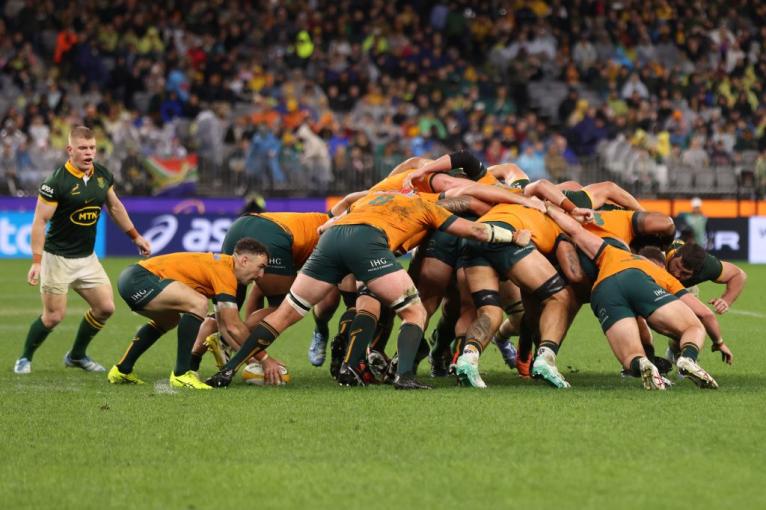
The truth of the modern scrum is the hooker now plays effectively as a third prop in the tight, but is still expected to offer many a skill-frill outside it. The good news for Joe Schmidt is the front row is one area where Australia can expect to make immediate gains, maybe even improvement ahead of the curve, in the forthcoming double-header against the Pumas.
At loose-head, Angus Bell will have one more game under his belt after returning from a recurrent, long-term foot injury in the second game against South Africa, while 135kg Taniela Tupou is likely to be added to the squad on the other side after a recent family bereavement. A quintet of Bell, Tupou, Allan Alaalatoa, Isaac Aedo Kailea and Jame Slipper is a depth chart to be respected, even feared on the global stage.
The men in the middle who will be expected to sew the scrummaging effort together are newbie Josh Nasser and craggy Top 14 returnee Brandon Paenga-Amosa. Queensland rake Matt Faessler may be something of a folk hero in his home state, but at 105kg he is a goodly size for the position as it was circa 1995, not 30 years later.
From the overhead angle the size differential between Faessler and his opposite number – 120kg Malcolm Marx – is all too obvious, and it was far too hard to mask in the first Test. This was one of five penalties the Wallaby front row gave up at the Suncorp.
For the mini-tour in the spiritual home of cohesive scrummaging, ex-Queensland rake Paenga-Amosa has been added to the selection mix. He is as big as Marx and an even better scrummager. He was already very good when he left Australian shores for French club Montpellier, but his most recent comments announced a further leap forward in development:
“Scrummaging was a big one over there [in France]. Everyone knows that tight-heads like taking that angle [inside]. For example, Nella [Taniela Tupou] is very good at it and everybody knows, or every hooker knows [it]: ‘Hey, this week I’m going against Nella. I’ve got to drop my left shoulder. I’ve got to protect my loose head,” he told The Roar podcast.
“The reality of French rugby is that everyone’s like Nella. That’s the truth. I wouldn’t say everyone’s like him in terms of power – Nella’s just a freak – but everyone scrums like that.
“Everyone takes that angle, comes hard at your neck, and tries to break the seam between the loose-head and the hooker. I feel like that’s an area I had to improve on, and I’ve gotten a lot better as a scrummager.”
The key to a strong-scrummaging hooker in the modern game is one who can promote ahead of his props, and particularly the loose-head, to ‘take point’ in an advancing scrum.
The first clip is taken from a Super Rugby match against the Blues before Paenga-Amosa left for the Top 14, and it illustrates just how effective the ex-Reds rake can be working in concert with old mucker Tupou. The Blues’ tight-head is holding his ground, but the pressure exerted by the Queensland numbers two and three is entirely too much for the defending hooker and loose-head [the Reds’ 2024 recruit, Kiwi Alex Hodgman].
The second example comes from a Champions Cup game between Montpellier and Exeter, and shows how the modern hooker can become the spearhead of an aggressive attacking set-piece. Paenga-Amosa is the most advanced of the Montpellier trio as they roll over the top of the Chiefs front row; and that is no mug opposite the Australian, it is Luke Cowan-Dickie, an ex-prop in his England age-group days and one of the strongest scrummaging hookers in all of Blighty.
The Top 14 experience opened Paenga-Amosa’s eyes to the breadth and variety of the global game, and it has added many more arrows to his quiver of skills:
“I was so small-minded thinking that the way Australia plays, the way we play in Super Rugby, is the only way.
“I didn’t really understand what they meant until I was over there, where I got to experience a different type of game of rugby, a more physical game that doesn’t have too much structure to it. The physicality is just another level.
“I had to unlearn a lot of things, to re-learn how to do things another way.
“In Super, I would say the [lineout] throw is a lot more direct and it’s sharp, it’s quick; as opposed to France, [where] it’s a lot more like a lob because of bigger bodies, players are not as quick getting off the deck or in the air.
“Learning how to [deliver] two different types of lineout throw, or scrummaging two or three different ways, it really added to my arsenal.”
With the best scrummaging hookers now often reserved for ‘bomb squad’-type duty from the bench, Paenga-Amosa is the ideal man to form a late-game backbone with Allan Alaalatoa on one side of the front row. and either Isaac Kailea or James Slipper on the other.
The other positive to emerge from the middle of the front row in Perth was the promotion of Nasser to starting hooker. Nasser was a tight-head prop for the Junior Wallabies at the 2019 World Cup, but sensibly chose to move his 115-kilo frame into the middle of the tunnel in the pro’s.
In his first season as a starter for Queensland in the 2022 iteration of Super Rugby Pacific, he flashed Test-worthy potential both in the tight and the loose.
Hookers who can lead their props through the seam between the opposing hooker and tight-head are already worth their weight in scrummaging gold; if they can passably impersonate Dane Coles in the wide channels as well, you are on to a winner.
The first-half scrums were noticeably more solid for Australia in Perth than they were in Brisbane, with the Wallabies emerging well in credit with a penalty and a free-kick won at the set-piece, none of their own feed lost and a reliable attacking platform to boot.
The Joe Schmidt rebuild will take time and patience, and it will take even longer than anticipated with overseas players likely to be excluded from selection for the foreseeable future. But one department of the team in which the Wallabies can improve immediately and dramatically, and may soon find themselves ahead of the global curve, is in the front row.
Bell and Tupou returning at both prop positions, and Paenga-Amosa coming back in between them, represent three players who can make an immediate impact on a jittery Pumas scrum during the mini-tour of Argentina. With Paenga-Amosa’s avowed attitude, they can scarcely go wrong:
“If I get the opportunity, I will take it and run with it. If I don’t, then it’s just not meant to be. But that’s definitely a goal for me, to get back in the squad or to compete with the other hookers and essentially make the Wallaby jersey better; whether it’s pushing other players to be better, or it’s me being pushed to be better. I’m just trying to build rugby in Australia, essentially, bro.”


Comments
Join free and tell us what you really think!
Sign up for free