
The Investec Champions Cup is a tournament renowned for its generosity at the pool stage. Two thirds of the original 24 clubs are destined to qualify for the knockouts, and some of those will lose more games than they win.
A more cutthroat intensity only really manifests in the final round of the group stage. Only then does it become live or die. No second chances, no repechage, no back door entry to the knockout stage of the competition. You either live to fight another day, or you go home empty-handed.
There was a sharper edge, and a more personal meaning to that mantra for two of the number 10s involved in the game between La Rochelle and Harlequins. The 48-year-old Ronan O’Gara has transitioned into the world of coaching and built a cathedral of rugby worship in the Bay of Biscay, but his days in Le Vieux Port are numbered.
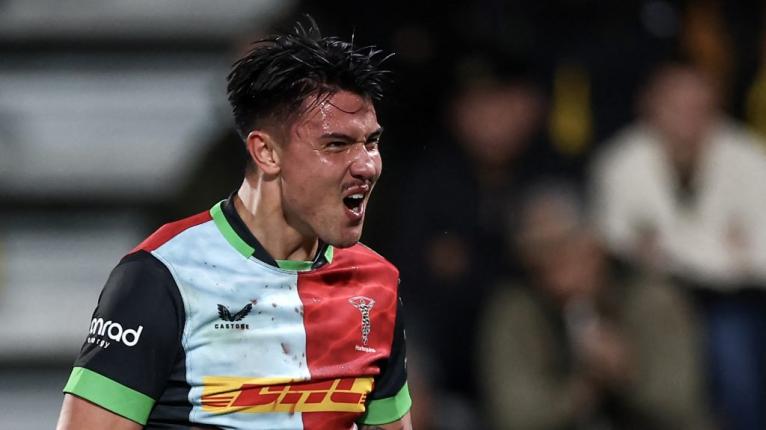
Marcus Smith will be 27 in a few weeks, and he has reached a crossroads in his playing career. He stars for a club which has fallen behind the curve in the Gallagher Prem; now he is ranked no higher than third in the England pecking order at his preferred position of fly-half, having been hailed as a generational teenage talent.
O’Gara and Smith have arrived at a turning point in their fortunes. They have reached that critical juncture when somehow the Irishman’s two Champions cup winners medals, and the little magician’s 46 England caps and two Lions tours, no longer seem to matter so much. However successful it was, the promising past has paled and the present choice is all.
La Rochelle only needed one point from the game against Quins to secure their passage into the round of 16, but they managed to snatch defeat from the jaws of victory in the dying embers of the match. The word ‘unacceptable’ was ringing around the head of the Munsterman after the game, ricocheting from one chamber of the mind to the other.
“It’s not an easy night. It’s a huge disappointment. I take my job very seriously. What is this, tonight? The club, me, everyone: we’ve lost big tonight. It’s unacceptable. It’s not possible, especially when you look at the number of opportunities we have to stay in the competition. That’s why I’m even more frustrated.
“You have no idea of ??the frustration, the disappointment, the rage in my head seeing this in front of our fans who pay a huge amount of money to be here on a Sunday. It’s unacceptable.”
O’Gara has reportedly been in discussions about his future with the club, having previously name-checked several Test nations he would like to coach in the future. The end in the Charente-Maritime is coming, and it is coming fast.
The man who set the seal on La Rochelle’s demise was none other than Smith, who potted a last-gasp penalty to sink the home side and bring down a dark curtain of bewildered silence over the Stade Marcel Deflandre. It was a rare highlight reel moment in a season which has seen rather more snakes than ladders.
Eddie Jones’ career as head coach of England ran in parallel with Smith’s emergence as a teenage rugby sensation. The Australian first crossed paths with Smith in 2015, with the Brave Blossoms based on the south coast at the World Cup while Smith was playing for Brighton College. When he was appointed by the RFU after the tournament, he lost no time including the mercurial youngster in the England senior squad as an apprentice, polishing his own infant x-factor and other people’s boots.
Six years later there were dire warnings about the pitfalls of celebrity after 18-year-old Emma Raducanu had won the US Open in women’s tennis.
“There’s a reason why the young girl who won the US Open hasn’t done so well afterwards,” Jones said. “What have you seen her on? The front page of Vogue and Harper’s Bazaar or whatever, wearing Christian Dior clothes. All that is just a distraction around her.”
That sense of inner tension in the development of Smith never left Jones’ media pronouncements. The view of endless potential – “there is no ceiling to how good [he can be]” – after a man-of-the-match performance against Italy in 2022, was always balanced by a cautionary warning – “if he keeps wanting to get better and having a learning mindset, then he could be an outstanding player at Test level by the World Cup.”
By the time that World Cup arrived 12 months later, Jones had been dismissed by England and Smith had been pushed out to full-back. Jones still had time to reiterate his double view.
“He is not a superstar yet, he’s a promising young player,” the coach said. “Marcus is 24, he has got a lot of learning to do – but unless he plays [at 10], he never gets that learning. At Test match level instinctive players, particularly when they are in high decision-making positions, they take time to mature.
“I think we will see over the next two years whether or not Marcus Smith has what it takes to go as far as his potential suggests he can. At some stage, you have got to take a bit of pain if you play a guy like him. He is a good player, a very good player, but he is not a full-back.
“That is up to [Jones’s successor] Steve Borthwick, but if you want to develop him as a player? Of course, he has got to play 10.”
The advance of Fin Smith at Northampton and the resurgence of George Ford at Sale have relegated Smith to third-string 10 and a bit-part player who can cover outside-half and full-back since then. His talent has yet to be either fully developed, or fully trusted at national level.
A statistical comparison of the run-pass-kick balance among the three main contenders helps illustrate why that is still the case.
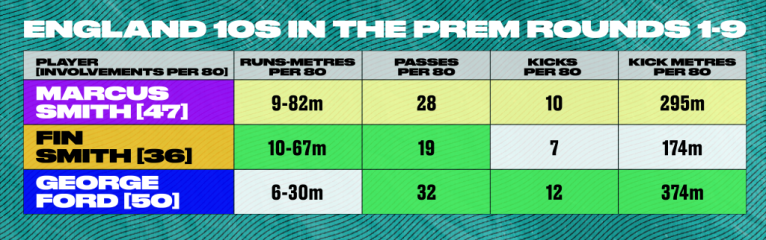
Some 88% of George Ford’s involvements come via the pass or the kick, so he can be described as a facilitator and a territory controller. Then 81% of Fin Smith’s actions are ball in hand, either run or pass, and the lower number of overall involvements shows he works best in a collective, with others such as George Furbank and Rory Hutchinson or Fraser Dingwall at Franklin’s Gardens.
Marcus Smith falls somewhere between the clarity of the other two stools. He is probably the best pure runner of the three but he kicks almost as many times per game as Ford. He passes almost as much as Fin, but in a team which creates the fewest clean breaks of any club in the league bar Newcastle Red Bulls. When you ask the question, ‘what does each 10 deliver as an England fly-half?’, two of the answers are clear but the other remains stubbornly opaque.
The game between La Rochelle and Harlequins gave ample indication just why that is still true with Marcus Smith in the prime of his footballing career. Let’s start with the shorthand, a simple wide attack from scrum.
— William Bishop (@RPvids1994) January 19, 2026
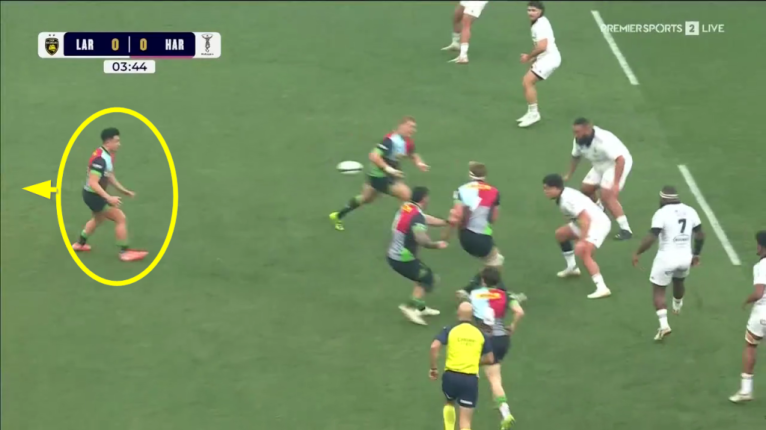
Scrums from positions inside your own half are often excellent platforms for attack, with the defensive open-side wing caught in a no man’s land: uncertain whether to hang back for the kick in behind or come up in line for a wide passing play. Smith’s first two steps make the decision easy for him: he takes two steps away from the north-south axis, and across field towards the far corner flag. That means he cannot kick and he cannot run. It turns the shoulders of the defensive centres outwards to follow the ball and makes the wing’s choice a straightforward one.
The longhand was writ in two other sequences, one in each half.
— William Bishop (@RPvids1994) January 19, 2026
— William Bishop (@RPvids1994) January 19, 2026
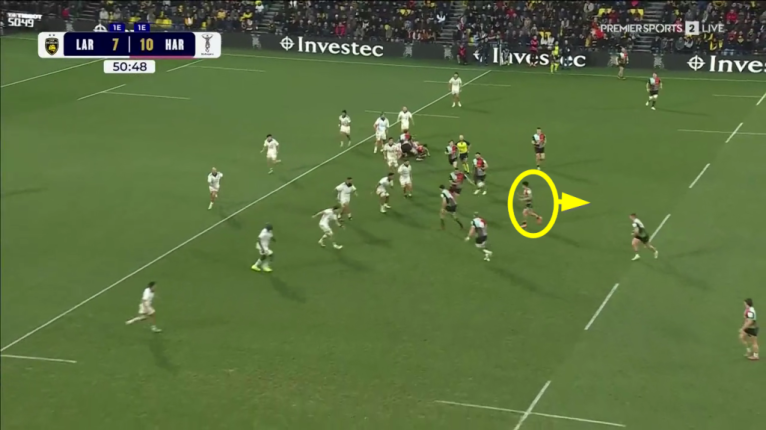
With a pod of three forwards in front of him, Smith is receiving the ball with his weight on the back foot, and the first step always takes him further towards the corner flag rather than straight ahead; going right to left or left to right, the likelihood of an effective run or kick diminishes with every step he takes. Compare and contrast this run by Smith’s namesake Fin.
— William Bishop (@RPvids1994) December 12, 2025
Fin Smith’s first step with his back foot is north-south and that naturally straightens his running line thereafter. The upshot is when Marcus Smith finally kicks, it is often a 50/50 because all the options with ball in hand have been exhausted.
— William Bishop (@RPvids1994) January 19, 2026
— William Bishop (@RPvids1994) January 19, 2026
Why is Smith increasingly seen as a full-back rather than a 10 by England? Because in the wide open prairie the running lines do not matter so much, and the magician can ‘run to daylight’. The Quins attack straightened automatically when Jarrod Evans came off the bench and Smith moved to 15.
— William Bishop (@RPvids1994) January 19, 2026
O’Gara and Smith may have been sitting on opposite sides of the fence last Saturday afternoon, but they have reached a common crossroads moment in their careers as coach and player respectively.
O’Gara’s time at La Rochelle looks to be all but done and a new coaching challenge, perhaps on the international stage, awaits. Smith has remained a prodigious talent for far too long, and he has slipped down the snake of Borthwick’s England pecking order at number 10. With Owen Farrell’s return to Saracens he may slide even further. Less butterfly cross-field float, more straight-up bee-sting. Rumble young man, rumble!


I cannot see MS getting a start at 10, unless we can rasie the cook from 1995. Having said that he’s too good to sit on the bench. Alex Mitchell is a good 9, but not in the same league as Du Pont, Faff, Gibson. I think with Smiths vision, speed, pass, tackling, I think he would make a world class 9.
I recall clearly his running threat in the game at Twickenham that we won in 2024. Every time Smith got a touch, the crowd shifted in their seats and the Oz defence wobbled. It’s no longer the case.
I fail to see the obvious benefit of playing Ford ahead of the better Smith. His running and passing games are a big step down, and his defense is the worst of all the options at 10 for Borthwick. Pick Fin and stick.
It’s an ongoing debate in Eng atm DM, Fin or Ford? But I would say Fordy’s running and passing games are better than average, he’s not just a kicker!
I remember playing at Sudbury - worlds apart from where they ended.
It all started when Keith Fairbrother looked to buy Wasps and merge them with Coventry in the mid 1990’s, so he could bring Premiership Rugby to the City and scale off the legacy foundations and build a bigger version of Butts Stadium (it was in the planning phase back then).
Wasps then dug out the blue print and decided to go it alone from a standing start in the City.
It was a bit like London Irish at Brentford, the need to fill the stadium was the greatest priority and changed everything else at the club as a consequence.
What’s your take for what ENG should be expecting in the 6 Nations NB?
Personally, I would like to see either Oghre or Tuipulotu given some games at hooker, as going into a RWC with 2 x mid 30’s hookers is risky and we could do with a better carrier as the 3rd choice.
I hope Fasogbon or Sela are given a chance in Stuart’s absence, as it will likely be a better cap spent than Davison in the run up to RWC 2027.
I then want to see the centres tested and I think this will likely be FRA’s 6 Nations but as long as ENG continue to improve, build their squad and give themselves a chance I will be pretty happy.
A win would be the icing on the cake but it also has a bit of fortune with the draw.
There will be preview to follow about this topic P, only 11 days to go now!
I guess Fasogbon will be next in line at 3 tho George Kloska could be a long shot, and I’ve always had a sneaking regard for Oghre inside him…. If they want a the most solid set-piece guy it would prbably be Jack Walker at Quins.
If I have read the Jamie George article correctly, it suggests he will retire at the end of next season. That will be a massive blow for ENG if he doesn’t stay on until RWC 2027.
We need Theo Dan & Kepu Tuipulotu to show some development over the next 18 months if that’s the case.
He’s a tremendous player and I know the Leinster forwards have great respect for his abilities.
One fo those forwards who can think his way through games, esp in the set-pieces. Priceless.
Top article, Nick. Thanks. I often wonder what players would have achieved if they had played for different nations. Marcus Smith as a Bok, or AB ? I don’t think the chaos of the end of Jones tenure with England helped him at all. But your analysis of his game I find very illuminating. It is now vet unlikely at his age he will become one of England’s standout tens. But then again, injury to any of his rivals might see him given a new lease of life. Actually thought George Ford was done a couple of years ago, but look where he is now.
I don’t think Marcus is too dissimilar to SFM in fact Miz. So with Tony Brown in their coaching team I can see him succeeding with the Boks.
The reason George Ford is still around is [1] because his basics are so sound, and [2] he has also always been able to think his way thru changes in the game and remain current!
ROG is an interesting character and has had an interesting career.
As a player, he was always talented, always overly aggressive and never afraid to mix it up . . . . but ended up playing second fiddle to Sexton but still managed to get his fair share of success and maximised his talent.
It feels like part of that has followed him into management. I don’t think anyone was surprised to see him move into coaching and the Crusaders was a shrewd move and La Rochelle felt like a big job that he really grew into with the squad.
It looked like a stellar transition and coaching career but you do wonder if they slightly over delivered and as the fortunes have reversed in the last 2 years, ROG has failed to replenish that team and sustain the standards.
It feels like the latest JIFF rules have made it harder to import players and they quickly found themselves with an ageing squad and a bit of a void, so the squad demographics have caught up with them.
It’s an interesting cross roads, if ROG stays at LR and rebuilds the next generation, he will be heralded as a complete coach and will have done the complete cycle. If he leaves, I wonder if it leaves a legacy of doubts . . . . But my take as a player was that he always knew his limitations and played to his strengths, so my gut feels says he will likely move and will be interesting to see which direction that takes.
It feels unfair questioning him after 2 CC victories (that’s an impressive record) but their fall from grace is equally concerning. Over to ROG to steer the debate and see what he decided is the next chapter.
Yep he’s got the pelts on his pony wit those two EPCR wins. I don’t se him staying for a rebuild at LAR though. He is almost at the end of a complete 7-year cycle and now it looks like both parties are feeling ‘the itch’ for change!
The article made me think who are the best 10’s I have seen live and then question what made them special.
Dan Carter is the best I have seen live, followed by Wilkinson. Very different styles of 10’s but both outstanding excellent when looking at their strengths and their ability to control games by playing to their skils. Those two were probably in a category of their own.
I haven’t seen SF-M in a live game yet but can’t wait, especially as he improves over the next couple of years and looks the most likely candidate to join the above club.
I would then say it was a close call between Jonny Sexton & Joel Stransky. Again, very different styles but both were the vital cogs the rest of their teams worked around during games.
Finn Russell is potentially the best (fastest) flat passer of the ball I have ever seen and DMac was one of the most skilful players I have seen live.
I’m not too sure any of the ENG current 3 are in that sort of category. Fin Smith is the one that I believe has the highest runway but he’s definitely a player that gets more from the team than the sum of the parts and is hard to judge him on an individual basis.
Ford is the best kicker of the 3 and that’s his super power. Fin Smith is probably the best all rounder of the 3 and Marcus probably has the best running game but is a strength that is being over played and defences are waiting for it.
It’s actually a tricky balance to judge them given the differences in skill sets but does feel like it’s a decision between Ford/F Smith as starter and then M Smith as bench, which is why it becomes such a binary decision and debate with ENG fans as to who is the best 10.
I would rate Wilkinson as my top 10 as an all rounder, but Carter would probably be most peoples choice. I have watched the game now for a long time, and the one I probably would pick as my favourite to watch for his balance and sheer brilliance would be Phil Bennett. Barry John a standout too. Mike Gibson was also a very good ten, though he also played as a centre a lot too. Ollie Campbell was very good. I never saw Jackie Kyle, but he was revered in Ireland. But that was in a very different era.
It’s a strong group of 10’s undoubtedly P, esp when you add Owen Farrell to it. Prob the best Eng has had in many years.
Eng can still develop with either Fin or Ford at the helm and they can let Marcus tweak his game to improve further in the background. They can afford to let him have the time to do that.
And Charlie Atkinson is another lively prospect.
Whilst Eddie Jones had quite a few character flaws, he always had an eye for players and had a clear plan for how he wanted to see them develop their game. I was actually told he had a 5 year development plan for every single player in his squad for how he expected them to develop.
I don’t think his comments are criticisms, they actually reflect his frustration at the lack of progress from when Marcus started. When you think about those comments, they have aged pretty well and whilst Marcus has improved his place kicking and penalty touch kicking in the last 3 years, I think his game management and variety has regressed slightly.
Yes he still has the talent but he looks stale to me, not energised.
You prob don’t want to be seen as a ‘promising young player’ or similar as your 27th birthday approaches!
His skill-set will keep him afloat ofc, but if he is to be Eng’s 10 we need to see more from him.
I just wonder if Marcus staying at Quins has stumped a bit of his development since Covid?
Ford played for Bath, Leicester & Sale and his game has changed with each move he made.
Fin Smith was a good young player at Worcester but has added to his game at Northampton.
I just wonder if Marcus Smith’s loyalty to Quins (which should be commended) has limited a bit of his progress. It should also be acknowledged that his drop in form has coincided with Quins losing their competitiveness in the forwards and losing Andre at 12, so there are wider factors than it just being about Marcus.
I think he’s stayed at Quins too long for his own good P.
We had a verbal agreement with him to join Racing about three years but ultimately he chose to stay put. I think a move to Top 14 would have helped him just as it helped Finn Russell.
Finn made the biggest jump forward of his entire career when he played for Racing 2018-22.
I really enjoyed the average involvements per 80 analysis and it paints an interesting picture from the data.
Of all their involvements, they all pass about 60% of the time, Ford usually squares up to the defence and then passes, Fin Smith usually distributes a bit wider (very quickly) but when you look at the average length of kick, Marcus & Ford usually kick long (+30m), whereas Fin Smith is roughly 17m, which is more of a cross kick pass to the wingers, rather than tactical positioning for territory.
I think Fin Smith has the capability but he also has Alex Mitchell inside him, who tends to do the longer territory box kicks from 9 rather than it being Fin Smith, which is where you mention he works as a system.
Interesting data. I actually thought Ford’s kicking percentage may be slightly higher and that was a pleasant surprise to see the same pass percentage. He does a lot of short inside passes before contact and I think that is why people remember the kicks rather than the passes.
Saints tend to kick short and they tend kick off 9 [60-40], so Fin doesn’t kick as much as Alex Mitchell, Quins are 50/50, Sale are 40/60 in favour of 10.
Clearly the best solution for Eng from a kick pov is Mitch/Ford or Mitch/Fin. With the second they have the Saints understanding ready-made, with the first they can have Mitch kicking high and short and Ford with his raking diagonals and spiral bombs.
Marcus is prob a long way behind both in that reckoning.
Really interesting article.
I remember when Smith first broke into the team under John Kingston, he often caught the ball with a bit of a skip but it used to square him up a little. He also used to play the flat pass to Andre and once that kept the defence honest, you would see the 12 dummy pass and then Marcus would do the arking run behind splitting the centres - you don’t see any of that in his game anymore but the drift does seem to be a problem.
That is another big diff ofc. Ppl had to respct Andre’s power and that gave Marcus a bit more latitude on the pass. They hv never really had that since he left.
Very interesting analysis about how he receives the ball in comparison to Fin. No doubt he will be be in the Damian McKenzie bench role for the start of the 6N in my opinion.
That is exactly who he will be until he shows otherwise SB. The NH answer to DMac!
It’s a tricky balance SB. I think Ford & Fin Smith are the starters and with +100 caps to his name, they probably need to build the experience of Fin Smith if he has to step in at starter for injury.
Marcus is the natural bench player because of the flexibility he provides, which means it will be a deliberate decisions who they pick at starter and balance their experience curves, with Marcus on the bench.
It’s also clear that Marcus has more impact as a bench player in an England shirt than he does as a starter.
In regards to the analysis of the Pod you don't mention that the service is poor. Too high not allowing him to run onto the ball. As a consequence he has to readjust taking his eyes of the defensive line to focus on the ball.
I also think that has something to do with the lack of gain line carries by Quins forwards. They used to frequently break the gain line with offloads and play on front foot ball but that has gradually faded over 3 seasons and they frequently play off static ball against well structured defensive lines. Neither of those things will help Marcus at 10.
True the structure and the passing is not tight by any standard. But I’ve seen Marcus making the same moves for too long now.😉
Was poor service the main issue in every single clip included in this article?
For 4 years we’ve been told repeatedly that every failure of MS led attacks is the fault of those around him, but maybe he didn’t run onto the ball because he almost never runs onto the ball?
I’ve yet to see Fin outplay Marcus, but it’s very hard to beat Ford.
I know it wasn’t the point of the article, but what was the result of the CC game?
It’s the article JW. Marcus kicked a last minute goal to win it for Quins. That did not make him man of the match.
There is a reason why the Eng coaches now prefer Ford and Fin to Marcus at 10, and if you asked the question whether he’s fulfilled his potential yet, the answer would be ‘no’.