
There’s a train of thought among rugby aficionados, commentators and pundits, that somewhere in the vicinity of 25 to 40 Tests of experience represents something of a sweet spot for players building their international careers.
NEW: Follow Your favourites in the App 📱
You can now follow their favourite teams, tournaments and players in the RugbyPass App!
The thinking is that once inside this range, players know more about the requirements of the top level of the game and how they need to prepare for it, they’re probably less inclined to make the kind of errors under pressure or fatigue that might easily be put down to inexperience, and they’re no longer a risky decision at the selection table.
By the time a player is reaching the upper ends of this range, the coach knows what they’re capable of and has played a major role in fashioning the player into the experienced international they have become.
In the modern game, with the number of Tests played by the top countries each year, a player can enter this range inside their second season at this level. A range of 25 to 40 Tests, generally, represents roughly three to four seasons at international level, which is getting toward one full Rugby World Cup cycle, and which covers off the average tenure of an international coach.
In Wallabies terms, Joe Schmidt (31 Tests) and Dave Rennie (34) both fell inside this range. Eddie Jones, on the other hand, wasn’t even halfway to reaching it, lasting just nine Tests in his ill-fated second stint.
The still-buzzing feelings of satisfaction and admiration have bubbled along after the Wallabies’ fantastic win over South Africa in Perth, and even with all the apprehension that comes with the prospect of a Bledisloe Cup Test in Auckland, there is definitely a feeling of optimism around the Australian team currently.
Obviously, as has always been the case, the way they back up that win will be as important as the Optus Stadium win itself. And with Nations Championship matches against England, Scotland and Wales (and a final weekend play-off game) to follow the Bledisloe Tests this month, the magnitude of trickiness won’t be letting up anytime soon.
But seeing how Australia beat the Springboks, and how this squad has emerged through the series against Japan and the tour of Argentina with new coach Les Kiss, has been really encouraging.
Of the team that beat South Africa in Perth, the total number of caps among the Wallabies match-day 23 was 876 – an average of 38 per player.
With 14 Tests to come between now and the start of RWC 2027, just under a year away now, Australian rugby fans are daring to dream about what sort of shape the Wallabies might be in by then.
Doing a bit of research on this last week helped fuel those thoughts ahead to the tournament next year, and it all pertains to that ‘sweet spot’ of Test experience that a lot of Wallabies are in now, or soon will be.
Of the team that beat South Africa in Perth, the total number of caps among the Wallabies match-day 23 was 876 – an average of 38 per player.
For a quick comparison, in the match prior, the draw with Argentina in Mendoza, Australia put a total of 645 Test caps out onto the field, an average of 28 per player.
The jump from Mendoza to Perth was significant in terms of Test experience, and the addition of Allan Ala’alatoa (94 Tests), Brandon Paenga-Amosa (31), Hunter Paisami (40) and Tate McDermott (56) added 218 more caps between them. McDermott didn’t get on the field in Perth but was obviously still heavily involved in preparations leading into the match.
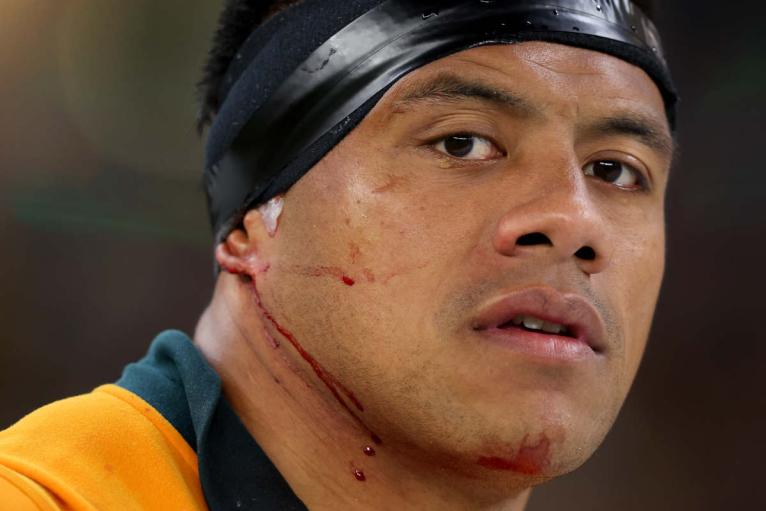
Of the match-day 23 in Perth, the Wallabies had seven guys with more than 50 Tests to their name, another six with more than 30 Tests, and four more with more than 25.
So that’s 17 guys involved in that remarkable win (including McDermott), who would almost certainly all be part of Les Kiss’ RWC plans next season, with between 25 and Ala’alatoa’s 94 Tests. That 17 represents just shy of 800 Tests between them.
In fact, 14 of the 23 have between 25 and 58 Tests, so there’s a real seam of Test rugby experience building together within the Wallabies squad.
There’s another five or six guys who could reach 25 Tests by the RWC next year, as well. Add another 10-14 Tests to these tallies, and it’s entirely feasible that the Wallabies could be sending upwards of 1100 caps worth of experience out onto the field for a RWC game, with an average caps per player in the high 40s.
Disciples of cohesion theory will tell you that shared experience goes way beyond Test rugby and can be measured a lot earlier than that top level.
As a comparison point, statistician Russ Petty confirmed that South Africa’s match-day 23 totalled 1288 Test caps in the 2023 RWC Final, including more than 300 off the bench. For the final Test of the Greatest Rivalry series in Baltimore, their number was 1204.
But disciples of cohesion theory will tell you that shared experience goes way beyond Test rugby and can be measured a lot earlier than that top level.
A look back through some Junior Wallabies squads is particularly revealing.
From that famed 2019 cohort, which finished runners-up to France in the Junior World Championship in Argentina, there’s some very familiar names: Angus Bell and Josh Nasser were the starting props in the final. Harry Wilson and Fraser McReight were in the back row; Mark Nawaqanitawase and Noah Lolesio were in the backline.
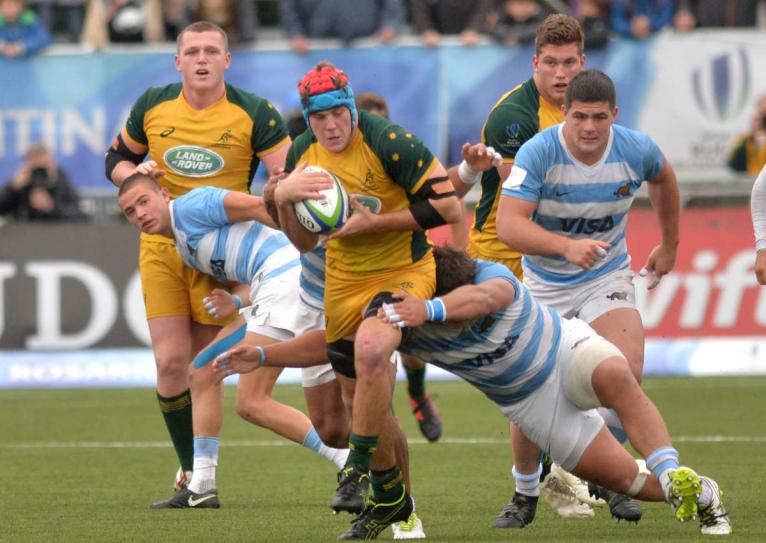
Nick Frost, Carlo Tizzano and Ben Donaldson were on the bench, as was Western Force scrum-half Henry Robertson, who we may well have seen at Test level this year, had he not suffered a serious knee injury late in the Super Rugby season.
Go back a year earlier, to the 2018 squad for the Junior World Championship in France, and you can add Matt Faessler, Len Ikitau, McDermott and Jordan Petaia to the list. Ryan Lonergan captained that side through much of 2018, too.
Add in some Brisbane City, Queensland Country and Canberra Vikings sides through the NRC years, plus ACT Brumbies and Queensland Reds teams who have played plenty of finals rugby in recent seasons, and you realise that a large chunk of this building Wallabies squad have played a lot of rugby, and importantly, a lot of it together.
They are building a really nice core group of players within the squad, who will be able to call on a healthy amount of experience by the RWC next year.
This Wallabies team has built a nice run of form and results for their new coach, and there’s no doubt they still have plenty of improvement in them, with some important Test matches still to come in 2026.
But they are also building a really nice core group of players within the squad, who will be able to call on a healthy amount of experience by the RWC next year. Very helpfully, a lot of that experience was built together.
They’re a long way from the finished product, these Wallabies. But it’s exciting to think where they could get to over the next 12 months.
 Register your interest to receive priority updates on RWC27 ticket releases. Don't miss out, stay in the loop!


Comments
Join free and tell us what you really think!
Sign up for free