
One of the best-loved telly series of the 1970s and 1980s was It’ll be Alright on the Night, presented by English comedy writer Dennis Norden. Norden was perfect for the role. He had just the right amount of understated wit, a coy curl to his lip to introduce a reel of TV bloopers from both sides of the Atlantic, and keep the studio audience rolling in the aisles.
At Stade de France, Ireland had to get everything right on the on the night on a wet Thursday evening. In the event they produced a 50-minute blooper reel followed by an earnest half-hour recovery which showed what might have been. By the final whistle the bookies were proved right, and seven-to-one on odds proved too difficult for the men in green to overturn.
While France head coach Fabien Galthié will be gratified the reset button has been pressed so firmly after the traumatic loss to the Springboks in November, Andy Farrell cut a frustrated and dejected figure in an interview with Virgin Media after the game.
“Obviously France were playing a different game to us in the first half,” he said.
“I suppose you make your own luck in this game and rightly so, with the way they went about their business.
“We created a few chances of the back of scraps on the floor or high balls, but that’s the game.
“You’ve got to show a bit of fight and intent and we lacked a bit of that in the first half, which is very disappointing.
“There was bit of a response – more than a bit of a response – in the second half, but France were worthy winners, that’s for sure.”
Ireland skipper Caelan Doris added a bit more flesh to the bones, lauding “a good impact off the bench” while lamenting the fact “our kick-chase let us down”. That is the essence of the game, distilled from a cold-press analytical post-mortem.
My second preview piece highlighted two areas where Ireland had to succeed in order to achieve a successful outcome. The first was gaining control of the game via the bench. The Irishmen won the battle of the benches in the last 30 minutes by 14 points to seven, building 38 of their 91 rucks [42%] in the last quarter, winning three penalties while conceding none at all in the last 25 minutes. Okay. So far, so good.
The camera started to whirr, and the blooper reel began with Ireland’s use of turnover ball in the first 49 minutes compared to their opponents. The previous article referenced how, at their peak in 2023, Ireland could score from a wider variety of scenarios, but over the past two seasons their capacity to score tries from any situation bar a set-piece launch has evaporated. Farrell’s side had scored a massive 86% of their tries from a scrum or lineout launch over the past two Six Nations.
That was one vital statistic which had to change for Ireland to build attacking momentum, but on the night, it was very rarely all right.
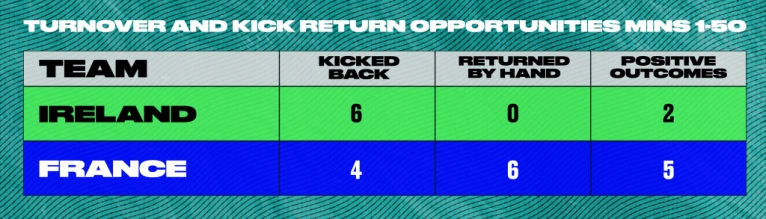
A colossal total of 78 kicks were launched into the dank Paris air – 39 by each side – but where Ireland focused exclusively on kicking back to their opponents, Les Bleus were prepared to return the ball by hand and make the second pass on any change of possession. Even Ireland’s two positive outcomes came off the boot: a raking left-foot 50/22 from full-back Jamie Osborne and a neat right-foot kick-pass from Sam Prendergast releasing Tommy O’Brien down the right.
By way of contrast, France combed all the sweetness they could out of the hive on turnover and kick returns: three clean breaks, two tries and two more penalties all oozing from the same rich resource. They were especially lethal on moves running right-to-left, in the direction of UBB flyer Louis Bielle-Biarrey.
— William Bishop (@RPvids1994) February 6, 2026
— William Bishop (@RPvids1994) February 6, 2026
The signs of a new French confidence in UBB methodology are plain to see: Thomas Ramos automatically making the second pass and doubling around Yoram Moefana to receive the offload and release Bielle-Biarrey down the left sideline, with converted back-rower Charles Ollivon swift enough to run the inside support line in the first clip; Ramos, Depoortere and Moefana interpassing to let loose the greyhound again for an even more spectacular run down the left 10 minutes later.
The impetus France generated from changes of possession did not need a deeper dive into the phase-count. Nine passes, one kick and a ruck were enough.
— William Bishop (@RPvids1994) February 6, 2026
This time it is the little Union Bordeaux-Bègles magician Matthieu Jalibert, seeing the opportunity for a quick throw-in and re-energising the movement with a short chip over the top after Bielle-Biarrey finds his path blocked down the left; Ollivon obeying his back-row instincts, ranging far and wide on the opposite side of the field to finish the move.
A special mention for two Bleus who played their role in Galthié’s reconstruction of La Nouvelle France to the hilt: Mickael Guillard showed why he will become one of the finest big forwards of his generation. For those of us wondering who would do Gregory Alldritt’s donkey-work on the carry, the answer came via Guillard’s 16 carries for 82 metres with three busts. The young Lyonnais giant is two players wrapped in one body: a second row who does his work in the tight while finding the time to become the dominant forward carrier on either side. His average of one run every three minutes would have had even Alldritt nodding with approval.
The other hit in France’s extended UBB offence was perennial ‘best player in the world’ Antoine Dupont. To the many pondering how Dupont would gel with Jalibert, the world-leading scrum-half gave the most eloquent and selfless of answers. Although he dominated the kicking game, Dupont was content to let Jalibert conduct the orchestra on the run and via the pass. The UBB outside-half ran for more metres, made five more busts and had two more break- or try-assists than the great man. Indirectly, his success reflected Dupont’s generosity, like the moon reflecting the light of the sun.
What of Ireland? Had they played the first 50 minutes as well as they did the final 30, the game would have turned out to be more of the classic nail-biter desired by any true neutral. The key turnover and kick return table for the last half-hour had a different complexion.
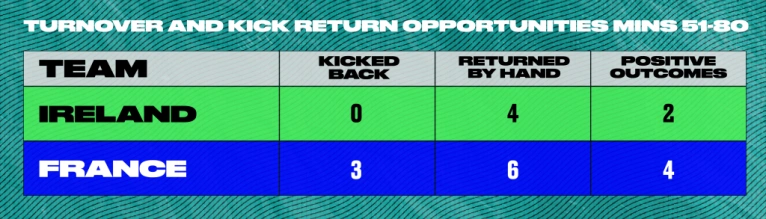
In the last 30 minutes Ireland stopped kicking the ball back to France automatically, and they looked all the better for it. They may not have had as much offensive firepower as their hosts, but they were able to build more control of the game and force more mistakes out of their opponents. France’s ‘boom’ period, which took them out to a 29-0 lead on the scoreboard, ended in the 49th minute, after one more try and another clean break from turnover.
— William Bishop (@RPvids1994) February 6, 2026
— William Bishop (@RPvids1994) February 6, 2026
Dupont, Ramos and the rest of the UBB backs are the foundation for la Belle Nouvelle France – who knew? They are already on the same wavelength as those three-quarters from Stade Chaban-Delmas.
The last kick-away by O’Brien was the final straw for Ireland. They finally started to see a counter-attacking horizon which has become second nature for the faithful all the way up and down the Garonne.
— William Bishop (@RPvids1994) February 6, 2026
When you get the benefit from a change of possession, make the second pass and try to keep the ball in hand rather than giving it straight back again. It is a simple lesson, dearly learned – and jolly deadly when implemented.
Where Ireland were setting trends in the game only three years ago, now they are struggling to stay abreast of them. This should be a wake-up call to Farrell and his cohorts. They only got half of the game plan right, and that is not enough. Not in Paris. Not on the opening night of the Six Nations.
Farrell solved the fourth-quarter puzzle but his charges realised far too late that turnover ball is king. Until Ireland stop kicking so obsessively, and start running for their lives in such scenarios, they will not find the skeleton key to unlock the door to success later in this tournament.
Galthié learned his own harsh lesson in November, and he has rebuilt his Bleus from the ground up. A more mobile back five in the forwards and a majority of UBB threequarters with key empathy added from two Toulousain backs, Dupont and Ramos. Chapeau, mon brave.
Watch all the upcoming SVNS action for FREE on RPTV!
*Available live in select territories


Excellent analysis thanks NB. French are showing what needs to be done to challenge Boks. But I cannot believe how rugby has become at this apex level a game of kick volleyball. 78 kicks - seriously? Someone observed it was like watching rugby league kick on the fifth tackle, except on every tackle! The French flare masked this horror stat. Thank god. But surely this can’t be future of our game.
Thanks for the article and insight@NB
Have Ire got the coaches to change things as needed I wonder? I wish I wish I wish they had a Felix Jones character as a catalyst to predict and advise on what is needed instead of react. They could order that Irish chap back from Bordeaux too! 😉
But as you say, Ireland must play on turnover ball.
The last try by LBB was a beauty. Good skill by Ramos to slice kick but the pass before by Dupont was beautiful. O’Brien was forced to come in to help Osborne which meant LBB’s full rectangle was wide open. It was a killer kick by Dupont. Ringrose and McCloskey were buried, and it was Doris, Loughman, Clarkson and McCarthy to the left of the ruck. Ramos lined it up and called Dupont. You can see Dupont studying the line of Irish forwards before kicking.
Hopefully there will be key tactical changes v Italy. I think the plan was to use tonight’s A match as a kind of trial for a few squad positions for Italy. May have to play a simalar team to yesterday now to develop a plan before England.
And it leads me to the observation from yesterday: France has often prioritised discipline over jackals and preferred conceding a turnover than a penalty. Beirne had 3 of those, and from what I recall, giving the ball back was a smarter move for the French than letting the Irish gain territory with a penalty.
Just like SA’s defence is aggressive and will concede line breaks, but all in all, it will be worth it. A game of probabilities. And I don’t know if what France did yesterday was not part of that gambling.
It also reminds me of the brillant gamble SA does with box kicks: they will either get the ball, or knock it on, or the other team will knock it on, so scrum and high probability of a penalty for them. Could there be a similar vision here?
This decision of leaving the turnover does not disadvantage France, as they’re the best at chaotic unstructured rugby.
What do you think?
The reason is prob related to the article Soli… If a team knocks the ball on, there is a moment of unconscious relaxation [expecting the ref’s whistle to blow] so in effect, it becomes like defending another turnover scenario. Better to force the ref to blow up and set a scrum then.
Yes that was interesting wasn’t it? I’m sure nine out of ten refs wd have awarded Ire a pen instead for holding on, but Karl Dickson asked thme to play the turnover through - which was far less advantageous!
And just between you and me… I’m sure SA deliberately knock the ball on to prevent clean catches when they chase high balls. The worst the ref can do is set a scrum, and they rather like those 😁
I had a gut feeling this would be a more mobile athletic team, with a UBB style of attack hitting the outside channels and it pretty much turned out that way - an absolute thing of beauty in those first 40 mins.
FRA were scintillating and whilst it lost a bit of momentum after some of the bench changes, I don’t mind that, as it was job done, game won and then saving the starting players so they are ready for the next challenge.
You don’t win a Six Nations in the 1st round but you can certainly lose one, so well done France, one big game down and two to go. 👏👏👏
Ire were sadly far too compliant with their kicking game and kick-chase, but yes - that selection in the tight five does indicate Galthie is going to pick more rangy athletes than opt for the Meafous and Tuilagis of this world to start the game.
I do feel he’ll be worried that France hit that flat spot for about 35 mins after half-time, it’s something they’ve done before and a side like Eng wd be well equipped to exploit it.
They’ve lost the bench battle to both SA and Ire now so I don’t buy the ‘job done, relax’ theory!
Ireland need to freshen up and that starts with the coaching box.
It looks and feels stale atm doesn’t it? Those of us who were hoping for some reaction from the SA game were disappointed.
The sad aspect is that the players are so eminently coachable.
The bench was good but the rest was old porridge. France like England are moving on.