
The headline is an injustice. Although scrum-halves in France are indeed pouring off the production line with factory-like regularity, they do not have any robotic resemblances. They have flair, they have individuality, and they are their own men. Springbok tight forwards might argue the point, but it is probably the single deepest pool of talent at any position, in any one nation on planet rugby.
Stade Rochelais supremo Ronan O’Gara commented a while back there were at least six number nines in the Top 14 worthy of wearing the red cockerel on their chest, and it does not take too long to work out who they might be. Apart from ‘the best player in the world’ Antoine Dupont, there is Maxime Lucu of Union Bordeaux-Bègles, whose partnership with Matthieu Jalibert at the club is as well-grooved as Dupont’s with Romain Ntamack for Toulouse. Those four represent the most complete 9-10 complements in French rugby right now.
Consider Baptiste Serin of RC Toulon, who is enjoying something of a renaissance, even a rugby rebirth in 2024-25 in the Var department at the ripe old age of 30. Serin was also a previous long-term partner of Jalibert in the halves at UBB, so you can make the four, five.
BAPTISTE SERIN.
THAT’S OUTRAGEOUS! #TOP14pic.twitter.com/rscNXLU5lM
— Tight Five Rugby (@TightFive_Rugby) January 4, 2025
Next off the conveyor belt is Baptiste Couilloud of Le LOU in Lyon, current captain of his club and a previous skipper of the national side in an Autumn Nations Cup final against England. Couilloud possesses, or rather is possessed, by a wolfish appetite for try-scoring which rivals even the great man of Les Rouges et Noirs.
The two young up-and-comers are Nolann Le Garrec of Parisian giants Racing 92 and Baptiste Jauneau of ASM Clermont Auvergne, le petit general of the all-conquering France Under-20s side of 2022 and 2023. It is not as if the assembly line stops there either. There are others shadowing the top half-dozen, waiting for the slightest sliver of opportunity: ex-Wasps and England man Dan Robson is kept out of the starting line-up at Section Paloise by rough, tough Thierry Daubagna, while Paul Graou would start for most other clubs were he not playing behind Dupont in the Haut-Garonne. Sébastien Bézy was forced out of Toulouse by the signing of Dupont from Castres and now finds himself behind Jauneau at Clermont. They are all players who have, or had at the apogée of their careers, international potential.
The scrum-half is the brains of the operation in France, and that is why historical number nines such as Jacques Fouroux, Pierre Berbizier, Dmitri Yachvili and Morgan Parra are more prominent in a trip down French rugby’s memory lane than the arguably more talented men they partnered – Jean-Pierre Romeu, Freddy Michalak and Francois Trinh-Duc. It is also why they are the ones who push hardest to mentor the national team after their playing careers finish – Fouroux, Berbizier and Fabien Galthié in the contemporary era.
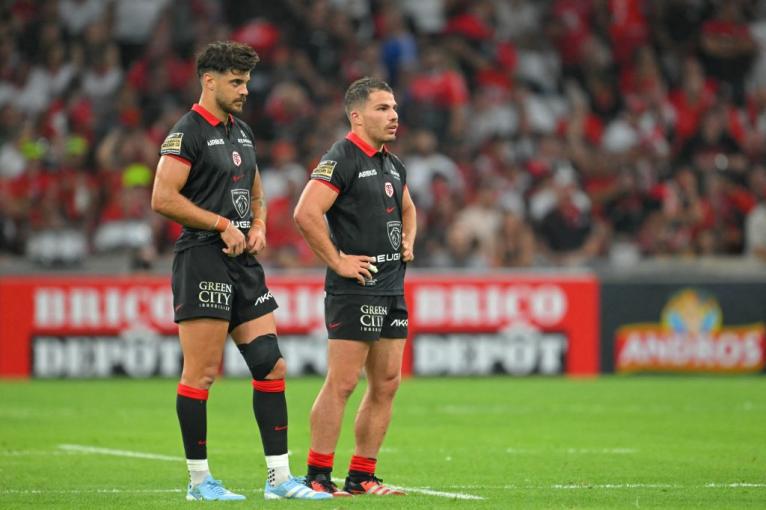
The number 10 may provide the dancing pyrotechnics at rugby’s equivalent of the Moulin Rouge, but make no mistake – the scrum-half is elected leader and runs the government from the Palais Bourbon. As a player and a coach, he shapes the team he wants around him.
A simple statistical sidebar can be used to illustrate this. In the current Top 14 season, six of the top ten kickers are number nines, but that number dwindles to two in Super Rugby 2024. Out of a 15-strong list of Top 14 kickers who average over 10 kicks per game in the league, 11 are scrum-halves and only four operate from fly-half. The list includes Dupont, Graou, Lucu and Serin, and other influential overseas half-backs such as Montpellier’s Cobus Reinach and Ben White of Toulon.
The situation is turned on its head in Super Rugby Pacific, where only two of the top 15 kickers in the competition play scrum-half [Willi Heinz of the Crusaders and Jordi Viljoen of the Hurricanes], and the number of kickers who average more than 10 kicks per game drops to a mere six. There is less kicking south of the border, and that automatically shifts the ‘central intelligence agency’ of the team out one spot, to first five-eighth.
It is equally hard to think of any Super Rugby head coach, recent or present, who specialised as a scrum-half in their playing days. There is no ex-scrummie coaching in Australia or New Zealand of the same stature as a Fouroux or a Berbizier or a Galthié in France.
The overweening emphasis on the number nine jersey can cause some creative friction when change is in the air. Racing 92 are still learning how best to fuse the outstanding talent of Le Garrec with a man of vast experience, one well versed in running the cutter, Owen Farrell. If the power balance needs to shift to accommodate ‘Faz’, it also needs to respect French rugby culture in the process.
This has happened before in Paris. Listen to the words of Welsh sage Eddie Butler in The Guardian back in 2016 after Racing had narrowly defeated Leicester Tigers in a Champions Cup semi-final.
“What Dan Carter did for Racing took this non-involvement to a new level. It required a partner and, here, Maxime Machenaud stepped forward, a half-back colleague more than happy to use Carter as the ultimate dummy. The scrum-half kicked and ran the show, linking with his forwards, prodding the team forward by hand and boot. It was a performance worthy of Carter himself.”
Even a playmaker as great as Carter was restricted to making his contributions on defence, making two crucial tackles in that nail-biting win at Welford Road.
There were signs the new point of equilibrium is being discovered in Racing’s 31-22 victory over the Stormers in the final pool round of the Champions Cup. Le Garrec was deservedly nominated for ‘star du match’ but more importantly, a novel playmaking balance between the scrum-half, Farrell at 10 and Dan Lancaster at 12 was increasingly evident.
No player-of-the-match effort by the young nine goes by without an outrageous improvised pass. Remember this from the last Six Nations against Wales?
At La Défense arena on Saturday evening, it was matched by a one-handed, underarm delivery going in the opposite direction.
The kicking ratio at Racing is evenly balanced between nine and 10, with 95 kicks launched from the top two scrum-halves compared to 94 off the boot of the main two 10s after 13 rounds. The same equipoise was a feature of the game against the Stormers. Le Garrec handled the longer punts, especially on exits, while nine and 10 contributed shorter kicks on attack.
The last grubber by Farrell sparked a piece of quick thinking by Lancaster which led directly to Racing’s third try.
After fishing the original ‘live’ ball out from behind the advertising hoardings, Lancaster hurls the lineout throw out to Farrell and one pass later, Vinaya Habosi is scoring a try on the other side of the field.
Le Garrec’s quicksilver footwork in and around the edges of the ruck was a problem for the Capetonians throughout, and it was tacked on to further excellent work by Farrell and Lancaster in the build-up to Racing’s first try.
In the last two clips, the position is set up by a break by Le Garrec, amplified by a change of direction from Lancaster and finished by an exquisite double-pump from Farrell.
France is still the main breeding ground for dominant number nines by the truckload – scrum-halves who not only goad and coax the best out of the big men in front of them, but dictate the character of the play outside. Dupont, Serin, Lucu, Le Garrec, Couilloud, Jauneau.
Dupont may be irreplaceable, but he is not indispensable. Sometimes there may be two of them on the pitch at one and the same time. Half will go on to become head coaches or directors of rugby after their playing days are over.
It is impossible to alter the culture of French rugby from without, even the great ones such as Carter and Johhny Sexton have found out the truth of that statement. But it may be pulled, slowly inveigled towards a new point of balance from within. A character change, via a stream of gentle negotiation.
At Racing 92 and maybe beyond it, Farrell could become a key player in that process: As the legendary U.S college basketball coach John Wooden once said, “Be more concerned with your character than your reputation, because your character is what you really are, while your reputation is merely what others think you are.”


Comments
Join free and tell us what you really think!
Sign up for free