
“I’m more interested in beating the three teams from the southern hemisphere than I am in winning the Six Nations. I want to test myself against the likes of South Africa, New Zealand and Australia. Did you know they have won all the World Cups played out so far?
NEW: Follow Your favourites in the App 📱
You can now follow their favourite teams, tournaments and players in the RugbyPass App!
“I want England to become the first northern hemisphere nation to win it, and I want us to do it by playing quality rugby. Not just by kicking the ball down the f**king pitch and running after it.”
Those were the words of Clive Woodward which persuaded Great Britain supremo Phil Larder to hop codes and become the first-ever leaguer to coach the England national team in 1997. Six years later, Larder had built the finest defence in the world and England were winning the World Cup in Australia. To this day, that remains the only occasion when a side from north of the equator has won the Webb Ellis Cup.
Winning the Six Nations is not really the point, not in the year before a World Cup is due to be played. Developing a robust style which can succeed in all conditions, against all opponents is very much the aim. Forget the tribal rivalries, and look at the bigger picture. No more kick and clap.
If Larder has a spiritual successor in the modern game, it is Shaun Edwards, the defensive mastermind of Les Bleus for the past six years. When the ITV Sport cameras panned in on Edwards’ glowering face in the aftermath of France’s trenchant 48-46 victory over England, the fact that his defence had conceded 96 points in the last two games was mentioned in passing. The Wiganer’s face darkened for a moment as he paused to explain the difficulties of defending in the modern game. Then it brightened suddenly with a cheeky parting shot: “That’s seven – seven [Six Nations] titles now.”
Edwards has now won three championships with France to add to his four with Warren Gatland’s Wales between 2008 and 2019. But he has never come close to winning a World Cup with either country, and that is something he will want to change before his glittering international career is over.
For Edwards to affect a volte-face on the same good Australian earth where Woodward turned the odds on the southern hemisphere 24 years before, he will need tight forwards who can tackle, then get off the ground and make another bloody tackle – on hard, unforgiving pitches, and more often than not, in hot or humid conditions. The same applies to an England defence which has conceded an average of over 30 points per game, and gave up over 40 points in two matches against Ireland and France.
For Edwards, the balance of the French tight five must still be in question.
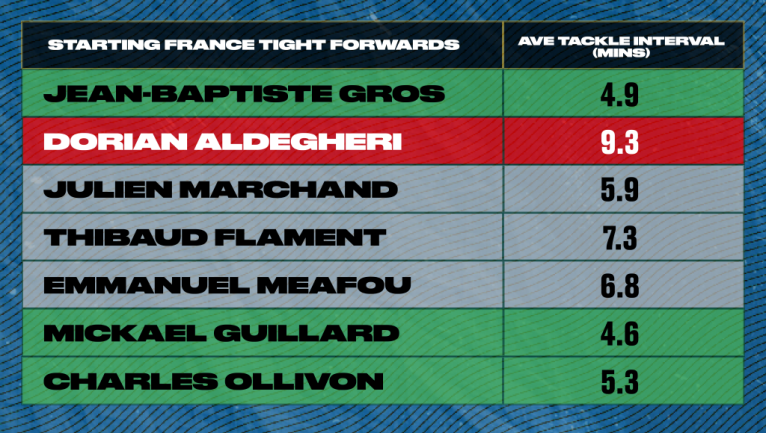
An interval of six to eight minutes between tackles is the mean for an international tight forward. Edwards has three – Gros at loose-head, Guillard and Ollivon in the second row – who are either superior, or elite operators in defence. Three of the four Toulousain tight forwards who started the game against England are fair to middling, while another has been poor in that aspect of play in the course of the Six Nations.
The single biggest problem is at tight-head prop, since the unfortunate retirement of Stade Rochelais colossus Uini Atonio before the Six Nations ever got underway. Aldegheri is below par for tackles made, and he has given up five penalties at scrum time into the bargain. There is little upside for Fabien Galthié, whether the coin falls on heads or tails at number three.
By way of comparison, the two dominant set-piece tight-heads in the championship – England’s Joe Heyes and Italy’s Simone Ferrari – were capable of engineering scrum penalties and contributing positively to the defensive structure. Heyes averaged 6.7 minutes between tackles while playing 65 minutes per game; Ferrari was even better, with a 5.4-minute interval between tackles, while being on the field for an average of 10 minutes less than the Tigers man.
The equivalent stats for the England tight five illustrate just how vast the potential for Red Rose improvement in 2027 really is.
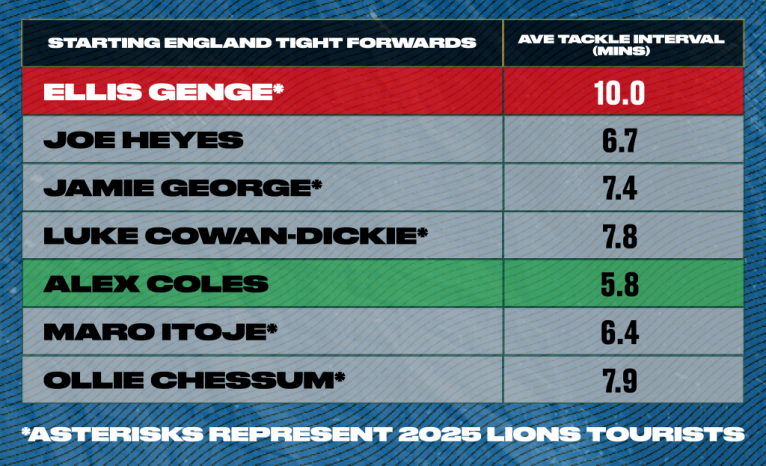
Taken in isolation, Genge’s tackle work-rate is as unimpressive as Aldegheri’s, but there is a great deal of significant ‘mitigation’ to that picture. The Bristolian carried 39 times at the Six Nations, compared to a combined total for both the French starting props of 24. He was also part of one of the two most dominant scrummaging front row units in the championship.
The Lions fatigue factor is likewise, clearly pointed: at the 2025 Six Nations, Genge was averaging 7.5 minutes between tackles, a whole two and half minutes less than his tackle interval one year later. In 2025, George and Cowan-Dickie lopped more than a minute off their own tackle interval in this year’s tournament. There is ample scope for improvement, perhaps more so in old Blighty than across the Channel in La Belle France.
To claim a team which finished with an unprecedented number of Six Nations losses is in as good shape to win the World Cup as the champions of the competition may seem outlandish, but that is how the theory touted by Woodward works. You don’t worry about Lions fatigue or Six Nations success, you keep your eyes on the ultimate prize. And you stop kicking the ball down the pitch and running after it.
That is why veteran England and Lions hooker George took the bullish, four-square stance he did after the game.
“Under Steve [Borthwick] I think we will be right up there with the favourites to win the World Cup. We’re a great team, a great group of players and he’s the perfect person to take us there.
“He has been unbelievable for English rugby. It’s crazy what has been happening over the last few weeks and he is absolutely the right man to lead us forward for a long time.
“That’s because he’s an English coach who cares so much about this game – but he’s also a very, very good coach who has created an excellent programme. When you combine that with a good group of players it’s a recipe for success.
“It hasn’t been where it has needed to be over the last few weeks, but the excellent thing about Steve is that we will have answers.”
Many of those answers were unearthed on Saturday night at Stade de France. For the one and only time in thia Six Nations, the men in white stopped kicking obsessively [only 26 kicks in the game] while bettering the hosts for:
- Total metres gained [419m to 323m]
- Gainline dominance of the carry [64% to France’s 49%]
- Ratio of lightning-quick ball [65% to 52%]
Les Bleus still made more offloads and clean breaks, but England finally revealed how they could evolve profitably towards the World Cup. That should be enough to keep Steve Borthwick in a job at the RFU.
England went off like a firecracker right from the beginning, and showed they had learned their lesson on kick returns from the game in Rome one week previously.
— William Bishop (@RPvids1994) March 15, 2026
On the first phase from the opening kick-off return, full-back Elliot Daly momentarily contemplates the Roman solution with a kick at 0:32 before feeding Cadan Murley instead. When the kick finally comes off Daly’s left boot three phases later, it is infield and creative rather than straight out into touch and programmatic.
That set the tone for subsequent events in the first half.
— William Bishop (@RPvids1994) March 15, 2026
— William Bishop (@RPvids1994) March 15, 2026
In the second of the two clips from the same sequence of play, it nine Ben Spencer, enjoying his finest outing in an England jersey, who finds a creative solution with the boot after the France defenders have been drawn up to the front line in typical Edwards fashion by multiple phases of passing and handling.
The creative use of the kicking game was also key to a try from lineout later in the half.
— William Bishop (@RPvids1994) March 15, 2026
Spencer only chips through when the French backfield defence has been stripped bare by multi-phase attack and the odds have shifted in favour of his side.
Les Bleus deservedly won the Six Nations, but ironically Galthié may still have more questions to answer to become a World-Cup winning head coach than Borthwick. That sounds strange when one side finished at the top of the table with four wins, and the other finished near the bottom with only one. But in reality, there is not so much of a gap, if any, between the two nations with 18 months to go.
The French supremo’s best combination in the tight five forwards looked no clearer after the close shave on Super Saturday, and the cupboard looks especially bare at tight-head prop. Meanwhile the big Cumbrian has probably secured his own position with England’s best performance of the entire campaign, and Genge, George, Cowan-Dickie, Chessum and Itoje can look forward to long-term recovery from Lions fatigue. The welcome return from injury of Fin Baxter and Will Stuart in the front row, and George Martin behind them, will add depth.
If anything is giving Rassie Erasmus sleepless nights, it is probably that prospect. The England tight forwards can match the Springboks. Is Rassie wary of England’s potential to go all the way at the World Cup and scupper a Springbok three-peat? They did it 23 years ago in the same country, maybe they can do it again. As long as they don’t keep kicking the ball down the f**king pitch and running after it.


Was really great to see from England. A brillant example that the return of the box kick was just a brief cameo. Thank god
No really what a match!
I would just like to see him getting a decent run of bench spots to find his feet, then we will start to see what he has to offer.
That’s a fair comment but he’s also a couple of years of conditioning behind them.
Sadly I think RWC 2031 will be his tournament rather than RWC 2027 but the more game time we can give him the better he will be for the future. Big learning curve at this stage of his career.
If they persist with the idea of Tommy Freeman at 13, which I feel they should, then he will always shoulder some of the load up the middle of the field. Probably he’s better suited to it than Seb Atkinson.
Which returns us to the question of why Atkinson would be in the starting XV. ‘Work rate and tip on passes’ is not enough. If you look at the profile of the best 12’s around the world now, most are big powerful beasts - DDA and Esterhuizen for the Boks, Jordie or Tupaea or poss Tavatavanawai this season for the ABs, Bundee and McCloskey in Ireland etc..
The only real exceptions are Len Ikitau and Yoram Moefana, who are bit smaller but possess exceptional agility and skills in and around contact. And both tend to play with a big 13 [Depoortere and Suaalii are both around 6’5 and 100 kilos].
Unless you have seen it up close, it is hard to understand just what a physical position 12 has become, and that’s why a guy like Levani Botia can play both 12 and 7. A lot of the demands now overlap.
As I suggested previously, ultimately it will boil down to where they want Tommy Freeman and Ollie Lawrence.
I’m sure Lawrence would have gone on the Lions tour had he been fit, so you have two top-class guys you want in your backline. Either they play in the centres together or Freeman moves back to wing to accommodate Lawrence at 13.
If it’s the latter, you can pick between Van Rensburg, Atkinson and Dingwall et al at 12. If the former, it creates room for Roebuck, Caluori or Hendy et al on a wing.
My own view is that Freeman has a huge upside at 13 and should stay there. Which means Lawrence at 12, who has the physical point of difference Atkinson lacks - at least from what I’ve seen so far.
“No. Took a look again and four of Freeman’s seven runs area are straight, and in between the 15’s. One was the launch play for Coles’ try and another finished Eng’s last try.”
As I said, Atkinson was the only English back who exclusively carried into contact through the centre of the pitch. Freeman’s carry to set up Coles try only made ~3-4m and was enabled by a lovely tip on my Atkinson. Freeman’s carry to score England’s last try was technically through the centre of the pitch, but only one French defender was outside him, so it was nowhere near the centre of the defensive line. It also wasn’t into contact, he went through a gaping hole.
“Having looked at Atkinson’s contributions again, I believe the main problem may be the lack of top-end power. He tends to get knocked down by first contact with the ball and ball-carriers often keep their momentum through his tackles without it.”
Yes I agree. I’ve been saying this for months. The view of Atkinson as a power centre has never been based in reality.
“you question what his function in the midfield might be?”
Work rate & tip on passes.
I’ve also gone through the game to look at Atkinson’s contributions. His first missed tackle was an attempted ankle tap on LBB just after 12 minutes. LBB was already over the line, and Atkinson had been nowhere near him when he started sprinting back to cover. The fact that he was able to attempt a tackle at all is impressive, and you can’t tell me that he should have made it. At 47 minutes he got stepped by Jalibert, which is the only unambiguous defensive error he made all match. At 78 minutes he got bounced off a tackle, but the tackle had already pretty much been completed by Underhill, so its hard to see Atkinson’s failure to connect as an issue. I’m not sure what the stats guys are counting as his 4th missed tackle. Overall this was a very good defensive performance. Obviously someone like Lawrence would have had more impact in the contact area, but he would have also made fewer involvements.
No. Took a look again and four of Freeman’s seven runs area are straight, and in between the 15’s. One was the launch play for Coles’ try and another finished Eng’s last try.
Having looked at Atkinson’s contributions again, I believe the main problem may be the lack of top-end power. He tends to get knocked down by first contact with the ball and ball-carriers often keep their momentum through his tackles without it.
He’s not as powerful as Lawrence or Freeman and nowhere near McCloskey or Menoncello for example. So then you question what his function in the midfield might be?
I’m not wedded to the idea of Lawrence at 12 but I am questioning where Atkinson’s point of difference might be at a higher level than the Prem. I guess we’ll find out.
Atkinson was the only English back who exclusively carried into contact through the centre of the pitch, so its extremely misleading to compare his metres gained stats to the players outside him. That’s not to say he’ll be especially happy with only gaining 5 metres, but he got through a lot of work (including making more successful tackles than any back on either team), and his teammates will appreciate that.
Having 2 crash runners is very different from having 2 outside centres. A crash runner can still do a lot of damage out wide (hence why so many teams put a forward on the edge), but a lot of 13s aren’t suited to playing narrow. You also need to consider that Ireland have traditionally used inverted wingers as extra distributors, so they don’t need a playmaking centre. England play with a more traditional back 3, so there’s a danger that if they went with Lawrence and Freeman the ball would just never get beyond 2nd receiver.
“I’m sure Seb Atkinson will come again. But SB does not need need to make extraordinary efforts to shoehorn him in once Lawrence returns to full fitness”
I appreciate you would like Lawrence to be selected at 12, and that you don’t rate Atkinson. We disagree on these things and that’s fine. But I think its pretty clear by now that Atkinson is Borthwick’s preferred option at 12, and that he has a strong preference for selecting Lawrence at 13. No one is getting shoehorned anywhere, he’s just going to continue selecting his preferred players in the positions that he thinks they are best at!
I’m finding it hard to get to grips with these claims.
Yes SA carried 8 times for 5 metres net, the least number of metres gained of any Eng back - Freeman was 7 runs for 52m net for example. His tackle % was also the poorest of all the Eng backs except Daly at 71%.
I’d agree Lawrence needs to defend at 12 - apart from anything else he’s a great jackal and 12 presents many opportunities there - but a combo with Freeman give you plenty of wriggle room to mix and match with ball in hand.
For example you can run a simple ‘slice’: Freeman can run the straight line and Lawrence can run ‘overs’. We used to do with Gavin Henson and Tom Shanklin in Wales all the time!
I doubt many in Ire would recognize this! They are both great heavy traffic runners, not outside links.
I’m sure Seb Atkinson will come again. But SB does not need need to make extraordinary efforts to shoehorn him in once Lawrence returns to full fitness, and esp as Freeman gets more experience at 13.
I don’t think I’m sugarcoating his performances, I said he was very poor against Italy, but he was much much better against France. That’s not to say he was perfect, and in some aspects of the game he was still poor, but he also carried more than any other English back, tackled (successfully) more than any other back on either side, beat 3 defenders, and distributed well.
The problem with Ollie Lawrence is that he’s England’s best midfielder, but he needs to defend at 12 and attack at 13, so fitting him into the team is a lot harder than it should be. I think putting him alongside a mobile 12 makes more sense than putting him alongside a converted winger. If its a choice between Atkinson/Ojomoh/Dingwall defending the wide channels, or Freeman attacking through the centre, I’d go for the former every time.
Bundee and Henshaw are a slightly different equation, given (1) they are both just as good running crash balls as they are carrying further wide, and (2) Ireland have traditionally used inverted wingers as extra distributors, obviating the need for a playmaking centre.
That’s why you’re a cyclist Carlos, teams don’t work the same way…😁
Nope. You go back home knowing you lost. Like that yank said, winning isn’t everything, it’s the only thing. You have to learn how to get it.
In the autumn Asher looked at least 120 kegs to me.
In fairness, at the time Asher was 105KG and he said it would take him about 3 years to reach 125KG and he was at 115KG last year amd will be interesting to see how big he is when he gets back.
Sela was still young then (19) and was 110KG and he’s put on a bit of size since then, so is probably 125KG.
Fasogbon was 120KG at U20’s and was 138KG last season, which is why he’s currently test weight, with the others needing a bit more time to add more mass.
I think Tuipulotu is 118KG, he’s quite a bit bigger than our other hookers.
That’s Steve Thompson size and we haven’t had that sort of carry ability for a while.
Nice read.
Though it forgot that in 2003, England had Wilkinson to kick the ball d̶o̶w̶n̶ ̶t̶h̶e̶ ̶f̶*̶*̶k̶i̶n̶g̶ ̶p̶i̶t̶c̶h̶ between the f**king posts.
🤣😁 the did indeed GD!
Well it’s a prescient call by Nathan Catt, but I’m always a little suspicious of weight/size targets.
I’d like to see how Asher works out at THP first, I think it would be easy for him to transition back to the other side if necessary. Right now he’s ahead of both Sela and Fasogbon in terms of senior experience and development.
I think Conor is repeating Nathan Catt’s comments.
I had almost the same discussion with him before the U20 World Cup win and he said he thought the future ENG front row would be AOF/Baxter at LHP, he even called Tuipulotu at that stage when he would have been U18 and Sela/Fasogbon at THP.
It wasn’t a bad prediction for a bunch of ternagers but it was all about how long it would take to hit the size targets the RFU set for them.
They want 125kG LHP & 140KG THP and that will be tough with Ashers frame size to get there, hence LHP being more likely.
I do think JVP will get more chances, even if Mitch remains #1 choice and most of the backline turns green, gold and black!
I still think Raffi has a place and has a point of difference with his defensive capability and ability to take on the edges in the final stages of games (he’s the closest thing to Danny Care since he retired) but that game doesn’t fit Borthwick’s style and they don’t appear to be wanting him back.
Thus, I am starting to look at the next generation but IF they take Fin Smith & Mitchell, I think you get a natural trio with McPartland who also knows how to fit that style and game plan and is doing it most weeks.
I also think Bracken will have an interesting year learning from Tomos Williams next season. He’s got pace to burn and a brilliant pass, so also injects a lot of energy into those final 20 mins for Sarries when he comes on, so is another to keep an eye on.
I watched GB&R podcast last night, with Mike Brown & Marler on with Tindall.
They raised some interesting points about ENG, mainly around the discipline issues but Mike Brown raised the point that it was the senior players giving away the penalties & yellows - Itoje, Genge, Earl etc, who really should know better.
They talked about why there were so many and one comment was the on-pitch communication. In Johno’s time, you always used to hear them say (no pens), it was constant communication from that team and they did say when Murley chased the kick, it should have been shouted no pens, which Mike Brown said does temper your decision making to wait and not give penalties away.
ENG have a good scrum, line out & maul, so they should trust it.
They did have a good defence, which they trusted in the Autumn and fell apart by the Six Nations. I think this is the thing that made them panic, knowing they were soft outside, sol killing the ball to stop it being moved wide.
They also knew they weren’t scoring points, which Fin Smith certainly corrected.
For me, this still comes back to an issue with D, which they either knew was fragile and why they tried to stop the ball being put wide.
Selection also had a big part of this and I don’t think Steve Borthwick & Lee Blackett were in sync on tactics until that final game.
Whilst Marler was his disruptive, annoying self, he did raise 1 good point on Steve. He said “he’s one of the best forward coaches I have ever worked with”. The detail he goes to is incredible.
The problem with that is that he had a lifetime of knowledge with the forwards and if he tries to apply the same process and thinking to the backs, he’s got no chance.
Mike Brown also raised another key point - the reason why the fans are so quick to turn is they don’t trust Borthwick. When your Head Coach has greater aura (and authority about them) - think Rassie, Andy Farrell, Eddie Jones, it buys you more patience from the fans before they eventually turn (Gatland is a good test case). Mike Brown says Steve Borthwick has never built that level of trust with the fans and I think there is something in this, hence why they go quiet when he wins and turn when he doesn’t.
Lets be honest, Borthers communication with the fans isn’t great, it’s not a comfortable skill and he prefers being with the players on the training pitch than being with media (I don’t blame him) but if you are not good then you need someone else to do that - it’s no longer optional in the modern world.
Oh I think they turned on Eddie pretty darn quick too, And Gats got cut short shrift in Wales in his second term - even at times during his successful first stint!
England are averging three tries per game conceded since the beginning of November and inc the 6N, winning 5 out of 9 in the process.
To add the France comparison, the French have been shipping an average four tries per game in November and the 6N, despite winning 6 of those 8 games!
Food for thought.
I think when you watch that 1st video, you see the difference that Fin Smith creates for the players outside him.
Look how quickly he moves the ball and how much space he gives the next player with ball in hand - they typically get 4-5m between them and the defender, so they can make a decision on their terms and is why we tend to move the ball wider. He usually distributes early but he also mixes it up by taking it to the line and the short pop pass, or occasionally takes it on himself.
This gave ENG the time and space they needed to move the ball, creates more space and then they create the options off the 2nd receiver, which added greater depth and deception to the attack.
If you looked at the same clips with Ford, you will see him carry it to the line and then pass with only 1-2m and the centres usually get hit by the defender whilst trying to pass the ball under pressure.
I’d love to see a ratio of how many times the 10’s get the ball and how many times the outside centre touches the ball for Fin Smith vs George Ford - I think that statistic would be telling.
All Blacks!All Blacks ! All Blacks !!!!!!
They did have hte benefit of many replays and from every angle it looked like the two supports got well in front of Flament! But hey, maybe the reffing priorities in that situation have changed?