
Thoughts become words, words turn into actions, and it is but a short step from action to the formation of character and a larger destiny. Three weeks ago RugbyPass pondered the possibilities of New Zealand selecting Leicester Fainga’anuku of the Crusaders as a hybrid back/forward in the André Esterhuizen mode pioneered by Rassie Erasmus for the Springboks. It did not take long for the idea and the words to take one big step closer to reality.
NEW: Follow Your favourites in the App 📱
You can now follow their favourite teams, tournaments and players in the RugbyPass App!
On Super Saturday at the One New Zealand Stadium, Rob Penney finally picked the versatile midfielder in his starting back-row against the NSW Waratahs.
Fainga’anuku played seven and did not look remotely out of place. Far from it. He will start with the same number on his back when the Crusaders take on the Hurricanes this Friday. His performance was one of the main topics on Sky Sport’s The Breakdown in the aftermath, and the consensus among the three backs discussing it – ex-All Black wing Jeff Wilson, former Wallaby midfielder Morgan Turinui and New Zealand and Samoa dual international Lima Sopoaga – was overwhelmingly positive.
LS: “I don’t know where they’re going to pick him next week. Pick him at centre, pick him at seven, who knows? It worked in my opinion; he was unbelievable. Did everything that he should have.”
JW: “Look, it was an outstanding performance on a short turnaround. I had spoken to him a couple of weeks earlier in Christchurch, and he actually just wanted to get more involved in the game, so this is the way to do it: convince the coaching staff that you can play in the loose forwards.”
MT: “That jersey, the number seven, meant that he could just ‘go’. And we saw that he did all the core roles so well of what a seven must do. His decision-making was good, but he did it just a little bit faster than everyone else.”
There were a couple of caveats raised about a forward playing as a back. First by Wilson. “I think his skill set absolutely suits the way the Springboks play. Does it suit the way Dave Rennie wants to play?’
Then Turinui. “There is ‘could’, then there is ‘should’. If you’re an outstanding back-rower, you stand more of a chance of being involved consistently than being put out into the midfield.”
The debate raised some questions of nuance – around the differences in a forward-playing-as-a-back, which represents the majority of the hybrid population at Test level; and a back-playing-as-a-forward, which is the role Fainga’anuku would occupy in the All Blacks.
The comparisons made by Wilson and Turinui cited the former, with Wilson also mentioning South African Kwagga Smith in dispatches, rather than Esterhuizen.
The principal reason for using Fainga’anuku in the back-row as well as midfield would be to increase his number of involvements in the game. Fainga’anuku is an 80-minute man who thrives on hard work, and he gets better with every repetition. When he was first shifted from wing into the 13 jersey by RC Toulon for the 2024-25 Top 14 season, with a smattering of back-row cameos added for good measure, his numbers were transformed.
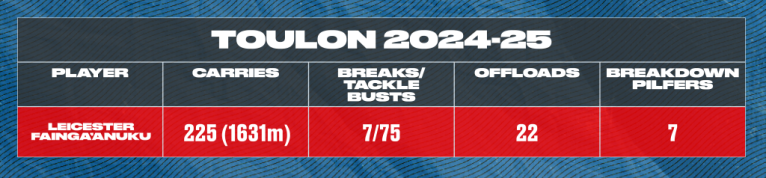
Fainga’anuku carried on 41 more occasions than the next back in Top 14, Racing 92’s Josua Tuisova, and the four players who ranked ahead of him in the league for pure carry volume were all number eight forwards: Billy Vunipola, Jack Willis, Abraham Papali’i and Sione Kalamafoni. That is some heavyweight company indeed to be keeping.
Only Tuisova came close to Fainga’anuku as a back-line tackle-buster, with both juggernauts posting an average of four busts per game throughout the season. And when you see that 10:1 ratio of busts to breaks, it is the unmistakeable sign of a man who thrives on the hard, physical grind of the close carry, a true thoroughbred workhorse.
The other reason for the repositioning is the growing expectations of the role over the past few years. Wind the clock back to Ireland’s tour of New Zealand in 2022, and one of the main planks for Ireland’s historic series win was the new understanding of the open-side flanker’s function they brought with them to the shaky isles.
New Zealand have always been the undisputed kings of seven play historically, with a stream of outstanding individuals wearing the blue-riband shirt with distinction in the professional era, most notably Michael Jones, Josh Kronfeld and Richie McCaw.
In 2022 they had another good one in Sam Cane, but over the course of the series he was outworked on the carry and at the tackle by his opposite number, Leinster’s Josh van der Flier.
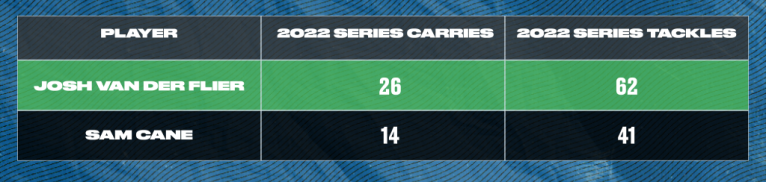
In the Leinster attacking system which Ireland adopted, the number seven has the extra responsibility to be a ball-carrier as well as a cleanout specialist and a link man, and Van der Flier’s success changed the idea of what the spot could produce with ball in hand. Since then, most international teams have broadened their expectations and espoused a similar approach.
That is just some of the background to the thought process behind Fainga’anuku’s shift. The ex-Touloun centre duly obliged against the Waratahs, topping the stats for total carries by a forward [19], pick and goes [six], offloads [four] and tackle busts [three], with one close-range try to add to his tally.
— William Bishop (@RPvids1994) April 28, 2026
— William Bishop (@RPvids1994) April 28, 2026
Fainga’anuku’s ability to offload from the most unpromising of pick and go, or one-out situations is quite uncanny. He has a forward’s capacity to bend the line with power but the soft hands of a back are working to find the right moment in the background. In the next two sequences, the power close to the try line is self-evident in the first clip and the hands make all of the difference in the second.
— William Bishop (@RPvids1994) April 28, 2026
— William Bishop (@RPvids1994) April 28, 2026
There are three major soft touches on the pass which keep the attacking momentum flowing before Macca Springer converts the try: an offload off the ground which springs full-back Johnny McNicholl through the hole, a tip-on and re-ruck over the carry by George Bower, and another pull-back ball from the first forward line of attack with the weighted dexterity of a Sexton or a Mo’unga. That is the short-hand for what a top-class hybrid can deliver.
The presence of Fainga’anuku offered the Crusaders plenty of flexibility on attack, as he lined up as a third centre on shorter lineouts and shifted to number eight at the base of attacking scrums. He also proved himself capable doing the dog-work at the driving lineout.
— William Bishop (@RPvids1994) April 28, 2026
— William Bishop (@RPvids1994) April 28, 2026
In both instances, Fainga’anuku sets up as the ‘+1’ insert at a 5m attacking lineout, but they are two very different examples of the application of power. In the first example he stays tight and the drive proceeds directly through the dent he makes in the NSW defensive fabric, in the second he breaks off and used his tackling-busting strength to set up David Havili on the fringes of the maul.
Let’s leave it to another back, ex-Crusaders halfback Bryn Hall, speaking on the Aotearoa Rugby Pod, to summarize the quandary Fainga’anuku presents to New Zealand rugby.
“Leicester was the top ball carrier in the forward pack, and I think that’s what his role should be: to get over the advantage line, get touches, and make it a little bit more difficult for defences… You saw on the edge with the little offloads, picking and going through the middle, having more of a license in and around the ball.”
Scott Robertson was unwilling to shift from the 5/3 split or experiment with hybrids, and you can still sense some of the same reluctance among the All Blacks’ ex-player fraternity. Sometimes it’s not easy to see the wood for the trees, or the fundamental character of a player aside from the label of ‘back’ or ‘forward’. New supremo Dave Rennie may be just the eye-popping tonic rugby in athe land of the long white cloud needs.

Your home for rugby. Download the RugbyPass app on the App Store (iOS) and Google Play (Android) now!
Follow your favourite teams, tournaments and players, and get personalised news and Match Centre notifications direct to your device.
From live rugby streams and upcoming fixtures to breaking news, in-depth analysis and live scores, RugbyPass has everything you need to stay connected to the game.


Not tricky for me Toko, Tupaea and Proctor have been the form pair.
I don’t believe Tupaea is going to do what the All Blacks need at 12 however. He would be a great Crotty/ALB option, but I’d prefer the SBW option in LF. I also think he could transition and work on his footwork to be that Kriel option who has endless energy to cover the backfield (like Rieko but with less pace but better reading ahead and offball work).
Yes you can say we have more depth at 12, I would agree with that. But on the surface without any manipulation it’s 3 each, the three from your first paragraph in order, and at 13 it’s Rieko, Proctor, and LF (I assume its logically safe to assume you have him as a 13). How we and Rennie are going to order those 6 is different however, Jordie and Rieko are the incumbents but I do not think that means they will be his choice (this is really a side topic I don’t know what I bring it up).
I understand you rank the outside three as more of a problem somehow. I’m just completely the opposite. The 13s are the rocks of these options (at least the first two). When it comes to the 12s there are just so many questions. Is 12 Jordie’s best place? Did Tupaea lose the contests too often, especially defensively, at test level? Is TT going to be found out when he goes up against sides that are as big and strong as him?
I don’t have any such questions about Rieko and Proctor. I know Rieko is not going to throw Proctors passes, but I trust him in what he does. So the question now becomes, how do we solve all these puzzles? That is what Rassie has done brilliantly for South Africa, and that’s what I see LF doing for the All Blacks (eventually), obviously I’m not suggesting Rennie should throw him in at 12 but Penney is doing a lot of the work playing him at 7, 12s natural accompany. Would love to get into the nitty gritty more.
See my other post about LF.
The thing with Nonu vs LF is that there’s not much use in drawing in players with your size and power if you can’t get it out to the players outside you. I’m thinking of running hard at the line so they plant their feet and then giving a bullet pass to your 13 running full tilt into space. Or a skip pass to your winger.
The skill and vision to do that is quite unique and requires a lot of time in the position ideally with the same 13. The way modern «out and in» defenses work is the with rushes at the 13 or the space in between to cut off the space. So it’s even harder now than in Nonus day.
LF is explosive and powerful so I’m sure he would find away to break tackles and offload it into space but if a team contained him I don’t think he could get it away as well as Barrett or Quinn. Do you know what I mean?
Someone with some footage (@NB ) could confirm this but he plays very differently as a 2nd playmaker outside Love and behind a pod of forwards while sometimes slotting in at 1st receiver. It looks similar to what he did at Leinster if you ask me
Yeah I think who the 13 is is more of the question that 12 as I think both Jordie, Quinn and TT are good and unique options each with their own strengths.
But who to partner them with at 13 is the tricky part. Your solution is to move LF in but I am not so sure as he hasn’t played there before I think he could be put under pressure but a Rush D. It then also puts other players out of position so so risk outweighs the reward as he could just play 13
And remember, this discussion was ab out utilization, not who the best 12 should be. I’m saying Jordie provides you one option and I think LF should provide the other if Big Jim can’t replicate last years form.
Love Tupaea and don’t think he’ll ever let anyone down, but I don’t think he’s going to replicate his Super domination at test level, as he’s just not big enough (he could be a center option, much like Kriel though).
Center is covered with Proctor and Rieko imo.
That LF isn’t ranked highly or that ABs should look for a Nonu type player?
Making a playmaker role work is the most complicated option, good on them if they pull it off.
Barretts playing no different now than what he did for the ABs last year. The problem is more that you don’t want a few of the other options defending at 13, I’d take hes big strides over the other options just not being able to read where to be.
I think it’s easy for people to concentrate too much on how Nonu was a playmaker, and completely forget what he did that was important. His other touches were just icing on the cake, and that would be the same with Barrett as well but he refuses to put on muscle (he wants to be able to play golf to a high level).
LF is basically playing at 12 for the Saders now, that’s what I like about his and TT abilities in black. Yeah my pref his to have Jordie finish, so I’d be starting with one of the other two, but chasing a game in the last 30 might be more what’s needed too.
I agree, Razor had these options too of course so I’m not getting carried away yet but I certainly get excited by Super Rugby (whos doing what).
Could you see him play 6 or 8 too ? Depending on who will be in the starting backrow the openside (Lakai then ?) will not necessarily be the one who will be subbed ?
He is some rugby specimen. BTW, the decision to shift him was made easier by how damn good Havili was as the power carrier in the centres. He was my preferred MoM.
I am at that stage late season that I always seem to reach now where any pre-season optimism has been completely rinsed by a string of poor performances but this one really stung. We tackled gamely but lacked any ambition until Wilson arrived and even he over-kicked with minutes ticking down and the ball precious.
I simply can’t see what parts of our game have improved under McKellar - we’ve added two test locks and our lineout completely disintegrated when needed. The Crusaders controlled territory and possession brilliantly but we made the job easy by thoughtless kicking and a woeful chase. Arrrrrrr.
Tend to agree re McKellar. Sucks to be you because Havili had a shocker the following week (thought I always admired his tenacity with his power game, even when it was sufficiently lacking at test level).
Yes it’s becming hard to see where DMK takes hte Tahs from here DM. They should be at least a 50% team with the palyers they have but they don’t feel really close to it…
He’s a better 7 than a 13, that’s for sure. His defence at 13 is rubbish but so is Proctors the only other option really would be Rieko.
I vote time in the chair for Leister at 7.
Rieko stared at 11 Leinster in the EPCR semi yesterday, he’ll stay there!