
Back in 2013, Jamie Roberts was at the heart of one of the meanest defences in Six Nations history. After shipping three tries in an opening round loss to Ireland, Wales were watertight, keeping France, Italy, Scotland and England try-less in a title-winning campaign.
Official World Rankings in the App 📱
You can now check the official International World Rankings in the RugbyPass App!
It wasn’t just Wales who were obdurate. Defence reigned supreme in a tournament that saw 10 of the 15 matches yield two tries or fewer. Only two teams – England against Scotland and Scotland against Italy – managed to cross the line on four occasions. Alex Cuthbert was the highest try scorer with a measly four, double the four players who ended in second place.
Thirteen years on, the picture could hardly be more different. We’ve seen 82 tries scored in just four rounds, 45 more than all the tries scored in 2013. Louis Bielle-Biarrey has already surpassed Cuthbert’s tally, while only three games in 12 have ended without a try-scoring bonus point.
This year’s tournament has followed a trend that has been developing for some time. There were 108 tries scored last year, a record for the Six Nations. Five of the top try-scoring tournaments have come in the past seven seasons and this year’s competition – with an average of 6.8 tries per match – is on track to be the second-most of all time. Attack is not simply getting the better of defences, it is reshaping the way elite rugby games are won and lost.

For Roberts, part of the explanation lies in how teams now generate chaos rather than structure.
“This has all happened because of how important the box kick is becoming,” the former centre with 94 Test caps for Wales, along with three for the British & Irish Lions, says. “All of a sudden, you’ve got your dangerous players, your back three players, running against unstructured defence.”
Structured play off scrums and line-outs once defined the attacking patterns of Test rugby. Today, much of the incisive damage comes from the broken-field situations caused by kicks. Creating confusion in the back field, Roberts argues, often leads to points.
“The box kick was not the weapon it is now when I was playing,” he says. “There are forwards at the bottom of the ruck, there could be forwards on the edges if you lose a ball. It’s all carnage.”
Kicks in play are on the rise. Last year saw teams kick the ball on average 60 times per game. And with law changes making contestables resembling a lottery, hoisting spiral bombs on unfortunate fullbacks is a smart move.
Kicks in play are on the rise. Last year saw teams kick the ball on average 60 times per game. And with law changes making contestables resembling a lottery, hoisting spiral bombs on unfortunate fullbacks is a smart move.
Jake Sharp, Northampton Saints’ skills and kicking coach, agrees that modern kicking tactics are less about field position and more about creating attacking opportunities from broken play.
“Fundamentally, the simplicity of it is that kicking creates really big transitions,” he says. “You get lads that are 130 kilos having to run 80 metres before making a decision. It’s no wonder some of them slip tackles when it’s time to front up.”
The kick, in other words, has become a tool for disorganising defences rather than surrendering possession. If forwards are forced to retreat or scramble across the field – like Ellis Genge had to do when he coughed up a simple try against Scotland – the attacking side often finds space before the defensive line can reset.
Interestingly, tackle evasion rates have largely stayed the same over the past six years (between 17% and 21%). This suggests tackle technique has not deteriorated and points to a game where players are finding space more frequently.
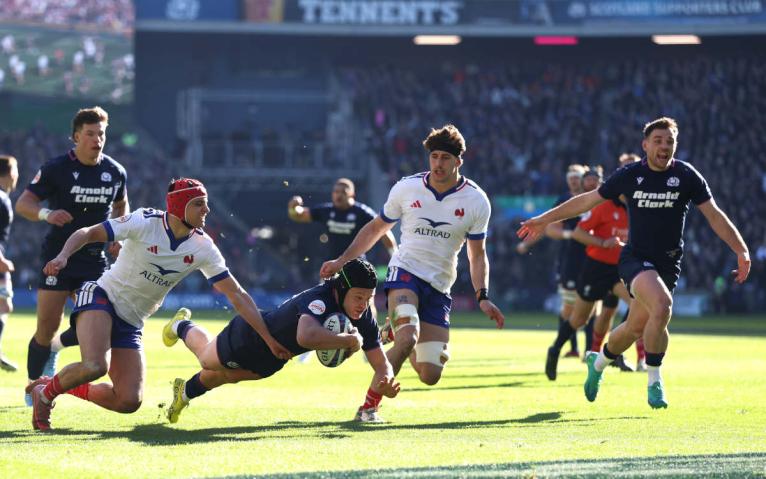
That is not to suggest that attacking teams rely on effective crapshoots. France haven’t scored 24 tries – seven more than any other team – simply because they’ve kicked the leather off the ball. They’ve overwhelmed teams with wave after wave of massive bodies in blue hammering the gainline. Scotland, the only team to have beaten the title-favourites this campaign, matched their energy with breathtaking ruck speed and tireless ball carrying.
The modern game rewards teams that keep the ball alive. Once momentum is established through a series of offloads and support runners on the shoulder, cracks start to appear. This year has seen an average of 16.6 offloads per game
“I think the tackle rule now – and how conscious players are of height in the tackle – means that players can probably offload easier,” Roberts says. Height restrictions have forced defenders to tackle lower, making it harder to wrap up a carrier’s arms and prevent the ball being moved on in contact.
Everything we do in training is about making it more stressful than a game. We want things to move as fast as possible; faster than it moves in a game. We want defences scrambling.
Jake Sharp, Northampton Saints’ skills and kicking coach
“You only have to watch the French and the way they have confidence in offloading the ball. Once you’re getting behind that first line of defence, it becomes very hard to stop that momentum.”
Sharp sees the same phenomenon from a coaching perspective. Modern training grounds resemble Hieronymus Bosch paintings designed for the single purpose of creating pandemonium.
“Everything we do in training is about making it more stressful than a game,” Sharp adds. “We want things to move as fast as possible; faster than it moves in a game. We want defences scrambling.
“Because when teams are defending against structure, they can often go two on one in the tackle. And because everyone is an athlete, that tends to stop momentum. But if you can regularly create situations where it’s one on one in the tackle, that is where you start to see teams fold.”
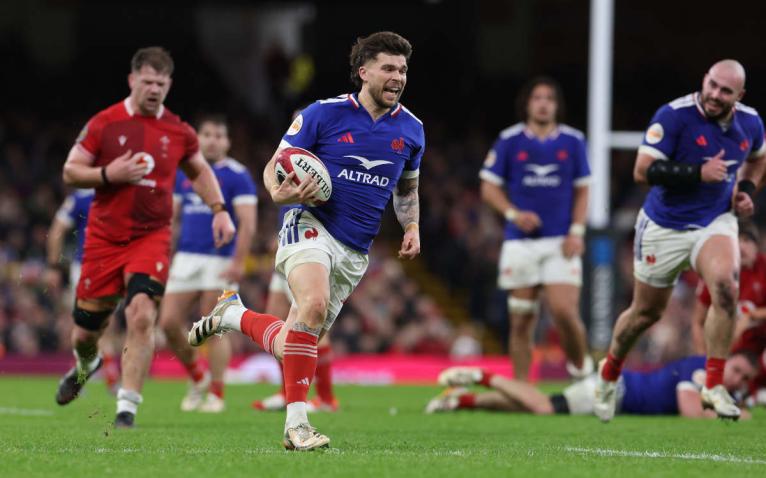
If the game now looks chaotic, it is not by accident. Law interpretations have also helped tilt the balance towards teams with the ball.
“The interpretation of the laws by referees impacts these conversations massively,” Roberts says. “That defender used to be able to lie there for a few seconds and slow the ball down. Mate, refs see it a mile off now.”
The result is quicker ruck speed – with 45% of rucks this season lasting less than three seconds – and fewer opportunities for defensive lines to reorganise. In the past, a well-timed infringement at the breakdown could buy precious seconds for a retreating defence to reset. Now the risk of conceding a penalty is far greater. Faster ball creates a relentless tempo that stretches defensive systems to breaking point. Naturally, teams with the sort of athlete who can cope tend to come out on top.
“When you look at the most successful teams, who do they have at inside centre? They have big, ball-carrying inside centres who can get over the gainline.
Jamie Roberts
“The athletic ability at international level and the Premiership is so high that you have to find ways to manipulate defensive systems,” Sharp points out. “If you’ve got 15 men that can do it versus 14, well now you’re onto an advantage, aren’t you?”
Yet despite the rise of what is now called the ‘hybrid’ player, some traditional principles remain unchanged. For Roberts, the role of the powerful inside centre still holds enormous tactical value.
“When you look at the most successful teams, who do they have at inside centre?” he says. “They have big, ball-carrying inside centres who can get over the gainline.
“That’s physics, mate. However much the game evolves, it wouldn’t surprise me if we had this conversation in 10 years’ time and the inside centre was still the difference between teams getting go-forward and teams getting stopped in their tracks. You can have all the silky skills you want but if you’re not moving forward you’re not winning games.”
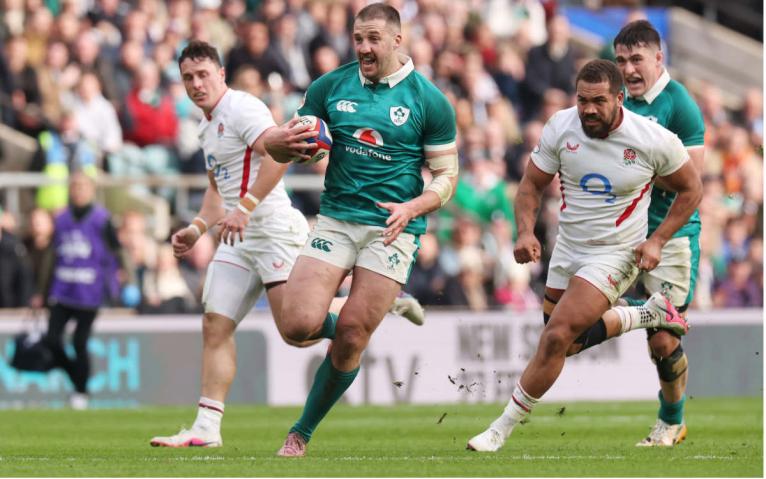
It’s curious to consider what conversation we will be having in 2036. Rugby’s tactical history has always been cyclical. There are periods where defence is the dominant force, as it was between 2008 and 2013, and there are periods, like the one we’re in, where attackers run amok. No doubt a young coach somewhere in the game’s ecosystem is devising a plan that will one day shape defensive theories for a generation.
Until that pendulum shifts once again, let us revel in this glut of tries and marvel at the attacking prowess on display. As Sharp says, “tries put bums in seats.” After one of the most thrilling weekends in Six Nations history, it’s hard to argue with that.


Great piece DG!
Cheers mate!
So like Rennies mo from when he joined the Chiefs back in 2012?
This year’s 6N is the best in many, many years. Regardless of how the game is being played, having 5 teams that can all beat each other is incredible. If Wales continue their improvement into next year 2027 could be the best edition ever.
“Rumble, big man, rumble!”
That big Welsh pudding owns the try of the tournament. Absolute unit
Beauty of a score
rhys carring through all defences
The Six Nations has finally landed on the world stage. After all the hoopla this year has been as good as a TRC, well done to all teams involved.
A part of me does miss the 12-6 games of yesteryear, played out in disgusting February weather
Ugly but beautiful
Scoring tries to kill games looks to be the new trend. Unless you’re England against Italy.
God that game was a delight to watch
Love the idea of more tries but hate kick-a-thon rugby - it is dire to watch. One of the great things about rugby is the structured contests - scrums, line outs, planned moves, as well as open “chaotic” running and passing. Thankfully I don’t think there is any necessary correlation between more tries and kick-a-thon rugby. Only 42 kicks in France - Scotland game and less than 50 in the England Ireland game. If anything the numbers of kicks have dropped as this 6N has progressed.
Super read.
I'm nowhere close to the early retirement, financially comfortable brigade so I don't have the time to sit down and work it out, but…
I reckon it's a safe bet every player across every position is on average taller and heavier compared to a decade ago. The conditioning is elite right across
With momentum and the laws of the game, a big ball carrying player will likely win out over an equally big tackler. Most 6N teams are skilled at offloading now as well
“I'm nowhere close to the early retirement, financially comfortable brigade so I don't have the time to sit down and work it out, but…”
Heart bleeds for you buddy…tears are running down my legs! 💔 😂
In preparation for last Saturday, Scotland followed the French way of long chaotic “keep ball alive” training bouts. Getting players and teams used to attacking and defending in chaos. Coming to every 6 nations team soon.
Good article, an interesting read about the 6N. Not a single reference to Rassie or the Boks either, I'm impressed.. closest you came was Hieronymus Bosch. Didn't he once run out at halfback for the Free State?
Did you know the ABs once toasted the boks 57-0