
In just under a fortnight, the inaugural Nations Championship will resume, with the northern half of the competition due to complete with a momentous ‘finals series’ of six matches over one Twickenham weekend at the end of November.
Official World Rankings in the App 📱
You can now check the official International World Rankings in the RugbyPass App!
The tournament will arrive hot on the heels of the analogous event in the women’s game, the WXV Global Series. Both are shop windows for professional rugby at the highest level, in different arms of the game. Both look to consolidate competition between the two hemispheres in a major tournament outside of the four-year World Cup cycle. Both feature the top 12 teams, with a Nations Cup or Challenger event operating underneath the main competitions, and the possibility of promotion and relegation hovering between the two sometime in the future.
From now on, nobody working in either the men’s or women’s game will be able to think ‘World Cup’ without thinking ‘Nations Championship’ or ‘WXV Global Series’ first, as the stepping stone to success. They will help deepen cross-hemisphere rivalries by creating more regular fixtures on the international calendar.
The three-match series between the English and Canadian women has proven an historic success. Almost 20,00 raucous supporters attended the first game of the double-header between the two World Cup finalists at the BMO field in Toronto, and another 13,117 pitched up at Ottawa’s TD Place, breaking the previous record of 11,500 in the multi-sport capital city stadium.
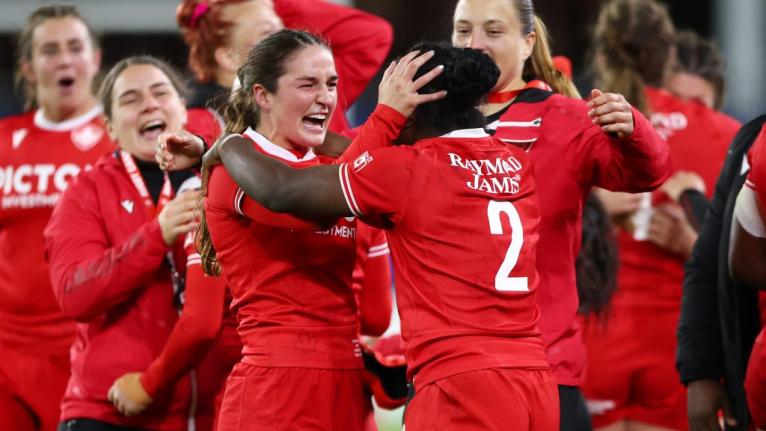
Canada have now gone three games undefeated against the world champions, and their success has attracted an extra CAN $2.8m of federal funding for Rugby Canada via the Sport Support Program, with the total budget for the 2026-27 season rising to almost CAN $5m. The announcement was made to great fanfare at half-time in Ottawa, and Canada went on to win 31-22 after leading by five points.
Earlier this year, the Canadian government had contributed just under CAN $1m to help Rugby Canada host both Nations Cup and WXV Global Series fixtures in the country, and the five men’s and women’s events have cumulatively provided an estimated boost to the local economy of over CAN $50m.
The Nations Championship is a potentially transformative vehicle for the men’s version. Previous Private Equity investments had largely been used as stop-gaps, financial means to keep the emergency generators running during the dark days of Covid-19, rather than invest in the infra-structure of the game. The new tournament changes all of that, by giving the usual underpowered ‘friendlies’ in July and November a real competitive context, with silverware at the end of it.
One of the two standout fixtures when hostilities resume will be the encounter between England and Australia. You can expect both teams to be fully stacked, and the two coaches have a point to prove after recent results. Steve Borthwick’s 12-match unbeaten run came crashing down around his ears at the Six Nations, and his charges have only won three of their eight games in 2026. After a promising start, Les Kiss’ Wallabies lost the Bledisloe Cup double-header to New Zealand disastrously, by a combined margin of 93-40.
Borthwick has still to agree to the all-out attacking mindset of the Prem epitomised by champion club Northampton Saints, and he will probably view the recent Greatest Rivalry series between South Africa and New Zealand as an excuse to return to the set-piece backed, kick-heavy methods he knows and loves best. Kiss knows how to attack but the concession of 14 tries to the All Blacks suggests he does not know how to defend, at least against the very best of the best.

Both coaches could learn some important lessons from the recent double-header in Canada. The Red Roses lost the decisive game in Ottawa because they had forgotten how to attack with ball in hand, despite winning six penalties or penalty advantages from their scrum and scoring a driving maul try which started on the Canadian 22m line.
England mounted 20 attacking sequences with ball in hand, but only five of them enjoyed positive outcomes via a try, break or penalty. Four other balls were kicked away and the other 11 ended in turnovers at the tackle or breakdown, or handling errors.
England skipper Meg Jones launched a robust defence of the Red Roses after the game, claiming “I genuinely believe we’ve got the best players in the world. When we’re firing, we’re genuinely unstoppable. Just look at what this team has done over the last decade.
“We’ve changed the game in magnitudes, multiplied crowds and brought attention to us, and you take that away from what we’ve done.
“But, as I said at the beginning with the girls, high performance is based on what you do now. We don’t dwell on the past. We’re not anxious about the future. We’re focused on the present.”
Most of that is indisputable. England does have the best domestic league, and the greatest professional playing depth in the world.
But the reasons why the Red Roses failed against Canada were mostly linked to their relative lack of development when in possession of the ball. Since the retirement of the twin attacking consciences of English rugby, Emily Scarratt and Abby Dow, that aspect of their game has gone backwards. The England women under John Mitchell and the men under Borthwick have made the same choice to their cost, and Mitchell hinted he already realises what needs to be done to rectify the situation.
“Test matches of this quality, against the best teams in the world, always come down to execution,” the New Zealander said. “We presented ourselves with many opportunities and we just didn’t quite execute when we needed to. That’s a reality, that’s a fact. That’s no-one’s fault. It’s not a judgement; it’s purely the reality of what you receive when you don’t nail it.”
If the experience of the Red Roses has highlighted how a lack of focus on handling skills can cost even the most powerful of teams, the high quality of coaching on the other side of the fence will have reminded Kiss how his resources at scrum-half can be used with more profit on defence.
https://t.co/lwF9B8uUq0
— William Bishop (@RPvids1994) October 25, 2026
Canadian scrum-half Olivia Apps starts in the tramlines from an England lineout, and she never shuttled fruitlessly in the space between the backfield and front line of defence as Ryan Lonergan did for the Wallabies.
https://t.co/uHY208Uiz2
— William Bishop (@RPvids1994) October 25, 2026
Apps is again positioned in the trams as England set up a lineout drive, and that is where she stays for the entire sequence, giving the home side a solid 13-woman front line with two players in the backfield. It condenses the spaces between tacklers and allows the women in red to pick up the shrapnel on the ground when the ball is inevitably spilled by their opponents. There is no energy wasted shifting between wing and midfield, or front line and backfield.
That extra body in the line was critical in denying England from two very promising counterattacking situations.
https://t.co/N0UTrCq1GG
— William Bishop (@RPvids1994) October 25, 2026
https://t.co/G5kdzVqs6L
— William Bishop (@RPvids1994) October 25, 2026
In the first sequence, Apps chases her own kick to make the first tackle, and from then on her movement is short and economical, between left wing and backfield. Canada resolutely maintain 13 bodies in the line at all times, and that gives them an extra push at the line or an extra body in the tackle. In the second clip, Apps’ replacement wearing 22, Justine Pelletier, stays in line on the left, and that grants a tackle-and-jackal turnover on the right via the combination of number eight Lizzie Gibson and 10 Taylor Perry.
There will be clear lessons from the women’s game for both Borthwick and Kiss when England meet Australia in a must-win clash on 8th November.
The men in white must discover how to harness the power of attack from their domestic competition to avoid the fate of the women. The Wallabies need to take a hint from Canadian women’s head coach Kévin Rouet and adopt a far more efficient use of their resources on defence. If neither take notice, the Nations Championship funfair could be over very quickly indeed.

NEW IN THE APP: Official World Rugby Rankings hub! Compare team rankings side-by-side, with data going back 20 years.
Download the RugbyPass app on the App Store (iOS) and Google Play (Android) now!


I think the reality is dawning that “winning” rugby requires a very robust defence, supported by an efficient attack and with higher BIP time, it’s mainly down to the teams that can hold the opposition in defence and absorb pressure, whilst making the most of their chances in attack.
SA have the best defence but have been a little clunky in attack this season, so is their area to improve.
The AB’s and FRA have both vastly improved their attacks (which are probably the best in the world at the moment) but they still need to improve their “inner” defence to live with SA and that’s the work on over the next 10 months. How they learn to stop the SB’s power forwards will likely determine their success by RWC2027.
ENG have gone from a great defence in 2024 to a poor one by 2026, whilst being cloaked in tactical & selection confusion that isn’t helping. The new EPS contracts appear to be locking-in out of form players to their squad selection and this latest squad announcement suggests the matchday 23 stays mostly the same, whilst they fiddle around the edges with the 3rd choice players. It’s hard to see what the catalyst for improvement is but they need to raise the game in defence, which has struggled under Wigglesworth.
AUS are in a similar place to ENG in that they could be a good team if they fix the leaky defence.
ARG are my dark horses - when fully fit and on form, they can go toe to toe with anyone and that very aggressive defence they showed against SA could be the new gameplan as they gear up towards RWC 2027. They have made the bold coaching moves in this area and that could well be a masterstroke the way their forward pack is evolving again.
Interesting times ahead but SA and FRA are the two teams best placed to deliver. AB’s have potential but injuries are holding them back at present.
Thank you for giving Kiss …….and Scott McLeod…… some tips to fix up “their” disastrous defence.
If Kiss doesn't pull McLeod in to line quick, hell I’ll be keen to get Cheika in.
Australian rugby can’t afford to put up with really stupid selections and coaching any more. We are running out of patient supporters ……
The amount of people I run in to who say they used to be Wallaby supporters is depressing and worrying.