
There is truly no rest for the wicked. Only 21 days after the conclusion of the Rugby Championship on 4th October, a panting herald clad in green and gold has announced a further six-week cycle of international rugby in the opposite hemisphere. Joe Schmidt’s Wallabies claimed a sketchy 19-15 win over Eddie Jones’ Brave Blossoms in Tokyo and the next merry-go-round was underway, scarcely after the last one had finished.
NEW: Follow Your favourites in the App 📱
You can now follow their favourite teams, tournaments and players in the RugbyPass App!
Two of the November rounds in will occur outside the official international window for player release, but that is nothing new. For all four of the southern hemisphere tourists, there will be questions surrounding player availability, squad depth, and even potential upheaval in established coaching groups.
So, who made the most positive strides at the Rugby Championship, and who stands to gain most from the November internationals?
South Africa
Fixtures: Japan [1/11], France [8/11], Italy [15/8], Ireland [22/11], Wales [29/11].
Rassie Erasmus’ men are in the process of big transition at a high level of performance. The shift in the dynamic of selection between Eden Park in round three and Wellington in round four illustrated that change starkly. Rassie’s Bokke want to keep their pressure defence and scrum authority while bolting on Tony Brown’s spectacular counterattacking methods. The allure of the new is balanced, and occasionally upset by the tug of the old.
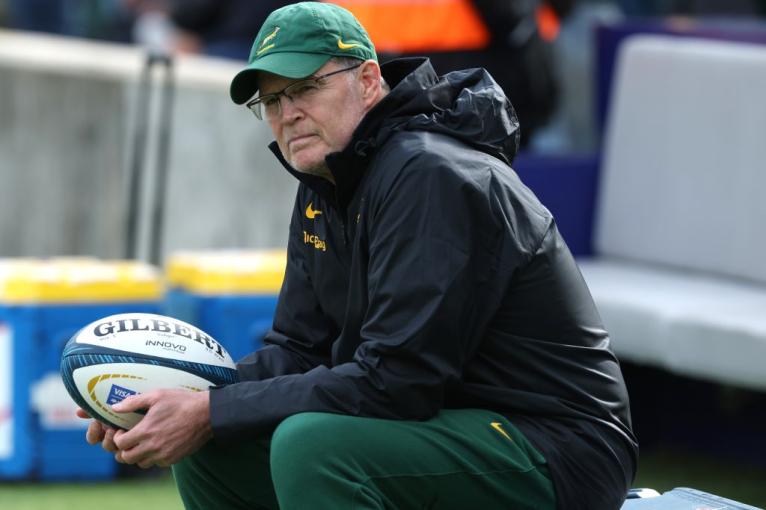
“I think one of our goals is to stay in the present, do well, and not just focus on the World Cups like a lot of people want us to do.
“Definitely trying to build squad depth [has] played a role in the lack of continuity.
“We gave a lot of guys chances. I think we gave 47 players a chance. I would’ve loved to give Faf [de Klerk] more chance, would’ve loved to give Franco Mostert more chance.
“And we must be honest with ourselves. Ntuthuko Mchunu is not here, Gerhard Steenekamp is not here, Salmaan Moerat is not here, Cameron Hanekom is not here, Evan Roos is not here, and Elrigh Louw is not here.
“And I can go on. Edwill [van der Merwe], Kurt-Lee [Arendse], [Aphelele] Fassi – so we also had to dig deep. We have five tough matches ahead and a lot of work to do.”
Rassie wants his Boks to win now, while they are in the midst of one of the most startling stylistic transformations in their history. To come good at World Cups is not enough. The latent instability was underlined by Erasmus’ acerbic reaction to the news his hooker/prop hybrid Jan-Hendrik Wessels had been banned for nine weeks for a groin-grab on Connacht forward Josh Murphy.
On X he wrote: “It just got tougher!! We now have to beat them on the field and in the boardrooms,” followed by the pithy, and far less complimentary Afrikaans version, “Hamba man. Tsek. Loop Kak.”
Wessels was one of the big improvers in TRC 2025, top of the breakdown pilfers charts at an average of just under one and a half turnovers per 80 minutes of action, and able to turn in a top-class performance at either loosehead prop or hooker. Without the Bull, the development of the new ‘bomb squad’ front row containing Steenekamp, Wessels and Wilco Louw has been set back nine crucial months.
The core Springbok stats suggested a slight fall-off in performance from the same tournament the previous year.
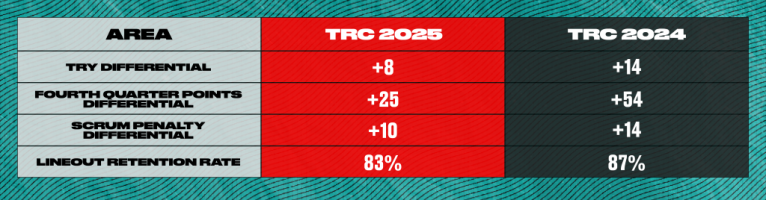
That performance level is still very high when you consider the transformation in scoring potential which is happening right now.

Under the auspices of Brown, the ability to score quickly from changes of possession is undergoing a huge upsurge, and to achieve that boost you may have to accept a slight, though maybe temporary, decline in other areas.
Key match: Everyone is licking their lips at the prospect of the clash in Paris on 8 November, between the kings of the north and the south respectively, and the true top two nations in the world. Will be it be sweet revanche for that contentious World Cup quarter-final in 2023 for Les Bleus, or will the game provide further confirmation Rassie’s charges are heading down the right tactical path?
New Zealand
Fixtures: Ireland [1/11], Scotland [8/11], England [15/11], Wales [22/11].
‘Razor’ Robertson’s All Blacks finished with one more win in the 2025 than they did the year before and shared their individual series with the world champion Springboks, where they lost 2-0 in 2024. But the suggestion they are narrowing the gap on South Africa is undermined by the raw stats and the manner of dispatch by the Bokke in Wellington. At present the men in black are treading water rather than progressing.
There have been darker hints of problems behind the scenes on the coaching ticket recently, with backs coach Jason Holland following Leon MacDonald out of the door only 14 months after the ex-Blues supremo left Robertson’s staff. Both men were part of the attacking program with the national side, and ex-full-back Israel Dagg has speculated Scott Hansen is the common denominator in their departures, while describing the current state of national uncertainty with some eloquence.
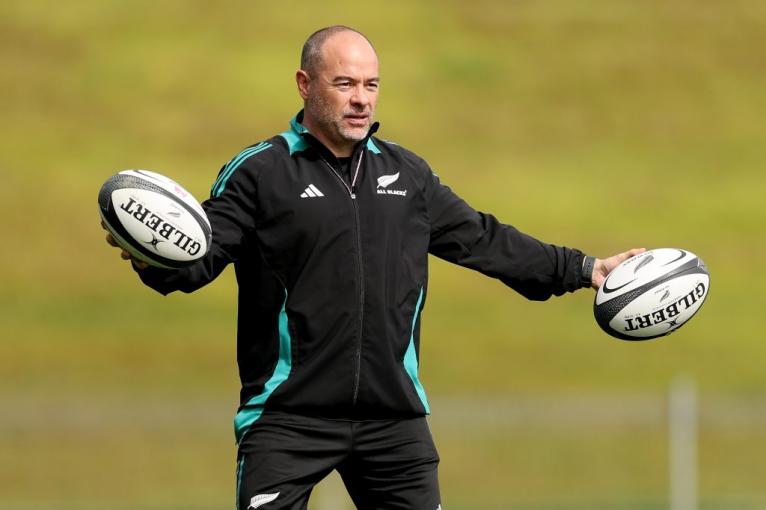
“There’s one message here talking about some rumours that Scott Hansen is the problem with Holland and Leon MacDonald,” Dagg said on the Scott and Izzy Show. “That they couldn’t work with him anymore and Holland wanted to leave last year but was convinced to stay for one more year.
“There’s a lot of confusion out there, so many voices, so would the best thing be to take away that extra voice, allow Scotty Hansen to take a bit more of a role, which he potentially has been already doing, and Tamati Ellison looks after the defence?
“Is that the right thing going forward? Or do we go over and get a Ronan O’Gara? Who is the next best coach that can come in and take that role?”
There remains an abiding sense the playing identity of the All Blacks is no longer as clear as it once was. When coaches work at cross-purposes and the tactical aim is as clear as mud, it is no surprise some of the key individual stats show little sign of improvement.
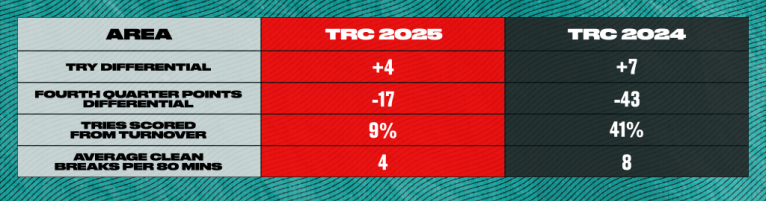
It is hard to identify one particular area where New Zealand is improving, especially on the attacking side of the ball – the zone of expertise previously involving MacDonald and Holland, and now populated by Hansen alone.
Key matches: Recent games between New Zealand on the one hand, and Ireland and England on the other, have suggested all three teams are operating on a similar level of performance, so the matches in rounds one and three, and especially the ‘needle game’ at Soldier Field in Chicago first up, will likely tell the tale of where Razor’s All Blacks stand in the global pecking order. That is where the new ‘big rivalry’ between New Zealand and Ireland first started back in 2016.
Australia
Fixtures: England [1/11], Italy [8/11], Ireland [15/11], France [22/11].
For Schmidt’s Wallabies the 2025 season has become a litmus test of squad depth, a matter of sheer survival. Australia has already gone ‘full metal jacket’ with a three-Test series against the British and Irish Lions, followed by six matches in the Rugby Championship. Sprinkle in a couple of other games against Fiji [before the Lions in July] and Japan [ahead of the November tour proper], and the four remaining fixtures will make a grand total of 15 in the calendar year. That is two or three more than you would play in a typical international season.
Australia’s resources are being sorely tested as Schmidt goes to the well one more time before Christmas. The scenario in the second row is symbolic. Australia suffered two more injuries to Lukhan Salakaia-Loto and Josh Canham against the Brave Blossoms, to add to the likely unavailability of Will Skelton and Tom Hooper, now back with their clubs in France and the UK, for at least part of the international window.
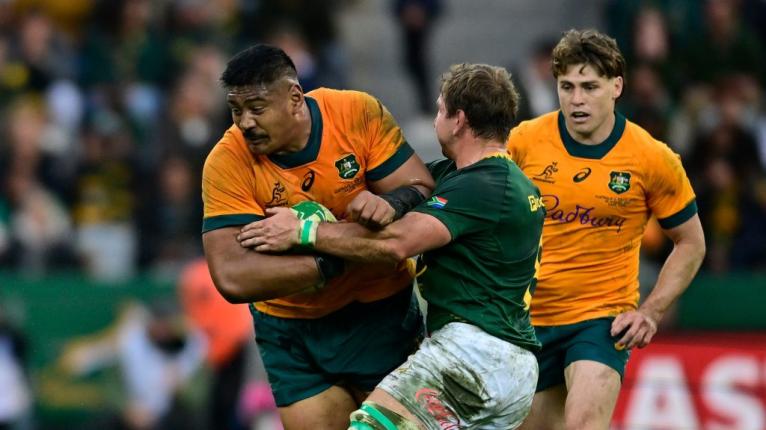
It leaves Nick Frost and Jeremy Williams and not a lot else. Frost is already closing in on around 1900 minutes of footy, well into Fabien Galthie’s red zone for seasonal fatigue. He is showing the telltale signs of wear and tear.
As the head coach observed dryly: “With England [in the first round], they’re a strong pack and it just means we’re light in the second row and we may need to get some reserves dug out from Australia.
“Josh Canham obviously won’t be available next week and, as yet, I don’t have the full feedback on Lukhan Salakaia-Loto.
“But I don’t think [flanker] Nick [Champion de Crespigny] here is that keen to play another 60 minutes at lock, so we’re going to need to find someone else to do it.”
Ironically, the essential stats from TRC 2025 suggest it was the Wallabies, along with the Springboks, who were poised to make the most significant jump forward in development in November.
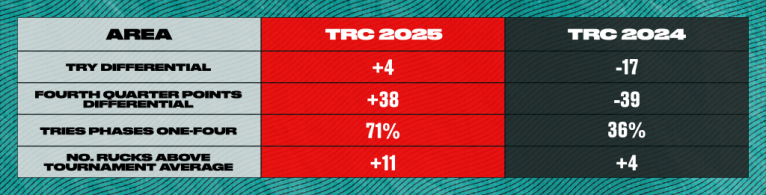
Schmidt’s Wallabies addressed virtually every area they needed to fix from the 2024 tournament. They shipped 11 fewer tries, enjoyed better ruck-building and hence more control of the ball, scored tries far more quickly and went from weak to strong in the final 20 minutes of games.
Key matches: The two pivotal matches are England in round one and Ireland in round four. The last-gasp 42-37 victory over the auld enemy at Twickenham in the equivalent fixture last year was one of the kick-starters of Wallaby progress, and Schmidt will want to confirm his Australia are still a nose ahead of Steve Borthwick’s side. With France in Paris likely to be a bridge too far, the Wallabies need a win over Ireland in Dublin to come away with a 3-1 tour record. The average margin of the past seven games over an 11-year span between the two nations is fewer than two points.
Argentina
Fixtures: Wales [9/11], Scotland [16/11], England [23/11]
At the 2024 Rugby Championship, Felipe Contempomi’s Pumas claimed a win against every one of the southern hemisphere ‘big three’ for the first time in their history, and finished at an even 50% with three wins and three losses. They almost repeated the feat one year later, finishing three points shy of victory in the final game at Twickenham in a match the Springboks had to win.
For all the improvements made, the truth is Argentina still have to prove they can compete consistently in the highest echelons of the game. Contepomi is still living and coaching in the middle of a process whereby a side which used to depend so heavily on its scrummaging and mauling capacity, is now looking to espouse the high-tempo, all-court game the ex-Leinster centre learned under Leo Cullen and Stuart Lancaster in Dublin.
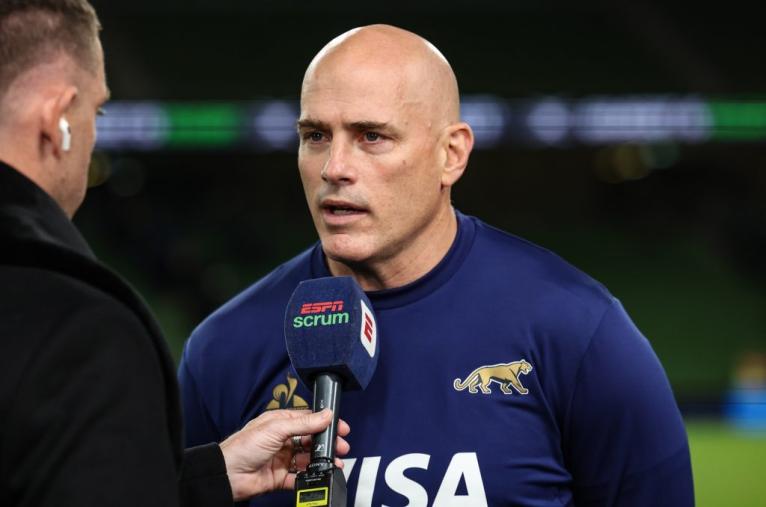
Lancaster recently described this process in a RugbyPass interview: “We [Lancaster and Contepomi] spent four years together and worked on developing our attack – and that is the area in which the Leinster teams at that time developed the fastest.
“The popular perception is most games are won by the teams which win the collision zone, but it’s not so easy to win them by power alone anymore. All professional teams are big and physical nowadays. You cannot take a punt on being bigger and more powerful than the other guy at this level, because they are all big and powerful.
“So, you begin to think of options, passing, footwork and running lines that challenged defences, and a better connection between forwards and backs. We found we could replace winning collisions ‘in the aggregate’.
“In other words, if we won super-quick ball through the efficiency of our running lines, our cleanout and precise ball placement, we could achieve the same impact on the defence as a tackle break.
“They would not be able to either regroup or compete in time if we were accurate at even a short machine-gun sequence of lightning-quick rucks, especially with our nine and 10 playing flat on top of them.”
Although he will have the rump of his Europe-based core group available, based around a back row containing four true top-shelf performers, and the quality of Juan Cruz Mallia, Bautista Delguy, Rodrigo Isgro and Santiago and Mateo Carreras in the back three, Contepomi will be without two key players. Joel Sclavi is his sole Test-worthy prop in the scrum, and Tomas Albornoz is his ace playmaker at number 10.
There will be a lot of pressure on Racing fly-half Geronimo Prisciantelli to back up his promising first outing against the Springboks, and for 23-year-old Boris Wenger and 20-year-old Tomas Rapetti to develop as quickly as possible alongside 114-cap Julian Montoya in the front rank.
Further Puma progress is balanced on a knife edge, as the following table reveals.
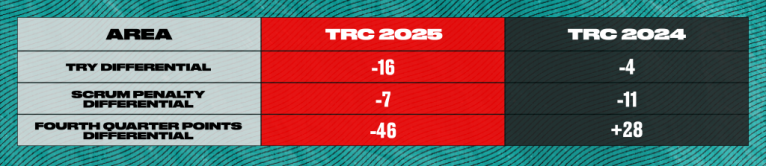
The development of Wenger, Rapetti and Priscinatelli and others represents a race against the clock. Without Sclavi in the final round, Argentina conceded five penalties from the tight-head position at scrum time. Without Albornoz, the Pumas scored only eight tries in their last four games.
Key match: The Pumas will enjoy the kindest November tour schedule of all, with only three games and a gentle upward slope from Wales to Scotland building to the climax at Twickenham. Argentina should beat Wales and Scotland is 50/50, so the success or otherwise of the tour will probably be determined by the result against England on 22 November.


Just cannot agree that France is the number 2 nation in the world. France does not dominate the Six Nations year after year even with all players available for selection.
It’s coming NB, you can feel it.
The only problem is that I felt the same way from 1999-2003 (and they were just joyous times to be a fan at Twickenham) and I was lucky to see all the games during that period. That was some team!!
It wasn’t quite the same but was a similar feel to Eddie in 2016-2019 (which got Twickenham fully behind the team and believing).
. . . . and a similar thing is building but I don’t think SB has quite convinced the fans they are there yet and may need a NZ win to convince them this is a worthy era.
In some ways, it was a brilliant era to be a fan. I remember thinking “this team is going to be pretty good in about 1999/2000 but then we realised quite how special that team was, we suddenly had a new watermark that set an unbelievably high bar for the future that few ENG teams have matched.
I thought ENG had a chance in 2019, couldn’t believe how well we played against NZ and then sadly had a high speed front end collision with Rassie’s 18 wheeler-truck of Champions, which left us with a mild depression”, so it just takes me a bit longer than it used to to let the excitement flow like it once did. . . . . but i’m getting there slowly. 🤣
Eight wins in a row tells you everything P!
It’s not regret but I think it has taken we a while to trust it can deliver against the better teams and its been uneven progress.
12 months ago, defence was poor and attack improved in 6N’s, with an improving bench. In ARG, defence was exceptional and attack was good.
This year, defence is exceptional, bench strength is the best it’s been and attack OK (but a bit clunky).
With so much change, it’s been hard to gauge the baseline and I think we have made more progress than people realised.
Yes, I think that’s a fair reflection of the game.