

At the end of a mesmerising six weeks and 15 games of Six Nations rugby, France could finally celebrate a third Six Nations title in five years and a record eighth – one more than England, two more than Wales and Ireland – since Five Nations became Six.
The stats barely tell the story of a Championship that brought a glut of sensational matches, upsets, drama and 29 tries on the concluding ‘Super Saturday’, contributing to a new record of 111 tries for the tournament as a whole.
When Tommy Freeman scored the 111th for England in the 77th minute in Paris, it seemed that Ireland, Triple Crown winners over Scotland earlier in the day, might be about to celebrate a third title of their own in the past four years.
But a stunning penalty from Thomas Ramos with the last kick of a breathless 13-try, 94-point encounter at the Stade de France brought the curtain down on the greatest championship the Six Nations has ever seen.
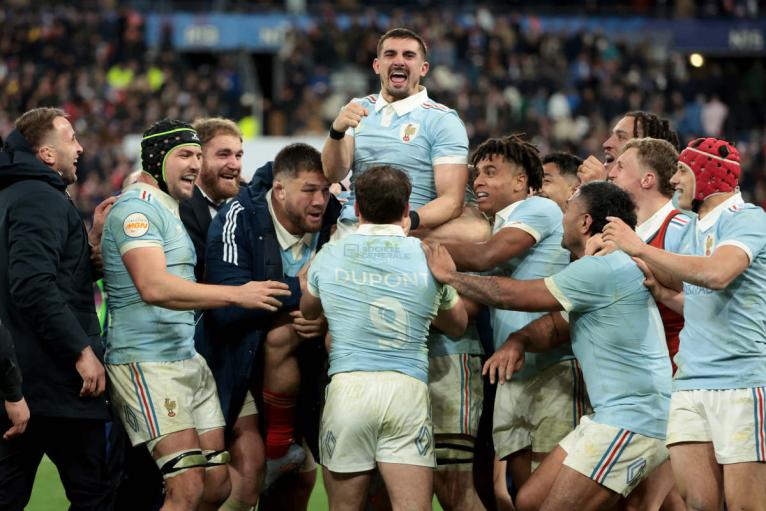
As Shaun Edwards, France’s defence coach who was savouring his seventh title – after winning four previously with Wales – put it: “Rugby at the moment, particularly in the Six Nations, is just phenomenal isn’t it?”
You’re not wrong Shaun. Here are some of the highlights, and our RugbyPass gongs, with additional contributions from Jamie Lyall (JL) and Owain Jones (OJ).
GAME OF THE CHAMPIONSHIP
There have been some scintillating matches this year, although your perspective on these might depend on where your allegiances lie.
Some of the rugby France played on that opening Thursday night against Ireland, 39 days ago, was sublime. Witness the try Charles Ollivon scored – initiated by a chip over the top from Matthieu Jalibert – or the second of Louis Bielle-Biarrey’s brace, with Thomas Ramos volleying the ball with the outside of his left foot into the path of the Bordeaux bullet.
Then there was Scotland’s epic Calcutta Cup win over England – with Finn Russell at his mesmeric best – and Ireland’s stunning 42-21 dismantling of Steve Borthwick’s side at Twickenham’s Allianz Stadium, a record Irish win and points tally in south-west London.
Anyone fortunate enough to be at Murrayfield a week past Saturday can justifiably claim to have witnessed one of the all-time great Six Nations matches as Scotland derailed France’s Grand Slam bandwagon in sensational fashion in a 90-point, 13-try epic.
Playing rugby from the gods at a pace France couldn’t live with, Scotland won every one of their 125 attacking rucks – a remarkable stat – and led 47-14 when Tom Jordan scored their seventh try in the 63rd minute, before a late French rally produced four more tries, two of them mini-classics, that not only put a more flattering gloss on the scoreboard but also ensured France’s title destiny remained in their own hands on the final day.
But it turns out 13-try classics are all the rage just now. Out of 405 matches in Six Nations history, only two have seen both teams score 40-plus points. They both occurred in France’s final two games of the championship, when Les Bleus conceded 96 points but still won the tournament.
While Scotland’s 50-40 victory over France was perhaps the single most impressive performance from one side, the way France v England waxed and waned, with the lead changing hands for a sixth and final time with that nerveless last kick from Ramos, made for the most dramatic conclusion to this or any other championship. Breathless, bewildering, brilliant.
TRY OF THE TOURNAMENT
So many contenders. The afore-mentioned gems from Ollivon and Bielle-Biarrey against Ireland were two of at least half-a-dozen French scores that could all make a top 10.
Three of them came against Wales in Cardiff. The opening try – started by Antoine Dupont’s offload out the back to Théo Attisogbe, finished by Émilien Gailleton – and France’s third, featuring a brilliant long pass from Ramos and a Jalibert break before Fabien Brau-Boirie applied the coup de grâce, were top drawer. The fifth, when Bielle-Biarrey took a high ball and offloaded to Ramos in one movement before collecting a return pass, racing up the left touchline and sending Attisogbe over, was another belter.
The classic French counter-attack Jalibert launched from his own 22 at Murrayfield, at 47-14 down, with Yoram Moefana releasing Attisogbe down the right flank, the one-two with Jalibert (even if the return was suspiciously forward) and the looping inside pass for Dupont to score was reminiscent of Philippe Saint-André’s Twickenham classic in 1991.
Then there was Scotland’s opener against England, with Finn Russell’s one-handed slap-pass – in the face of an onrushing Tom Roebuck – giving Huw Jones the space to skin Maro Itoje before scoring in the left corner.
Italy’s winning try against England – Paolo Garbisi’s cross-kick to Monty Ioane on the left touchline, the winger’s catch and step inside Roebuck before an inside pass to a marauding Tommaso Menoncello, who barrelled straight through Elliot Daly before releasing Leonardo Marin to the line – was another masterpiece of execution.
But those were virtually all backs doing their thing. For sheer, unadulterated joy, was there anything better than watching a marauding 132kg (22-stone) prop bamboozling a couple of defenders and running one in from 35 metres?
There didn’t seem to be too much danger for Ireland when Wales’ Rhys Carré took a pass from Tomos Williams near the left touchline, between the Irish 10 and 22m lines. Tadgh Furlong, Robert Baloucoune and Jamie Osborne thought they had things covered. But Carré, using Eddie James outside him as a decoy, left Furlong chasing shadows as he dismissively fended off Baloucoune before stepping inside and showing a turn of pace to motor to the line, despite Baloucoune’s attempt to atone with a last-ditch tackle.
The grin on the big prop’s face, and the adulation of his stunned team-mates, was priceless.
PLAYER OF THE CHAMPIONSHIP
One of Guinness’s most famous advertising slogans was ‘Good things come to those who wait’ and that maxim must surely apply to ‘Big’ Stuart McCloskey. At the ripe old age of 33, the Ireland centre is finally basking in the widespread adulation he deserves.
In a decade since making his Test debut, he has won only 26 caps with Robbie Henshaw, Bundee Aki and Garry Ringrose the preferred midfield trident but his form in this year’s Six Nations was such that he can no longer be ignored.
His game against England was a case-in-point. He tortured England on both sides of the ball, busting through the red rose defence at will, memorably bumping off Ollie Lawrence to create Ireland’s second try, scored by Robert Baloucoune.
With Ireland winning 42-14 with seven minutes left, he also chased down Marcus Smith – who had intercepted a pass and appeared to be heading for the try-line – to haul him into touch in the Irish 22, inducing a bout of fist pumps from his coach, Andy Farrell.
In Round Two against Italy, there was a lovely pirouette and offload to send Jamie Osborne over and his quarterback-style, one-handed overhead pass to Baloucoune for Ireland’s third try was further evidence of a burgeoning skillset.
His spot tackle on Finn Russell in the final round against Scotland was similarly influential, and if casual observers see the 6ft 4in, 17st Ulsterman as simply a bash-and-crash merchant, his looping 20-metre pass off his left hand to put Baloucoune away again showed his softer skills. Right up there for Player of the Tournament. (OJ)
LE RECORDMAN – LOUIS B-B
France winger Louis Bielle-Biarrey is still only 22. If he carries on at his current rate of try-scoring, he could set Six Nations records that will never be broken.
Last year he scored eight in the Championship, equalling a longstanding record held by England’s Cyril Lowe (1914) and Scotland’s Ian Smith (1925). When he raced onto Antoine Dupont’s cleverly-judged kick into England’s 22, got a toe to the ball ahead of a retreating Jack van Poortvliet and then dotted down his fourth try on Saturday at the Stade de France, he went one better.
Bielle-Biarrey’s record ninth try of the campaign was his 18th in 14 Six Nations matches since his first outing as a replacement against Ireland in 2024, a strike-rate of 1.29 tries per game in the Championship. The next best, among players who have 10 or more tries, is 0.70. With a fair wind on the fitness front, it seems only a matter of time before he passes Brian O’Driscoll’s Six Nations record of 26 tries. He might even do it next year.
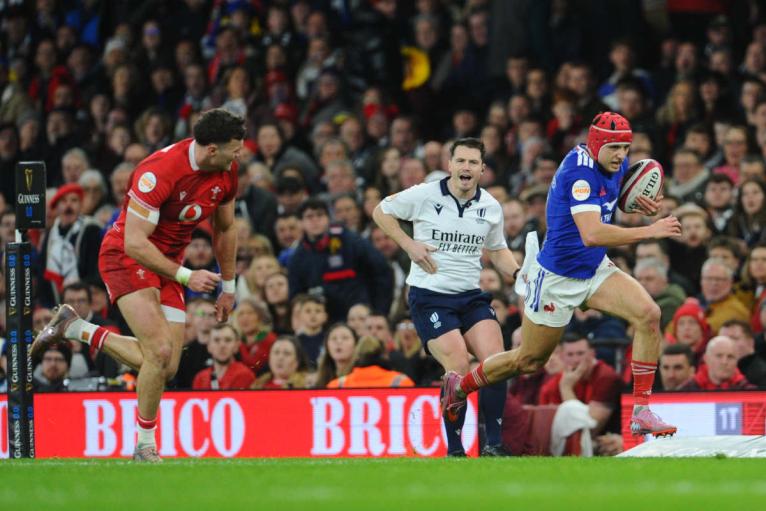
Having joined compatriot Philippe Bernat-Salles (2001) and England’s Tommy Freeman (also 2025) in scoring in all five rounds of a Six Nations last year, Bielle-Biarrey has now become the first player to achieve the feat twice. His quartet against England – the first time he has scored more than two in a Test – took his overall tally to 29 in 27 caps and were part of a French total of 30, equalling the record they set last year.
But Bielle-Biarrey is not just a finisher, even if the likes of Dupont, Jalibert and Ramos are always looking for space into which to thread kicks to utilise his blistering pace, knowing he will likely win a foot race against anyone.
His aerial skills, kicking game – whether chipping ahead for himself to chase or dabbing balls in-field for others – and pin-point passing have created several tries in this campaign, notably for fellow wing Théo Attisogbe. Quite simply a brilliant rugby player.
HISTORY MAKERS – FORZA ITALIA
In the press seats, peering down upon the Stadio Olimpico as the frantic final skirmishes were fought between Italy and England, people were collectively losing their minds. The local sound engineer who plugged the cables and wires into our commentary kit clasped his hands as though locked in prayer, his eyes wide as dinner plates. Some journalists were in tears. Plenty were quivering. Italy’s hour was finally at hand.
The histrionics in the stands sat in striking contrast to the comments of the Italian team in the aftermath. They embraced the pressure, backed themselves and the cohesion and the belief they have developed for the past six years.
It was the most cathartic day for a rugby community who at times have felt like the runt of the litter.
They didn’t actually play particularly well. Apart from succumbing to Welsh desperation on Saturday, this was their poorest performance of the lot. Sam Underhill’s high shot – with Italy two scores and a player down and preparing to sacrifice Louis Lynagh to make up a full front row – was a huge momentum shift.
It was also the most cathartic day for a rugby community who at times have felt like the runt of the litter. Told they didn’t belong. That they should make way for Georgia. That they offered no credibility or jeopardy and were mostly just a sensational away trip for the punters.
Nobody’s saying these things about Italy anymore. This group have shredded false perceptions and taken scalps, propelled by the cussedness of Michele Lamaro and his workaholic forwards, the immense Simone Ferrari and Danilo Fischetti up front, the shrewd playmaking of Paolo Garbisi and Nacho Brex and of course, the game-breaking magnificence of Tommaso Menoncello, soon to be a Toulousain Galactico.
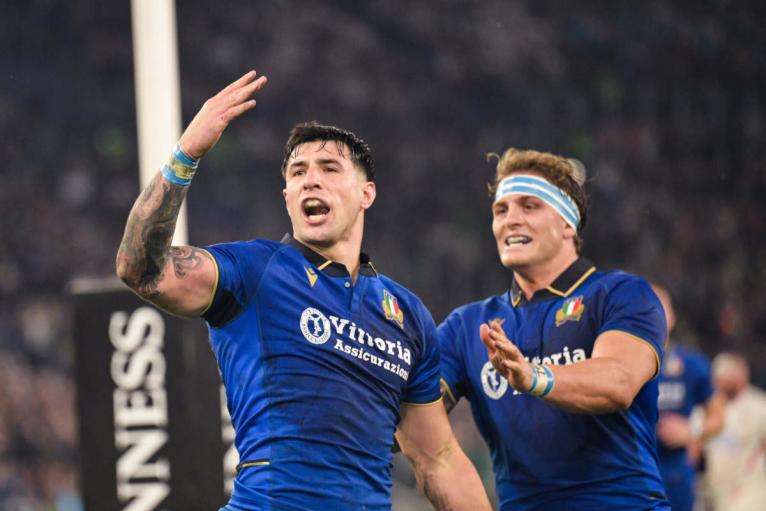
Menoncello roared in for a brilliant try in the first half, then set up the 74th-minute winner with a thunderous charge down the left and inside ball to Leo Marin. This was the state of the sides in microcosm. Two childhood friends and lifelong team-mates, filleting England’s new combinations, uncertain game plan, confused decision-making and ramshackle defence.
In a truly great championship, this was Italy’s greatest hour. (JL)
ZEROES TO HEROES TO ZEROES
A week into this topsy-turvy championship, Steve Borthwick’s England were a 12-in-a-row winning machine and Gregor Townsend’s Scots taking verbal fire like Crockett and Bowie at the Alamo.
It is impossible to speak for an entire fanbase, but these were no fringe malcontents on social media. For the first time in decades, a Scotland team was booed off at Murrayfield following the spectacular autumn collapse to Argentina. The clamour for change reached a crescendo when Scotland’s lineout dissolved in a Roman deluge. This was more of the same. Groundhog Day. A talented team destined to labour in Six Nations mediocrity under a coach who could rouse them no further.
The anxiety lay in the passage of time; the very real risk Finn Russell and his cohort would retire with highlight-reel moments and isolated wins, but no silverware reflective of their class. A new coach might not change that, but for many supporters, it was high time to find out.
Meanwhile, Borthwick’s kick-and-swarm formula was overwhelming teams by the week, buttressed by a back row of fetchers, giant specimens on the wings and his patented Pom Squad. They arrived in Edinburgh favourites to retain the Calcutta Cup and put Townsend in the thumbscrews.
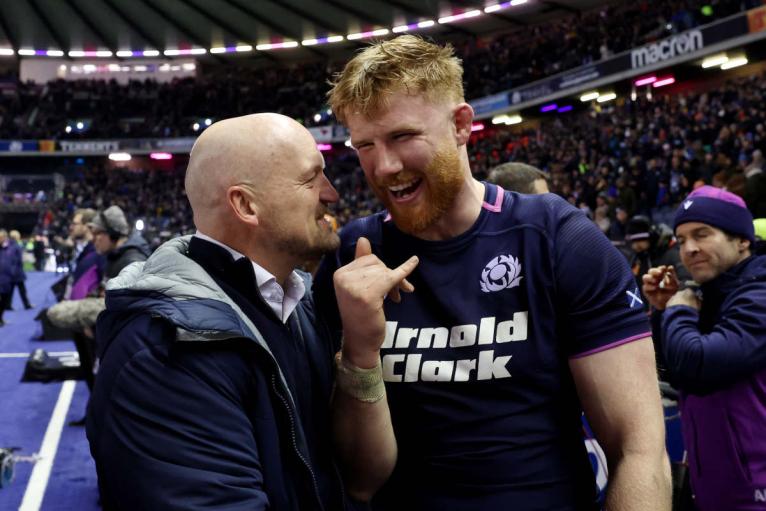
Like planes criss-crossing in the sky, the two coach’s trajectories have followed wildly opposing paths since: Borthwick plunged into a fresh crisis and another unwanted record on his CV – the poorest England campaign on Six Nations record; Townsend delivering the finest Scotland performance of the millennium in shellacking France, a third win on the bounce.
In the end, neither has rid themselves of their criticism, but nor are they staring down the barrel. Borthwick remains dogged by barbs about his character and the robotic nature of England’s play. Their Super Saturday flair in Paris will at least calm some detractors.
Townsend’s championship quest died in a brutally familiar suffocation in Dublin; a ghoulish reminder of the one Six Nations foe he has yet to conquer, and the flaws his team still carries. From hero to villain and back again, and now some kind of intangible middle ground, harder still to pass judgement on, when set in the context of this bonkers season. For now, both men have done enough to keep themselves in a job. (JL)
TEAM OF THE TOURNAMENT
15 Thomas Ramos (France) – Top points-scorer (74, including two tries) for the fourth straight year, overtaking Ronan O’Gara’s run of three from 2005-2007. The world’s best goalkicker nailed 28 out of 32 (87.5%), including that nerveless winning penalty to seal the title. Takes the odd risk at the back but so quick to spot an opportunity to counter and a hugely influential presence for France with his running, link-play, pinpoint passing and kicking from hand, as well as at the sticks.
Honourable mention (HM): Jamie Osborne (Ireland)
14 Kyle Steyn (Scotland) – Has neither the raw power of Duhan van der Merwe nor the striking agility of Darcy Graham, but a superior player to each of his rivals with all the tools required of a modern-day wing. Tremendous in the air, a tidy kicker and bruising defender – the only back in the top 16 players in this Six Nations for dominant tackles, with seven. Made the most tackle-breaks (26) and scored three tries, earning Player of the Match awards against England and France.
HMs: Robert Baloucoune (Ireland), Théo Attisogbe (France)
13 Tommaso Menoncello (Italy) – A generational talent, still just 23, who played every minute of the tournament. He averaged eight metres per carry and posted the fourth-most metres run. Only Steyn broke more tackles. Physically blessed, but learning to harness his explosive prowess and muscular frame. Barnstorming tries against Scotland and England and ran over Daly to tee up match-winning score for Marin, underpinning an exceptional championship for Italy’s golden boy.
HM: Émilien Gailleton (France)
12 Stuart McCloskey (Ireland) – So many highlight-reel moments. Andy Farrell called him ‘the Irish fridge’ after the win over Scotland and the quality of his performances “immense”. The Ulster centre had the third-most carries (74) and 105 post-contact metres – second overall – plus the joint-most dominant contacts with the ball (18) and a dominant carry percentage of 31.6%. But his passing also stood out. He assisted the fourth-most line breaks (nine) and the joint-most tries (six).
HMs: Yoram Moefana (France), Sione Tuipulotu (Scotland).
11 Louis Bielle-Biarrey (France) – A record nine tries in one Six Nations and only the second man – after England’s Chris Ashton against Italy in 2011 – to score four tries in a single game. The first to score a try in every round of two Championships after repeating his feat of 2025. Now scored in 10 successive Six Nations games and already France’s top try-scorer in the Six Nations era, with 18 in 14. Does everything at breakneck speed and has the full package.
HM: Monty Ioane (Italy)
10 Finn Russell (Scotland) – Matthieu Jalibert was sublime at times – the Frenchman had more offloads (14) and line-break assists (13) than anyone and was joint-top for try assists (six). Despite being shy of his best against Ireland, Russell’s all-round excellence edges it. Pivotal to demolitions of England – his one-handed pass to Huw Jones a highlight – and France. Quickly-taken kick-off to create Darcy Graham’s try against Wales was also key to victory. Nailed 20/23 kicks at goal (87%).
HM: Matthieu Jalibert (France)
9 Jamison Gibson-Park (Ireland) – Plenty of candidates, with Scotland’s Ben White, Dupont and Wales’ Tomos Williams all having their moments. But ageing like a fine wine, the tempo-setting 34-year-old is our pick. Ravenous work-rate off the ball, hounding opposition players, he made almost as many metres from breakdown snipes as Dupont, from 15 fewer runs. Always had his hand on the tactical tiller, key to the sacking of Twickenham and had his foot on Scottish throats again.
HMs: Ben White (Scotland), Antoine Dupont (France), Tomos Williams (Wales)
1 Rhys Carré (Wales). Came of age as a Test player, aged 28. Dropped by two previous coaches over weight and fitness issues, but now a cult hero after finishing as Wales’ top try-scorer with three, including a sublime finish against Ireland he will dine out on for the rest of his days. His set-piece and breakdown work – witness his reaction to winning a penalty in the win over Italy – also showed his enthusiasm for the less sexy stuff. As one fan’s placard said: ‘Keep calm and Carré on’.
HM: Danilo Fischetti (Italy)
2 Dewi Lake (Wales) – Julien Marchand had a fine campaign with France – winning 34 of the 35 lineouts he threw into – and Ireland’s Dan Sheehan took his Six Nations try record to a remarkable 15 in 23 games. But Lake has shouldered the woes of a nation in recent months so his Herculean efforts at the Welsh coalface were especially noteworthy. Made 66 carries in his 255 minutes of action, routinely running into heavy traffic, and 12th in the list of top tacklers. Never hid.
HMs: Julian Marchand (France), Dan Sheehan (Ireland)
3 Simone Ferrari (Italy) – You wouldn’t think it to look at his enormous torso, but Ferrari has shed a few pounds to play Gonzalo Quesada’s high-energy game-plan. The more svelte prop’s work-rate was impressive, contributing around 16 tackles per game, but not at the expense of his core work. Ferrari took the Scottish scrum to the cleaners and was at the tip of an Italian wedge which sent Tadhg Furlong and his pals skywards. Missed against Wales. Just edges England’s Joe Heyes.
HM: Joe Heyes (England)
4 Charles Ollivon (France) – Started three of France’s matches at lock before shifting to his old domain in the back row for the finale against England, picking up a first Six Nations winner’s medal after missing 2022 and 2025 through injury. The former captain, 32, has shown tremendous resilience to come back from a serious knee issue. His ball-playing ability and running game give France a different second-row dimension. Extended his record try tally for a French forward to 19.
HM: Emmanuel Meafou (France)
5 Tadgh Beirne (Ireland) – Others such as France’s Mickael Guillard may catch the eye more in open-field but Beirne’s value to Ireland, as it was to the Lions last summer, is priceless, especially at the breakdown. Ireland won seven turnovers against Scotland. Beirne was responsible for five of them, all when the Scots were in possession in the Irish 22. Such big plays have become his calling card. He was similarly destructive in the demolition of England. A world-class Test-match animal.
HM: Mickael Guillard (France)
6 Caelan Doris (Ireland) – Jack Conan showed his enduring value to Ireland, but the versatile Doris deserves a spot, even if he started four matches at No.8 and one at seven. The only forward to play every minute of the championship, his footwork, strength and offloading were of the highest calibre and only two players made more than his 81 tackles. At his destructive best against Scotland as he led Ireland to the Triple Crown, his cerebral captaincy adds to his talismanic role.
HMs: Jack Conan (Ireland), Guy Pepper (England)
7 Rory Darge (Scotland) – France’s Oscar Jégou played like a thoroughbred until he blotted his copybook with a reckless eye gouge against Scotland, copping a four-week ban. But Darge was consistently impressive, returning to the levels of his early years in the Test arena. A breakdown pest, winning five jackal penalties. Helped create the speed of ball the Scots thrived on, entering more rucks (209) than anyone. Footwork and running lines also came to the fore in attack.
HMs: Oscar Jegou (France), Alex Mann (Wales)
8 Ben Earl (England) – There were some fine displays from No.8s. Jack Dempsey had two huge games in Scotland’s wins over England and France, Aaron Wainwright delivered in spades for Wales and Caelan Doris, back to his best, is included at six. But Earl was a beacon of consistency in a tough campaign for England, the top ball-carrying forward for a third year running with 95, 29 more than any other player. Also made the most post-contact metres with 111m.
HMs: Jack Dempsey (Scotland), Aaron Wainwright (Wales)


Comments
Join free and tell us what you really think!
Sign up for free