
Money has always been a slightly dirty word in rugby. It was the original reason union and league went their separate ways back in 1895. It took union another 100 years to finally admit players deserved to be paid for their time. It was 90 years behind football in that respect, as highlighted by an excerpt from the following piece written by ex-Ireland international Andrew Trimble and Dan McKeown.
HSBC SVNS returns to Cape Town this December!
Don't miss your chance to see the world’s best rugby teams take centre stage 5-6 December in Cape Town.
“Football made its peace with money in 1885, when the FA legalised professionalism in England rather than lose the northern clubs that were already paying players. Football has been learning how to run a professional sport for 140 years, rugby has been learning for 30. The governance philosophy in rugby union was designed for the amateur century, and is now being asked to do a job it was explicitly built to prevent.”
The rest of Trimble and McKeown’s excellent article explores the impact of that dissonance ab initio, and explains in depth why the club game has suffered from the most basic fact of all, that its financial stakeholders still take relatively little part in decisions made about the game’s future.
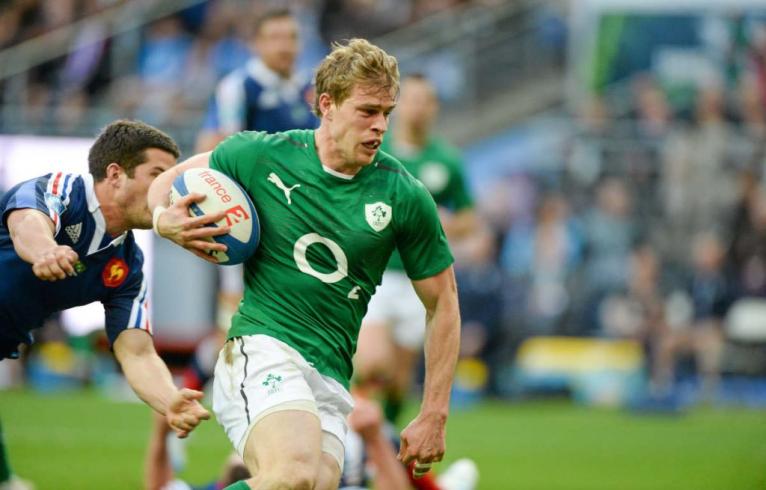
The dynamic tension between the LNR and FFR in France, and Prem Rugby and the RFU in England are just the two most obvious examples of the difficult balance between power of governance and the power of investment, and the dialogue between the two has seldom been straightforward. The question about how rugby absorbs private investment remains the highlight item of the sport’s ‘to do’ list.
This is all a far cry from the NFL in America or football in Europe. As Trimble and McKeown observe: “The NFL owns itself. Thirty-two franchises own the league, the league owns the product, and no governing body sits above it – taking a cut or deciding when its players are available… All the upside lands with people who have a reason to reinvest time, capital, energy and initiative.
“[In football], Europe’s top-division clubs turned over €28.6bn in 2024, [while] FIFA budgets around $13bn across a four-year cycle. The international game in football is enormous, yet structurally secondary to the club game. Clubs own the assets. The federation rents them, and both sides do very well out of it.”
The brand new Nations Championship has become the biggest vehicle to date for the introduction of private investment into international rugby, and at long last there is a chance to terraform the commercial landscape of the sport anew. The shape of the tournament is dictated principally by the backing of Silver Lake and CVC Capital Partners.
CVC already has a big slice of the pie in Prem Rugby and the URC, and most recently, it cut itself a 14.3% stake in Six Nations Rugby Limited. Where Silver Lake wants to monetize the All Blacks brand in which it has invested, CVC has taken control of large swathes of the European rugby economy, and both share the usual aims of private equity firms in sport: streamline the global calendar, fix cross-purposes in the hierarchy between club and country, and build a premium brand which is easily recognised in lucrative sporting markets such as Asia and North America.
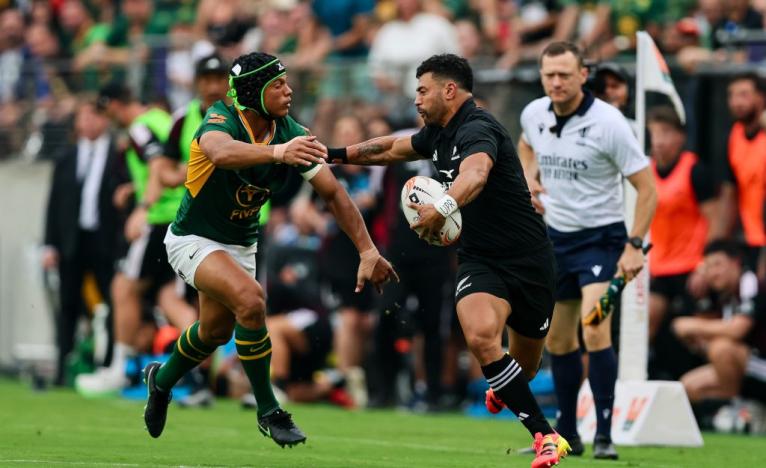
Hence the fourth Test of the RGR series being moved to the M&T Bank Stadium in Baltimore, feeling out a new audience in the USA ahead of the 2031 World Cup. Hence the consolidation of the two July and November windows into one tournament.
The biennial competition provides a £500m baseline underwritten by 80 broadcasters worldwide over its first two iterations in 2026 and 2028, with a clear preference for free-to-air over pay-to-view television, and a digital, direct-to-fan [D2F] strategy designed to maximise the audience and increase the all-powerful ‘average revenue per user’ factor commercially. Between them, CVC and Silver Lake have invested over £1bn in professional rugby and this is their first major stab at getting some bang for their buck.
In order to be investible, the sport has to be understandable to new punters, so many of the so-called ‘dark arts’ have to be brought into the light and made plain to would-be supporters. The refereeing decisions have to be simple, clear and obvious. If new people do not understand what is going on, there will be no profit for anybody. The Nations Championship is not about appealing to diehard fans, it is all about drawing a wider audience to rugby, all year round.
That’s why the first three rounds of the tournament in July produced an average of over 37 minutes of ball-in play time, nine tries and 63 points per game. The competition also generated fewer than 18 penalties per game – lower than the last major tournament in the north [Six Nations 2026, at 18.5] and the previous two down south [the 2025 Rugby Championship at 20.3, and Rugby’s Greatest Rivalry 2026 series at 19.5].
As usual, the scrum is the laggard in the queue as the sport develops.
Saturday’s match between the Sharks and Leinster in the URC amply illustrated the problem with demystifying the scrum. It was refereed by Welshman Craig Evans, who is generally considered one of the more promising officials in the league, but it signally failed to do its most fundamental job, that of getting the ball back into play and restarting the game.
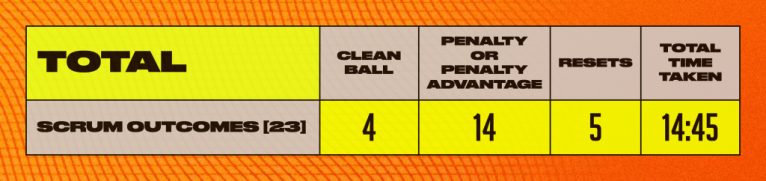
There were only four clean balls generated from a total of 23 scrums, including five resets taking just under 15 minutes with the game-clock ‘on’ within an overall ball-in-play time of 30 minutes and six seconds. Five of the six starters in the front row were experienced international players, but the game did not suggest any model which might be useful in the Nations Championship in November.
In all, Evans awarded 29 penalties and almost half of those were sanctions [or penalty advantages] at the scrum.
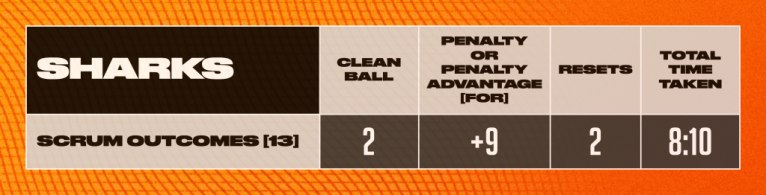

Both sides won penalties almost exclusively on their own feed without making much, if any, impression on the opposition put-in. The dilemma for a referee trying to diagnose the technical symptoms in real time was amply underlined by the passage of the following three scrums.
https://t.co/rCaLbQzsDt
— William Bishop (@RPvids1994) October 5, 2026
https://t.co/pKl6bnVnGG
— William Bishop (@RPvids1994) October 5, 2026
https://t.co/YI58wL7yBl
— William Bishop (@RPvids1994) October 5, 2026
At all three set-pieces the wheel follows a natural rotation around the Sharks loose-head Thomas du Toit. In the first instance, the Sharks are penalised for stepping left before walking around; in the second, Evans calls for a reset, which provokes an irate response from Leinster hooker and captain Ronan Kelleher; on the third, another wheel grants the Sharks a penalty advantage leading to a try by flanker Vincent Tshituka. Three similar scrums yield three different outcomes, but to the naked eye coming to a game of rugby for the first time, there will be no differences at all.
The Nations Championship represents the first opportunity rugby has embraced to shift gears, and harness the vast potential of private investment in the international game. If there is one quality rugby needs above all others now, it is accessibility. It is a time to educate, elucidate and demystify the secret handshakes from the amateur era, and make them available to all.

NEW IN THE APP: Official World Rugby Rankings hub! Compare team rankings side-by-side, with data going back 20 years.
Download the RugbyPass app on the App Store (iOS) and Google Play (Android) now!


I’d say they go to one game (it costs a fortune for NFL) and they probably watch the other. i would be very surprised if they had that much cross over going to both games.
That’s a very valid point but the build up to game day is massive, they literally hype it to pieces all well on podcasts, radio, Instagram stuff - you really can’t avoid it which is where they build the fan base engagement to such strong levels.
The other key issue Ed is that with a state population of circa 5m, they still convince 130k people to pack out both stadiums for all the games. That’s a really healthy level of support in both States.
Tbh I don’t know much more about it. I have heard NFL are trying to creep forward in the weekend which would tread on some college toes, but it certainly does present an interesting comparative model for rugby.
In particular the amount of analytical info available to fans runs far in excess of what is available to rugby fans. So they do make a huge effort to make a complex game understandable.
Exactly right, the Sport Broadcasting Act protects hs/college slots from the nfl games to a high degree, and yes, almost all of the nfl players come via the college pathway.
However, I followed Jay-Wai’s example and looked up some data on fan crossover and it exists to a fair degree, albeit with some notable demographic and geographic exceptions (as PMcD describes below). The figures I found (since this is well outside my gen knowledge levels) were from S&P Global (a pretty credible source), 2025 showing that 87% of football fans watch the NFL and 55% of football fans watch college football. With those levels of overlap there has to be a level of $ competition between them for tickets, media viewing subscriptions, merchandise etc..
Anyway, what is very clear is that American Football is so far down the road ahead of rugby commercially that it’s almost beyond any meaningful comparison as sporting codes and there are undoubtedly plenty of lessons for rugby if they look hard enough.
Well if you look at the basic design of the sport, high school games are played on Friday nights, college games on Saturdays and NFL on Sunday. And the NFL cannot broadcast on Friday and Saturday by law. So that to me looks like a deliberate non-compete clause.
Plus the NFL does not have any development league of its own other than college-ball.
No, they are both very well attended and pull from different supporter Groups, so they co-exist side by side with each other at similar levels.
If you take Wisconsin & Michingan Uni, they both typically pull 65k fans per game and the games are attended by former alumni & current students. The Hotels are full (with home support) and people meet up with their old college friends and go to the games together.
Green Bay (Northern Wisconsin) is 75k attendance , with Detroil Lions being 65k and is more resident based, which is why people support the different teams to similar levels, rather than being alumni based.
Obviously the NFL is higher priced and a higher standard but the University Coaches were being paid about $8-10m a season and the players were getting nothing despite these huge commercial revenues being created, so you can see why they had to give something back and the NIC’s (commercial sponsorships) can earn a player $3-6m a season, so yes they are starting to make a decent living from being a University football player 9and more from that loyal Uni fanbase than they may earn in the NFL.
It’s a different sporting universe over there, which they commercialise to the max but ultimately the fans will pay to watch and the ticket prices are enormous in comparisson.
So you’re saying there is no commercially competitive element to the college/nfl relationship, seriously? And the amateur/pro difference has been reduced significantly with the fairly recent changes that now allow payments to college athletes, some of them graduate with $m’s in the bank! Collectively they were paid $1.8BN last year…
Would be interested to hear@PMcD take on this since he’s pretty astute on these matters.
Yes the college/NFL relationship is entirely co-dependent, tho I would not say it’s competitive because of the amateur/pro difference…
I told you I didn’t read all the article, if the relevancy was further in than what I read you can easily just share it here.
Yes, you’re absolutely correct re players but his (or rather AI’s) point was that they very much do compete commercially, for example, it’s only the enactment of laws that have protected the crucial college game broadcast windows.
It’s actually quite an informative view of a very interesting relationship between two entities that simultaneously exists as a mutual codependency and a commercially competitive relationship.
I don’t think he was Ed.
College-ball, while huge in itself, is a prep for pro-Footy. The players who ‘graduate’ play it at a diff stage of their careers, so there is no direct comp between the two… At least it’s not the same as the comp between club and international rugby, where players are being pulled two ways at the same time in their careers. which is the issue with Top 14 in a nutshell.
I can understand that but he was actually spot on with his competing point…
You’ve now been officially christened Jay-WAI 🤣
But I won’t be talking to the ‘WAI’ part any more!
He does and if I am really honest, I think we are starting to see it in his performance.
He wasn’t the same player last year and he’s been solid the last 2 games but was pretty much in a class of his own each game when we won the PREM.
In his mid thirties he really needs to cut back P!
It has turned out that way.😁
Yep no answer as yet…
The current scrum situation as a penalty machine is their golden goose and they won’t give it up lightly.
But scrums can absolutely be better, many said removing the hit was mad until it worked so well.
A very well timed article!