
When the end came, it didn’t take another review. Only two matches into the Six Nations, after the ‘forensic’ report into Welsh failures in the Autumn Nations Series, the man the WRU had backed to get them out of trouble found himself backed into a corner. Within a couple of short hours at the Vale of Glamorgan hotel in Hensol, Warren Gatland was gone.
It was as if the conclusions from that weighty report had disintegrated, flimsy as wet newspaper in heavy rain. CEO Abi Tierney had claimed at the time, “We analysed to see… [whether] it would make a positive difference to change the coach. Actually, what would make a difference was if we backed Gatland to turn it around.” Somehow, Gatland’s abrupt departure only two games later was symbolic of the fissure between the Welsh Rugby Union and the stark reality of professionalism that has always existed.
The WRU is still groping towards a fully professional solution in the country, rather than consolidating on established foundations after the sea-change in the game back in 1995. Let’s wind the clock back 30 years, just for a moment, to set the scene. Jason Smith was a prominent legal representative for players and coaches in Wales and England when the bomb dropped.
“As soon as the floodgates opened, it was sheer madness,” said Smith. “It happened overnight and there was nothing progressive or planned about it. Professionalism created a culture where everyone was now expecting to get paid, however high or low on the playing ladder they were – League Six North or whatever.
“Right from the start, I felt it was unsustainable. About five times a week, every week, as I did the rounds negotiating contracts for my players, I’d be thinking: ‘They’re going to go bust’. There were no proper business models in place at the clubs.
“As regionalisation loomed, there was too much money circulating around too little quality in Wales, and spread over far too wide an area. Unfortunately, the same ill-conceived pattern was repeated when regionalisation was introduced in 2003-2004, and that showed the essential lessons had not been learned.”
According to Terry Cobner, who was presiding over the transition as Wales’ first-ever director of rugby, the union discovered it only had enough money to contract between eight and 10 players – and a significant contribution to their salaries would be still be required from the players’ clubs in any case. Cobner and Graham Henry understood the talent base existed for two, or at most three, professional entities in Wales.
In the event there were five regions formed initially, dropping to four with the demise of the Celtic Warriors after only one single season of competition. There were some unlikely club mergers, and a majority dose of private investment in all the remaining four. It was the Irish format, without the beating heart that made it all tick over across the Irish Sea. It was a formula for failure. As Smith recalls, “the WRU and the club benefactors did not start with a clean sheet of paper. They started by trying to protect pre-existing interests, then embrace other people in those interests.”
In the absence of central contracts and brand-new regional identities, with private investors bidding against each other for the same players and a wage bill spiralling out of control, Wales was bound to fall foul of the cash-rich owners in France and England. When benefactors such as Mike Cuddy, Peter Thomas and Tony Brown inevitably bowed out, Wales was left in a very black hole of its own making.
Gatland was swimming against the tide of regional entropy when he took the Welsh job in 2008. Under his stewardship, Wales became the ‘upside-down’ success story, nourished from above, not below. The financial welfare of the four regions became totally dependent on the winning profile of what the late Eddie Butler jokingly called ‘the fifth region’ – the national team. And King Canute Gatland was good enough to turn back the tide, time and time again: winning four Six Nations titles, three Grand Slams and reaching two World Cup semi-finals between 2008 and 2019.
In his second coming, the day of reckoning was bound to come. As Butler put it, “The top has become heavier and more important than the bottom of the game, and it doesn’t take a structural engineer to point out such structures tend to come crashing down upon themselves.” Wales lost 14 games in a row before Gatland departed by mutual consent on Tuesday. No Welsh region was good enough to gain entry to this season’s Investec Champions Cup. Go figure.
More subtle signs of the same entropy have been in evidence within the national side’s performance on the field for some years. When Gatland was in his coaching pomp, he had an outstanding defence coach in Wiganer Shaun Edwards and a remarkable head of strength & conditioning in Craig White, supported by an army of trainers. When Wales won in the Gatland era, it was because they were fitter, more physical and dominated their opponents in defence.
It was a world away from the Welsh tradition of the 1960s and 1970s, when Wales depended on a constellation of smart, skilful but often undersized ball-players, particularly in the backline. By the time Gatland’s Wales beat England to the 2013 Grand Slam, the listed size of their three-quarters read like a unit of back-row transplants: Jamie Roberts [6’5 and 108 kilos], Jonathan Davies [6’1 and 105 kilos], Alex Cuthbert [6’6 and 106 kilos] and George North [6’4 and 114 kilos].
The true long-term regret of the Gatland era has been the steady erosion of tactical nous and constructive, quicksilver thinking in the backline, and that is probably the reason for Matt Sherratt’s elevation as interim head coach. Sherratt is an out-and-out attack coach
Since Dan Biggar’s departure, the cupboard at 10 has been shown to be bare and the factory-fitted line of playmaking geniuses such as Barry John, Phil Bennett and Jonathan Davies first stalled, then ground to a halt. There appears to be nobody to orchestrate a backline on the pitch, and nobody to coach a structured attack which can release whatever talents still lurk within the Welsh three-quarters off it.
Nowhere was this unpleasant fact more in evidence than during Gatland’s last game in charge at the Stadio Olimpico in Rome. The outcome was entirely predictable from the statement of Welsh ambitions right at the very beginning of the game.
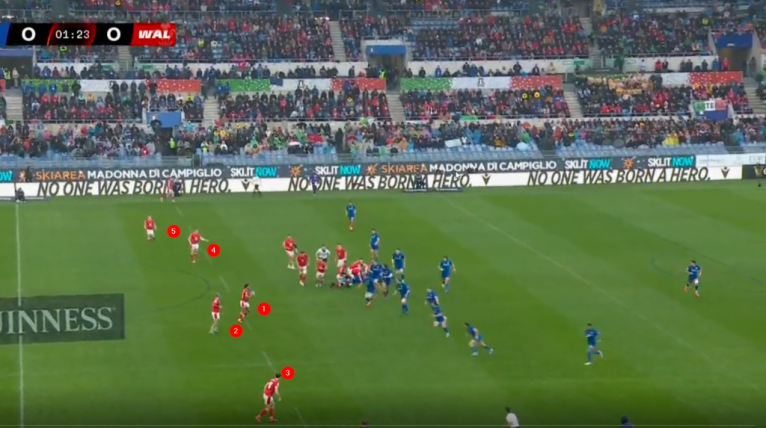
Wales are ideally placed in the middle of the field deep within the Azzurri half, and can play happily to both sides, but attacking alignment is non-existent and a kick from the boot of 10 Ben Thomas is the only option. Wales had already kicked six times on the Italian side of halfway within the first 30 minutes of the match.
Even when they won prime turnover ball just outside the home 22, Wales had little or idea what they were trying to achieve thereafter.
The potential first receiver, Wales 12 Eddie James, is at least 10 metres off the line when the ball emerges and that excludes him from the attack. When the ball goes out via a forward and 13 Nick Tompkins, he ignores the man coming on to the ball at the highest velocity outside him [10 Thomas] in favour of throwing a long speculator, well ahead of left wing Josh Adams.
A problem with the depth and reorganisation of the two lines of attack was the central feature of the first half.
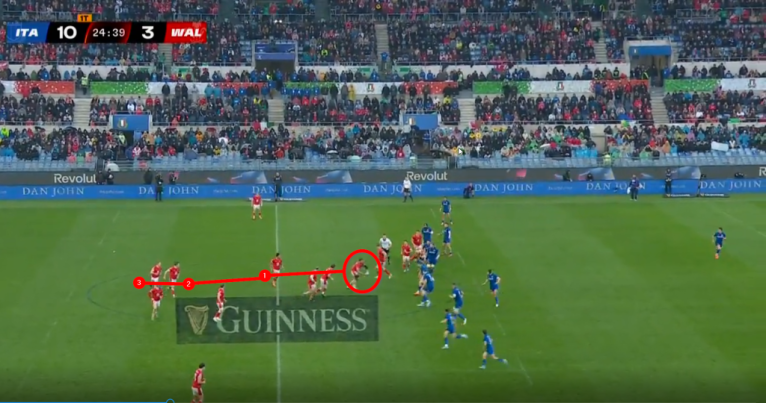
The second Welsh forward pod up is still in the process of reloading when Tomos Williams passes the ball, so it has to go to the first forward rather than the second. The situation behind them is scarcely any better, with Thomas out of position and his two primary strike runners too deep. The ball cannot be played from pod to Thomas, and even if Thomas does get it, the Italian D will eat the space reserved for his outsides by the time he passes.
The outcome, with the Welsh backs little more than disinterested onlookers, was predictable.
The sheer depth of Welsh positioning on attack was a constant problem.
The ball has been turned over just outside the Azzurri 22, but the lack of coordination and poor alignment behind means that the next tackle is made in between the Italian 10m line and halfway.
A neat breach is engineered for Tompkins on first phase, but there is no way of exploiting it on second with all the Welsh players bunched in a centre-field herd no more than 20 metres apart. There is a real chance to break on the final phase if the two forwards outside Thomas run hard straight lines and James keeps his depth beyond them, but once more the opportunity goes to waste.
Upon the announcement of Gatland’s departure, Tierney commented:
“I really hope that [Warren] is remembered for the Grand Slams and championships he won. They should be his legacy.
“We want to bring back hope and ambition to Welsh rugby and we want to help the players rebuild their confidence and mindset.
“Matt Sherratt isn’t going to change that around in three games, but if we can see some hope and ambition, then that will be a step in the right direction.
“[Welsh rugby] is at a low ebb and we have got to turn it around. It’s the same systemic problems that have been around for a long, long time.”
The rusted-on supporter of Welsh rugby could be forgiven for wrinkling his or her face into a wry smile at hearing the same old statements made, time and time again. The endless reviews that lead nowhere, the promises that are never kept, the underlying problems that are never addressed. It is like the same day repeated with minor variations. For the time being, that dyed-in-the-wool supporter is fully entitled to be skeptical. As the late and much-lamented Butler said, “Me? I love rugby where the sun don’t shine – not on The Truman Show riviera south of the M4.”


Comments
Join free and tell us what you really think!
Sign up for free