
American investors are on the march and seeking to conquer the summit of English professional rugby. The floodgates have opened quickly. The story started back in February, with the Rugby Football Council voting overwhelmingly to scrap the old promotion/relegation system once and for all, while looking towards the new horizon of a franchise system borrowed from US sports.
Visa Priority RWC2027 Ticket Sale: 28 - 30 Sept 2026
Register your ticketing account now for Visa Priority Sale access. Visa sale: 28 - 30 September, 2026
The final straw for the old model was a damning 2025 Leonard Curtis Rugby Finance Report, which revealed ailing Prem clubs made a combined loss of £34m in the 2023-24 season, with the debt total reaching £342.5m across the league. Six of the 10 clubs were still balance-sheet insolvent, which means they were reliant on handouts from benefactors for survival. Despite some encouraging sprigs of growth in matchday and commercial revenue, nobody made a profit for the third year in succession.
So far, nothing new under the sun. Prem clubs have been operating at a loss for as long as anyone can remember. The most interesting part of the report was a recommendation of the American sports franchise model.
The analysis concluded a franchise licensing system could save the clubs anywhere between £1.1m to £1.9m annually on a typical £20m turnover from shared services, if -and it’s a big if – it was combined with centralised governance. The non-negotiables would include:
- Independent financial regulation.
- Disciplined cost controls – with the existing £6.4m salary cap paired with a recommended wage-to-revenue ratio limit of 70% initially.
- Transparent annual licensing and grading.
- Solidarity with a properly-supported second tier.
In other words, the Prem would need to tip its hat to an independent ‘policeman’ regulating the financial health and wealth of the league. Speaking at the launch event, Alex Cadwallader, a Leonard Curtis director and former England U21 player, observed: “There are no surprises in our latest report. Not in the most recent figures. Not in the figures for the last 10 years. The current model is proven. It is a loss-making one.
“The clubs collectively have been loss-making every year in the last 10 years once the exceptional items such as ground sales in 2014/15 and the CVC investment deal in 2018/19 are removed. The amount of debt continues to grow.
“The game is reliant on benefactors funding their clubs for which we are grateful. However, this cannot continue. The competition in France is moving forward and ‘disruptors’ with new models are circling. The question really should be ‘why would we not consider a different model?’”
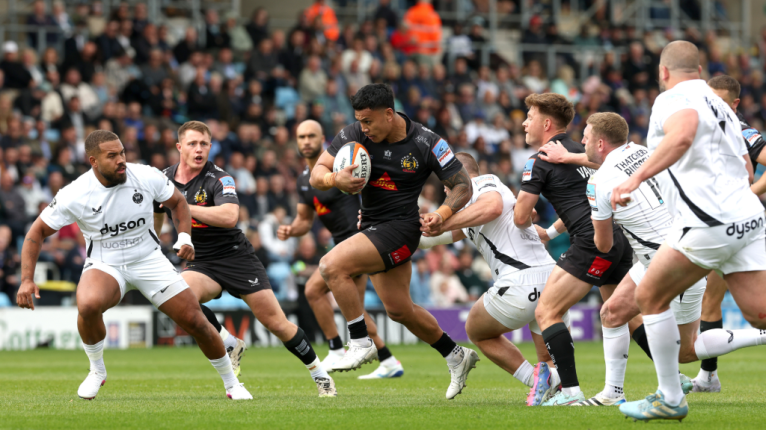
It is the proposal of a new franchise model which has attracted American money, because it grants the investor security of tenure in the league. First the Cornish Pirates from England’s second-tier Champ attracted interest from Pittsburgh-based Stonewood Capital Management, but that was only the first course. The second was plated last week, with the Exeter Chiefs membership voting to sell the club to the American owner of AFC Bournemouth, Black Knight Sports & Entertainment, which forms one part of billionaire Bill Foley’s investment portfolio.
Long-time Exeter owner/benefactor Tony Rowe was in no doubt about the importance of the deal and the shift towards a new financial model: “Whether you like it or not, professional sport is all about money. We need money to survive. All the stars are aligned to transform English rugby beyond where it is today.”
Foley’s investment planning already has a history of sporting success. The Vegas Golden Knights won the Stanley Cup within six seasons of their debut in the National Hockey League and Bournemouth currently sit in pole position for a lucrative Champions League run next season, despite having one of the smallest budgets and stadiums in the league. The ‘Moneyball’ use of data under Foley’s Black Knight consortium has been a significant factor the rise of the Dorset club and Exeter have been traditionally built along the same lines, extracting maximum value from underrated assets.
There is already significant US investment in English football, but English cricket also received a huge shot in the arm with a £650m windfall from the sale of stakes in the franchises in The Hundred competition. It was a seminal moment for an under-funded sport, with investors attracted from far and wide: from Google and Microsoft to Knighthead Capital Management [owners of Birmingham City Football Club] and Cain International, one of Chelsea FC owner Todd Boehly’s constellation of investment companies.
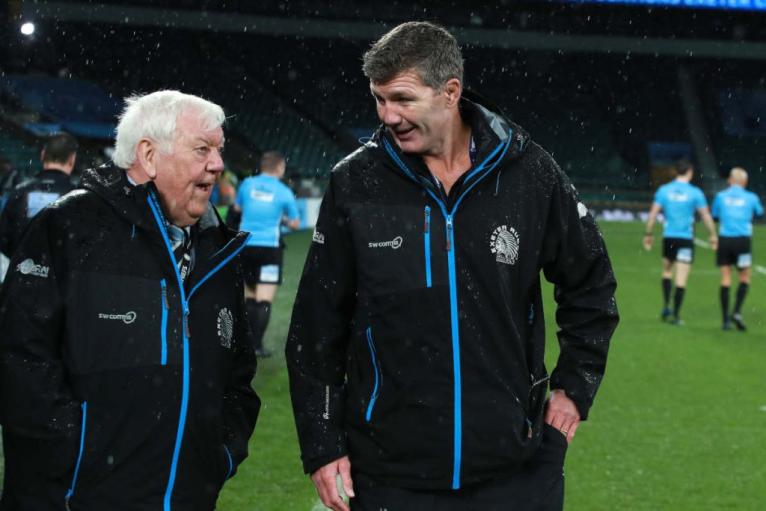
Following the Red Bull takeover at Newcastle and Sir James Dyson’s investment in Bath Rugby, there is at long last the mirage of an oasis in England’s rugby desert. If it delivers on the promises it is making, it will revolutionise the Prem in particular and the sport in general.
As AFC Bournemouth has already discovered, there will be an emphasis on the use of data to extract optimal value from existing assets, or better identify undervalued new ones. There will be much streamlining, with nothing for free.
After a disastrous 2024-25 Prem campaign in which they won a paltry four of 16 league matches, Rob Baxter had set about the reconstruction of the Chiefs’ tight five forwards. Wales second row Dafydd Jenkins and ex-Wallaby Scott Sio were two solid starters, and Baxter reckoned on the recycling of 36-year-old Jack Yeandle for one more year at hooker. The keys were finding a partner for Jenkins at lock and a reliable tight-head successor to the likes of Tomas Francis and Harry Williams.
Zebre second row Andre Zambonin was plucked from the citadel of obscurity in Parma to plug one hole and it prompted a breakout Six Nations championship for the 6ft 8ins Azzurri lineout caller. Baxter then had to back his judgement on the potential of Josh Iosefa-Scott at tighthead prop. Iosefa-Scott had played 11 NPC games for the Waikato and three Super Rugby matches off the bench for the Highlanders when he left for the West Country of England in 2021.
The 24-year-old was huge at 6ft 4ins and 145kg, but he was very, very raw. He was the kind of project the Chiefs were well-versed in bringing to fruition.
It took the Exeter the best part of three-and-half-seasons to establish Iosefa-Scott could cope with the pressures of a Prem scrummage. There were many times when it looked like the Hamilton-born hulk might not make it, but when he signed a two-year contract extension in March 2025 it provided a black-and-white stamp of approval.
There is no better proving ground for an aspiring Prem tight-head currently than Bath, and Iosefa-Scott found himself up against the redoubtable South African Francois van Wyk at the weekend. He established he would be no pushover at the very first scrum.
— William Bishop (@RPvids1994) May 12, 2026
The Chiefs opt for a long 11-second scrum, with the Iosefa Scott eventually getting the upper hand on Exeter’s tight-head and pushing through on his side of the set-piece. The home side were unlucky not to receive a penalty from referee Karl Dickson.
Iosefa-Scott’s combination of physicality and ball skills is a huge force in both red zones. He scored one try from close-range on the drive, and his skills created two other opportunities at opposite ends of the field.
— William Bishop (@RPvids1994) May 12, 2026
— William Bishop (@RPvids1994) May 12, 2026
In the first clip, the big Kiwi makes an interception on his own goal-line but is not satisfied to merely surrender in the tackle and ensure a safe exit. He tramples Bath nine Ben Spencer then the chicken-wing offload moves play deep into Bath territory. And how many tight-head props can become a playmaker, running the ‘no-look’ pass with an option both front and back? Very, very few.
The two men on whom Baxter was depending to stitch together his 2026 tight five, Iosefa-Scott and Zambonin, worked in concert to great effect throughout the game.
— William Bishop (@RPvids1994) May 12, 2026
— William Bishop (@RPvids1994) May 12, 2026
In the first example, the pair are doing their bread-and-butter jobs in the tight, with the spring-heeled Italian winning lineout and the New Zealander caving in the open-side of the Bath lineout defence to win a penalty. In the second they are showcasing their skills as passers, authoring three offloads between them as play moves across the width of the field from left to right.
Baxter has once again blended a tight five unit at Sandy Park which is big, physical, mobile and highly skilled.
— William Bishop (@RPvids1994) May 12, 2026
The first event in this long sequence highlights the improvement Iosefa-Scott has made in the nuts and bolts of forward play, with the big man standing above the ruck despite Bath’s several attempts to move him. A repeat involvement by the prop two phases later on the run creates space for Jenkins to chip ahead to the Bath goal line, with Zambonin first up to win a turnover on the deck. Now that is what you call multi-tasking.
The Americans are on their way, and especially, their much-needed investment money. It has poured into English football, now it is making inroads in the minority sports of cricket and rugby. It has the potential to make a huge difference if the franchise model so popular in American sports is adopted hook, line and sinker by the professional layer of English rugby.
Exeter Chiefs will be one of the first rugby clubs to benefit, if due diligence allows Black Knight Sports & Entertainment to complete its sampling of the cream of Devon successfully. The club dominated by the Baxters for so long will no longer be a family concern, it will suddenly become an experiment in global investment.

Your home for rugby. Download the RugbyPass app on the App Store (iOS) and Google Play (Android) now!
Follow your favourite teams, tournaments and players, and get personalised news and Match Centre notifications direct to your device.
From live rugby streams and upcoming fixtures to breaking news, in-depth analysis and live scores, RugbyPass has everything you need to stay connected to the game.


Good point 🤣🤣🤣 . . . . I think it was October 2024, where they gave Bath a good beating at The Rec and played like a team possessed. That’s the last time I recall them turning up in D. 🤣
You’ll enjoy it😁
It’s even simpler than that P. When was the last time they won a game through their D??
Yes, it’s the Bristol attack game and they are not great at tight, technical arm wrestles.
They used to have a better forward pick and go game with Sinkler, Luatua, Attwood & Vui in the front 5 but those days are ling gone.
That will be an interesting piece, to help understand the subtle questions an experienced selector can add, which has been lacking in both NZ & ENG since 2023.
I think getting clarity on tactics & selection has become more critical than ever.
I think there’s a problem of adjustment too - I watched that UBB pool game and it was clear UBB had prepared very well for them on D, but the Bears made no adjustments on the hoof. They just went down with all hands, doing the same thing. The best teams do not do that, they find a way…
See next piece P! Ted still has that bright mind and he’ll never lose the coaching bug… he’s needed because it is another very young coaching group under Rennie too.
Perfect. Just the right timing for England to have done all the work developing him and New Zealand to sign him back near his peak. As well as the knowledge of going up against the English component of the next Lions group.
The new model is working well it seems.
Who says he wants to play for NZ? Sounds like he feels committed to England.
These non negotiables are stupid, you might as well have a promotion-relegation with them in play and putting a stop to the sugar daddies.
The Americans can’t make America’s rugby good….
Correct Carlos . . . . But there is a very good underlying college rugby scene starting to grow, which will one day gradually build a stronger fan base for the game to grow.
But they are proven sporting investors C!
Surely 10 teams aren't enough. Wales provides 3/4? And if that works, it would be awfully tempting for Scotland to move their two strong sides. Leaving a positively weird URC with West and East Europe covered, but nothing in between to go with South Africa.
Exeter looked great on the weekend. Whilst none were MoM, I liked how the Oz players went. Hooper is now an elite 6, and we already knew of the quality of Sio and Len.
Whatever else he brings, and that’s obviously plenty, Baxter has a wonderful eye for talent and an understanding of the pieces required to build a squad.
What is the preferred squad size for a GP team? I note that Heaven hasn’t been getting a run at hooker of late, and there is another young bloke, from Cornwall, in the squad also.
“I liked how the Oz players went. Hooper is now an elite 6, and we already knew of the quality of Sio and Len.” Agreed, Derek. I smiled wryly on looking at one of those player ratings on the Exe players in the game. Hooper got a 6.5. , the only player so low. I then watched the full game yesterday, and Hooper had many very good involvements. By no means a laggard.
Wales has an opportunity to move out of the URC and into the Prem if it has its wits about and cuts to 2 pro regions. There are a wealth of enticing cross-border fixtures out there for a couple of talent-stacked Welsh sides.
The aussie guys always go well at Exe, and Lenny and Tom are no exception. Tom Hooper is becoming a wonderful all-round 4/6 hybrid.
35 seniors + 12 academy ‘bridgers’ is the answer to your Q I believe…
If you really wanna make it work I reckon make it a English Irish Scottish Welsh comp don’t know where that would leave the SA teams and you would have to drop some of the English clubs know some would hate this idea but there is a heap of upside from costs to audience look at the NRL Oz is not a big country and has plenty of competition from other sports ( nothing on football granted) but it is filled with amalgamated clubs and new franchises traditionalists will argue that you won’t keep getting fans but rugby people love rugby right?
As above I think it’s more likely Wales will pull out of URC and try to join the Prem with two or at the outer, three strong regions, and that will renew some ancient rivalries as well as balancing the numbers between the two leagues. Atm the four Welsh sides add very little to the URC. So leave four Irish, four from SA, two from Scot and Italy apiece in the URC and add two Welsh teams to the Prem!
You’re probably correct about a UK&I comp being the optimum way forward for the investors but it sure leaves SA screwed and not forgetting Italy!