
The intensity is back, the novelty is back. The Greatest Rivalry in rugby is finally back on the rails. The novelty has been given a huge helping hand by South Africa’s abandonment of Super Rugby and move towards northern domestic competitions. The players no longer experience the ho-hum staleness of the over-familiar. The razor-edge intensity has been merely dormant, awaiting the time to wake up like a vengeful ghost summoned on some unwitting rugby Ouija board.
NEW: Follow Your favourites in the App 📱
You can now follow their favourite teams, tournaments and players in the RugbyPass App!
The 47,130 baying fans at the DHL Stadium in Cape Town will eagerly testify to both. It was a portentous occasion with meaningful bite, and in the course of the 80 minutes Springboks supremo Rassie Erasmus drew rather more blood than his counterpart Dave Rennie. The All Blacks beat the Stormers comfortably enough in the end, 38-21 and six tries to three, but the game was played out under rules which will suit South Africa rather more than New Zealand, if the early omens extend as far as the Test series which begins on 22 August at Ellis Park.
World Cup-winning coach Steve Hansen put his finger on the pulse of that four-game series in the Rugby Unity podcast when he observed: “It’s going to be fantastic to sit back and watch it, because they are contrasting styles. And we’ll learn a little bit more about the All Blacks’ team and about the South Africans as well, because they’re going to have to front up against each other four times. So what style is actually making the better progress?”
On Friday evening in Cape Town, it was the South African style which made most progress in a match refereed by a Prem official not naturally aligned with the Springbok cause, Karl Dickson. Take a look at the following table:
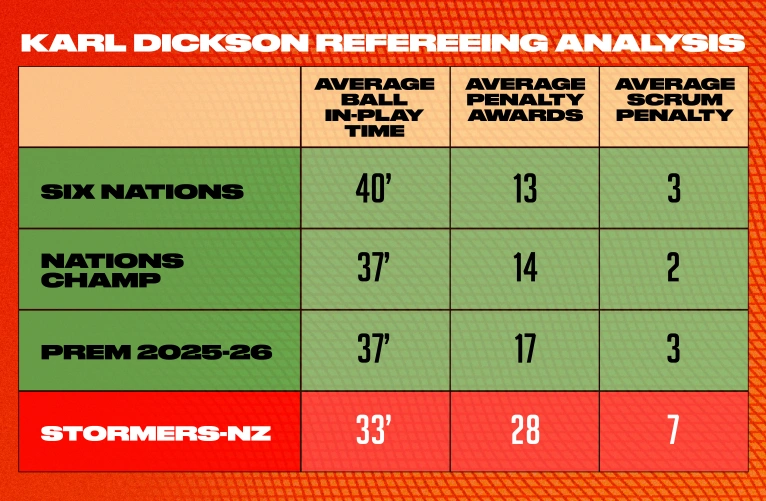
In his other refereeing appearances in 2026, both domestically and internationally, Dickson averages between 37 to 40 minutes of ball-in-play time, 13-17 penalties and two or three scrum penalties awarded per game. In Cape Town his refereeing profile changed completely: anywhere between four and seven minutes less ball-in-play time, double the number of penalties awarded as a whole and twice the number of penalties given at the scrums.
It raises some questions around how Dickson and the rest of the elite refereeing panel nominated for the whole cache of tour matches – Nika Amashukeli, Matt Carley and Angus Gardner – can avoid the Test series becoming a penalty-laden slugfest.
A stop-start, set-piece-based game will certainly not suit the All Blacks, as New Zealand head honcho Dave Rennie highlighted after the game:
“It’s a good introduction for us to South African rugby and a proud province. We obviously started pretty well, and it felt like which side had the ball got rewarded by the referee.
“Set-piece wise, we gave away a number of scrum penalties and they were able to piggy-back their way [upfield, with] a handful of maul penalties and obviously yellow cards.
“We knew that they’d come at us with their set-piece. So, we’ve got to be better in those areas [scrums and lineouts].”
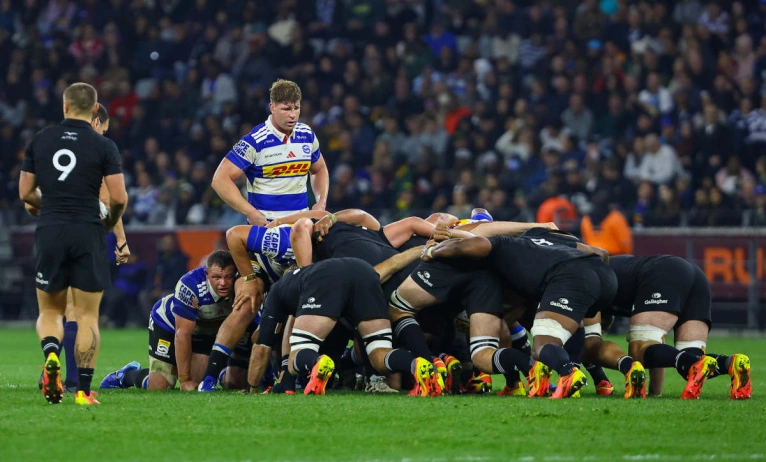
The two main focal points for Rennie and rest of his coaching crew will be the defence of opposition scrum feed and defence of the lineout drive, both of which were refereed to the letter of the law in Cape Town. Of 13 total scrums, seven ended in penalties, three in free-kicks and one was reset. Only two scrums produced clean, usable ball in the course of the game and both of those were fed by the All Blacks’ No.9 Cortez Ratima. The home side did not clear the ball from the scrum once in the entire game.
Within that frame, the lion’s share of the penalties and free-kicks [seven in all] were awarded to the feeding side, with the defending team only benefiting from the whistle on two occasions. All Blacks tight-head Pasilio Tosi was pinged three times for collapsing on the Stormers’ feed, but was rewarded for the same action on the New Zealand put-in. Go figure: “the side which had the ball got rewarded by the referee.”
The situation was, if anything, even worse in defence of the maul, and for both sides. There were eight penalties awarded against the defensive side at the maul in the first 20 minutes of the match, punctuated by a yellow card on New Zealand No.6 Simon Parker for ‘dragging’ in only the 14th minute.
It is exactly the outcome Erasmus would have been hoping for when he made the following remarks around the new rule requiring defenders beyond the ball to retire immediately behind the hindmost foot on their side of the maul:
“We can’t maul from lineouts anymore because it’s becoming a dragging competition. So, the option was to play it off the top because mauling is dying and the only place you can maul, we felt, was in the midfield, [because] now they can’t plan who swims around on what side.
“I think there were more maul-drive tries scored in this opening round [of the Nations Championship] than altogether in the 2026 Six Nations, if I have my stats correct. I want to give World Rugby credit there.
“Because you can’t drag in a maul anymore, you have to put more numbers in. The guys who stop the maul now have to get out and defend after that… [They] are tired of stopping mauls. You can’t just put four guys in and drag a maul to the side.”
Scrum and maul penalties awarded routinely to the attacking team dominated most of the first period, as both sides struggled to come up with answers to the lineout drive which did not involve ‘dragging’:
— William Bishop (@RPvids1994) August 8, 2026
— William Bishop (@RPvids1994) August 8, 2026
With defenders no longer able to swim up the side of the maul, there is no easy way to stop the side in possession from rolling around a corner and making ground without a great deal of effort. Parker’s actions in the second clip earned him a yellow card for dragging, but Deon Fourie could just as easily have been sin-binned for the same offence in the first example.
The biggest plus for New Zealand was the return of high-flying Dutchman Fabian Holland to the national colours, and redemption in lineout defence was almost single-handedly associated with the activity of the 6ft 9in, 125kg Highlanders’ giant in the air:
— William Bishop (@RPvids1994) August 8, 2026
— William Bishop (@RPvids1994) August 8, 2026
— William Bishop (@RPvids1994) August 8, 2026
The All Blacks began to put up an aerial contest at virtually every lineout as the game proceeded, reckoning rightly that there were better chances of stopping the maul before the ball ever returned to terra firma. Holland was key to their improvement in the air after conceding a volley of early penalties in defence on the ground. He will also be a central figure in the All Blacks’ ability to disrupt a Springboks lineout run by either Ruan Nortjé or Lood De Jager in the Test series, in the company of one of either 2.03m twin towers Josh Lord or Sam Darry, or spring-heeled 1.98m Tupou Vaa’i.
The other more subtle bonus of a genuine contest in the air in lineout defence was revealed at a set-piece just after half-time:
— William Bishop (@RPvids1994) August 8, 2026
Holland does not win the ball in the air this time around, but the action of jumping takes him naturally into the seam between the receiver [No.5 Connor Evans] and open-side lifter [No.7 Hacjivah Dayimani]. As soon as Holland has split that pair, penetrated the gap and reached over on to the back man at the maul [Fourie] there is very little chance of the drive succeeding.
There were some positives to be garnered from the opening match of the Greatest Rivalry tour for new head coach Rennie, in particular the All Blacks’ strength in the final quarter, winning the final 20 minutes 24-7 against a Stormers side which had been strong in that period of the game throughout URC 2025-26; and the power-packed performance of big Holland, who is already building his case to be a key member of the New Zealand tight five for the Test series.
Rennie will be far more concerned about the shape of the refereeing, which kept the ball too close to set-piece and never far from a penalty award to the side in possession at both scrum and maul. There were eight penalties, or penalty advantages given at the maul and another nine penalties or free-kicks given at the scrum, and that would be far too many for his liking. That they were awarded by a referee who is one of the new breed, a pioneer of fluid, open play in the penalty-lean Prem, will be especially galling. The background battle in the officiating will be fought especially hard over the next fortnight, but for now at least, it is round one to Rassie on the coaching scorecard.


Scrums are looking weak in Ireland.
Munster and Ulster do not have great scrums atm, I’ll grant you, but we are very solid thanks. The Reds would not give us any trouble.
Yep and I have seen the Irish scrums. Neither are at the Reds level. Honestly, I think Ireland has issues in the forward back and particularly at the scrum. I consider Ireland the fastest going backwards scrum in the top 12 nations.
Have you actually seen the Connacht scrum?😁
No chance particularly given how poor the Ireland scrum was against Japan. Completely out of depth at Test Level. Ireland even with the full strength team are a hold the scrum at best team. I do not rate the Irish scrums as highly as you do.
I’d still back Billy B versus JTA, De Lutiis or Nongorr.
Only as injury cover. He is the fourth options THP at the Reds.
Wasn’t Broomfield the regular THP in Super Rugby?
I did, and noted the low tackle completion rates and teams rotating due to the low standard of opposition.
Didn't realise you thought the Reds would only play wider squad players??? But maybe you are right and the Reds will run the wider squad. The Reds are not lacking in the back 5…
Yeah the officiating/results/outcomes of those contest are only a prblem for the ABs if it was the intention of the refs to take this through the series. I was really please with the quality of play from the AB forward pack, won most contests, especially pleasing dismantling their maul and the double teaming defensive hits.
On the other hand if it was just a poor start from a referee not familiar with how these changes are supposed to be applied then why had he only focused on the defensive side? Look at that first clip and you’ve got the ABs (and again I was pleased they were doing it well, playing to previous applications) both backpeddaling dragging the maul and getting ahead of the ball carrier to protect the ball in the maul. Why isn’t this type of action punished as well?
Same with that second clip. The ABs repeatedly stopped the Stormers maul and here in this clip Aumua goes to tackle the ball carrier but there is an offside player in front (who he tackled) which allows the carrier to dot the ball down unopposed.
Tight margins of course, Tosi did the same thing later one when the ABs had “seamed” the Stormer maul side to side and the ball carrier became isolated and so was tackled by Tosi. In this instance you feel it might have been the one correct reward the Stormers received as he probably didn’t need to do that (just continue to maul/reposition).
Do you actually watch any NH rugby? Doesn’t sound like it.
Billy Bohan v Nick Broomfield? I know who I’ll take thanks. And we have a big back five with plenty of options. You might get within 10-15👍
No chance, the Irish scrums have a soft underbelly these days… and the Irish national team lineout struggled against just one of the Reds lineout jumpers. Ripe for the picking that lineout and the questionable defence of the URC 😁
I have a sense THP may be his natural spot P - and aybe, where he is most needed at Test level.
He certainly has the size and strength to pull that off. The AB starting front row is competitive with anyone else but their current weakness is the replacement front row and that’s where I think Williams shifting to THP could be a game changing moment to give then an 80 min scrum.
At times that has let them down but also saved them.
Interesting comment OM.
The NZ backs I’ve seen over here tend to have highly-evolved individual skill sets but their understanding of systems needs a lot of work!
We would not have any problems with that Qld scrum, quite the opposite. Lineout fine, then we’d run you off the paddock!