
Glasgow Warriors have reached a fascinating juncture in their evolution. Long established as a URC power, there is a gnawing anxiety among supporters who have seen belts tighten, A-listers sign meaty contracts elsewhere, and a premium placed on Scottish-qualified recruitment. Jack Dempsey, Huw Jones and Adam Hastings are leaving in the summer. Before them, Franco Smith was irked by the union’s refusal to sanction deals for experienced Puma Sebastian Cancelliere and Afrikaner Henco Venter, each key to the title surge of 2024.
NEW: Follow Your favourites in the App 📱
You can now follow their favourite teams, tournaments and players in the RugbyPass App!
Scottish Rugby has a wider strategy to bring young players through in greater numbers, and at faster pace to nourish the professional game. The bar has been raised for overseas signings without Scottish heritage. Though the addition of Jamie Ritchie from Top 14 strugglers Perpignan would be a boon, squads are no longer as stacked and academies asked to plug the holes.
Against this backdrop, the Warriors are promoting players like baseballs from a pitching machine. Eight academy members have agreed senior contracts for next season while a further three have seen URC game time. Wing Fergus Watson, 6ft 4ins and 100kg, produced a statement display in his first match against Benetton. Kerr Yule, Kerr Johnston and Johnny Ventisei are muscular specimens in the backline while Matthew Urwin is being groomed as Glasgow’s long-term 10. Jack Oliver, whose late father Greg played for Scotland, joined the academy from Munster last year and found himself on the bench in a Champions Cup quarter-final. Seb Stephen and Macenzzie Duncan have played over 400 minutes apiece in the Warriors pack with Dylan Cockburn and Ryan Burke featuring on tour in South Africa.
Some of this has been enforced by the climate the powerbrokers have created, coupled with Glasgow’s injury list and recuperating internationals. But if the union has drawn up the blueprint, the club is getting on with the construction.
At the heart of it, a charismatic Dubliner who talks like a steam train. Luke O’Dea is the academy’s strength and conditioning specialist who has helped prepare these young men for the rigours of top-end rugby. The players respect his knowledge and his verve, and respond well to his lofty standards. Talk to the debutants, and O’Dea’s name appears over and over.
It nearly looks like an overnight success when someone makes his debut but we’ve been in the darkness grafting for the last two-and-a-half years.
“It nearly looks like an overnight success when someone makes his debut but we’ve been in the darkness grafting for the last two-and-a-half years,” the Irishman says. “It is really nice for me to build momentum in a programme and have the lads get their labour rewarded.
“The more you do it, the more successful you become, the easier it is to onboard people. When the next cohort come through, the academy means something and it’s class to be a cog in the wheel that is moving the club forward.”
O’Dea learned his trade at the Leinster juggernaut where he worked closely with the late Dave Fagan, revered in the industry as a pioneering trainer. The Glasgow academy is laden with nous. Shade Munro, the former Scotland lock and assistant to Gregor Townsend when Glasgow won their first title, takes care of the forwards while recently retired Warriors icon Duncan Weir trains the backs. Nick Ryan manages the whole setup, Eilidh Wright is the young team’s dedicated analyst and Josh Kennedy is their resident physiotherapist. Naturally, Kennedy spends many hours scheming with O’Dea.
Under their tutelage, there has been a clear and definite shift in how the talent conveyor functions. Seasons are broken into blocks, and every player has two targets to hit in each period. They chase size, strength, speed, stamina and power-related goals as well as the carrot of first-team minutes. Some have gained over 10kg of muscle since joining the programme. Teenage prop Jake Shearer is hoisting over 140kg off the floor in his Olympic lifts.
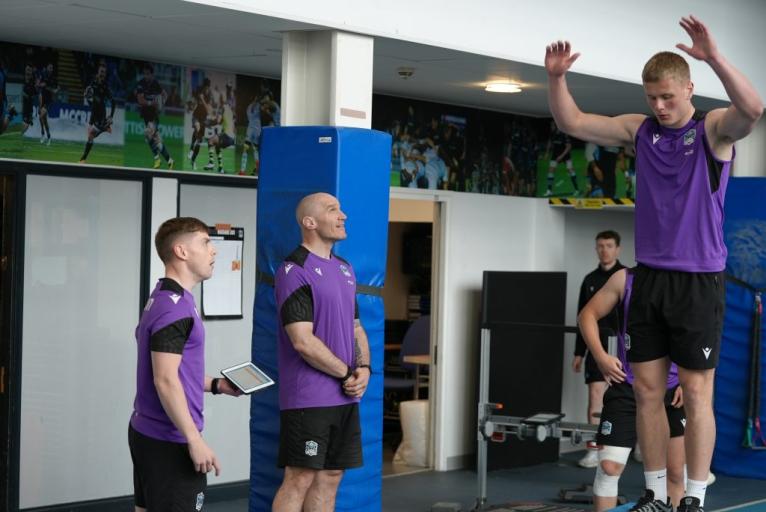
O’Dea takes a tiered approach to his training. An 18-year-old rookie such as prop Jackson Rennie might follow a simple but effective weights regime until the gains slow down. Then the nerdy stuff kicks in. O’Dea highlights Jonny Morris, a 22-year-old back-row rehabbing a serious knee injury. Morris wants to gain upper body mass. The pair have scrutinised scientific papers and gradually built Morris up to a gruelling routine involving two weights sessions a day.
“What got you to where you are won’t get you to where you want to be, so we have to reinvent the wheel sometimes,” O’Dea says.
“Total sets per muscle group, per week is a big metric we use. Can I push Jonny towards the top end of that? An average number is 10, Jonny is on 25. He comes in on Monday, does his four key upper body lifts, really low volume, high weight, loads of rest time, spends half his time in the gym sitting down, but when he’s on the bar it’s bloody heavy. Then he waits a couple of hours, does his knee rehab, mobility, then hits a hypertrophy (muscle building)-based session.
“By the end of a season, you should see a marked difference in someone’s performance capabilities. By the end of two seasons, you go from someone who might struggle at URC level to someone like Ferg Watson who is player of the match on his debut.”
Sometimes you’ll find the thing that unlocks rugby performance isn’t rugby ability, it’s physical competency.
Some rugby folk despair at these “conditioning blocks”. Surely, above all else, a young player needs time in the saddle? Townsend himself has stated “the game is often the best teacher”. That’s undeniably true for certain players. For many others, toil in the gym is the crucial ingredient.
To illustrate this point, O’Dea cites Ryan Burke, the 21-year-old lock who made his debut in Johannesburg last month. Burke arrived as a gangling 18-year-old weighing under 100kg. The Warriors hierarchy were excited by his potential but elite second-rows simply cannot be so light. Two years and 16kg of beef later, Smith blooded him in South Africa, where lock forwards are hewn from granite.
“The biggest limiting factor to Ryan getting main team involvements wasn’t his rugby, it was his physical competency and size,” O’Dea says. “We needed to have key development blocks throughout the year where his main focus was putting on size. He has done immense things with his mass gain.
“Sometimes you’ll find the thing that unlocks rugby performance isn’t rugby ability, it’s physical competency. That’s one of the most S&C things I’ve ever said and I don’t live by that – plenty boys just need to play rugby – but sometimes there are lads who, if they spend the next two years with intermittent physical development blocks, running alongside Lions in training with a great coach like Franco, play high quality A games and then play for a club like Ayr and get some good games, that’s all you really need. The number of games you play in a year doesn’t need to be as high as a lot of people think.
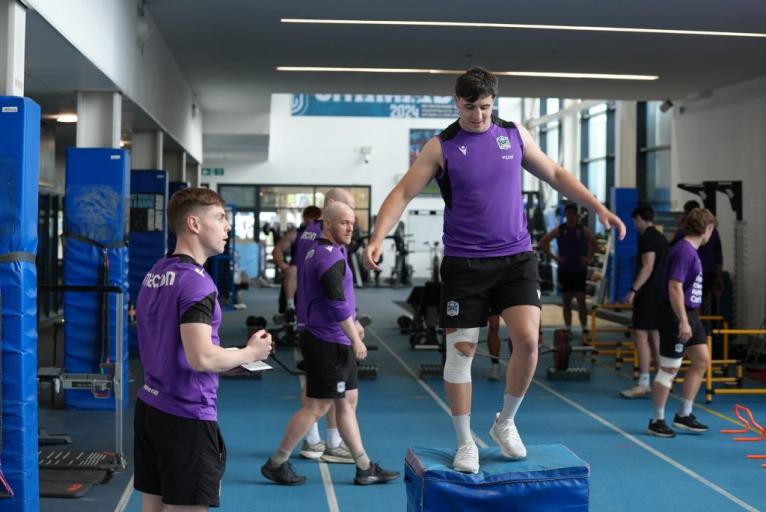
“Rugby is changing. If you look at how physical and fast the game is now, it’s not like it used to be. A lot of boys go out and play, break into a main team and can’t string games together. They just can’t deal with the demands of pro rugby. Rugby comes first and always will, but you can combat it through strength and conditioning.”
O’Dea learned much of this back home. He spent nearly seven years in the Leinster system, where lavish private schools create high-performance environments of their own and churn out top athletes by the boatload. Those players might spend five years between Leinster’s sub and senior academy before they get near a first-team contract. Where before Scottish Rugby placed an age limit of 20 on their academies, that has been restored to 23, allowing players more space to develop.
“For the first time in a long time we’ve had players who’ve been in the academy for three years, had a development cycle in the junior academy then minimum two years in a structured environment and we are bearing the fruits of it,” O’Dea says.
“It’s come at a really good time. We’ve been outpriced on some key players and our squad size is coming down but for the first time, we’ve had an academy capable of dealing with the brunt. Franco is looking at Kerr Johnston and Ferg Watson and thinking ‘you guys can deal with the pressure we are facing’. Consistency is what works for Leinster and what we have now in Scottish rugby.
We don’t want players who are capable of just being at senior level, we are nearly above some of the senior players.
“We don’t want players who are capable of just being at senior level, we are nearly above some of the senior players. If five players in the academy are actually ahead of the senior boys in some capacities, the senior boys will rise too and everybody gets better.”
Smith has never been afraid to give youth its chance. He capped many of the Italian players who have earned credibility in the Six Nations and pushed Gregor Brown, Max Williamson, Gregor Hiddleston, Alex Samuel and Euan Ferrie into prominent roles with Glasgow. Smith has nicknamed the colossal Williamson ‘Bakkies’ after the great Springbok enforcer and put Hiddleston in touch with Malcom Marx for guidance on becoming a world-class hooker.
Smith is deeply invested in what’s happening beneath his first teamers. He and O’Dea have regular discussions about who is ready to make the jump, and when their services might be needed. Where are the pinch points in the season? Is the teenage back-five forward going to be trained as a bruising lock or a workhorse blindside? The players must be conditioned to meet the high-tempo demands of Smith’s tactics.
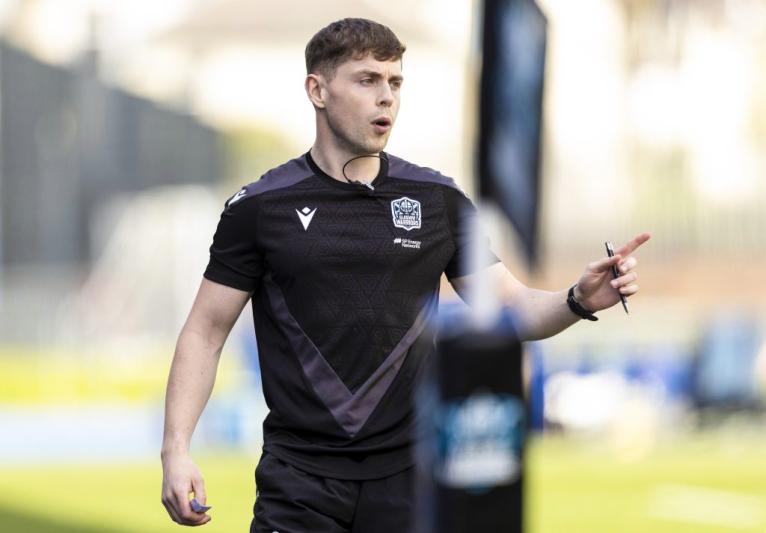
“Franco really sets us up for success in how linked he is with us,” O’Dea says. “Harry Provan is a senior academy player who played his first game in 366 days last month after a torn hamstring and torn quad. Harry ran his bronco fitness test six weeks ago, and Franco came out and watched the whole bronco. Harry was the only player running. When the boys are heavy strength testing, Franco is down in the gym watching.
“Around 60-70% is based around strength, speed, power and conditioning but the remaining nuance is based on what Franco wants. The fit, fast and powerful style. That’s the icing on the cake.”
Having brought through mostly backs this season, O’Dea’s emerging forwards get a lot of love. Stephen, the 20-year-old hooker, has been selected routinely and at 116kg, possesses a physical profile Scotland seldom unearth. O’Dea has kept his weight steady and honed his anaerobic fitness.
“Seb could be an absolute monster and we just don’t get that here,” O’Dea says. When you do get it, it’s really important you nurture it.
Dan is an absolute freak. He hit nine metres per second in a max velocity test which I think is the fastest second row in Glasgow Warriors history.
“Seb’s point of difference is his size and the fact he is a set-piece hooker but he is conditioned enough now to fit in our playing system. The perceived ‘weakness’ is more than good enough. It’s no use for me to have someone huge, strong as f**k but can’t get around the park.”
Others are breaking records and pushing boundaries already.
“My top three picks for next season are Dan Halkon, Dylan Cockburn and Jake Shearer,” O’Dea continues.
“Dan is an absolute freak. He hit nine metres per second in a max velocity test which I think is the fastest second row in Glasgow Warriors history and is faster than some of our backs. He is 121kg, runs a 4:58 bronco, his back squat is 212kg.
“From a rugby IQ perspective, he runs the lineout and is an absolute nause. From a mentality point of view, he never takes a backwards step. Next year he will really shine.
“As a dynamic six, Dylan is going to be really exciting and he got a spin against the Lions and Stormers in South Africa.
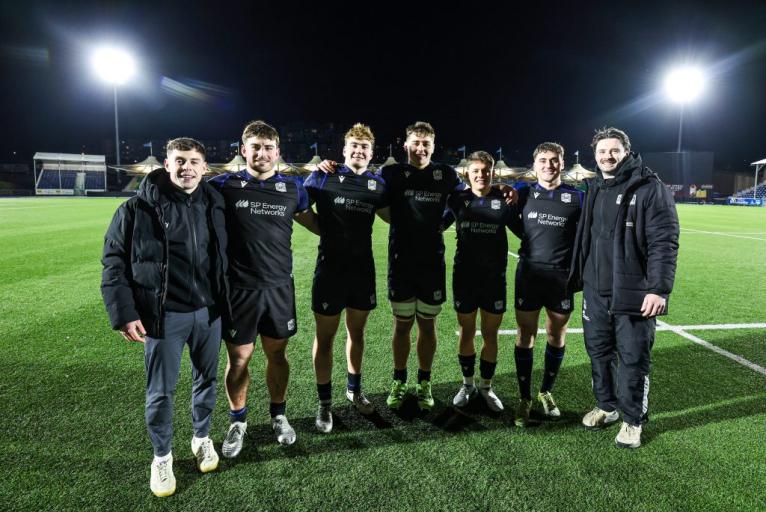
“Jake is a 115kg prop, really strong. Every time Jake trains on the scrum machine, Shade says ‘he’s a bloody animal, we don’t have enough bands to tie on the machine’. Those three I think are going to be really dominant.”
This stuff will never carry the allure of a Super Rugby recruit, nor can eight academy signings drown out the noise generated when a big dog Warrior pens terms elsewhere. These men remain green and unproven in the business of chasing titles and such a transition in approach is usually accompanied by short-term pain. The national U20s continue to lag behind many of their rivals at Six Nations and World Championship level.
While Scottish Rugby has often been accused of neglecting the talent on its doorstep, and failing to prepare those youngsters for the ruthlessness of the pro game, the hope is change is afoot. This is how a healthy club functions, and with the aid of O’Dea’s exacting regimen, Glasgow and Scotland see a bright future ahead.

Your home for rugby. Download the RugbyPass app on the App Store (iOS) and Google Play (Android) now!
Follow your favourite teams, tournaments and players, and get personalised news and Match Centre notifications direct to your device.
From live rugby streams and upcoming fixtures to breaking news, in-depth analysis and live scores, RugbyPass has everything you need to stay connected to the game.


Very fascinating article, particularly on the changing nature of S&C for players through their journey as a pro, whether from initial start, later gains, or from a rehab perspective