
The late Karl Lagerfeld once memorably proclaimed, “No one wants to see curvy women”. It was a cri de guerre in a fashion industry which wanted to create a sense of exclusivity in the clothes it marketed. You had to be skinny and body-perfect to wear the garments it manufactured. If you were oversized or plus-sized or just oddly-shaped, you could forget it.
NEW: Follow Your favourites in the App 📱
You can now follow their favourite teams, tournaments and players in the RugbyPass App!
It can be the same in sports too. In the Major League Baseball sea-change depicted in Moneyball, the general manager of the Oakland A’s, Billy Beane, launches a major assault on the ‘good body nonsense’ which judges a player’s value on his physical build and athletic tools:
As Beane’s assistant, the Peter Brand character played by actor Jonah Hill, explains: “People are overlooked for a variety of biased reasons and perceived flaws. Age, appearance, personality. There is a championship team of 25 people that we can afford – because everyone else in baseball undervalues them. Like an island of misfit toys.”
The ‘good body nonsense’ now seems to extend to the selection of the Wallabies tight forwards. Consider the case of Visesio Kite, the 2.04m (6ft 8in), 147-kilo (23 stone) 16-year-old prodigy who left Australia for the Atlantic coast of France last year. Rugby Australia were less than thrilled to see him go, but nobody at home had offered the teenager a professional contract, even though he was living in the state of Queensland and had dutifully followed the road carved out by national pathways.
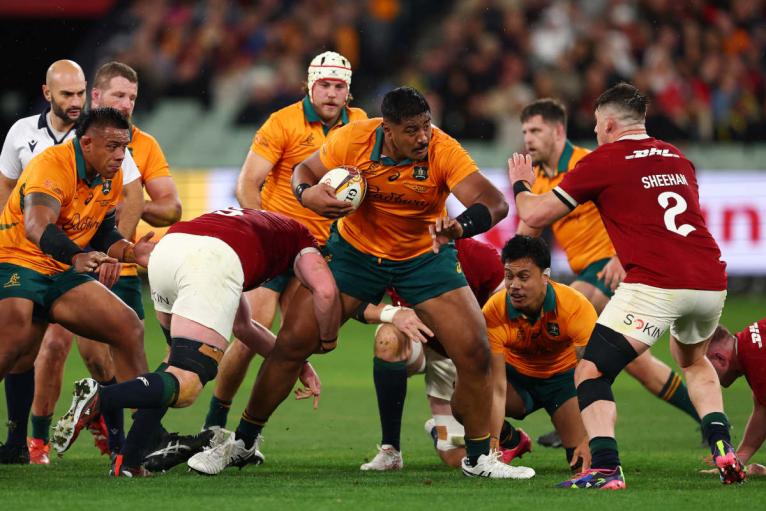
‘Sio’ agreed terms to join La Rochelle on a multi-year academy deal instead. He is now settled in the Bay of Biscay and recently extended his contract until 2028, and a wider question about talent identification and development was raised by James Kite’s assertion that “[La Rochelle] has a proven track record of developing forwards with similar attributes to my son.”
Head coach Ronan O’Gara clearly foresees the young giant as a spiritual successor to Will Skelton, who also left Australia to fulfil his ambitions in Europe, first with Saracens and latterly with Les Bagnards. The clubs Skelton represented won three European Cup finals in the space of six seasons, and the New South Wales leviathan became arguably the most influential tight forward in European club rugby. He certainly left his mark on Leinster.
At 6ft 8in (2.03m) tall and tipping the scales at 140 kilos (22 stone), Skelton is of similar outsized proportions to Toulouse anchorman Emmanuel Meafou, another Australian-raised lock who left for the rouge-et-noirs academy in 2019 because he felt his career was best served overseas.
At the time, I was just too big, and they wanted me down at a certain weight.
Meafou had appeared for the NRC’s Melbourne Rising in Victoria, Darren Coleman-coached Warringah in North Sydney and the New South Wales Sea Eagles on two dozen occasions and he had a burgeoning rugby portfolio, but he failed to secure a berth in any of the Super Rugby franchises in Australia.
The reason Meafou was rejected by the NSW Waratahs circles all the way back to the ‘good body nonsense’ pilloried by Billy Beane:
“Near the end of the NRC I had some talk with the Waratahs, but it was also part-time, just coming in for a couple of training sessions. I ended up going into the Waratahs for a physical and just never heard back.
“It was kind of like a Will Skelton situation again, for them. At the time, I was just too big, and they wanted me down at a certain weight. We just wanted a pre-season deal where I could be in there and do the training, to have the help of them to get my weight down. But it felt like they wanted me down [in weight] before I got there.”
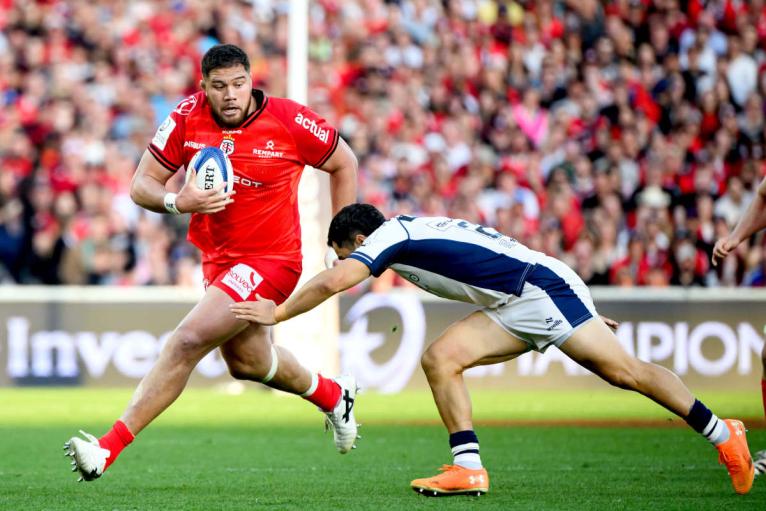
Just like the NFL, the Top 14 loves a good big man – the more knobbly and outsized they are, the better. Diversity is an accepted part of sporting life in the Top 14 – one for all, all for one, warts and all. Standing only 5ft 9in (1.75m) but already weighing a massive 130 kilos (20st 6lb), Iona College skipper and tighthead prospect ‘Hopo’ Leota signed for Parisian giants Racing 92 immediately after leaving high school in 2024.
Why don’t the very big men stay in Australia, or are Skelton, Meafou and now Kite simply outliers? As ex-Wallabies skipper Michael Hooper observed during the third Test on Stan Sport, when it was already too late: “[Skelton] has just changed the look and the dynamic of this whole Wallabies team, and everyone around the world [now knows] just how important he is for this Wallabies jersey.”
Concerns about the effectiveness of the Australian lineout with a non-jumping lock on the field turned out to be just more good body nonsense. In the second and third Tests, with Skelton yoked to his natural partner in the second row, athletic 6ft 9in Brumbies leaper Nick Frost, the Wallabies won 94% of their own ball while pilfering seven of their opponents’ throws:
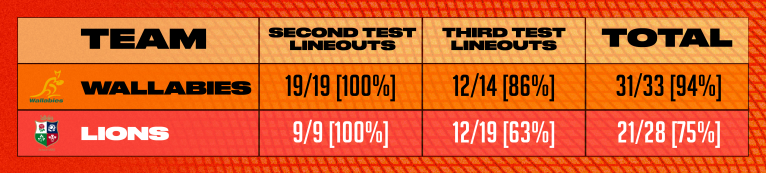 Lions lineout stats” width=”6667″ height=”1513″ />
The other big fallacy in the second Test was the selection of 113 kilo (17st 11lb) Tom Robertson ahead of 140 kilo (22 stone) Taniela Tupou at bench tight-head, despite the previous season-best form ‘Nella’ had showcased for the First Nations and Pasifika XV. As the Wallabies scrum slowly crumbled to dust in the second half in Melbourne, most yellow-clad supporters were left to wonder what the ‘Tongan Thor’ could have achieved, had he been given the chance.
At the elite end of the game, there is a dynamic and often uneasy balance in selection, between players with big-impact involvements and those who post the higher numbers. If there was a worry for supporters of the green-and-gold at the announcement of Joe Schmidt’s Wallabies squad for the forthcoming Nations Championship, it is that there are still rather too many of the latter and too few of the former in the second row:
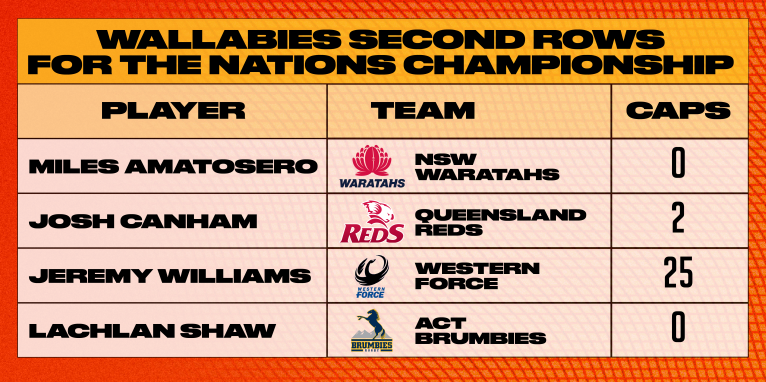
The glaring omission of both Nick Frost and Queenslander Lukhan Salakaia-Loto rightly raised some eyebrows. Frost and LSL are both game-changers: the Brumby is one of the elite lineout leaders in world rugby, while Salakaia-Loto is the closest Australia has to a Skelton-type enforcer, in the absence of the man himself.
Wallabies supremo Joe Schmidt’s comments illustrated how second-row selection was weighted towards numbers, work rate and repetition rather than significant high-value impacts:
“I think the volume of work that Lachie Shaw got through this year was unbelievable, really. The amount of contacts he gets through in the games, the amount of kilometres that he’s chalked off during the Super Rugby season has been outstanding.
“Lukhan’s an incredible athlete. I think he had some really good moments. It was probably just stringing consecutive moments together.
“What we do need is fast-jumping locks, and we know he’s got that speed, but he’s just not quite where we’d like him to be at the moment.”
It would be a stretch indeed to describe Will Skelton or Emmanuel Meafou as “fast-jumping locks”, because they do not jump at all. In fact, it would be impossible to whip the newspaper out from underneath their size 19 feet. In future, the same will probably be true of Sio Kite when he eventually represents his adopted nation against his country of birth.
You can forget about fancy lineout jumping. Both players are there for the hardest of hard-contact scenarios, to do the filthiest of the dirty work. They are unapologetically power-based tight-head locks who shove behind the man under the most pressure of all in the front row. They drive lineouts and they destroy mauls:
— William Bishop (@RPvids1994) June 20, 2026
— William Bishop (@RPvids1994) June 20, 2026
— William Bishop (@RPvids1994) June 20, 2026
“Wales put Christ Tshiunza up against Skelton. He flies up in the air, incredibly athletic and powerful. Skelton couldn’t get off the deck – there’s a lot of him – but he piles into you when you [return to earth]. I’m sorry, but he’s just stronger than everyone else,” as David Flatman noted eloquently in commentary on that second clip. It was but one of many wins for the outsized on the day.
The waters of second-row selection muddy further when you look at some of the relevant Super Rugby Pacific 2026 stats:
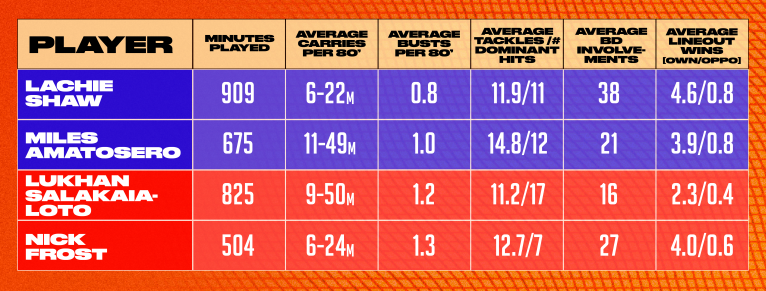
Frost’s absence is the more explicable of the two. Between 9 November 2024 and 8 November the following year, the Ponies’ lineout caller participated in 30 matches and 2276 minutes of top-flight rugby within a 12-month span. The physical and mental exhaustion left an indelible mark on him. When he began training again in 2026, “anything that involved bending my knees [hurt]. So, sitting up, standing, I just really struggled – getting in and out of the car.”
There is an excuse for giving ‘Frosty’ a rest. Not so Salakaia-Loto, who has played only 14 matches and 985 minutes since 1 November 2025. He will be fit, firing and raring to go – if only he had somewhere to go. Just point him in the right direction, and shoot. It really should be that simple.
The ex-Saints stalwart carries the ball better than any other second-row in the country and he makes the most dominant interventions in contact:
— William Bishop (@RPvids1994) April 24, 2026
— William Bishop (@RPvids1994) April 24, 2026
Like the man he should be by rights replacing in the national side, he knows his way around the dark labyrinths of a lineout maul:
— William Bishop (@RPvids1994) April 24, 2026
Is Lachie Shaw’s development and kamikaze commitment to the cleanout worthy of recognition? For sure. Should Miles Amatosero’s development into a solid starter in NSW be rewarded? Yes. But Salakaia-Loto was the next cab on the rank after Skelton, and he is the only lock in Australia who can put the frighteners on opponents in the role of enforcer.
Does it matter if he is a biscuit short of 130 kilos, or one of those plus-sizes who qualify for Peter Brand’s ‘island’ of slightly misfit toys? Aussie has been steadily losing its very big men to other nations because they are habitually under-valued when they should be its greatest treasure. Now is the time to plug the leak, and reverse the trend of the good-body nonsense. Rugby is after all, a game for all shapes and sizes. All are worthy of inclusion.
 Register your interest to receive priority updates on RWC27 ticket releases. Don't miss out, stay in the loop!


Just take that “energy” pill mate
Haha oh the irony!
That one did split my sides…😁
Aha. A movie buff too NB. WOW. We should get a room…
Couldn’t agree more Nic. I wonder why selectors dont spend more time thinking about who the opposition would least like to play against.
That 1st half of the second lions test when skelton and valentini were running around the corner on consecutive plays, bending the line phase after phase was brutal. Probably the best bit of Aussie rugby i’ve seen in years!
Is it the original Jurassic Park movie? The Jeff Goldblum character IIRC 😁
Who said that!?
‘I am always on the lookout for a future ex-Missus Hammer Head’.
We are a dating site now🤣
PSDT has run the lineout before so knows all about the LO…
If my wife preferred league. She’d be my ex-wife.
Perhaps, fortunately for her, she also prefers small and vigorous.
Here’s an interesting take on the big vs athletic
Springbok coach Rassie Erasmus has explained why Junior Boks captain Riley Norton was called up ahead of the more experienced JJ van der Mescht
“We all think JJ is a wonderful player. It’s not to say that JJ is not a player for the future, but what we do currently probably suits what Riley gives us.”
“One player is a lineout caller who is very athletic around the park. The other is a bruiser who plays very direct. It depends on what you need for a specific Test match.”
Yep that’s perfectly reasonable G.
But if Rassie had to select a RWC squad now, only one of them would be in it, and that’s JJ.