
Twilight is the time when day meets night and the light blends with the dark. Earth’s atmosphere disperses scattered shards of sunshine, and the world exists in a state of partial illumination. That is where the Wallabies are right now, living in the twilight zone. There is some light, but not enough to create a new dawn.
The definition of ‘success’ depends on the start point of the venture. When Eddie Jones was installed as head coach of England after a disastrous home World Cup in 2015, paradoxically he inherited a squad primed to succeed. The Red Rose promptly embarked upon an 18-match unbeaten run, and that became the foundation stone for the best win record in English coaching history.
When Joe Schmidt took over from the same man as Wallaby supremo at the end of the 2023 World Cup, he found the state of the game in Australia in a shambles. After the final whistle blew on his tenure with an emphatic 57-10 win over Italy, he recalled the day of his appointment.
“It was a total clean-out after the World Cup,” Schmidt said. “There were two other members of staff, so we had no coaches.
“We had no real support staff and a lot of the players, even post World Cup, either weren’t available or there had been some guys who’d been left out and were teetering on the edge of heading overseas.
“I knew no-one. So, it was about convincing them we can still get together and be competitive.”
On one hand, anything would have qualified as a success after the 11-game Jones-mentored, Hamish McLennan-inspired debacle leading up to the 2023 World Cup. Schmidt’s start point was rock bottom and the only way was up. On the other, restoring the good name of the proud two-time winners of the Webb Ellis Cup demanded a minimum 50% win ratio, and that proved a bridge too far.
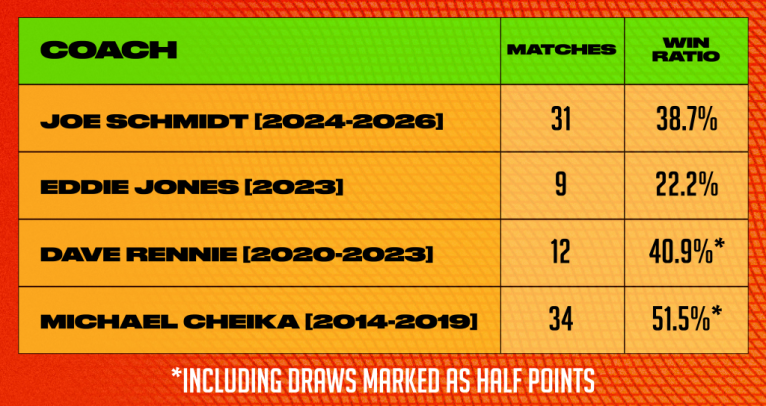
Taking World Cup cycles as a guideline, the head coach at the 2015 and 2019 World Cups came in at over 50% while reaching the knockout stages on both occasions, including one appearance in the final in 2015. The record of the two coaches for the next four-year cycle fell to 37% with the Wallabies dropping out at the pool stage. Schmidt’s win ratio of just under 39% represents a slight overall improvement, but it has fallen short of restoring Australia’s credibility as a contender for major international honours.
Comments after Schmidt’s farewell match against an understrength Azzurri side carried with them the bittersweet irony of a double-edged sword. Skipper Harry Wilson and star recruit from league, Joseph-Aukuso Sua’ali’i testified in remarkably similar terms to Schmidt’s coaching of the basics.
“What he’s left for us, the fundamentals of the game, it’s something that will never, ever leave us as players,” said Sua’ali’i.
“The fundamentals he’s taught us has really just made rugby a lot simpler for us,” the captain said.
If coaches at the pinnacle of the game are remembered for their teaching of the fundamentals to elite players, it means there is something awry at the level below, in the coaching at Australia’s Super Rugby Pacific franchises.
That is where the true weakness of Australia’s inverted professional rugby pyramid lies, broader at the top and narrowing towards the bottom. As Schmidt himself observed: “I do think we need to keep growing the strength in depth.
“We lacked a bit of belief in the second halves in those two games [against Ireland and France, because] there hadn’t been much success in Super Rugby.
“I think we’ve got to prove [to be] really competitive there, and not have four Kiwi teams playing off in semi-finals.”
The house will take time to rebuild, and it is why even the best parts of the Wallaby game coached by Schmidt were not class-leading. In the first three rounds of the Nations Championship, Australia were one of three top-tier nations, along with Scotland and New Zealand, striving to win matches with the possession game on attack. They set anywhere between 120 and 140 rucks per game while achieving an above-average speed of delivery of just under three seconds.
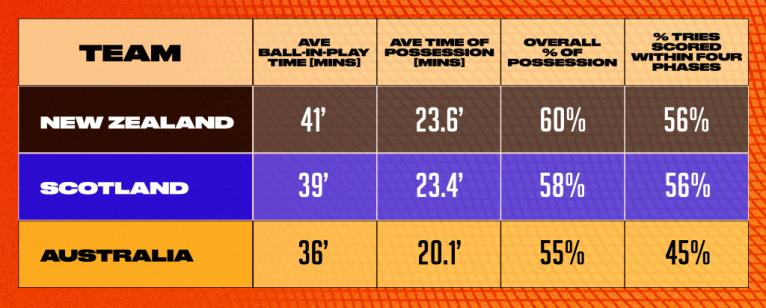
Australia are not only behind the All Blacks, they are no longer on par with Scotland in their ability to play keep-ball, wear out the opposition and score efficiently from a snowball of ruck-building. That part of the game is Schmidt’s forte as a coach and it has been an essential strand of Aussie DNA all the way back to Rod Macqueen in the late nineties and early noughties.
The negatives of the Schmidt era orbited around the themes of stubbornness in selection and uncertainty in the high office at number 10. There has been no desire to move Sua’ali’i from centre to the back three, where he would probably be bestplaced in attack and defence. One of the great strengths of the ex-Sydney Rooster’s game – an extraordinary leaping ability encased in a 6ft 5ins – has gone to waste as a consequence, while residual uncertainty around contact and in defence remains.
Will Skelton is one of the best forwards in the world and he changed the course of the series when he started against the British and Irish Lions in last year’s second Test. Skelton was also available for the first Test but left out for Jeremy Williams.
Without Skelton, the Irish-based Lions pack thrived. With him, the physical balance shifted in favour of the green-and-gold. Well as Josh Canham and Williams performed in the Nations Championship, some of the same prejudice against high impact-based forwards lingered in the non-selection of Queensland’s Lukhan Salakaia-Loto.
Under Schmidt there has also been little sign of the long-standing merry-go-round at number 10, which pre-dated his arrival, being resolved. The Kiwi mastermind started seven different players in the pivotal role in his 31 Tests – Noah Lolesio, Ben Donaldson, Tom Lynagh, James O’Connor, Tane Edmed, Carter Gordon and Declan Meredith – with another two utility players [Hamish Stewart and Jock Campbell] covering the spot off the pine. Cater Gordon may well be ‘the man’ in future, but time is running very short indeed to prove the point before the 2027 World Cup begins.
Schmidt chose, in the words of the immortal Johnny Mercer, to ‘accentuate the positive, eliminate the negative, and latch on to the affirmative’ in his leaving address.
“We actually showed that we could do some things [against Italy].
“So that’s part of why I’m encouraged and that’s part of why I’ve loved the challenge because when people say we couldn’t, like especially the Lions we were [being] so written off, I was really proud of the way the players came together and competed.
“After 25 years of doing this professionally, I know that results are not the only visible demonstration of progress.
“You can’t sell out stadia [five successive sell-outs in 2026] if people aren’t getting some sort of belief about what potentially the team can deliver.
“We’ve stabilised things, albeit with a big help from the Lions [tour revenue], from the financial perspective. We’ve got people coming back.
“There are increases in young kids playing the game. The schools are very competitive. We were competitive at our age grade as well – two big wins in recent years over the Kiwis.
“There’s lots of positive signs and sometimes those seeds take a while to grow, but there is a fair bit to be excited about.”
The best bits of Schmidt’s tenure were in evidence against an Italian side shorn of its Six Nations stars, with seven cast-iron starters including scrum anchor Simone Ferrari, ruck-buster Manuel Zuliani, electric back-three man Ange Capuozzo and Herculean centre Tommaso Menoncello all missing.
The first half-hour alone provided ample illustration of how efficient Schmidt’s teams can be at quick and decisive entries to the opposing red zone, and unexpectedly inventive at exits from their own end. The Wallabies scored 31 points from five early red zone entries.
— William Bishop (@RPvids1994) July 21, 2026
— William Bishop (@RPvids1994) July 21, 2026
In the opening sequence of the game, the Wallabies kept the ball for four minutes and used all of the Nations Championship law changes to their great advantage: first winning a penalty under the stricter defensive protocols at the breakdown; then driving a lineout where Italian defenders have to regroup behind the ball after swimming up the side. Two easy penalties and the Wallabies find themselves encamped on the Italy 5m line, with a score duly arriving. More tinkering with the laws will be necessary to make the maul a true contest, as opposed to an endless succession of spin-offs and rolls upfield, in a form of legalised obstruction.
The other area where Schmidt’s teams tend to be exceptionally well-drilled is on restart return exits, where the Ireland side he coached [2013-2019] and the Wallaby outfit he has just left have struck an excellent balance between contestable kicks and wide runbacks with ball in hand.
— William Bishop (@RPvids1994) July 21, 2026
— William Bishop (@RPvids1994) July 21, 2026
In the first instance, nine Ryan Lonergan is looking for Tom Wright to wave his wand with a flourish as midfield playmaker, in the second he launches a pinpoint high kick to be reclaimed by wing Harry Potter. In both clips, Australia are already looking to make the second kick after the break is made, with Wright moving up to attempt one of his patented 50-22s from first receiver, and Lonergan forcing a goal-line dropout which finished in the fifth green-and-gold try of the half. Another three minutes spent with the ball firmly in Wallaby hands, another score at the end of it.
Schmidt accomplished many good things as coach of Australia, but ultimately a tailor can only work with the material he is given. Until the professional pyramid underneath the national side becomes stable and successful at Super Rugby level, and the grassroots in locations as far afield as Western Sydney and Victoria are truly connected to them, the Wallabies will continue to live and play in the half-light. A twilight zone of what they once were in the past, and could yet be in future.

NEW IN THE APP: Official World Rugby Rankings hub! Compare team rankings side-by-side, with data going back 20 years.
Download the RugbyPass app on the App Store (iOS) and Google Play (Android) now!


Interesting you bring up Sir Clive since he can't wait nowadays to share his opinions on everything rugby and was a significant cause of Eddie's departure from Twickenham.
I suspect the real reason he left pretty much immediately in 2004 without any real fanfare was because it was just so offensive to his ego that on his return to Australia following their triumph at the World Cup following the longest game in World Cup history they were swept 3-0.
Pretty hard to back up from that when you started your first press conference right before the opening test by smugly stating “We love playing in Australia because we never lose.”
The introduction statement says “he has stepped aside after making admirable progress”.
Hmmm. Last 8 tests:
Scrapping in against Japan in Japan on the way to the Northern Tour.
Suffering 4 straight losses including to Italy.
Then 2 straight losses in The Nations Championship in front of sell out crowds and a decent win on his final match against an under strength Italian team.
Some admirable progress🤦♂️
RA have a lot to answer for the shambolic performances since sacking Rennie prior to RWC 23.
If the metric is filling stadiums then they have been successful because of the Lions Tour win fall and the novelty of the Nations Championship creating extra excitement from touring followers and local fans.
Performance on the pitch is the most important aspect and the Wallabies have failed to deliver consistent 80 minute performances.
Schmidt was seen as a saviour by RA who should have allowed him to walk away last year. If Kiss was the preferred choice then he should’ve been given the opportunity of taking the job pre Northern Tour.
From down south this side of the meridian the Aussie team that played South Africa in the two tests last year, that were a tad unlucky to lose at leat one of the losing tests to the Lions and looked pretty good in the last 30 minutes of their tests so far this year albeit against a weakened Italian side which btw had bothered bigger fish, is a vast improvement on the one that were almost whitewashed at the RWC three years ago. So yea I think Schmidt did some good stuff.
Are you reading another article?
Where does it say this exactly?
The actual opening statement and summary of the Schmidt era reads, “That is where the Wallabies are right now, living in the twilight zone. There is some light, but not enough to create a new dawn.”
Then later, “The house will take time to rebuild, and it is why even the best parts of the Wallaby game coached by Schmidt were not class-leading.”
At least read any part of the article before commenting on it.😉
“If coaches at the pinnacle of the game are remembered for their teaching of the fundamentals to elite players, it means there is something awry at the level(s) below” This! (with the (s) I added) says so much about the problems here and the lack of accountability at RA in resolving them. Like the Waratahs the Wallabies can replace whoever they want in the coaching box, but it will not result in changes to the fundamental flaws in the development of players, coaches and administrators in the game. As such while there might be a few bright moments now and then, it also won’t change the overall results.
Having players at Super and international level who can’t pass one way, throw the ball behind or above the receiver and so kill any momentum, lack the experience to read the game and so make decent decisions on where to be and know when to pass and when not to, can’t kick accurately and when they do kick don’t have anyone chasing to contest them is a disgrace and talks to the poor pathways, lack of long term planning and myopic decisions made by RA. No changes in coaching staff at the top levels is going to change any of this
Yes RA have tried everyone at NSW - Aussies, Kiwis, local coaches like Darren Coleman, Brumb-coated coaches like Dan McKellar and Kiwis like Penney and Gibson. None of it has made a shread of diff.
So I do believe that the main source of improvement has to be at SRP level. Player I.D needs ot be better and so does the teaching of basic skills, then the players can get to the WBs looking for nuance and refinment rather than learning what they should have learned ten years before.
The only other dispapearance I can think of which comes near it is Clive Woodward’s in 2004, 18 months or so after winning a RWC with England…
Coaches don’t tend to retire voluntarily from the game only a couple of years after their greatest success in it - unless other factors are at play….
It’s OK to get sick of something. He probably could have got another job but obviously needed a change. I don’t think there’s any great conspiracy. People need a change sometimes.
All very well blaming it on the Tahs but an ex-player and coach of his stature shd have ben able to get another job - outside Oz if necessary. Which suggests to me there’s a lot more to it than meets the eye.
Hmm my reply got deleted. Probably because of disparaging comments I made about Richard Graham. He was not good is understatement of the year. He thought he knew better than McKenzie. He didn't.
McKenzie had had a long career in rugby winning a couple of World Cups as a prop and he had probably just had enough, especially with the politics in Australian rugby. He had given them so much and they ie the Tahs, just shafted him.
But that doesn’t answer the question. He was an international head coach so shd have been able to get a job somewhere.
Maybe this?… https://www.theguardian.com/sport/blog/2014/may/14/ewen-mckenzie-queensland-reds-super-rugby
I guess Moyo represents unhappiness at Polly’s performance v Scotland??
You wouldn’t have selected him ditto Moyo would have been better off giving Willemse time in the 10 jersey if he will be used as cover in a 23 and it’s hard to say how they go when the front row are tearing teams hearts out, but what do I know NB who am I to question and am I allowed
😰
Double aye to that Bazz.
It’s hard to see how any coach could have done much better and that coaches can only shift the dial so much in Australia, we’ve had some of the best in the world and the trajectory has been the same. The win/loss record is obviously an important metric, but it is only one metric, and not necessarily the best to assess a team that is really still in a building phase (2024 was recovery!). You could look at something like average losing margin, and the trajectory there is much better, with the 2025/2026 results close to half the losing margin in 2024 and during Eddie’s reign (roughly 10, compared to closer to 20). Much has been made of the so called merry-go-round at 10 (really sick of that phrase but here I am using it), but losing Noah, Lygnah and Dono between Fiji and SA games in 2025, and Carter then Dono in 2026 had nothing to do with Joe. He consistently backed his first choices and backed youth at 10 when he could. The injuries led to a massive increase in uncertainty around whether to risk players who weren’t ready or back experience but lose the future benefit. In that situation I think we need to permit our coaches a greater degree of experimentation and error. Much has been made of the LSL situation, but what about how Joe’s selections at lock have led to some real depth of capability there, with players that weren’t as conspicuously impressive (e.g. Williams, Canham). Joe has made his mistakes, but he righted the trend that was heading sharply down, and I suspect that as with what he left in Ireland and as with Stuart Lancaster your old mate, the true test of his time will be what happens in the wake.
Anybody could have lifted the Wallabies from the Tah infested rock bottom Eddie Jones left.
Literally anybody. Schmidt barely lifted them off the ground. His record in his last 9 games was in fact no better than the nine games Eddie Jones coached……
Thanks TL for a good post.
I don’t really feel we shd be comparing Joe’s reign to Eddie’s, which was a short-term, quicfire disaster of only 11 games in 10 months.
Joe has had two and half years in the job and the chance to build something. What’s he’s left is a legacy of upskilled players but a team without an Australian identity.
I do believe that sone of his playing systems are outdated and he hung on to them too long. I also believe his selection process was flawed. Tane Edmed at 10? Tom Lynagh now appears to be out of the reckoning? Noah nowhere? He has not developed any 10s and he’s consistently ignored power in the tight five. Tom Robertson at #3 was another goof which cost Aussie the second Test more than the Jac Morgan cleanout.
So it’s a mixed bag. He’s brought order but he hasn’t brought Aussie back to the top six where it belongs.
U mean like a helmet to protect myself from green and gold painted rocks? He ain’t no Canham and he def never done anything like Frost did above in his time in the 20s if he proves me wrong I’ll wear it
A balanced and well structured discussion, thank you Nick. A accurate and fair assessment of Coach Schmidt’s contribution to the Wallabies pluses and minuses. There is a lot of disfunction in Rugby Australia structurally, over Twenty years of poorly conceived decisions. The Lions financial windfall paid the horrendous debts and the RWC2007 will fill the bank account. That will only paper over the problems for a time, unfortunately. Good people, fine intentions (when in power positions) do not breed success, and the last decades have not even had them always. I am ever hopeful.
Cheers K.
RA will have nowhere to go once they have the money in the bank from the two RWcs ofc, so that is where we will see their true mettle as admins!