
The faces will all be familiar, but there will be no friendly handshakes before the game, no winks or cheeky grins when the first scrum packs down. In four weeks’ time, it will be the anniversary of Ireland’s scrum annihilation by the Springboks, and it will be marked by a rematch on the same third Saturday in November, at the identical venue on the banks of the River Dodder.
The poker-faces will be earnest and focused, giving nothing away when hostilities resume. Leinster prop Andrew Porter had his metaphorical head in his hands 12 months ago but this will be a fresh start armed with new information. 21 November 2025 may have been a bitter pill to swallow, but the technical and physical lessons will have stayed with all the members of that Ireland front row.
The keynote for ‘Ports’ was the picture of dominance the Springboks were able to present to referee Matthew Carley:
“It’s obviously tough to deal with out there in the moment, to fix those problems, when you’ve given away a few penalties. I suppose you have that other side where probably the ref has that in his head that they’re the dominant scrum. I take responsibility a lot for that. Like your bad day at the office, and that was just one of them.”
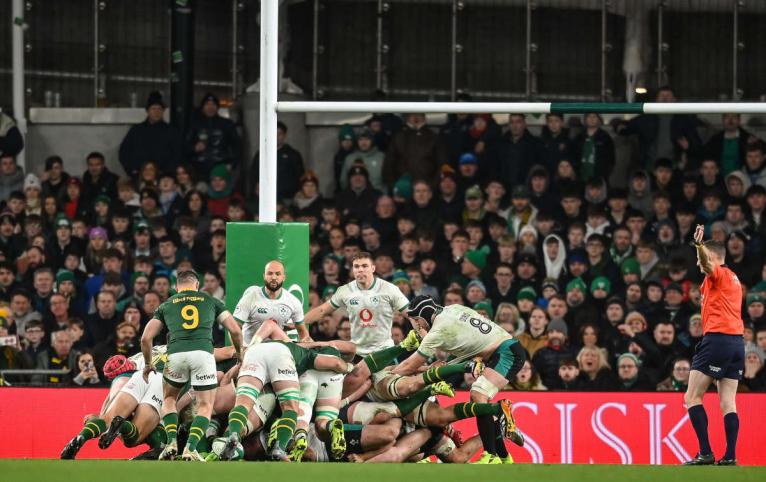
‘Dominance’ was also the word South African head coach ‘Rassie’ Erasmus reached for more than once after the match had finished, repeating it like some kind of magic talisman, fingering it like a rosary of prayer beads:
“Ireland had previously dominated us as a group. We know they’re still up against us [overall], so we won’t get carried away with it. We were thankful we managed to beat them here. It’s been a long season for us. We are proud after a long season to grind through a win against a team like them at home.
“I do think we were dominant in the scrums. I thought we were dominant for most parts of the game. Today it was hectic and difficult to manage and to understand who was off and who was on, who had an HIA and that’s Test match rugby at the highest level.”
Paint a picture of dominance and you own reality, as the All Blacks found to their cost in the recent Greatest Rivalry series. But the most panoramic of pictures always begins with the smallest of details, and at scrum-time that means the set-up.
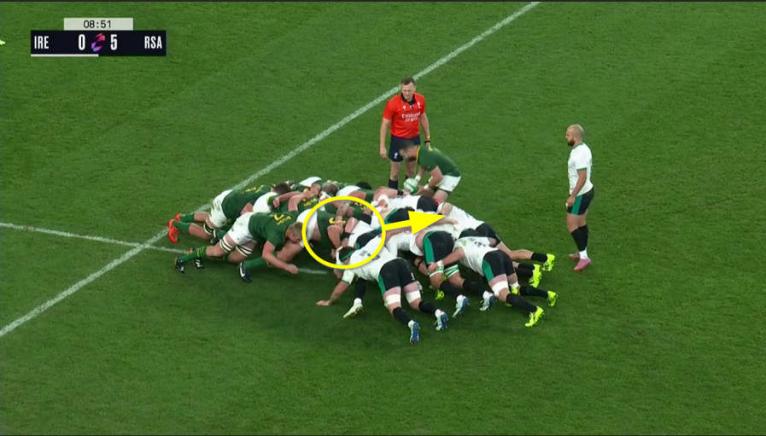
The most cogent scrum comments after the demolition in Dublin came from the lips of ex-Leinster and Ireland tight-head prop Mike Ross:
“A lot of the time, the South African [tighthead] props were hard on the angle. Personally, I’d be delighted to see an Irish prop going in at that angle and being rewarded. It’s great if you can get away with it, you know?
“On a couple of occasions, it was very clear and obvious that they were driving up, and out to the left. If you look at it, it’s right there. But they were winning the engagement, which makes it easier to go forward and paints a good picture to the ref. If you are refereeing to the letter of the law, you reverse one or two of those [calls].
“[But] it got into that snowball effect – giving up penalties, so you’re losing props and giving up more men. It was not going to get any better. South Africa were rewarded for dominance when they were not always legal. If you want to encourage that kind of thing – well, reward it.”
At set-up the Springbok tighthead, whether it is Wilco Louw or Thomas Du Toit [in the screenshot] is on an angle, and that is what caused Dave Rennie’s All Blacks so much grief during the RGR series. The South African tighthead wanted to shift closer to the centre of the scrum at ‘set’, and that meant hooker Malcolm Marx was tiptoeing a few centimetres away to his left from the initial placement of his brake foot.
That enabled Marx to scrum under the right shoulder of his opposite number, and the Springbok loose-head to step out a little further to his left:
https://t.co/2a6UTxWrlu
— William Bishop (@RPvids1994) September 7, 2026
Du Toit sets up on the angle, Marx drives up and through the right shoulder of France hooker Julien Marchand, to the point where he loses the bind with his tighthead, and Boan Venter walks around Régis Montagne to complete the picture. With the benefit of the eagle’s eye view, it is easy to see that the South African back five forwards all take a short step left before they start driving ahead. There is the meat of proper ‘scrumming through’ à la Rassie, but there is more than just a hint of the secret sauce, the ‘walking around’ described by Dave Rennie.
Ross went on to pay tribute to the scrumming prowess of Marx in the middle of the fray: “The more I looked at it, the more I was impressed by Marx. He is a scrummaging beast.” With Deon Fourie or Johan Grobbelaar in the middle of the front row, Springbok scrums do not advance at all, and sometimes they even retreat; but with Marx in situ, they look unstoppable.
In the new global rugby economy, news travels fast and no innovation remains the unique preserve of the nation which created it for very long. South African methods of achieving a picture of dominance at scrum-time have been analysed under the microscope. The last weekend of rugby – the first round of the men’s European Champions Cup and the WXV Global Series in the women’s game – already provided numerous examples of other countries copying South African scrum methodology to great effect.
South Africa won eight penalties at scrum-time [including penalty advantages] against Ireland last November. At the weekend, the England women won another seven penalties versus Canada, and perennial Champions Cup contenders Leinster won six against Clermont in the Auvergne. They both used the same techniques as the Springboks.
Not many clubs are capable of treating an away-day in France as the cue for a wild scrum party, but that is exactly what the Dublin province was able to do in the Stade Marcel-Michelin. The all-British & Lions front row of Porter, hooker Dan Sheehan and tighthead Tadhg Furlong, which had started the game against the Boks last November, ran riot against their Top 14 opponents. There were some subtle differences in the body position of three-tour Lions Test starter Furlong at set-up:
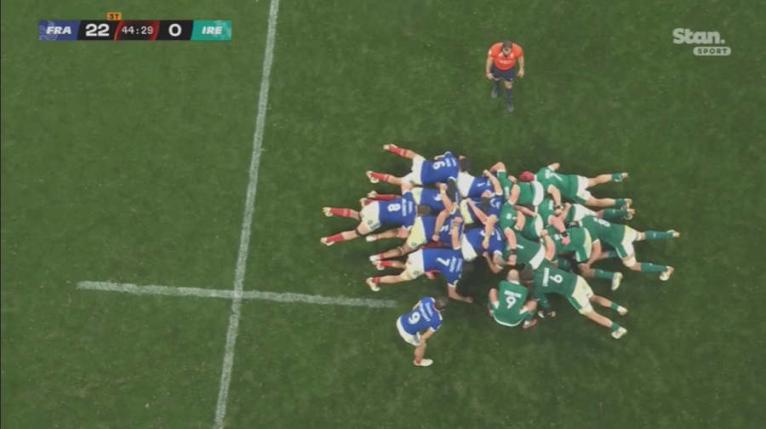
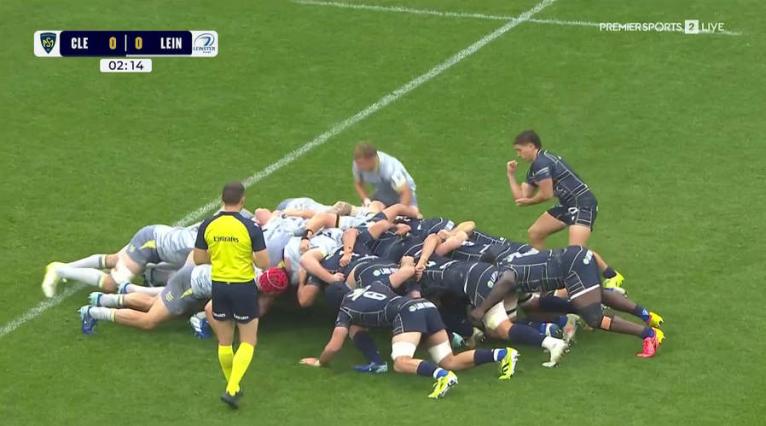
Furlong looks straighter in the overhead shot from the 2026 Six Nations match versus France than he is against Clermont a few months later. If Furlong was indeed shaping more towards the centre of the scrum at ‘set’, then subsequent developments on the Leinster feed certainly supported it.
https://t.co/OO4vWDrQNC
— William Bishop (@RPvids1994) October 19, 2026
https://t.co/16KdW3TbIq
— William Bishop (@RPvids1994) October 19, 2026
https://t.co/sFPQa43Nn0
— William Bishop (@RPvids1994) October 19, 2026
At the first scrum Furlong steps left at the set-piece, and the lateral movement of the feet by the back five forwards is especially clear in the second and third clips – step left, push ahead. Or in the rather more controversial RGR parlance, ‘walk around, to scrum through’.
By the final clip, the English referee from last November in Dublin had seen enough and awarded a penalty try and a yellow card against Clermont’s academy tighthead prop Nohem Ez Zahouany, who was filling in for Montagne on the day. It was a Springbok-influenced set-piece rehearsal by the top provincial scrum in Ireland. What is good for the South African goose is most definitely, a tasty titbit for the Irish gander.
The transfer of South African I.P did not end there. At Sandy Park in September, the Red Roses’ 39-game winning run was halted by a 26-26 draw against the Canadian women, and England did not win one scrum penalty on the day. Four weeks later, the women in white won seven penalties against the same opponents, with the identical groups of props in its 23-woman matchday squad.
Veteran Amy Cokayne did resume duties as starting hooker, and that addition alone may have been as significant as the difference Marx makes in the middle of the Springboks’ men’s front row:
https://t.co/NxZyDYd3Uz
— William Bishop (@RPvids1994) October 19, 2026
Number three Sarah Bern angles in, while loosehead Hannah Botterman and the lock behind her step left after the feed; then the scrum goes straight ahead towards the goal-line unopposed, with the Canadian pack left in an undignified heap on the ground behind them. It works like clockwork every time, as Leinster discovered in the Champions Cup. You can go from feather-duster to rooster very quickly indeed, if you have the right information to hand.
Ireland is preparing for scrum war in round six of the Nations Championship. South African methodology has been absorbed and understood elsewhere on planet rugby, and Andy Farrell’s charges know what the latest ‘picture of dominance’ looks like.
The word has spread like wildfire, and some high-level matches in the men’s and women’s games are now generating the same lopsided penalty outcomes as in Dublin last November, or in the RGR series in August and September.
There have been sanctions, yellow cards and penalty tries galore awarded at the set-piece. It is not a pretty picture, but it could just be what the men in green need to stand up and fight against the world champions on their anniversary in Dublin.

1 YEAR TO GO
The countdown is on until the biggest Men’s Rugby World Cup ever kicks off in Australia. Go All Out and secure your seats with tickets now available!


For Porter ,the 2 Clermont tighthead props were 20 and 19 years old loosehead props. All tighthead were injuried ….
Another week another anti Bok scrum article by NB. Seems Rennie and his NZ cohorts have found an “unlikely” mouthpiece to echo their narrative before the test season resumes. Ironic how Porter has long been criticised for his own scrummaging angles.
How about you do a series of deep dives on the AB scrum tactics next NB or is that just not in your and “Kiwi Pass” best interest.
Just get WR to insist that SA’s loosehead pushes straight.