
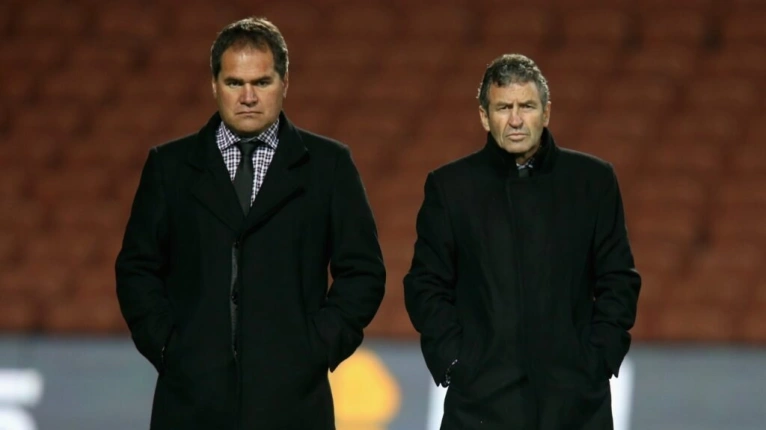
The wondering and the waiting is finally over, and Dave Rennie has been appointed head coach of the All Blacks. There will be caveats, and there will be no ‘saviour’ moment after the nuclear fallout of Scott Robertson’s dismissal, but there is the realistic prospect of a return to some of New Zealand’s core rugby values.
Rennie’s long-time confederate at the Chiefs, Sir Wayne Smith, may even come back to lend a helping hand. Whatever his utterances in public, there is little doubt ‘The Professor’ was painfully aware of the limitations of Razor’s coaching panel in private.
Rennie may just be the man to coax Smith’s unique rugby IP back to home shores. The coaching pair were coupled to the Chiefs’ great profit in Super Rugby, winning the competition in two of the three years they worked together in 2012 and 2013, and Rennie’s clear admiration for the man alongside him has not dimmed with the passage of time. “He’s fantastic, the best coach in the world,” Rennie said. “It was a privilege to coach with him for three years.”
Why was that partnership so valuable? The late and much-lamented ex-head of elite coach development at the RFU, Kevin Bowring, tells an anecdote about Smith, the coach ahead of his time.
“Smithy was in teaching mode, giving a seminar to a bevy of English Premiership coaches. He was showing a video clip where the ball had been kicked long, into the 22m zone of the receiving side with just one man on chase.
“‘What choice of play would you make here? How many of you would run the ball back?’ he asked.
“The tip of his baton tapped the screen patiently, like a musical conductor awaiting the first note of response – but only one hand went up, rather apologetically at the back of the room. Smithy was left facing the stony-face silence of his ‘orchestra’. It was an awkward moment.”
With Rennie in charge of the Chiefs, everyone was playing the same tune and Smith’s innovations went straight into the gameplan. During their twin-title winning spell, the Chiefs had the lowest time in possession in the league when the domination of territory and possession was perceived to be the way to win games of professional rugby.
The Chiefs bucked that trend, and they made the most of their chances from the ball kicked back to them, from anywhere on the paddock. As Rennie observed at the time, “What we did well was the ability to turn pressure into points. So, from a defensive point of view, if we defended really well and we got a turnover, we were pretty clinical around that.
“The ball’s kicked to you as many times in a game as you have scrums, lineouts and kick-offs put together, so there are plans around counter which have been effective for us. This year we had the least amount of possession in the comp but ironically, we had 70-odd percent possession in the quarter-final we lost [32-30 to the Brumbies in 2014], so the stats don’t always marry up to what’s really happening.”
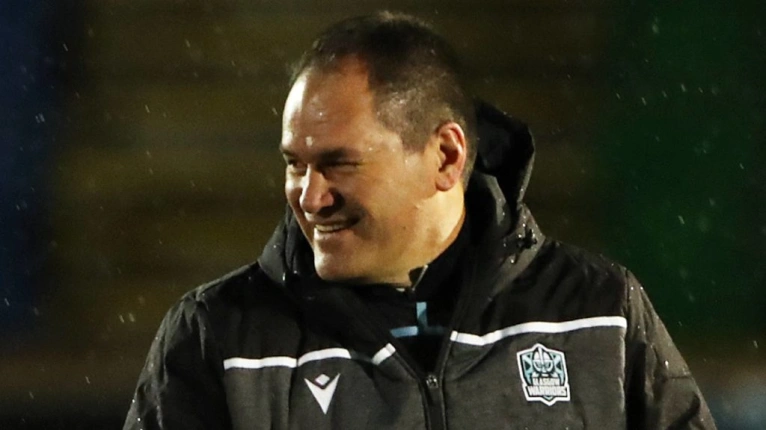
When he first moved to Glasgow after his successful stint at the Chiefs, Rennie was still riffing on the same theme. “I want us to have a confidence that if it’s ‘on’, we launch from anywhere, From 95 [metres] out, it’s sometimes easier than five out.” This is the attitude which New Zealand was so sorely lacking in the Robertson era, and which eventually turned Smith’s face away from New Zealand, and in all likelihood, towards the Land of the Rising Sun instead.
A recent report by World Rugby consultant and ex-international referee Corris Thomas illustrates just how far New Zealand had drifted on the rip-tide, away from its traditional rugby values. Of New Zealand’s 2025 Rugby Championship performance, Corris concludes:
“New Zealand brought an approach to the game that differed from previous years. That approach resulted in tries being scored from all parts of the field and from the various sources of possession. Tries from inside New Zealand’s own half of were not uncommon, as were tries from broken play, opposition kicks and tapped penalties.
“This year’s TRC was very different.
- New Zealand scored 86% of their tries from the set-pieces [lineout and scrum]. The other three teams averaged 56%.
- New Zealand scored only 15% of their tries from open play, the other three teams scored 48%, 43% and 41% respectively.
- New Zealand was the only team who did not score a try from a turnover or an open-field kick.
- New Zealand scored 70% of their tries from possession gained in their opponents’ 22m zone – the highest proportion of any team.
- New Zealand scored only two tries from inside their own half – the lowest proportion of any side.
- They also failed to convert 9 of their 21 tries which gave them a success rate of 57%. It was the lowest of any of the teams that played in this year’s Six Nations and TRC.”
Against that very stark backdrop, Rennie could, and should be the man to restore the heads-up, counter-attacking credibility which has been temporarily lost.
There will also be less emphasis on pure size in the forwards than there was under Robertson, and far more on mobile, highly-skilled big men capable of strong repeat involvements. In the aftermath of his All Blacks acceptance speech, Rennie name-checked Brodie Retallick while pointing out the necessity of opening up selection to include Kiwis plying their trade overseas.
“I get to see Brodie Retallick train and play every week. He’s stronger than he’s ever been; he’s fitter than he’s ever been. [But] I’m not sure if I’m allowed to [pick him] yet.
“If you want to win a World Cup, you’ve got [to have] your best players available. Obviously, Richie [Mo’unga] is coming back, which will be good. He’s been in great form in Japan.
Class is permanent.
Brodie Retallick with the clock in the red. After scoring two tries. His team up 78-19. pic.twitter.com/sLFgoIZZlI
— Jared Wright (@jaredwright17) March 2, 2026
“If you have someone like a Brodie Retallick coming into the environment, it will really grow the whole group. He’s done a phenomenal job around leadership at Kobe, and the quality [in the league] is really strong. There are sides up there that would beat Super Rugby teams.
“So, if I had the chance to get [Brodie] back, I’d certainly jump at it.”
And there will be brutality, and lots of it, at the breakdown. During the prime Leinster years when Rennie was head coach of Glasgow Warriors, there were always two non-negotiables for the Irish province: defend the counter-attacks from deep orchestrated by Finn Russell, and a disciplined response to the breakdown brutality led by ex-Hurricane Calum Gibbins.
If you were standing anywhere near the tackle zone you would be taken out, by fair means or foul. You might be held or grabbed when you were never part of the tackle, or blown out or blocked when you were standing three or four metres away. There was no such thing as a ruck perimeter in a Rennie game.
As ex-Auckland and All Blacks’ hooker James Parsons commented on the Aotearoa Rugby Pod recently, “Dave Rennie is all about the breakdown. [He will] get a high turnover count at the breakdown, and a high penalty count.
“When they get it wrong, they get pinged off the park, and when they get it right, their turnover count is through the roof.
“You think about the Chiefs, and I know because I had [their forwards coach] Tom Coventry at North Harbour, he said they have this thing called napalm, and that’s how they cleaned rucks: you carry, and I’m going to get rid of everyone else.”
Let’s roll back the clock to 15 September 2022, and an infamous encounter when the Rennie-coached Wallabies could, and probably should have beaten a New Zealand side containing his favourite Chief at the death.
‘Pistol Pete’ Samu epitomises the type of forward who will thrive in a Rennie-mentored pack: a lithe, adroit big man capable of strong repeat involvements on the edge or straight up the middle.
— William Bishop (@RPvids1994) March 4, 2026
— William Bishop (@RPvids1994) March 4, 2026
In Pro14 or Champions Cup play, Rennie’s Warriors were often happy to run a dozen or so phases from deep within their own 22, and in the first clip his Wallabies are chancing their arm from deep: the sequence starts with a Samu bust straight up the middle and finishes with a coruscating hit by Marika Koroibete near the New Zealand goal-line.
The second example begins with a kick return, and features two devastating carry-and-cleans taking the pill into midfield before it is brought back to Samu, inter-passing intricately with Koroibete down the left edge to convert an outstanding try.
Parsons’ double-facing interpretation of Rennie’s “brutal” breakdown mentality was underlined by the performance of Darcy Swain on that day in the Docklands, with the Brumbies second row nailing Lalakai Foketi into a defensive jackal which should have won the game for Australia, while also launching a nasty attack on the lower leg of Quinn Tupaea at a cleanout earlier in the game.
— William Bishop (@RPvids1994) March 4, 2026
— William Bishop (@RPvids1994) March 4, 2026
‘Napalm’ indeed, incinerating all in its path. The Wallabies gave up three yellow cards in one game, and that lack of discipline as much as a final brain-fade by Bernard Foley cost them the game. Win penalty, lose turnover, it could be a rollercoaster ride for fans of the silver fern under Rennie.
There is no question the newly-crowned All Black coaching king will reverse many of the stylistic and tactical trends of the Robertson era. There will be more kick and turnover returns and more counters from deep with ball in hand. Forwards will be selected for intensity and skills rather than pure mass, and the prophylactic thumb blocking overseas selections may finally be pulled out of the dyke, allowing the water to flow from outside the country and back into New Zealand.
Brutality in and around the all-important tackle area will also make a welcome comeback, though whether it is accompanied by the requisite discipline may depend on the reassuring, steadying hand of Smith on the tiller. Not the first time in his coaching career, ‘Smithy’ may be the vital oil that allows the wheels of the almighty All Blacks machine to roll again.
Watch all the upcoming SVNS action for FREE on RPTV!
*Available live in select territories


Hopefully the referees will be keeping a close eye on this.
As for the counter attacking, I’m curious to see how much improvement there is from the All Blacks under Rennie. I refuse to believe that the previous coaching staff were not encouraging this type of play and I believe they don’t have the personnel of a team like France or South Africa to be lethal on turnover. Time will tell in this regard.
Gotta laugh at the notion of Leinster feeling hard done to by illegal activity at the breakdown!!!
Kettle calling the pot and no mistake…🙄
I think breakdowns is the key area that changes by region and what refs allow as the norm.
Premiership refs like a clean breakdown and once the ball is available, they tend to protect the scrum half and encourage them to play away from the ruck.
Then comes the Investec and the continental refs tend to let a lot go at the breakdown in comparison and allow a lot more counter rucks which unsettles the scrum half.
URC are a little in the middle, they allow a contest but are not as protective as Premiership refs.
That’s where New Zealand would struggle with some of the English refs at the breakdown and what they allow.