
To say the try line is important in rugby is to state the intellectually obvious. Of course, the try line is important in rugby. It’s where tries are scored and five points are awarded. Although, as an aside it hasn’t always been this way. In the early days of the game during the 19th century, putting the ball down on the ‘try line’ was worth nothing, it just allowed you to ‘try’ a shot at goal – which was worth something.
But basic history lessons aside, the role of the try line has changed hugely over the past four seasons. Prior to this the try line signified the end of a process, it was the reward for skills, a velvety pass, or a delicious line-break. However, in recent seasons, getting to the try line has almost become the easy bit. The hard bit is now getting the ball down on the white paint.
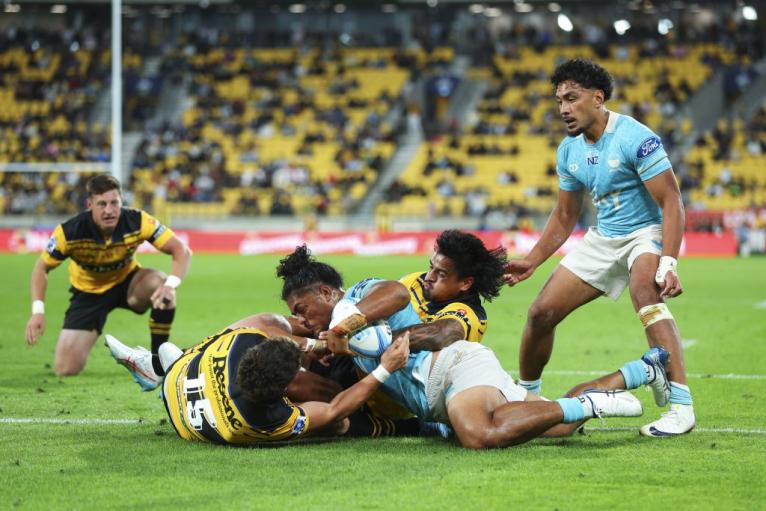
It all changed on 1st July 2022, when changes were made to the laws governing what happened when a player was held up in goal. Where before, the attacking team was awarded a scrum five metres out, the defensive side had earned a goal-line dropout. Essentially a chance to drop-kick the ball deep to the halfway line, or in certain circumstances executing a shorter kick in an effort to regain possession.
A chance to kick deep is way easier to defend than a five-metre scrum, so the need to defend the try line has become a far more high-pressure situation – in some games, it’s like watching seagulls defending a half-eaten pasty. It’s got to the point where try line defence and attack has now almost become the second unofficial set-piece – the other being halfway line restarts, and the two official set-pieces being the scrum and lineout.
This focus on try line defence has even led to a new tackle, which I have unofficially called the ‘duvet’ tackle. It’s where the defenders voluntarily attempt to get underneath the carrier, like they’re lying down on a bed, and then attempt to pull the ball carrier up over their body like a 16st duvet. The result being, the attacker (the duvet) can’t ground the ball, because he has a massive flesh bed/mattress underneath him – single bed if it’s a scrum-half, super king if it’s a Springbok lock.
The situation has been made all the more complicated because the try line, in ruck situations, becomes the offside line. And when behind the try line/offside line a player has no responsibility to be on their feet when making a tackle – therefore making it far easier to get their body under the ball. As we saw when Charles Ollivon executed this technique brilliantly against the Stormers in the last sixteen of the Champions Cup, being already on the ground, legally, provides a huge advantage when sliding underneath the ball carrier. Especially in that particular fixture, when Ollivon’s elite rugby knowledge resulted in Toulon knocking out the Stormers by a single point.

The whole reason the goal line restart law was enabled, was to discourage teams from taking multiple ‘pick and goes’ on the try line – and to try and score in the wider spaces. Multiple ‘pick and goes’ are not a great spectacle, and the repeated contacts obviously have implications for player welfare and HIAs – all of which are laudable reasons to have changed the law in the first place. However, with defensive coaches now being able to dominate and suffocate the try line, attack coaches now need to figure out a way to unlock that defence.
With narrow defences dominating on the try line, and attack coaches needing to go wider to score, the subsequent ‘conversions’ also become slightly more difficult with every metre you move wider from the posts. Imagine a scenario where a team needs a converted try to win, the best place to score is under the posts, but if the defensive team can simply hold you out, or worse still force a goal line dropout (with duvet tackles), then the only option is to go a bit wider. But wider often means more passes, more passes mean handling errors (or even kick passes) which substantially increase the likelihood of errors and decrease the likelihood of scoring.
And therein lies the dilemma. As a rule, rugby’s laws should always slightly favour the attacking team. Not by 90%/10% – but 60%/40% seems reasonable odds in favour of those trying to score. And in that regard the new tryline ‘set-piece’ seems to have inadvertently done the opposite. But that’s the beauty of rugby. You tweak one law, and it has another effect on something else. It’s like Newton’s third law but with 30 monsters and a ball that simply won’t do what it’s told.
Maybe the solution is to ensure all tacklers must be on their feet – even behind the try line. Maybe the goal line restart can’t go past the 22m line – meaning the attacking team has less meterage to recover on the following phases. Or maybe all conversions should be taken from in front of the posts – why should a try scored out wide be punished with a tougher kick at goal?
Either way, rugby will find a solution. It always does.


It’s still too far in favour of the attacker, this would be a great innovation if it’s actually legal.
The defending team should also not be offside as long as have some part in the ingoal. That would fix this situation immediately I think.
I’ve always understood the game of rugby to be a game played on your feet. So I’m surprised to learn that you don’t have to be on your feet behind the trylines. Seems silly - as much as I am against changing rules like I change my undies during a routinely bad round of golf - I think it’s a no-brainer rule tweak really.
But when I see a statement like “are not a great spectacle” I lose complete interest in the narrative. Every element of the game is a spectacle. Which is why rugby has fans and a fanbase that’s growing.
Nor as an attacking when attempting to score a try.
The very best thing to do re the laws of the game, is to stop bloody tinkering!!
Just wanted to say a big thanks to everyone who reads my columns on here. Cheers, Paul
This is a really good question and if they simply gave a scrum oin the 22 if the ball was held up, it would naturally give the TMO 1-2 mins to confirm if a try was scored whilst they are setting up and would also stop these constant TMP replays, which would also be a benefit to speed things up.
Absolutely fantastic idea. Scrum on the 22 is superb. Only problem i can see with this is very easy points for a team like South Africa with a dominant scrum.
This is a classic example of a law being brought in to stop the pick and go but failed to see how an entire new approach would be taken that overly favours the defence in these situations and after 4 seasons we can all see how badly they got this wrong.
If having a 5m scrum was too advantageous to the attack, then why not result in a scrum on the 22 (in line with where the ball was held up). That effectively gives the attack a chance for another strike move and will keep a more attacking element to the game.
To lose the ball because the opposition jump on the floor early is an awful rule in rugby.
The law doesn’t overly favour the defence, it’s still far too far in the attackers favour. Though if they are correct in this ruling it could be enough to favour the defence if everyone did it, and would encourage the attacking team try to.. well attack, instead.
If anything the rules is probably still too in favour of the attackers. If you fail, it should be a straight turnover, like a 22 drop out or tap instead. An attacking team should be rewarded for forcing the defending team to ground the ball in their ingoal, yes, but when it’s by their own failure to touch it down once theyve got there, you’ve had your go. It should be better reward when you make them do it voluntarily, like kicking in goal and them grounding the ball (that’s improved where it’s now a goal line, but failing to score shouldn’t get the same reward still).
Moral of the story? Stop changing the laws.
I have no solution but I do have a problem with “tries” continually being denied due to being held up. There must be a better way to reward the attacking team than having to field a drop kick somewhere near the half way line. Perhaps give them 3 points or free kick possession 15 yards out.
You don’t deserve a try if all you’re doing is throwing bodies at the line.
Maybe a scrum or line out on the 22? That way teams encouraged to develop more complex first phase attacking plays and corresponding defensive screens.
The tap rule after the scrum in SR is ridiculous in my view. The defense needs an opportunity to stop a guaranteed try and the other way to stop is being offside which would be a yellow card.
Rugby’s laws should kept the same unless all big nations agree to it, it’s the only sport aside from basketball where things change depending on the competition.
Not infringing is the simple option.
The only law trial being used in SRP that I'd like to see brought in globally is the law where a free kick is awarded for taking too long to clear the ball from a ruck or maul instead of a scrum.