
The two-horse race to become the new head coach of the All Blacks has suddenly become a neck-and-neck affair entering the final furlong. There is no clear winner in sight between Jamie Joseph and Dave Rennie and it may all be decided in a photo-finish. Stopping to pose and smile at the finishing post may prove fatal in a race which may be won on the nod, or in the very last stride.
There has been a noticeable upswell of support for the ex-Chiefs man recently after the Highlanders supremo got an early jump out of the gate. According to a report in The Post, a NZR delegation flew to Japan to interview Rennie after spending time at the Highlanders headquarters with Joseph last week. A recent viewer’s poll on Sky Sport’s The Breakdown suggested a narrow preference for Highlander over Chief but it was close, 55%-45%.
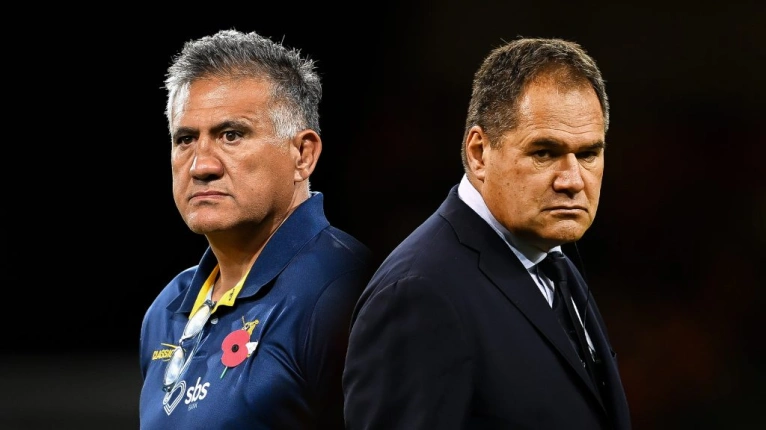
As the either/or choice tightens, Joseph is perceived as the tough hombre who will drive standards hard but may shed a few assistants along the way – Tony Brown now works with the Springboks, Tom Donnelly with the Wallabies and Kendrick Lynn with the Pumas – while Rennie may be the better collaborator and connector, the man who can mobilize the collective will of the assistants around and underneath him.
One of his playing charges at Glasgow, ex-Scotland scrum-half Mike Blair, recently rejoined Rennie in Kobe. Another Glasgow back of the Rennie era, Peter Murchie, was his defence assistant at the Steelers, before being promoted to the full Wales national coaching staff at the invitation of Steve Tandy. Both worked alongside Phil Healey, Rennie’s strength and conditioning maestro at Glasgow and the Chiefs.
If you asked two of the three wise men, Sir Graham Henry and Sir Wayne Smith, even now, they would probably plump for Rennie. ‘Smithy’ worked with him at the Chiefs and ‘Ted’ recommended his promotion after the third member of the trifecta, Sir Steve Hansen retired from international duty at the end of 2019.
Influential ex-All Blacks turned pundits are beginning to see Rennie’s side of the story and filter out the attractions of appointing him to the top job in New Zealand rugby. On The Breakdown ex-Blues hooker James Parsons observed: “Because they’re poles apart it’s really what you’re looking for.
“Off the back of what we’ve seen in terms of the breakdown of the culture and relationships, I do think a Dave Rennie, who brought the Chiefs together and had sustained success [is the better choice].
“Yes, the Wallabies results weren’t great but I do think he was just starting to break through with that side and he was let go. For me, he’s well placed.
“The head coach is one thing but I think it’s the supporting acts and how you make the whole team cover your gaps so it doesn’t become an echo chamber for one person.”
The suggestion the All Blacks head coaching role could become “an echo chamber for one person” once again, is a haunting backwash of the Razor era and NZR will be peculiarly sensitive to any repetition of it.
On the same programme, New Zealand centurion Mils Muliaina implied Rennie and Joseph could work together, but that is the least likely outcome. Both are used too used to being top dog to voluntarily accept demotion to sidekick at this stage of their coaching careers.
The encounter between the Reds and the Highlanders in round three of Super Rugby Pacific encouraged national supporters of the All Blacks and the Wallabies to cast the runes, and run a preview of the men who could be leading their countries into Bledisloe Cup battle later this year. Les Kiss is already confirmed as the head coach of Australia and Joseph may become his antagonist in the trans-Rasman rivalry scheduled to resume on 17 October in Sydney.
There is already one startling similarity between the two clubs after only three rounds of SRP play. Both teams are kicking far more than the tournament mean: 37 times per game for both clubs, 10 kicks more per team per game than the competition average. Joseph’s Highlanders have kicked the furthest and are currently the only franchise to have kicked for more than 1000m per game [1108m].
The biggest difference between the two lay in the quality of defence, and in this aspect of play there were encouraging signs Les Kiss will be able to move the Wallabies on from the archaic practices of the Joe Schmidt era. Before Christmas I observed how the Wallabies clung on to an old-fashioned 12/1/2 defensive system: 12 men in the line, two in the backfield with the scrum-half defending in the zone between the two. This tried-but-not-so-trusted system in the modern era emphasised linkages between defenders, at the cost of aggression.
— William Bishop (@RPvids1994) March 2, 2026
At this lineout from the November game against France, the basic philosophy is obvious from an eagle’s eye view: there are two backfield defenders standing deep, with the defensive front drifting across field to link up with them as play moves to the far sideline. The scrum-half fills the space in between the two, plugging gaps and picking up any short kicks through.
It was this system Eddie Jones felt could be due for improvement with the appointment of Les Kiss, speaking on the Rugby Unity podcast with David Pembroke before Christmas.
“[Les] has always been a more defence-minded coach. He’s always coached the defensive side of the game, so it’ll be interesting to see whether he takes that defensive mindset to the Australian team.
“I think teams either have an identity around defence or identity around attack, and I think the Australian side’s identity has generally been around attack.
“It will only be a subtle shift, and it’s only a nuanced change. But it’ll be interesting to see whether that comes forward, and you’ll maybe see with that a little bit more line-speed from Australia, a bit more aggression, because under [defence coach] Laurie Fisher, he plays that more connected defence – stay connected.
“There’s two ways of going about it. You either go line-speed, or you go connectedness, or you go in between. Australia has tended to be more connected, and Les [may] bring a more aggressive approach with a bit more line-speed, which has its risks, because then you tend to defend a bit narrower, and the outside space can be exposed.”
There were some signs in the game between the Reds and the Highlanders a defence overseen by the new Wallaby head coach could be about to undergo a more aggressive makeover.
— William Bishop (@RPvids1994) March 2, 2026
— William Bishop (@RPvids1994) March 2, 2026
In the first instance, the Reds are defending out of their 12/1/2 from a goalline dropout. Two men stay back, scrum-half Louis Werchon follows play to the base of the first ruck, and the other 12 defenders fan out in and around the breakdown. The difference from the Schmidt era is the Queensland backline is more ready to step forward, build its line speed and employ the spot-blitz, with 12 Hunter Paisami ‘spotting’ the second key receiver for the Highlanders [11 Jona Nareki] and dislodging the ball in the tackle. In the second clip it is the same basic structure, but with Lukhan Salakaia-Loto gimleting the anticipated first receiver and surging aggressively out of the line to take man and ball.
With the Landers behind on the scoreboard and Kalani Thomas on the field for Werchon, the Reds became more even more combative.
— William Bishop (@RPvids1994) March 2, 2026

— William Bishop (@RPvids1994) March 2, 2026

From the first goalline dropout, Thomas does not bother scanning play from behind the base of the first ruck, he joins the front line immediately. In the first screenshot, the Reds are in an aggressive defensive formation with only one defender committed deep and end defender [Harry McLaughlin-Phillips] hedging his bets between the line and the backfield. The extra body or two in the line pays dividends at the breakdown, with a double jackal attempt at the end of the first clip and Filipo Daugunu winning turnover in the second.
In the battle for the All Blacks job, Joseph’s involvement with the Highlanders this season may not work to his advantage, especially if there are more unflattering comparisons of the sort viewed at the Suncorp on Saturday. Thus far, Joseph’s men have scored only eight tries in three games while kicking the leather off the pill. “That’s not New Zealand rugby,” to coin Jeff Wilson’s phrase.
Will-be Wallaby head man Kiss emerged with more credit from his very personal duel, and it looks as if he is primed to up the ante on green-and-gold aggression in defence. When the Reds saw a clear target in their sights at the Suncorp, they stepped up and hit it. It may not prove as watertight as John Muggleton’s impenetrable D at the 1999 World Cup, which did not concede one single try in the knockout stages, but Aussie defence may just be ready to get a bit more filthy with the opposition. It is about bloody time.

Watch Super Rugby Pacific live and free on RugbyPassTV in the USA!


The change-up in our defensive model is long overdue. For all that Fisher brings to sides’ breakdown work, his stubbornness about how we defend kept us in the dark ages. Happy to see a change.
A performance like this one makes me wonder again how Joe persisted in not picking LSL last year. The Reds’ talisman - when a big carry or hit was needed, it was invariably he who provided it.
Nice analysis, the Reds certainly looked very connected in defense against the Highlanders. In terms of time frame, Rennie makes more sense a contract until the end of the World Cup. Then if he wins it, he continues and if not Joseph + Brown could be available.
Rennie seems to have the extra push behind him right now and that appointment would make a lot of sense. I’ve always fetl they really want JJ is he can bring TB with him!