
The RFU’s annual report for the fiscal year 2023/24 makes for interesting reading, at least as far as the division of funds goes. The annual operating loss of £37.9m could be expected in a World Cup year, with fewer Six Nations matches and the absence of November tour games dropping revenue from ticket sales, catering and hospitality and broadcasting income.
The lion’s share of the overall investment of £96.1m was parcelled out between the community game [£30.5m] and the national team [£28.7m], with £24.9m going to the men’s and women’s clubs.
The most understated but significant investment was the £12m reserved for ‘professional match officials, sports medicine and events and competitions.’ Last season the Nottinghamshire, Lincolnshire and Derbyshire RFU successfully applied to the RFU innovation fund for money underpinning a new campaign to recruit and retain referees.
The NLDRFU called it ‘a key enabler to the sustained growth in fixtures across all playing categories and levels’ and they were right. No money could be better spent than that 12.5 per cent of union revenue deployed via initiatives like the Ready2Ref and YMO [Young Match Officials] programs.
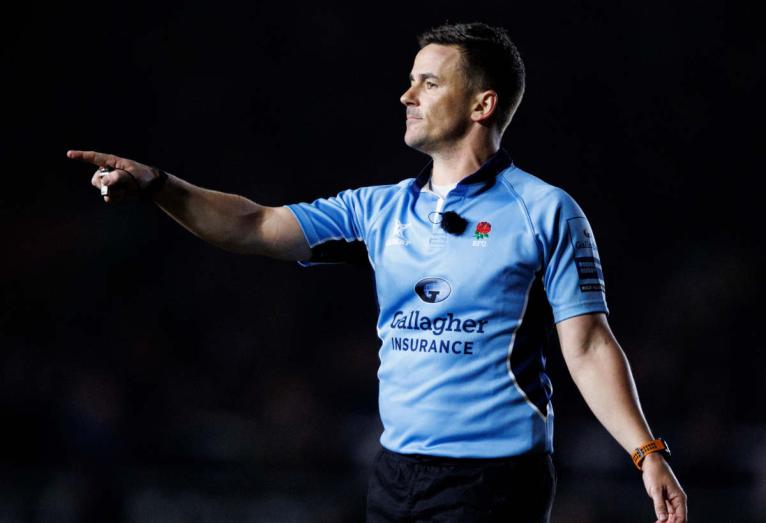
Without young, fit and competent officials, the game is going nowhere, amateur or professional, and there are no professional leagues around the world which feature match officials who are younger, fitter or more competent than those in the Gallagher Prem right now. The top four Prem referees – Luke Pearce, Matt Carley, Karl Dickson and Christophe Ridley – are all in the age range between 37 and 43, which compares favourably with their equivalents in football’s Premier League.
Games featuring the quartet in the first nine rounds of this season’s Prem typically average one-and-a-half minutes more ball-in-play time at 38.5 minutes, 0.5 more tries scored at nine per game, and one penalty less, at 19 per game. Sara Cox may be about to join that elite group with her own stats strikingly similar to the top four men in those key areas of performance.
What separates the men, and the woman from the boys in the Prem is top-quality communication with the players, and officiating which rewards positive attacking play. Take a look at the following table:
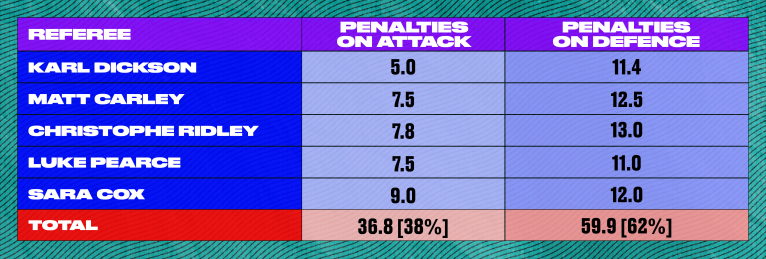
The majority of penalties are awarded in favour of the side in possession of the ball, and this is one of the major planks in the skyrocketing standard of entertainment and spectacle provided in the Prem over the last couple of seasons. It is also one of the reasons why the English game is currently producing a generation of outside backs and number seven forwards who are equal to, if not better than, any other on planet rugby. That is another ‘first’ for the game in England, and the refereeing of the game is key to it.
The foundation stone of honest and open communication extends to both players and supporters of the game alike. In 2024, Luke Pearce took to social media platform ‘X’ to explain a decision he made in a Rugby Championship game between Australia and South Africa. Pearce had penalised the Springbok defensive line for offside after Wallaby scrum-half Jake Gordon knocked the ball on, and one Springbok supporter questioned the decision online:
“There was a ruck where oz 9 think it was Gordon did at the time looked to have picked up the ball and play it and even shot up the d line. But then got penalized for offside. Can a 9 dummy a pass from the base to get the d line to shoot up?” [Fan]
“It was a mistake on my part. I didn’t see the 9 knock the ball on. We try our best but sometimes we get it wrong. Thanks for the question.” [Pearce]
Another poster summarised the quality of such fan engagement as follows: “How it should work! Courteous question. Honest answer. Mutual respect.”
It is impossible to argue with lucid and respectful communication, and that is what Pearce provided in the table-topping clash between Bath and Exeter Chiefs at The Rec last weekend. From an officiating point of view, the match was a wellspring of common sense and open communication, and it provided an object lesson in how to navigate the hidden reefs of the lawbook for any top referee.
Pearce began by skilfully guiding his ship away from the rocks of a game-long red card in only the third minute of the game. Wind the clock back to the November Test between France and South Africa, when Australian official Angus Gardner painted himself into a corner by failing to issue a yellow card instantly to Springbok second row Lood De Jager for a head-high challenge on Thomas Ramos just before oranges. When the review turned the colour of the card red, it meant South Africa could no longer replace the bearded lock with another player after 20 minutes in the cooler.
An important layer of the law for offences somewhere between yellow and straight red was lost in the process, but Pearce made sure it was intact after the following aerial contest involving Exeter wing Cam Ridl:
— William Bishop (@RPvids1994) January 7, 2026
Because Pearce issued the yellow immediately, the subsequent elevation to red on review meant the Devonians could replace Ridl after 20 minutes and return to a full quota of 15 players with an hour of the game still to run. The contest and the spectacle at The Rec remained alive and well.
Pearce’s next important intervention provided an excellent example of his world-class communication skills:
— William Bishop (@RPvids1994) January 7, 2026
— William Bishop (@RPvids1994) January 7, 2026
First Pearce explains in real time that a defender batting the ball down in a backwards direction towards his own goal-line cannot be considered an offence; then at the end of a sequence of play 45 seconds later he seeks out Chiefs skipper Dafydd Jenkins to explain the decision for a second time, and the conversation finishes with a laugh and a joke shared between Pearce, Jenkins and England veteran Henry Slade: ‘It’s not an offence for the ball to go backwards. [Bath] 15 Santi Carreras was lucky.’
Ex-England and Harlequins scrum-half Danny Care made a point of highlighting that involvement in commentary for TNT Sports:
“I tell you what – Luke Pearce again. What brilliant refereeing. He isn’t wanting to blow the whistle straight away, [but] happy to let play go and explain [everything] at the end of the play. Very clear comms to the players, and a great referee for the lads to work with.”
If an ex-scrum-half is giving a referee that compliment, he should surely take it. They do not come along too often. Pearce is willing to go the extra mile to provide utter clarity, and that tends to defuse negativity and resentment before they ever arise – for player and supporter of the game alike. Right or wrong, everyone always knows what decision he has made and why he has made it.
Shot-clock not working on a kick conversion? No problem, forget about it:
— William Bishop (@RPvids1994) January 7, 2026
Use your common sense: ‘shot clock not working, so ignore it for this one.’
Pearce’s desire to keep play moving and avoid unwelcome breaks in play also applied to that perennial bone of contention, resets at the scrum:
— William Bishop (@RPvids1994) January 7, 2026
Care again: “He has got great comms, hasn’t he? He doesn’t take any nonsense from front-rowers, tells them exactly what is going to happen.
“[He] speeds the game up, [and is] always chatting to the players. I used to love working with Luke Pearce from a scrum-half’s perspective, he always keeps the play flowing really well. Two quality teams, and a great referee.”
When the following scrum collapses with an ironic shrug, Pearce stops the clock immediately without awarding a penalty to either side: ‘I can’t guess lads, time off please.’ At the third time of asking, having exhausted all the tricks of trade at their disposal, the two front rows finally produce a usable attacking ball, thanks in large part to the patience the referee has shown.
England is doing a lot of things right, skipping along on the thin surface-film of planet rugby. It has produced a first-class, if trimmed-down, domestic product in the Gallagher Prem, with a big emphasis on constructive attacking intent and a reduced penalty count. It has been so successful that the national team now has quick, skilful number seven forwards and outside backs in abundance.
At the beating heart of the English rugby revolution is its cadre of younger, fitter, more streamlined referees; officials with the fitness to keep up with extended ball-in-play times, the common sense to make clear judgements and the communication skills to explain how and why they have made their decisions. Now Devonian Sara Cox is following closely in male footsteps and she will surely take charge of a men’s international in the near future. Right now, the Prem is prime time, it really is that good.

Rugby’s best of the best, ranked by experts. Check out our list of the Top 100 Men's Rugby Players 2025 and let us know what you think!


I think they have enough top sevens to make it work, and a genuine 8 like Fisilau or CCS may get time too.
Versus France it will be Eng kick-chase against French kick return and that is a contest I feel Eng are well-placed to win.
Their toughest assignment right now might be the need to find a capable rep for Will Stuart at bench THP!
You’ll find a discussion of current THPs [inc the Tank] on the newer thread😁
My only concern with the 5x7’s (because it’s still new) is can ENG maintain the same defence intensity week to week in a tournament like 6N’s (and then RWC run) and whilst it was successful at fortress Twickenham (it’s getting back that way), can this team still play like that AWAY? They are the main unknowns.
In the AI’s, we played the 5x7’s vs. AUS, NZ & ARJ but they changed the team during Fiji and there wasn’t the same energy vs ARG. I guess they will need to consider rotating starters & bench on a 5 game run, so I don’t think it should be an issue but we still haven’t tested it fully yet - this 6N’s will be the first true test.
I agree on the AWAY games and Paris will be a true test of this fairly new team in their 1st Championship decider, vs a very good team who are probably 12 months further down that road.
If ENG maintain that level of defensive intensity, they will be very tough to beat . . . . But Paris will be a test for FRA to show they are the strongest team and last year’s loss was a blip, whereas ENG will be looking to show this team really is as good as people are starting to think.
Given how close the teams are (with improving ITA also being a challenge, I think this could be an epic 6 Nations, just as TRC was with it being so close where all teams are capable of beating each other.
Interesting times ahead.
Spot on comment and great EQ P!
Eng have three away games this 6N and two of them are difficult, so the reasons for them to move away from their autumn approach are thin indeed.
I think if we are honest, given they went 4/4 in the Autumn, it will be emotionally difficult to change a winning team, especially for a fairly new coaching group (given the recent changes), thus I was expecting the same team, even thought I would personally prefer the Saints style of attack over the way we are currently playing.
I was with a few friends today discussing the rugby and they were talking about how easy it is to lose the Away games in the early rounds of the Investec but how it evens up a little in the latter stages, as they appoint more experienced refs and many clubs use larger venues, which have strong home support but loses some of the benefit of home comforts.
I think your point is valid with Saints - the attack looks great in the Premiership but the Investec is all about strong forward packs controlling the game, which is the same at International.
They did look a bit clunky with Belleau coming as a late rep, however I think the game may still have done for the chances of a backline orbiting around Fin Smith and the Saints running attack at the 6N - unfortunately.
We may still see Freeman at 13 and Dingwall at 12, but the likes of Hendy and maybe even the return of Furbank may be put on hold!
Great Article! Love the diversity of rugby topics that you cover.
It’s quite liberating discussing refs without castigating them for errors JA! Fair dues to those who are really helping he game develop👍
Was always a tough ask for Saints and losing Fin Smith would have been a body blow just before kick off.
They will learn from this and the quality of refs increases as the competition rolls on to the knockout stages.
Toulouse wouldn’t have enjoyed that Sarries pitch but interesting to see the two Willis boys going head to head.
They & Ribbans are the key players ENG are missing.
I haven't watched as much of the Prem as might have been the case post the November internationals because the Ashes series has taken most of my attention.
I’ve always rated Luke Pearce higher than Joel Jutge seems to based on the lack of marquee Tests Pearce officiates. In the Nigel Owens, Wayne Barnes and Craig Joubert mould, he has a good feel of what should be penalised and what could be pinged but doesn't absolutely need to be.
Matt Carley is an interesting case. By and large, I find him to be accurate and consistent, which is what you want from a ref. The problem is his games are a whistle-athon, which serves nobody in the end.
One thing left me disappointed in November is we had about as many cards as you’d expect to see dished out on Christmas Day. Yes, it’s probably a player issue but are refs too card happy now?
Matt Carley is an interesting case. When he’s clear he’s very good, but I’ve seen him flustered and sometimes gets too involved with the players.
But I think you’re right the card issue is nowhere near resolution, esp in relation to high hits. You see some ball carriers dipping so low that some head-high contact is inevitable.
Nice to read something praising good refereeing and also the investments being made in officiating by RFU. Thanks Nick
Cheers DM and HNY to you!
“The top four Prem referees – Luke Pearce, Matt Carley, Karl Dickson and Christophe Ridley – are all in the age range between 37 and 43,…” Only 43 the oldest, would have thought for three of them might have been 45 - 50. Christophe I would have guessed at being well under 30. So they all have years to go yet, which is very good news…..all top referees. And no question, the standard of play by the best teams in the Prem is in significant part down to the very high standard of refereeing.
Not so great if you’re an England fan if many of the best international refs are English.🙄
If I have to watch Andrew Brace ref one more England game it might finish me off.
CR is 32 the youngest [my bad], Karl Dickson the oldest at 43. The average age seems to be getting younger so I don’t think we’ll be seein any refs still at the top level in their fifties!
English referees are fantastic because of their clear communication and their desire to reward the attacking team and positive play. They make great common sense calls, they only consider the simplest solutions often not overcomplicating. They consider the spectacle, look for mitigation where they can and they enable positive play if teams are willing to move the ball. They would rather see play develop and enable that than blow their whistle for 50-50 calls and you have to admire that. All too often refs live on the wrong side of the grey area in the laws and blow their whistles far too often for the most technical infringements even when it presents no clear advantage to the infringing team. Pearce is arguably the best in the world right now, Dickson and Carley are also both cut from the same cloth, Ridley is a little behind but not far off and also has a calm head on him. This has to be the best English refereeing team ever produced and clearly its part of cohesive program aimed at creating quality refs with similar outlooks and clear training on how to interact and communicate with players. Other leagues and nations can surely learn from this which will help create a better spectacle across the board and consistent refereeing standards throughout.
I think that’s the key phrase SK. They try to keep ‘looking up’ at the wider context of what the game needs to be a success and sideline offences which are not material to the toucome of a play.
It’s the best English reffing group I’ve seen, and the fact Sara Cox can progress so quickly through the ranks shows how quickly it is progressing.
Brilliant take Nick, there really are some fantastic refs in the game at the moment that deserve some recognition. It’s interesting reading how much they can improve a comp and the players in it.
Props to England for investing in refs, international matches for other nations are much better for it.
Yes English refs used to have rep as ‘schoolmasters’ back in the day - always looking to tell the naughty players off…
Now what you see is spirit of cooperation with the players looking to provide the best version of the game.
I’m sure this is why the Prem is attracting more families and higher gate numbers in general, it’s the atmosphere at a lot of these games.
Great article and long overdue NB.
I have been so frustrated with the constant moaning of fans against refs of late. It’s simply become a toxic, no value debate . . . Because the result is never going to change and most fans subsequently embarrass themselves by arguing the wrong point after the fact.
I thought Luke Pearce & Sarah Cox were outstanding at the weekend. It’s about time we thanked their contribution are realised what a good job they do. Our game would be in an absolute mess without them. 👏👏👏
“and most fans subsequently embarrass themselves by arguing the wrong point after the fact.” Agree,PMcD, and also so often those same fans have at best a very hazy idea of the laws of the game. The scrum feed by the halfback is a common area of ignorance.
And hopefully the topic won’t attract the ‘toxic posters’ either P!!
The fact that LP was quite happy to admit a mistake on social media counted hugely in his favour. It showed refs are only human and it immediately de-escalated the whole issue.
It’s part of the current zeitgeist whereby English refs look to show they are ‘here to help’ the players and the audience.