




1
All Blacks winger ruled out for rest of 2026 as injury woes mount
5


 Share
Share 
After a succession of penalties, Wales are camped inside South Africa’s 22. It is the 50th minute of a game the Springboks have dominated, but the visitors are enjoying a rare period on the front foot. At 26-0 down, they are chasing their first points against the world champions in more than two hours of rugby. They might not get another chance before the final whistle.
Alex Mann carries and is nailed. Jac Morgan is drilled in contact. James Botham has a dart and is upended. Then, obscured in Tomos Williams’ blind spot, Paul de Villiers, in only his third Test, stoops low over the ball five metres from his own line. The whistle sounds. South African penalty. Pressure released.
Two minutes later, back inside his own 22, de Villiers repeats the trick with another swift steal. Five minutes from full-time, Wales go long at a line-out but are thwarted once more by de Villiers on the ground. His hat-trick of interventions kills three Welsh attacks and ensures South Africa complete a 43-0 victory without a stain on the scoreboard.
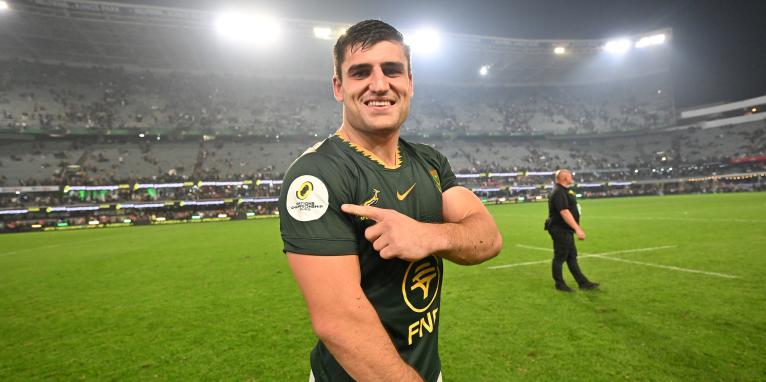
A try at the death caps off a remarkable performance from the 23-year-old who has needed barely three weeks to look entirely at home at this level.
For the first time in the Rassie Erasmus era, South Africa have a bona fide fetcher of this calibre in their starting back row. More importantly, de Villiers completes the set.


Alongside the battering-ram power of Jasper Wiese and the all-court brilliance of Pieter-Steph du Toit, de Villiers supplies the specialist ingredient the combination previously lacked. Wiese bends the defensive line. Du Toit influences almost every other part of the field. De Villiers controls the space at their feet.
That is not to suggest South Africa have lacked breakdown threats over the past eight years. Malcolm Marx may be the most destructive jackal in world rugby. Siya Kolisi has produced defining steals, while du Toit and Duane Vermeulen have overwhelmed rucks through the force of their arrivals.
Kwagga Smith has made a career from entering when a contest begins to lose its shape and turning disorder to South Africa’s advantage. His pace, low body position and Sevens instincts make him particularly dangerous against tiring cleaners, when spaces have widened and support players are arriving a fraction too slowly.
Francois Louw also supplied breakdown expertise from the bench towards the end of his career, most memorably with his decisive late turnover against Wales in the 2019 World Cup semi-final. In his prime he was an outstanding starting openside, but those years preceded the Erasmus era.
De Villiers offers something different. He provides that specialist influence from the opening whistle, before fatigue has loosened the structure and the breakdown has become a free-for-all.
It raises the question of how Erasmus might have used Heinrich Brussow. At his peak, Brussow was one of the purest fetchers in the sport. Low to the ground and almost impossible to shift once locked over the ball, his presence forced opposition cleaners to arrive earlier and in greater numbers.
His relative lack of size was often treated as a limitation as South Africa moved towards larger loose forwards capable of contributing at the line-out and carrying through heavy traffic. Yet the modern Springboks’ desire to play faster rugby might have created the ideal conditions for a player of his type.
Under Tony Brown, South Africa want to move the ball before a defence can reset. Their scrum-halves snipe around the fringe or whip passes away from the base. Carriers attack at pace with runners on their shoulders, while forwards who once might have crowded around the ruck are stationed across the width of the field to provide hands down the line.
There are more big bodies in the tramlines and more potential receivers beyond the first wave. The intention is to stretch defenders horizontally before punching through the spaces between them.
But ambition comes with risk. The more players a team keeps on their feet, the fewer it has available to secure the ball. An isolated carrier or inaccurate clean can turn a promising attack into an opposition penalty.
South Africa encountered that problem repeatedly last season. Against an understrength Italy, they conceded 17 turnovers as a 28-3 half-time lead at Loftus narrowed into a far less comfortable 42-24 victory.
At Ellis Park, South Africa surrendered possession 16 times as a 22-0 lead over Australia became a scarcely believable 38-22 defeat. The malfunctioning line-out, defensive disorganisation and poor game management all contributed, but so did the loss of control around the collision.
Then came Eden Park. South Africa had 53% of possession and 59% of the territory against New Zealand but conceded 24 turnovers in a 24-17 defeat. Promising attacking positions were repeatedly squandered before the pressure could become cumulative.
Those numbers do not prove a breakdown-related failure. A turnover can come from a handling error, a poor pass or a line-out mishap. But they reveal the fragility of a game plan that depends on speed, continuity and retaining enough players on their feet.
A balanced loose trio creates freedom elsewhere. The locks do not have to compensate by overcommitting to the breakdown. A mobile front row can contribute with the ball, rather than act as one-dimensional security guards. Du Toit can roam into the wider channels without leaving a vacuum behind him, while Wiese can attack the gainline knowing there is a specialist reading the contest that follows.
De Villiers can be just as influential without the ball. His threat forces opponents to commit another cleaner to the ruck, removing a carrier, distributor or decoy from the next phase. Even when he does not win possession, he can make an opposition attack narrower and slower.
That is what it means to complete the set. De Villiers does not merely add another virtue to an already formidable pack. He allows those around him to perform their own roles more freely.
South Africa already had the muscle, athleticism and ambition. De Villiers may be the skeleton key that unlocks the lot.

NEW IN THE APP: Official World Rugby Rankings hub! Compare team rankings side-by-side, with data going back 20 years.
Download the RugbyPass app on the App Store (iOS) and Google Play (Android) now!
Yes Paul de Villiers has been massive. Rassie might cop lots of criticism from some fans. But after three tests where he has rotated and trialed with abandon, Boks are well set for the year and the RWC.
We have almost three realistic options in every position.
LH: Ox, Steenekamp, Mchunu, Boan
Hooker: Marx, AH Venter, JH Wessels, Marnus vs Merwe, Grobbelaar
TH: du Toit, Louw, Sadie, Porthen, Fouche
4: Eben, Wiese, Kleyn
5: Lood, Nortje, van Heerden, Mostert
6: Kolisi, de Villiers, van Staden, Kwagga
7: PSDT, Elrigh Louw, Dixon, Ruan Venter, Tshituka
8: Wiese, Hanekom, Roos, Horne.
SH: Williams, Reinach, Papier, Pead, Jantjies
FH: Libbok, Sacha, Pollard, Horn, Moyo
12: de Allende, Esterhuizen, Willemse, Pollard
13: Kriel, Am, Moodie, van Wyk, Hooker, Julius
Wings: Kolbe, Arendse, vd Merwe, Williams, Mapimpi
FB: Willemse, Fassi, Horn, Siyaya
And Gillomee.
The options are just phenomenal
To me he is the archetypal SA rugby player: not flashy but uncompromising and hard as nails.
Apart from his prowess on the ground, he has also displayed some soft touches and silky skills. He’s pretty much the complete package.
Considering that South Africa has always had a plethora of outstanding loose forwards, it is significant that PdV is making such an impact at such a young age.
The golden age continues.
Very interesting and astute article. Lot of food for thought
Great article DG.
PdV on track to win breakthrough player of the year.
Some others that might be in the running:
Caluori, Benhard Jv Rensburg, Fineanganofo, and one or two others, but they are all playing catchup at this stage.
Brau-Boirie is definitely in the discussion, way more than the 3 players you mentioned.
Great read.
Du Toit influences almost every other part of the field.
I honestly can’t believe just how massive PSDT still is for SA. He has been incredible this year. And considering he barely played rugby this year?
I just hope he can maintain this work ethic without picking up any more injuries. He’s a national treasure and probably the best 7/lock we’ve ever had in SA.
Join free and tell us what you really think!
Sign up for freeStuart Lancaster must manage the game time of his Ireland players as Connacht embark on a set of potentially season-defining fixtures.
England's club sides are playing with elan but after a weekend of Champions Cup action, Steve Borthwick will know more about their resolve
Cameron Hanekom is gaining admirers in France while Sam Prendergast and Taine Basham have started the season with gusto
We’ll see things they’ll never see…
You know what also wins World Cups? Having a 10 who can tackle and sadly Nard is not it.
Hip hop or do you mean R n B tackle?
He didn’t pick up . It was a hip hop tackle .


 Clear
Clear 


 Copy link
  Facebook
  X/Twitter
  WhatsApp
  Messenger