
Money has always been a slightly dirty word in rugby. It was the original reason union and league went their separate ways back in 1895. It took union another 100 years to finally admit players deserved to be paid for their time. It was 90 years behind football in that respect, as highlighted by an excerpt from the following piece written by ex-Ireland international Andrew Trimble and Dan McKeown.
NEW: Follow Your favourites in the App 📱
You can now follow their favourite teams, tournaments and players in the RugbyPass App!
“Football made its peace with money in 1885, when the FA legalised professionalism in England rather than lose the northern clubs that were already paying players. Football has been learning how to run a professional sport for 140 years, rugby has been learning for 30. The governance philosophy in rugby union was designed for the amateur century, and is now being asked to do a job it was explicitly built to prevent.”
The rest of Trimble and McKeown’s excellent article explores the impact of that dissonance ab initio, and explains in depth why the club game has suffered from the most basic fact of all, that its financial stakeholders still take relatively little part in decisions made about the game’s future.
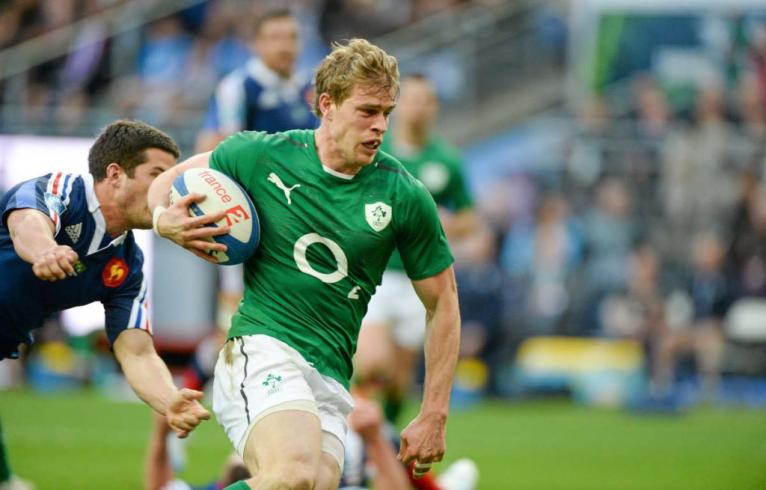
The dynamic tension between the LNR and FFR in France, and Prem Rugby and the RFU in England are just the two most obvious examples of the difficult balance between power of governance and the power of investment, and the dialogue between the two has seldom been straightforward. The question about how rugby absorbs private investment remains the highlight item of the sport’s ‘to do’ list.
This is all a far cry from the NFL in America or football in Europe. As Trimble and McKeown observe: “The NFL owns itself. Thirty-two franchises own the league, the league owns the product, and no governing body sits above it – taking a cut or deciding when its players are available… All the upside lands with people who have a reason to reinvest time, capital, energy and initiative.
“[In football], Europe’s top-division clubs turned over €28.6bn in 2024, [while] FIFA budgets around $13bn across a four-year cycle. The international game in football is enormous, yet structurally secondary to the club game. Clubs own the assets. The federation rents them, and both sides do very well out of it.”
The brand new Nations Championship has become the biggest vehicle to date for the introduction of private investment into international rugby, and at long last there is a chance to terraform the commercial landscape of the sport anew. The shape of the tournament is dictated principally by the backing of Silver Lake and CVC Capital Partners.
CVC already has a big slice of the pie in Prem Rugby and the URC, and most recently, it cut itself a 14.3% stake in Six Nations Rugby Limited. Where Silver Lake wants to monetize the All Blacks brand in which it has invested, CVC has taken control of large swathes of the European rugby economy, and both share the usual aims of private equity firms in sport: streamline the global calendar, fix cross-purposes in the hierarchy between club and country, and build a premium brand which is easily recognised in lucrative sporting markets such as Asia and North America.
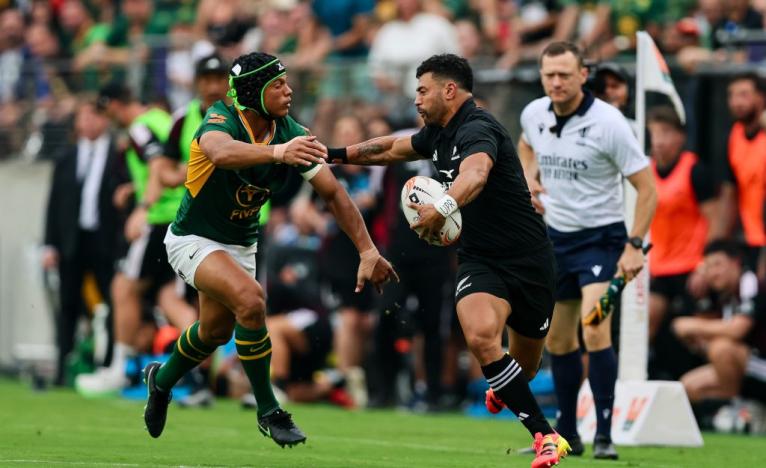
Hence the fourth Test of the RGR series being moved to the M&T Bank Stadium in Baltimore, feeling out a new audience in the USA ahead of the 2031 World Cup. Hence the consolidation of the two July and November windows into one tournament.
The biennial competition provides a £500m baseline underwritten by 80 broadcasters worldwide over its first two iterations in 2026 and 2028, with a clear preference for free-to-air over pay-to-view television, and a digital, direct-to-fan [D2F] strategy designed to maximise the audience and increase the all-powerful ‘average revenue per user’ factor commercially. Between them, CVC and Silver Lake have invested over £1bn in professional rugby and this is their first major stab at getting some bang for their buck.
In order to be investible, the sport has to be understandable to new punters, so many of the so-called ‘dark arts’ have to be brought into the light and made plain to would-be supporters. The refereeing decisions have to be simple, clear and obvious. If new people do not understand what is going on, there will be no profit for anybody. The Nations Championship is not about appealing to diehard fans, it is all about drawing a wider audience to rugby, all year round.
That’s why the first three rounds of the tournament in July produced an average of over 37 minutes of ball-in play time, nine tries and 63 points per game. The competition also generated fewer than 18 penalties per game – lower than the last major tournament in the north [Six Nations 2026, at 18.5] and the previous two down south [the 2025 Rugby Championship at 20.3, and Rugby’s Greatest Rivalry 2026 series at 19.5].
As usual, the scrum is the laggard in the queue as the sport develops.
Saturday’s match between the Sharks and Leinster in the URC amply illustrated the problem with demystifying the scrum. It was refereed by Welshman Craig Evans, who is generally considered one of the more promising officials in the league, but it signally failed to do its most fundamental job, that of getting the ball back into play and restarting the game.
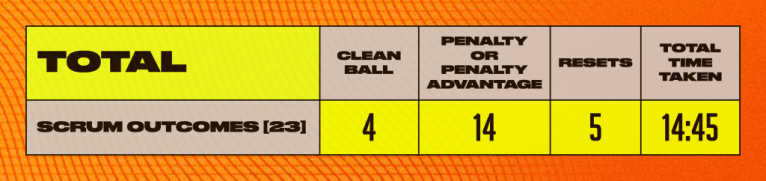
There were only four clean balls generated from a total of 23 scrums, including five resets taking just under 15 minutes with the game-clock ‘on’ within an overall ball-in-play time of 30 minutes and six seconds. Five of the six starters in the front row were experienced international players, but the game did not suggest any model which might be useful in the Nations Championship in November.
In all, Evans awarded 29 penalties and almost half of those were sanctions [or penalty advantages] at the scrum.
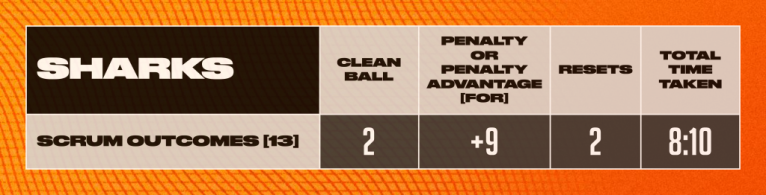
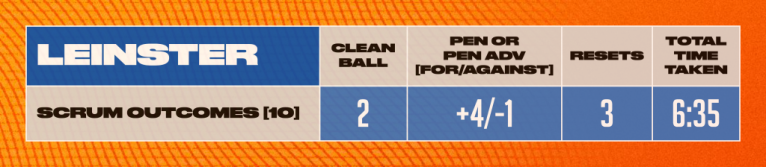
Both sides won penalties almost exclusively on their own feed without making much, if any, impression on the opposition put-in. The dilemma for a referee trying to diagnose the technical symptoms in real time was amply underlined by the passage of the following three scrums.
https://t.co/rCaLbQzsDt
— William Bishop (@RPvids1994) October 5, 2026
https://t.co/pKl6bnVnGG
— William Bishop (@RPvids1994) October 5, 2026
https://t.co/YI58wL7yBl
— William Bishop (@RPvids1994) October 5, 2026
At all three set-pieces the wheel follows a natural rotation around the Sharks loose-head Thomas du Toit. In the first instance, the Sharks are penalised for stepping left before walking around; in the second, Evans calls for a reset, which provokes an irate response from Leinster hooker and captain Ronan Kelleher; on the third, another wheel grants the Sharks a penalty advantage leading to a try by flanker Vincent Tshituka. Three similar scrums yield three different outcomes, but to the naked eye coming to a game of rugby for the first time, there will be no differences at all.
The Nations Championship represents the first opportunity rugby has embraced to shift gears, and harness the vast potential of private investment in the international game. If there is one quality rugby needs above all others now, it is accessibility. It is a time to educate, elucidate and demystify the secret handshakes from the amateur era, and make them available to all.

Your home for rugby. Download the RugbyPass app on the App Store (iOS) and Google Play (Android) now!
Follow your favourite teams, tournaments and players, and get personalised news and Match Centre notifications direct to your device.
From live rugby streams and upcoming fixtures to breaking news, in-depth analysis and live scores, RugbyPass has everything you need to stay connected to the game.


Another thing that would potentially put new fans off was the Sarries vs Sale match taking about 105 minutes to complete, not including half time. The first half itself took 52 minutes.
What about Gloucester scrummaging and mauling the Quinns into the ground. Now that is what I call rugby!
It looks like a rather atypical Prem game Mitch. 24 pens inc 4 scrum pens, only 5 clean breaks between both sides, and lowish ball in play time for the league. Maybe Sarries are trying to go back to an earlier form of their identity under Brendan Venter?
I am not sure why there is a constant comparison with the NFL across rugby, it was at the basis of the 365 nonsense too. Rugby is a tribal, competitive sport, fan motivation is rooted in National identity and in local club loyalty. The franchise model works against that tribal loyalty. No-one else plays American Football at a comparable standard, so any players with aptitude go to the US to be used up within 3-4 years, and along with baseball there is no global tournament to compete for player attention. Football can work on club/regional/international fronts as there isn’t the wear and tear on players of rugby. The TOP rugby cash cow is the 6N, so why not try to build out from what makes that commercially successful rather than hopelessly pine over at the US which has almost nothing in common with Rugby’s fan base, structures, history or culture?
Well said re the NFL. I enjoy watching the first Sunday match and enjoy it. The endless stoppages and 3:30 playing time is what the game is. No-one complains about the stoppages as the fans and players want fairness and the correct decision to be made that is all, and that is what we traditionalist are asking for with rugby.
The scum is part of the game, not some nuisance that SRP and NRL fan boys want to get rid of. Let the players scrum and let us get the right call made however long it takes. So stop the clock and let’s do what the NFL does and commercialise the stoppages with tv adds, sponsored stoppages, replays and analyses etc. Let welcome 2 hour long rugby matches.
Simply not true. American Footy is over 120 years old as a pro sport, and rivalries between Chicago and Green Bay, Washington and Dallas or Baltimore and Pittsburgh have far more longevity than any in rugby.
Ditto above. I can only think you are completely ignorant of NFL history if you really believe that it is deficient in those areas.
The key point is that NFL is a contact sport which makes money, an awful lot of money as a business. It is not a virtue to pride yourself on not being able to do that, while running your underpaid players into the ground with 30+ games per season.
No future there.
More to the point, what does ‘building out from the 6N’ actually mean? As a basis to incorporate SH teams?