
The most famous chapter in the six-part novella fought between ‘Sugar’ Ray Robinson and Jake La Motta was the epitaph in Chicago on 14th February 1951. By the 13th round the right arm of the Bronx Bull was hanging limply by his side and the Sugarman was slugging him to body and head at will. La Motta stayed on his feet, refusing to go down and taste canvas for the first time in his career, and the 1980 movie Raging Bull immortalizes the final moments in grainy back and white. A bloodied, exhausted Robert De Niro hangs on the top rope with one hand, while taunting Robinson to deliver more punishment with the other. Not for nothing has that fight passed into boxing lore as ‘The Saint Valentine’s Day Massacre’.
Watch Rugby's Greatest Rivalry LIVE
Two rugby giants collide. Stream live, replays and highlights free on RugbyPass TV.
Over one month ago, this RugbyPass piece signalled the Greatest Rivalry series would be fought on a philosophical battleground in the no man’s land between ‘contest’ and ‘no-contest’, between winning the ball and using the ball. In recent times, progress in the game has been associated with the bulge in ball-in-play time, more phases and fewer set-pieces, and ever more try-scoring. The Nations Championship averaged over 37 minutes of ball-in-play time, nine tries and more than 200 total rucks per game.
Dave Rennie’s shiny new All Blacks were at the top of that tree, averaging a colossal 41 minutes of ball-in-play, over 138 rucks built and six tries scored per game. While New Zealand were cruising down the freeway in their multi-phase Ferrari, South Africa were dragging all comers into the brutal back alleys of the game, to the brawls among the trash cans and the abandoned, burnt-out old bangers.
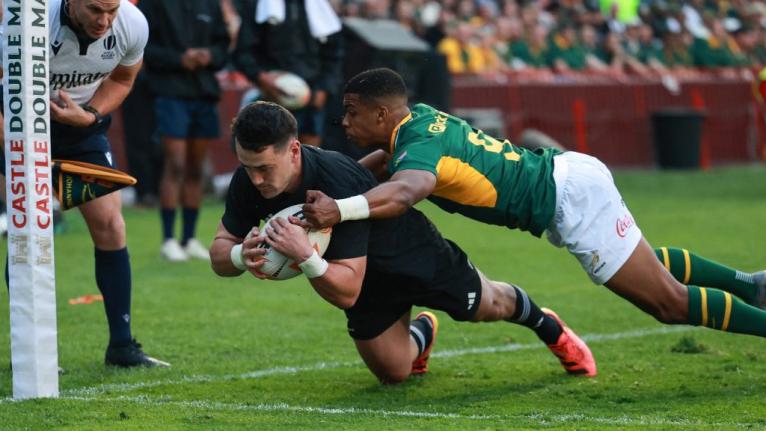
Springbok supremo Rassie Erasmus got the maul law changed to benefit the attacking side, and the scrums have been less of a restart and more of an end in themselves for the past seven years – a picture of dominance, rewarded by penalties. When Schalk Brits and the rest of his front-row mates pushed back on Erasmus’ suggestion every scrum was a penalty opportunity ahead of the 2023 World Cup, he grinned. “Why not?”
Ball-winning, rather than ball-using was going to be the essence of the current series, and the key performance indicators in Johannesburg could hardly have worked out more perfectly for the hosts. Every box Erasmus would have highlighted in his pre-match prognosis was ticked, and the Springboks got the game they wanted.
- Ball-in-play time dropped like a stone, from the 37-minute average at the Nations Championship, and the All Blacks’ high-tempo 41 minutes per game, to a measly 29 minutes and 34 seconds. Tick.
- English Prem referee Matt Carley was forced to award more than 20 penalties. He blew the whistle on 24 occasions with the Springboks winning the final count 14-10. Tick.
- The South African scrum won five penalties in the first 50 minutes, with an even balance between clean ball emerging from the set-piece and penalties awarded for technical indiscretions [five apiece].
- The All Blacks were restricted to setting a mere 58 rucks, a massive 80 rucks fewer than their Nations Championship average. It was attacking gruel rather than Michelin star fine dining to which they have become accustomed. Tick.
- South Africa won the contestable kicking game hands-down. The Springboks reclaimed six out of their 11 contestable kicks for a superior 55% return, while successfully receiving four out of five of New Zealand’s [80%]. Tick.
If you ignored the scoreboard for the first 50 minutes of the game, the contest looked every bit as one-sided as the last fight between Robinson and La Motta, and it told a tale of near-complete Springbok dominance.
There was one huge ‘but’. The Boks won the lion’s share of the physical contests, but the All Blacks had an infinitely better idea of how to use their thin trickle of the ball. The match as a whole proved conclusively that simply winning the ball, and winning penalties from your possession, is no longer enough to win games of modern rugby. You have to be able to use the ball and use all 15 men on the field. The bottom line, five tries to one, does not lie.
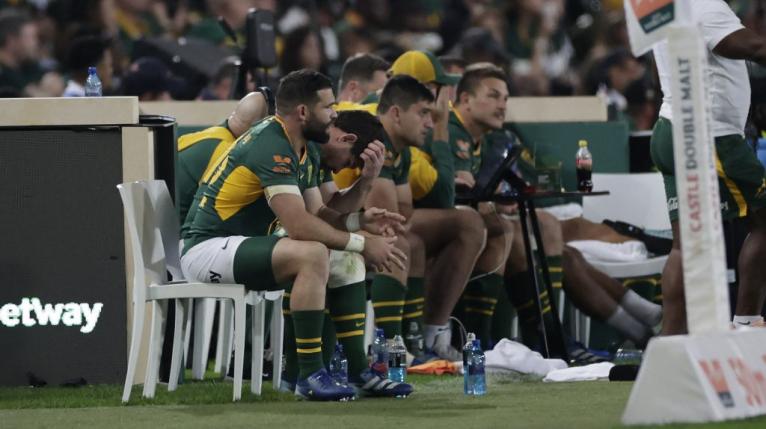
‘Dominance’ is never its own reward. The Springboks lost the first Test because they have been unable to rediscover the enviable balance they had at the Cake Tin, when they drubbed Scott Robertson’s New Zealand 43-10. They have struggled to rediscover a perfect equilibrium between ball winning and ball using ever since, and the writing was on the wall against Ireland last November. Despite winning nine penalties or penalty advantages at scrum time, and drawing two yellow cards on the Irish front row for persistent infringement, the Bokke only chalked up 24 points against opponents who were often reduced to 14, 13 or even 12 men on defence.
The lean attacking efficiency of that statement Springbok performance in Wellington, where only seven rucks were required to achieve one clean break and five tries out of six were scored on changes of possession, with all converted within five phases of play, has not been repeated.
Robertson’s charges kicked the ball 30 times at the Cake Tin, but Rennie’s men only put boot to ball on 18 occasions at Ellis Park. They starved the Bok backfield of countering opportunities in the process, and without reading the teamsheet beforehand, you would hardly have known Damian Willemse and Cheslin Kolbe were present on the field. At least, not in any meaningful attacking sense.
The scrum was a pivotal point of debate before the game, and it was just as central after it. As Rennie opined at the post-match press conference: “We will always debate scrums, and I reckon every team does.
“When you get penalised, you question whether they’re walking around. They got penalised for walking around eventually, and that was probably a key moment in the game.
“We got great impact off the bench. Ethan de Groot, to be fair, was crook overnight. We’re really happy with the effort up front, and scrum was really solid in that last sort of 30.
“‘Grooter’ went home early from the captain’s run yesterday and spent a large time in bed. And you know he’s tough and he barred up and gave us plenty.”
The fate of the scrum at Ellis Park revealed as eloquently as any one area can the difference between the two philosophies at play. For the first 50 minutes the Springboks looked unstoppable at the set-piece, with Tyrel Lomax unable to reprise his 2024 form versus the redoubtable Ox Nche and the All Blacks leaking five penalties. At times it looked like Dublin deja vu.
The key change for New Zealand came not at tight-head prop, with Fletcher Newell coming on for Lomax, but in the epicentre of the set-piece, at hooker. With cap centurion Codie Taylor sitting in between his two Crusader mates Newell and George Bower, the right side of the New Zealand scrum torn apart.
— William Bishop (@RPvids1994) August 23, 2026
The bind between hooker and tight-head disintegrates as the pressure from Nche’s replacement Gerhard Steenekamp and Malcolm Marx ramps up. But as soon as Asafo Aumua arrived as the new man in the middle, the picture changed completely.
— William Bishop (@RPvids1994) August 23, 2026
Because Marx cannot get any movement on Aumua in the centre, Steenekamp has to drag the scrum around Newell rather than pushing him backwards, and referee Carley, who enjoyed a notably sanguine and poised game himself, makes the right call.
Erasmus was honest enough to acknowledge the change the man he had called a ‘monster’ in midweek had made.
“I think it was the right call, and I do think Gerhard walked around [the corner of the scrum]. The suggestion from up top [in the coach’s booth] was to take the three points because we were only down by that much at that stage. But without a doubt, they scrummed really well. From then, the momentum shifted.”
The ace up South Africa’s sleeve at the scrum has always been Marx, who has been the biggest and best scrummaging hooker in the world for the past seven years. But when the All Blacks found their antidote to the Springboks’ scrum poison in the shape of Aumua, the picture at the set-piece, and of the game as a whole, changed for good. New Zealand did not lose any of the six scrums set after his arrival to penalty, and they scored one try and gleaned another yellow card from the set-piece. They were even confident enough to start scrumming for sanctions themselves.
— William Bishop (@RPvids1994) August 23, 2026
The scrum goes up and it is Marx who ‘pops’ first, forced upwards by the sheer power of the Hurricanes rake. It was not the only time New Zealand used the scrum as a platform to showcase the impressive length of their kicking game.
— William Bishop (@RPvids1994) August 23, 2026
In this instance it is Jordie Barrett’s centre partner Quinn Tupaea winning the 50/22 lineout turnover with a long raking punt from inside his own half. The Kiwi mindset is to use the scrum as a launchpad for back-row moves and positive attacking play, and it was this added dimension which won them the game.
— William Bishop (@RPvids1994) August 23, 2026
There will be questions around the front row for both sides after events in Joburg. Thomas du Toit cannot return quickly enough to pair with his old buddy Wilco Louw in a Springbok one-two punch at tighthead prop, while Aumua must start for the All Blacks in the second Test, whatever the propping combination around him.
In the wider spectrum of the series, New Zealand now know they can score tries with a beggar’s ration of the ball. If the scrum is solid, they have the playmakers and finishers to do the business. Within seven short days, the Springboks must rediscover their Cake Tin sweet spot, that elusive balance between winning the ball and using the ball.
For Erasmus, Ellis Park was a sharp dig in the ribs, a reminder dominance does not win games by itself. Brutality has a short shelf-life: La Motta’s career was finished after the Saint Valentine’s Day massacre. Sugar Ray fought on for another 14 years.

Your home for rugby. Download the RugbyPass app on the App Store (iOS) and Google Play (Android) now!
Follow your favourite teams, tournaments and players, and get personalised news and Match Centre notifications direct to your device.
From live rugby streams and upcoming fixtures to breaking news, in-depth analysis and live scores, RugbyPass has everything you need to stay connected to the game.


One thing that I mentioned previously as well is the Boks lose 1 home test every season where they play more than 3 games since at least 2018. This performance was remarkably similar to the one in Auckland last year where they manufactured plenty of entries but couldnt score due to heir own inefficiency. It also continued the poor theme set in the Argentina match only this time they came up against an opponent that could punish their profligacy. The Boks usually only play their best rugby by test 7 of the year. They were always vulnerable to go down at Ellis Park. Their coach too seemed lost in the Box. He brought his subs on in drips and drabs. He seemed far too reactive while the timing of Rennies Subs were superb. This NZ side is not what they were last year. They are playing on the go making plans within plans. You wont see another farce like the one with Barrett against England. If the Boks want to win they need to be positive like they were when they went to the cake tin but I see Rassie has brought Pollard back and left Libbok out. De Allende and Kriel start again while the two faster and arguably more skillful centre options in Willemse and Moodie are not included while Marx seems to be destined for another 80 minute shift with Fourie as cover (huge risk). Last years knee jerk reaction was full of positivity and free thinking. This seems like a return to the old tried and tested formula. Rassie has earned the right to gamble but for once it seems like he is on the back foot with Rennie and his All Blacks firmly under his skin and in his head.
Helluva game and lived up to the prematch hype for sure but nine times out of ten (probably more), the Boks win that game. In fact they may very well execute pretty much the same gameplan on Saturday coming and do just that.
No doubt Rassie got it wrong leaving out the tank from his 23 entirely and he also screwed up putting SFM straight back in after his injury timeout. His team were rusty in attack to say the least but the upside is a series that is very much alive and kicking, which doesn’t do rugby any harm at all - not sure TRC can say the same though but that’s a different story…
Your last line is thought provoking when you say “brutality has a shelf life” and normally I’d agree but not in this context. With 2 rwc’s tucked away, a third in sight and Rassie bulletproof at the helm, the Boks ain’t radically changing their spots anytime soon. Certainly not when it comes down to the white hot pressure of late stage rwc ko’s. That said, any repeat of this result and the shelf life could well be brutally shortened for some of their more seasoned players!
Aumua should start next test..but Rennie holds Taylor in high regard…looking forward to the team being named and the 2nd test.
The Boks will double down ..we know what’s coming.
Nick you asked 3 questions and these ended up being the 3 most important questions of the match. The truth is the All Blacks were far better in the shift. When they lost contestables their defence realigned faster than the attack could take advantage and they often turned the ball right back over. When they turned over the ball they exposed the Boks brutally with outstanding efficiency often eating the Boks up and exposing the gaping holes like D-mac did late on or wide areas where the Boks lost all their pace with both wingers going off injured. They adapted faster when their line was broken, they reduced the Boks to a measly 0.9 points per entry and they scored off most of their chances in the Bok 22. NZ had to change up their game having gotten none of the outcomes they wanted. The only thing in their favour was the turnovers where they lived and thrived. The Boks made their fair share of handling errors but to see a team winning 14 turnovers including 8 in the tackle at this level is truly mind blowing. It shows you how brilliant they were at breakdown time and in the tackle. They absorbed punches throughout and then countered in emphatic style. This NZ side cant be bullied, the Boks will have to outplay them and outsmart them to win
For the second test I see that Thomas the tank is back, that is good, Lood is back also good, however van Heerden is better. Krappie is in and Williams out, that’s good. Now the bad, why is Fourie in as the reserve hooker, and then Pollard ahead of Libbok - inexplicable.
Libbok is the no.1 flyhalf (Wellington proved it) and he needs a Krappie type fast scrumhalf. Rassie has to settle on his best play making combination but he does not pick the best players and he rotates too much and there is no continuity. That’s the big problem Nic.
Deon Fourie playing as a flank woulwould make sense, but when he had to put in a big shift in the World Cup Final, the Boks had no lineout and couldn't generate dominance of any sort in the scrums. Pollard getting picked was inevitable - so inevitable Ray Charles would have seen it coming.